Sam Altman's latest article: AI Agents Will Reshape the World Economy
TechFlow Selected TechFlow Selected
Sam Altman's latest article: AI Agents Will Reshape the World Economy
OpenAI is fully investing in AI agents, and these thousands of intelligent agents will eventually be widely used as virtual colleagues across various business scenarios.
 Navigating Web3 tides with focused insights
Author: Sam Altman
Compiled by: AIGC Open Community
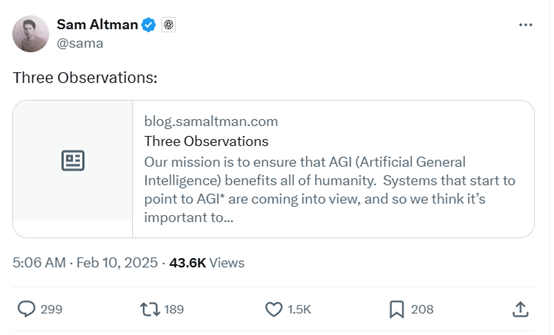
At 5 a.m. today, Sam Altman, co-founder and CEO of OpenAI, published a deep article titled "Three Observations" on his personal blog.
The article mainly presents three observations about the AI world: the intelligence level of AI models is roughly equal to the logarithm of the resources used to train and run them;
The cost of using AI at a given capability level decreases by a factor of ten approximately every 12 months, and lower prices lead to greater usage; socioeconomic value created by linearly increasing intelligence grows super-exponentially.
The article also specifically emphasizes that OpenAI is fully committed to developing AI agents—thousands of such intelligent agents will eventually be widely adopted as virtual colleagues across various business scenarios. Even if entry-level agents may perform poorly, they will still penetrate every domain and reshape the global economy.
Below is the original content:
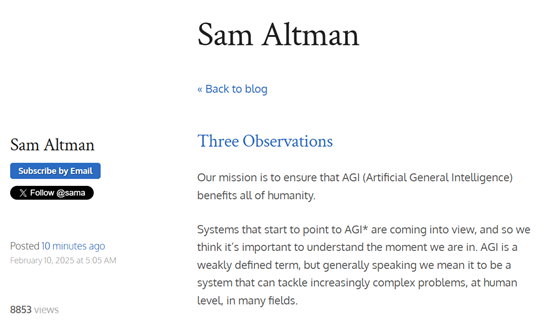
Our mission is to ensure that artificial general intelligence (AGI) benefits all of humanity.
Systems beginning to point toward AGI are now emerging, so we believe it's important to understand this moment. AGI is an imprecisely defined term, but generally, we define it as systems capable of solving increasingly complex problems at human levels across many domains.
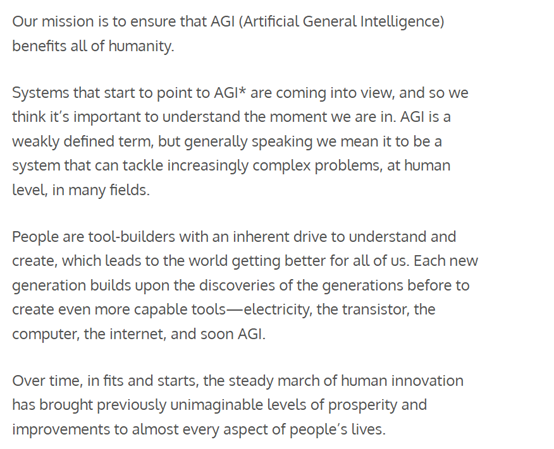
Humans are toolmakers with an innate drive to explore and create, a force that has consistently made the world better. Each generation builds upon the discoveries of the last, creating more powerful tools—electricity, transistors, computers, the internet, and now, soon, AGI.
In one sense, AGI is just another tool in humanity’s shared ladder of progress. But in another sense, AGI represents a fundamentally new beginning, making it hard not to feel that “this time is truly different.” The economic growth ahead looks astonishing—we can even imagine a world that cures all diseases, gives people more time with their families, and unlocks human creativity like never before.
Perhaps within ten years, every person on Earth will have capabilities exceeding those of the most influential individuals today.
We continue to witness rapid progress in AI development. Here are three observations about the economics of AI:
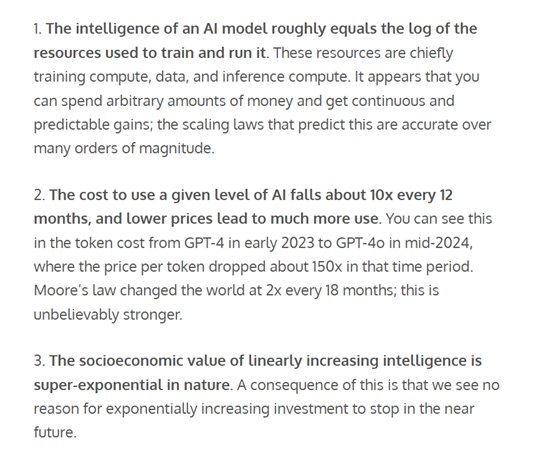
1. The intelligence level of AI models is roughly equal to the logarithm of the resources used to train and run them. These resources primarily include training compute, data, and inference compute. It appears that you can achieve steady, predictable returns for any amount of investment. The scaling laws predicting these returns hold accurately across multiple orders of magnitude.
2. The cost of using AI at a given capability level decreases by a factor of ten approximately every 12 months, and lower prices lead to increased usage. You can see this in the token cost decline from GPT-4 in early 2023 to GPT-4o in mid-2024—over that year and a half, the per-token price dropped by roughly 150 times.
Moor’s Law doubled performance every 18 months and transformed the world; the pace of AI cost reduction is even more incredible.
3. Socioeconomic value created by linearly growing intelligence increases super-exponentially. This suggests there is no near-term reason to expect diminishing returns on exponential investment.
If these three observations continue to hold, their societal impact will be enormous.
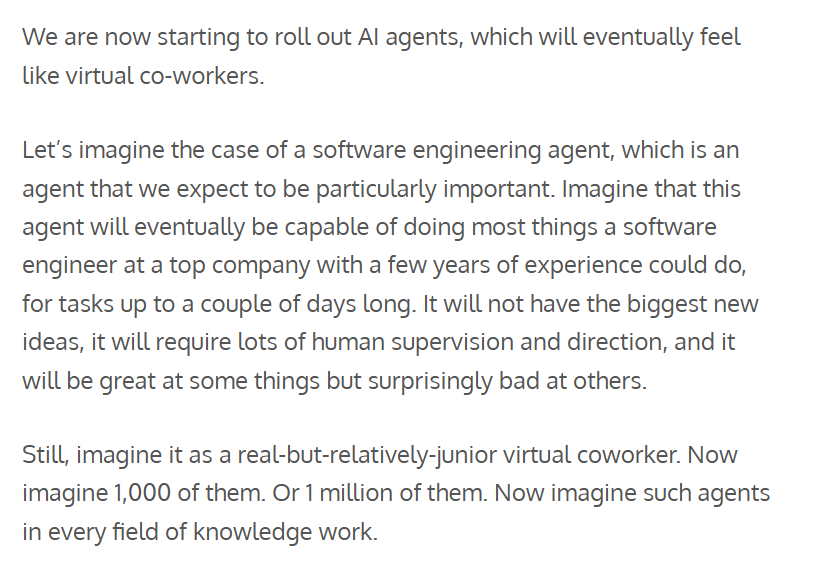
We are now starting to roll out AI agents, which will eventually be widely used as virtual colleagues.
Take software engineering agents as an example—a type we consider particularly important. Imagine such an agent eventually being able to complete most tasks performed by top-tier software engineers with several years of experience (tasks taking up to several days). It might not generate the most novel ideas, require significant human oversight and guidance, and excel in some areas while underperforming in others.
Still, you can think of it as a real but relatively junior virtual colleague. Now imagine having 1,000 such agents. Or 1 million. Then imagine similar agents existing across every domain of knowledge work.
In one sense, AI may be economically analogous to the transistor—a major scientific breakthrough that scales massively and permeates every corner of the economy. We don’t focus much on transistors or transistor companies, but we expect our computers, TVs, cars, toys, and more to perform miracles.
The world won’t change overnight—it never does. In the short term, life will remain largely the same; people in 2025 will spend most of their time much as they did in 2024. We’ll still fall in love, start families, argue online, go hiking, and so on.
But the future will arrive in ways impossible to ignore, and long-term social and economic changes will be profound. We will find new things to do, new ways to help each other, and new forms of competition—but these may look very different from today’s jobs.
Autonomy, intention, and determination may become extremely valuable. Knowing what to do and how to navigate an ever-changing world will be highly valuable; resilience and adaptability will be essential skills to cultivate. AGI will be the greatest lever for human will, enabling individuals to have far greater impact than ever before—not less.
We expect AGI’s impacts to be uneven. While some industries may change little, scientific progress could accelerate dramatically beyond today’s pace, and this effect of AGI may outweigh all others.
The prices of many goods may eventually drop significantly (currently, intelligence and energy costs limit many things), while prices of luxuries and inherently limited resources (like land) may rise even more dramatically.
From a technical standpoint, the path forward seems fairly clear. But public policy and collective opinion are crucial in determining how AGI integrates into society. One reason we release products early is to allow time for society and technology to evolve together.
AI will permeate every aspect of the economy and society, and we expect everything to become intelligent. Many believe people should be given more control over technology than ever before in history—including broader open-sourcing—and accept the trade-offs between safety and individual empowerment.
While we never want to act recklessly, and some major decisions and restrictions related to AGI safety may be unpopular, overall, as we move closer to achieving AGI, we believe it’s important to trend toward greater individual empowerment. The alternative path we can envision is one where authoritarian governments use AI to control populations through mass surveillance and eroded autonomy.
Ensuring broad distribution of AGI’s benefits is critical. Historical patterns of technological advancement show that most metrics we care about (health outcomes, economic prosperity, etc.) improve on average and over the long term, but increased equality does not seem technologically guaranteed—achieving it correctly may require new ideas.
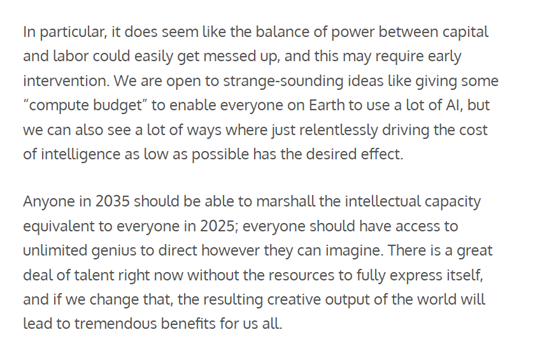
In particular, the balance of power between capital and labor may be disrupted, potentially requiring early intervention. We’re open to some seemingly strange ideas, such as allocating a certain “compute budget” to every person on Earth so they can access substantial AI capabilities, but we also see many paths to achieving the desired outcome through continuously lowering the cost of intelligence.
By 2035, anyone should be able to harness cognitive capacity equivalent to the sum of all human intelligence in 2025; everyone should have access to limitless wisdom, usable in any way they can imagine. Today, countless talented people around the world lack sufficient resources to fully realize their potential. If we can change that, the world will generate immense value—bringing enormous benefits to all of us.
Join TechFlow official community to stay tuned
Telegram:https://t.me/TechFlowDaily
X (Twitter):https://x.com/TechFlowPost
X (Twitter) EN:https://x.com/BlockFlow_News
 @sama
@sama