








From New York to Washington, America's anti-crypto forces are being fully reckoned with
TechFlow Selected TechFlow Selected
From New York to Washington, America's anti-crypto forces are being fully reckoned with
Washington's regulatory stance is undergoing a fundamental change.
 Navigating Web3 tides with focused insights
Author: jk, Odaily Planet News
With the incoming Trump administration, regulatory leaders who once spearheaded the U.S. anti-crypto agenda are now facing a sweeping reckoning. Major financial regulators such as the Securities and Exchange Commission (SEC), the Federal Deposit Insurance Corporation (FDIC), and the Commodity Futures Trading Commission (CFTC) are undergoing large-scale personnel changes and policy shifts.
It is evident that Washington’s regulatory stance is undergoing a fundamental transformation.
SEC: Gary Gensler’s Team Exits Entirely, Pro-Crypto Personnel Move In, Enforcement Procedures Change
SEC: New Leadership, New Priorities
The atmosphere at the SEC headquarters on 100 F Street in Washington, D.C., is quietly shifting. With Trump taking office, Gary Gensler resigned the same day, and pro-crypto Mark Uyeda became acting chair, temporarily assuming leadership duties until Paul Atkins’ nomination is confirmed. This building with its sleek glass facade is no longer an enemy of the crypto industry but is becoming a genuinely friendly regulator.
For more on Mark Uyeda’s background and pro-crypto stance, read this article: Uncovering the New U.S. Crypto Regulatory Leadership: How Long From Appointment to Implementation?
On February 5, local U.S. time, two sources revealed that the SEC now requires its lawyers to obtain high-level approval before launching formal investigations. The new requirement mandates that enforcement staff must secure permission from politically appointed commissioners to issue subpoenas, request documents, or compel testimony. Currently, there are three commissioners: Acting Chair Mark Uyeda, Hester Peirce (“Crypto Mom”), and Caroline Crenshaw (Democratic commissioner). Under the previous administration, the SEC only needed approval from two enforcement heads to initiate a formal investigation, while staff could conduct informal inquiries—including sending information requests—without commissioner authorization.
Meanwhile, many readers likely already know that SEC Acting Chair Mark Uyeda has established a new cryptocurrency task force led by Hester Pierce, a commissioner known for her crypto-friendly views and nicknamed “Crypto Mom,” with the ultimate goal of providing regulatory clarity and proposing a clear crypto regulatory framework (similar to the EU’s MiCA). Following this news, Acting Chair Mark Uyeda appointed Landon Zinda, former policy director at the pro-crypto advocacy group Coin Center, as his legal advisor and senior advisor to the cryptocurrency task force, joining the commission.
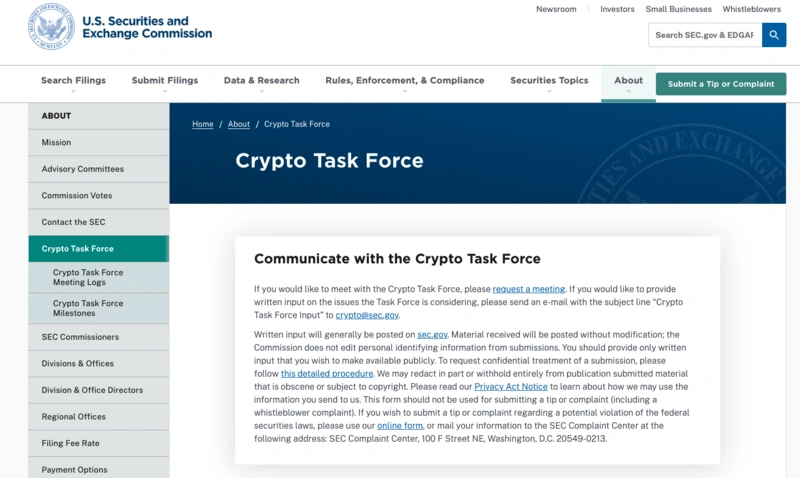
The SEC's supportive stance is clearly visible on the cryptocurrency task force website, which even provides an email address for crypto participants to contact the SEC directly
Source: SEC official website
Hester Peirce stated: "The cryptocurrency task force is considering recommending that the SEC take action to provide temporary prospective and retroactive relief for token issuances (in contrast to the SEC’s previous retroactive enforcement), where issuing entities or other willing parties provide certain specific information and keep it updated, and agree not to challenge the SEC’s jurisdiction in cases alleging fraud related to the purchase and sale of assets."
The Reckoning? Anti-Crypto Figures Are Being Marginalized
Odaily previously reported that nearly all senior legal officials who served under Gary Gensler, including those in the enforcement division and the Office of the General Counsel, have now departed, suggesting his entire team has been dismantled. Former SEC Chief Economist Jessica Wachter, Chief Accountant Paul Munter, and General Counsel Megan Barbero have also left.
What about those who stayed?
Reports indicate the SEC has reassigned Jorge Tenreiro, former Deputy Director of the Division of Crypto Assets and Cybersecurity and a crypto litigation attorney, to its Information Technology (IT) department. Tenreiro worked at the SEC for over 11 years; according to his LinkedIn profile, he began as an enforcement attorney and served as head of the agency’s cryptocurrency enforcement unit from October 2022 to November 2024.
Tenreiro was involved in multiple SEC enforcement actions against crypto companies, including lawsuits against Ripple and Coinbase. Since President Trump took office, the SEC has shifted its stance significantly and downsized its crypto enforcement division.
FDIC: Regulatory Hostility Disappears, Crypto Banking Services May Return
What Is the FDIC?
The FDIC (Federal Deposit Insurance Corporation) is an independent U.S. agency responsible for insuring bank deposits, guaranteeing depositors up to $250,000 in case of bank failure. The FDIC regularly reviews banks’ balance sheets, assesses risks, prevents improper practices, and takes corrective measures when problems arise—even closing severely non-compliant or insolvent banks. Additionally, the FDIC manages receivership and liquidation processes during bank failures, protecting depositors and maintaining financial system stability. When a bank fails, the FDIC typically arranges for another bank to assume deposits or directly compensates depositors, making the banking system more secure and reliable.
In short, the FDIC acts as the national bank insurer in the U.S., ensuring consumer deposit safety. For example, when Silicon Valley Bank collapsed, it was the FDIC that managed the aftermath and follow-up arrangements.
Why Is the National Bank Insurer Relevant to the Crypto Industry?
Due to its regulatory role, the FDIC was previously not seen favorably by the crypto industry—it restricted crypto firms’ access to banking services and drew widespread complaints across the sector.
Imagine launching a crypto company or project but being unable to open accounts at any major U.S. bank or access loans—essentially denied all standard banking services essential for business operations. This was Operation Choke Point 2.0 (translated as “Strangulation Operation” or “Chokehold Operation” 2.0), a policy banning crypto projects from accessing banking services, with the FDIC serving as a primary regulatory enforcer. We’ll discuss this policy shortly.
This is not baseless speculation. Nathan McCauley, CEO of Anchorage Digital, testified at a U.S. Senate hearing on “debanking,” stating that despite Anchorage Digital being a federally chartered crypto bank, it was still denied services by banks, damaging its business and forcing a 20% workforce reduction. McCauley noted that from 2021 to 2023, U.S. regulators progressively pressured banks to avoid the crypto industry through joint policies issued by the OCC, FDIC, SEC, and Federal Reserve, causing most banks to refuse partnerships with crypto firms—denying many basic banking services and forcing some to shut down entirely.
Consensys CEO Joseph Lubin stated his company was twice targeted by U.S. authorities attempting to cut off financial system access, making it a victim of Operation Chokepoint 2.0. In the most recent incident, a major U.S. bank (reportedly Wells Fargo) closed Consensys’ account after regulatory pressure. Lubin revealed the bank initially tried to delay the closure and expressed support for Consensys but ultimately yielded to pressure. Lubin himself was also personally targeted during this purge.
How Is Today’s FDIC Different?
With Trump taking office, the FDIC is undergoing a transformation.
The Federal Deposit Insurance Corporation (FDIC) recently announced it is actively reevaluating its regulatory approach toward crypto-related activities, including withdrawing and replacing Financial Institution Letter (FIL) 16-2022, to provide compliance pathways enabling banks to engage in cryptocurrency and blockchain activities while adhering to safety and soundness principles. The FDIC plans to collaborate with the Digital Asset Markets Working Group established under the Trump executive order to refine the regulatory framework.
FDIC Acting Chair Travis Hill previously criticized the FDIC’s stance for hindering banks from exploring blockchain and digital assets, stating: “I’ve long criticized the FDIC’s position on crypto assets and blockchain. As I said last March, the FDIC’s approach ‘has created a widespread perception that institutions cannot do business if they’re interested in anything related to blockchain or distributed ledger technology.’” After assuming office, Hill launched a review of all regulatory communications related to crypto banking, saying: “As acting chair, I directed staff to conduct a comprehensive review of all regulatory communications with banks attempting to offer crypto-related products or services.”
To enhance transparency, the FDIC recently released 175 documents detailing its oversight of banks engaging in crypto-related businesses. These changes collectively signal that banks may now custody clients’ cryptocurrencies, with FDIC insurance coverage.
Operation Choke Point 2.0: Coming to an End, Participants May Face Accountability
Just How Powerful Was Operation Choke Point 2.0?
We just mentioned that Operation Choke Point 2.0 (translated as “Strangulation Operation” or “Chokehold Operation” 2.0) was a policy prohibiting crypto projects from accessing banking services. In reality, the scale of this operation may far exceed readers’ imagination.
Blockworks described it this way: If FTX was the butterfly flapping its wings in the Amazon rainforest, then “Operation Choke Point 2.0” is the torrential storm now pouring down on the U.S. crypto industry.
This operation was driven jointly by the Biden White House, the Federal Reserve, the Office of the Comptroller of the Currency (OCC), the Federal Deposit Insurance Corporation (FDIC), the Department of Justice (DOJ), and “influential figures in Congress,” all aiming to cut off the crypto industry’s fiat on-ramps to strangle the sector completely.
Senators Roger Marshall, Elizabeth Warren, and John Kennedy pressured Silvergate, leading Signature Bank to drastically reduce its crypto-related deposits in December 2023. In January 2024, the FDIC, OCC, and Federal Reserve jointly issued a statement “strongly discouraging” banks from supporting crypto businesses, immediately followed by Metropolitan Commercial Bank shutting down its entire crypto operations.
Meanwhile, crypto firms attempting to control their own fiat channels faced obstacles—the Federal Reserve formally rejected Custodia’s (formerly Avanti) application to join the Federal Reserve system in late January, an application delayed for over two years. Although Anchorage became the first conditionally approved national trust bank in 2021, Paxos and Protego remain unapproved. The government classified crypto banks as “high-risk,” creating four major negative impacts: higher FDIC insurance premiums, reduced capital ratios from the Federal Reserve (limiting overdraft capacity), restricted business activities, and lower supervisory ratings (impairing merger and acquisition capabilities), further deepening the separation between banks and the crypto industry.
Moreover, most of these actions were invisible. Crypto firms couldn’t sue—and often had no evidence to prove wrongdoing. Many driving these efforts remained behind the scenes, secretly applying pressure.
All this began reversing with Trump’s return to power.
What Is the Current Stance of U.S. Regulators?
The U.S. Congress first held hearings on Operation Choke Point 2.0, inviting crypto industry figures to testify about how they were “choked off.” Representative Meuser stated at the hearing that the Biden administration’s Operation Choke Point 2.0, implemented by regulators, specifically targeted and debanked the digital asset ecosystem.
“The FDIC used private conversations and formal regulatory threats to pressure banks into refusing services to digital asset companies, their employees, and even their customers.
This is a serious abuse of power—not only stifling innovation but directly harming consumers by denying them access to new, potentially beneficial financial products…
Just yesterday, FDIC Acting Chair Travis Hill publicly exposed the Biden administration’s Operation Choke Point activities, which led to nationwide debanking of crypto firms… The FDIC has committed to correcting this issue going forward. I will continue monitoring its reform progress and explore legislative solutions to ensure such incidents never happen again.
Free markets can only thrive when innovation is fully enabled. Regulators have a duty to protect our financial system—but not at the expense of legitimate enterprises like energy companies and crypto firms.”
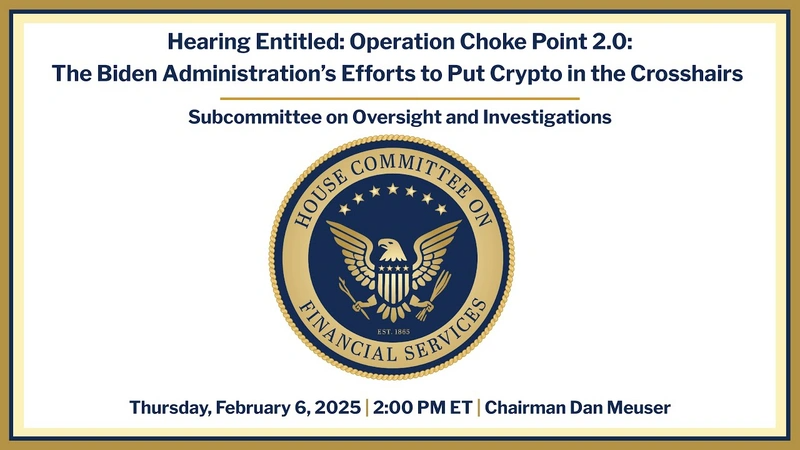
Official U.S. Congressional hearing acknowledging the existence of Operation Choke Point 2.0
Source: YouTube
Readers can reflect on the stark difference in current official characterizations.
Additionally, U.S. Federal Judge Ana C. Reyes issued sharp criticism of the FDIC’s conduct in the Coinbase lawsuit against the Federal Deposit Insurance Corporation (FDIC). The case arose when Coinbase sought documents showing the FDIC sent “pause letters” to banks restricting crypto-related activities—evidence of Operation Choke Point 2.0. Judge Reyes pointed out that the FDIC failed to produce a large volume of files related to Coinbase’s prior Freedom of Information Act (FOIA) request and may have destroyed portions of relevant case information.
Judge Ana C. Reyes directly questioned the FDIC during the hearing: “Can you explain why the FOIA request was interpreted so narrowly? Its content was clear and should not have been understood restrictively as you did.” Excerpts from the dialogue:
Andrew Dober (FDIC’s representative lawyer): Yes, Your Honor, I can—
The Court (Judge): No, answer my question directly.
Andrew Dober: On these matters, I do have a statement, Your Honor. The FDIC respectfully requests the court to stay this case for three weeks—
The Court: No, that won’t work. Answer my question now.
Andrew Dober: Due to leadership changes—
The Court: Answer my question now.
Andrew Dober: Yes, Your Honor. Could you please repeat your questions?
The Court: Who adopted such an absurdly narrow and illogical interpretation of the FOIA request?
Andrew Dober: Your Honor, I believe that was the understanding at the time—
The Court: I didn’t ask how you understood it—I asked who made that decision. That interpretation was so narrow it was almost laughable. Who was it?
According to The Block, Scott Johnsson, partner at VBCapital, commented: “It’s shocking to see a federal judge so harshly rebuke a federal agency’s lawyer in this manner.”
Judge Reyes not only plans to subpoena FDIC employees to testify in mid-February but also warned that if the FDIC does not cooperate, “life will become very, very unpleasant for the FDIC.” She further questioned whether the FDIC had followed legally required document preservation procedures and indicated Andrew Dober could face “serious sanctions.”
The reckoning is imminent. U.S. Senator Cynthia Lummis stated that the Senate Banking Committee has now uncovered the first solid evidence of Operation Chokepoint 2.0. She said, “Rest assured, the Digital Assets Subcommittee will identify the responsible parties and hold them accountable.”
CFTC: Restructuring the Enforcement Division
On February 5, 2025, Caroline Pham, Acting Chair of the U.S. Commodity Futures Trading Commission (CFTC), announced the agency has restructured its enforcement division to focus more sharply on combating fraud and ceasing the practice of using enforcement actions as a substitute for regulation. This reform aims to optimize resource allocation, improve enforcement efficiency, and ensure market integrity.
Under former Chair Rostin Behnam, the CFTC enforcement division established multiple task forces focusing on insider trading, cybersecurity and emerging technologies, and environmental fraud. After the restructuring, the number of enforcement task forces has been streamlined from several to just two: the Complex Fraud Task Force and the Retail Fraud and General Enforcement Task Force.
The Complex Fraud Task Force will handle complex fraud and market manipulation cases involving all asset classes, covering the full process from investigation to litigation. The Retail Fraud and General Enforcement Task Force will focus on combating retail market fraud and other general enforcement matters.
In her statement, Acting Chair Pham emphasized that this adjustment aims to end “regulation by enforcement” and improve operational efficiency, allowing the CFTC to more precisely target market fraud and misconduct rather than imposing excessive compliance burdens. The CFTC announcement further stressed that the new structure will more effectively prevent fraud, manipulation, and market abuse, ensure fairness, strengthen oversight of enforcement actions to prevent overreach, and enhance consistency and adherence to due process standards.
Why is this statement significant? First, it’s important to note that the CFTC has participated in cases involving Binance and Coinbase, making it one of the more active U.S. crypto regulators. Given the commodity nature of cryptocurrencies (e.g., used as gas fees), the CFTC believes the crypto industry may fall under its regulatory purview. Meanwhile, “regulation by enforcement” was a common strategy previously used by the SEC—a “you can proceed freely, but if something goes wrong, you’ll be penalized” approach based on permissive legality.
However, this strategy often provided no regulatory clarity. A classic example is Coinbase: when Coinbase first pursued its IPO, the SEC swiftly approved it without defining the nature of cryptocurrencies. Years later, the SEC sued Coinbase, arguing cryptocurrencies are unregistered securities and Coinbase operated a platform for unregistered securities. This erratic regulatory attitude created significant uncertainty for the U.S. crypto industry—which is exactly why the CFTC’s clear rejection of “regulation by enforcement” is a major positive development for the crypto sector.
David Sacks: The New Crypto Tsar in Action
David Sacks, the White House’s lead on cryptocurrency and AI affairs, emphasized during a recent press conference the importance of positioning the U.S. as a leader in digital assets and called for the swift establishment of a clear regulatory framework. He announced that both the Senate and House will collaborate on crafting crypto legislation to resolve the long-standing uncertainties facing the industry. Senator Bill Hagerty introduced the GENIUS stablecoin bill, aiming to provide legal support for the stablecoin market by standardizing issuance procedures. Sacks believes stablecoins can not only reinforce the U.S. dollar’s dominance in global markets but also generate trillions of dollars in demand for U.S. Treasury bonds, lowering long-term interest rates and strengthening the stability of the U.S. financial system.
During the press conference, Senator Tim Scott, Chairman of the Senate Banking Committee, set a goal of passing stablecoin and digital asset bills through Congress and delivering them to the president for signature within 100 days. French Hill, Chairman of the House Financial Services Committee, stated that the revised digital asset bill will build upon the FIT 21 bill, addressing previous shortcomings—such as the practical feasibility of the SEC classifying tokens within 60 days. The Senate also plans to coordinate on FIT 21 to ensure the final version receives presidential approval and becomes law.
According to CNBC reporting and interviews, Sacks also highlighted the negative impact of debanking on the crypto industry. He argued that keeping crypto-related businesses in the U.S. better protects consumers, as domestic presence allows regulators to more effectively supervise market activities. He cited the Bahamas’ regulatory gaps as a cause of the largest crypto fraud in history (referring to FTX) and urged the U.S. to avoid repeating such mistakes.
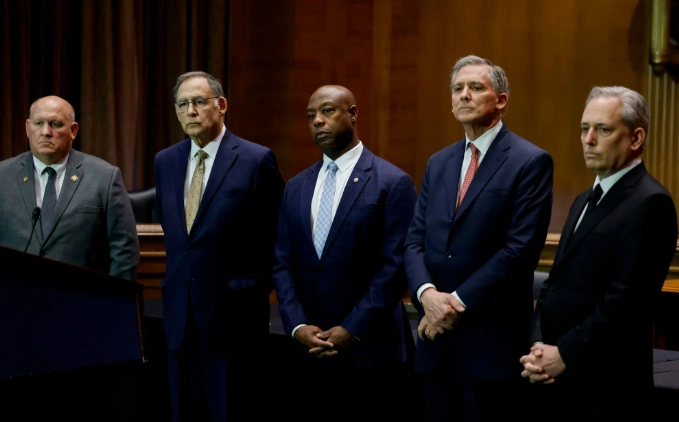
At David Sacks’ (far right) first press conference, he stands alongside senators and representatives
Source: Bloomberg
Sacks confirmed that the Bitcoin Reserve will be included in the White House Digital Assets Working Group’s research agenda and may include seized assets. However, he noted that the concept of a Sovereign Wealth Fund differs from the Bitcoin Reserve, with specific policies to be determined by incoming Treasury Secretary Howard Lutnick. The Trump administration is exploring Bitcoin’s potential role in the national financial system, though concrete plans remain under discussion.
David Sacks summed up the U.S. regulatory stance in one sentence: “The crypto war is over. I look forward to working with you all to create a golden age for digital assets.”
Join TechFlow official community to stay tuned
Telegram:https://t.me/TechFlowDaily
X (Twitter):https://x.com/TechFlowPost
X (Twitter) EN:https://x.com/BlockFlow_News
 Odaily






