Beijing Youth Daily: Can "digital assets" become a major asset class like real estate, stocks, and funds?
TechFlow Selected TechFlow Selected
Beijing Youth Daily: Can "digital assets" become a major asset class like real estate, stocks, and funds?
China's "digital asset" market is beginning to establish a standardized trading environment at the industry-level collaborative self-governance level.
 Navigating Web3 tides with focused insights
Source: Beijing Youth Daily
Editor: Bowen
On February 5, 2025, Beijing Youth Daily featured "digital assets" prominently on its front page and dedicated the entire A4 section to the topic. From a youth perspective, the report covered the development of the "digital assets" industry, investment stories, and societal engagement.
The article explored whether "digital assets" have the potential to become a major asset class like real estate, stocks, funds, or gold. It also mentioned that China's "digital assets" market is beginning to build a circulation environment at the level of industry collaboration and self-governance, moving toward a standardized market. Banks and large enterprises such as Industrial and Commercial Bank of China (ICBC), Ant Digital Technologies, and GCL Group have already entered the digital assets field by launching digital collectibles or RWA projects.
The extensive coverage by domestic media signals that the application of digital assets is gradually expanding into broader industries and sectors. It also suggests that regulatory "trends" in China may accelerate, potentially creating more notable opportunities in the near future.
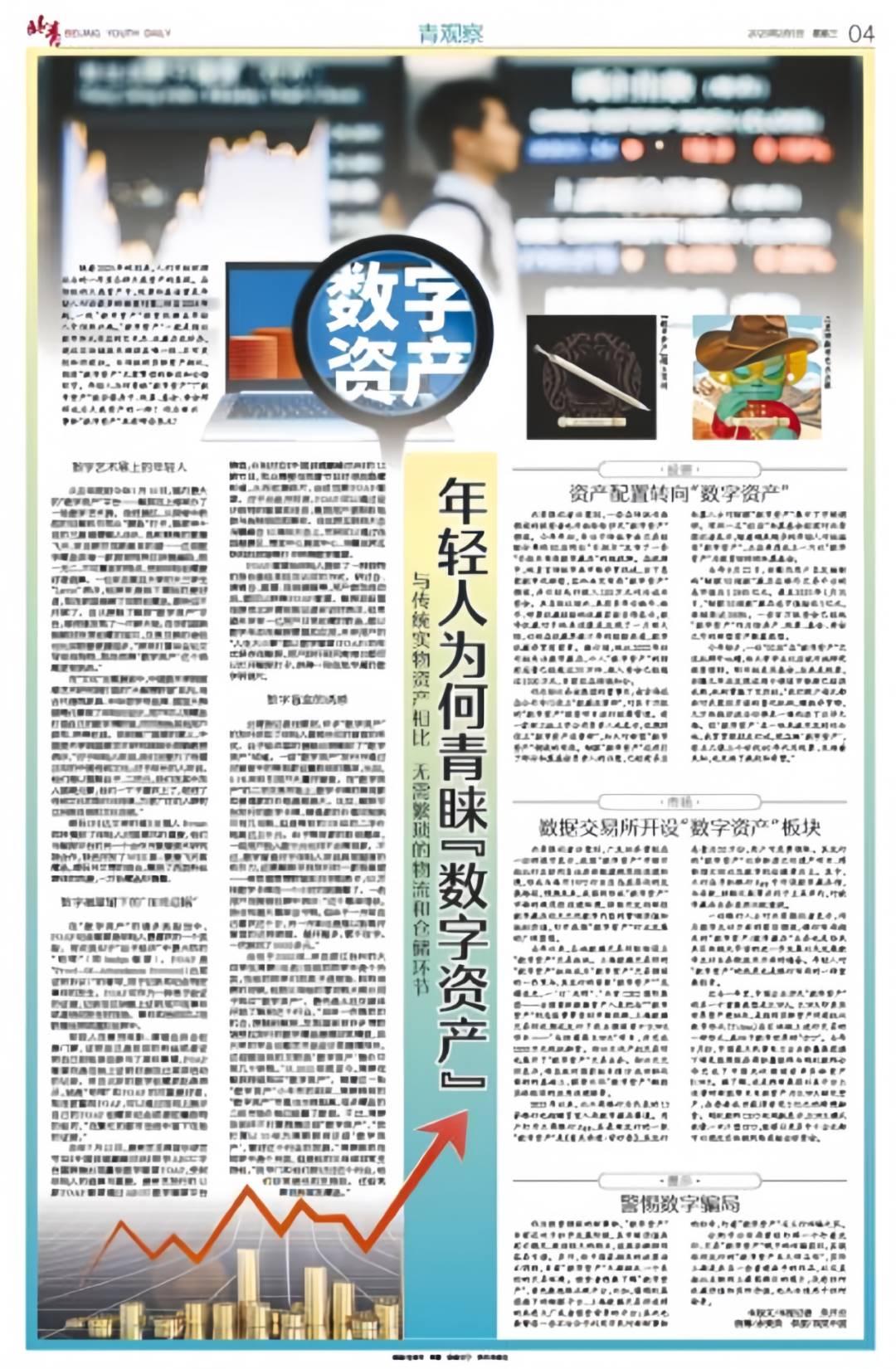
Full text of the report below
As 2025 begins, people are reviewing the performance of various major asset classes over the past year. Among traditional asset classes, stocks and funds were once the most discussed investment options among young people. But since 2024, a wave of enthusiasm for "digital assets" has quietly emerged among youth. "Digital assets" generally refer to artworks, collectibles, or rarities existing in digital form, with blockchain technology ensuring their uniqueness, immutability, and ownership. Compared to physical assets, owning "digital assets" eliminates complex logistics and storage requirements.
Why are young people drawn to "digital assets"? Can "digital assets" become a major asset class like real estate, stocks, funds, or gold? What makes this emerging concept stand out?
01 Young People at Digital Art Exhibitions
From late last year through January 10 this year, China's largest "digital assets" platform—Jingtan—held a digital art exhibition in Shanghai. Entering the exhibition hall, giant whales leaping from the deep sea attracted visitors to take photos, while a rock-style Sanxingdui bronze band, vivid Dunhuang flying apsaras, and cats from the Sphinx galaxy—all unique digital collectibles secured by special blockchain codes—became favorites among young collectors.
Lavis, a junior at Fudan University, said he used to be passionate about physical潮 toys and now his home is filled with physical collectibles, leaving barely any space to walk. After discovering Jingtan’s "digital assets" platform, he felt like he had discovered a new world. He can now view his collection anytime on his phone, and trading or exchanging is far more convenient than with physical items. "I originally planned to write my graduation thesis on Pop Mart, but now I think 'digital assets' is a more challenging topic."
In the "culture" themed exhibition, the China-Chic Art Research Institute at the China Academy of Fine Arts launched the "Great Whale Museum" series, reimagining ancient architecture, furniture, time-honored Chinese brands, and the national treasure panda with youthful designs. Users can create their own digital museums using these collectibles and open them for visits by others to earn revenue.
Discussing the significance of promoting China-chic culture, Professor Ni Bin, director of the China-Chic Art Research Institute at the China Academy of Fine Arts, said: "For young people, our goal is to spread positive traditional Chinese culture. For older generations who struggle to understand谷子or otaku culture, adding China-chic elements instantly resonates with them, promoting modern inheritance of traditional culture and building national and cultural confidence among wider audiences."
Bonan, the creative lead behind the潮IP "Davinci's Egg," also sensed young people's love for China-chic trends. They collaborated with Dunhuang Academy—the other partner of Jingtan—to co-develop the WEE Zai - Dunhuang Flying Apsara Zai collectible. The fusion of潮toys and cultural relics activated fan enthusiasm across both communities, selling out 10,000 units instantly.
02 POAP Badges as Proof of Attendance
Among various types of "digital assets," POAP commemorative badges are especially popular among young people. They resemble the hottest items in "谷子economy"—badges (known as "baji"). POAP stands for "Proof-of-Attendance Protocol," used to record and commemorate specific events. Stored on the blockchain, POAPs serve as easily verifiable proof that a user was present at an event, whether in the physical or virtual world.
Just as some people collect movie or concert tickets to prove fandom or personal attendance, POAP badges provide online records of participation. Zhao Yan, a digital collector from Beijing, said she loves both physical badges and POAPs but now values POAPs more. She can showcase her POAP collection online to commemorate or boast about unique experiences—"leaving evidence of presence in busy urban life."
On July 22 last year, iQiyi’s flagship music program "The Rap of China: Peak Battle" partnered with ARCC to launch a limited-edition digital badge POAP, which became highly popular among youth. iQiyi issued 12 POAP badges via the ARCC digital badge platform, each corresponding to one episode of the show. Viewers had to find hidden Easter eggs while watching to collect fragments and assemble that episode's POAP badge.
For content creators, POAPs offer a way to design unique badges and tasks that encourage active user engagement. During the 10th anniversary of the World Internet Conference Wuzhen Summit, attendees could earn digital badges by checking in at locations such as Xizha Scenic Area, the Exhibition Center, and the Wuzhen World Internet Technology Museum.
POAP badges offer young people a distinctive form of identity and social recognition. Whether at seminars, concerts, livestreams, or online courses, users receive POAP badges after participating. The general manager of Jingtan told Beijing Youth Daily reporters that he hopes one day one hundred million users will manage and use all their daily collectibles digitally on Jingtan. He envisions users recording every significant life moment via POAP badges on Jingtan, checking in during travels worldwide to receive location-specific digital postcards.
03 The Allure of Digital Blind Boxes
Reporters from Beijing Youth Daily noted that many "digital assets" are released in blind box formats favored by young people. Tactics from the谷o economy have been adopted in the "digital assets" space. Some issuers set extremely low odds for rare items within blind boxes—such as 0.1%—to entice users to open large quantities. In secondary markets, prices for rare and common digital cards differ significantly. For example, on the Jingtan platform, common digital cards may be worth just a few cents, while rare UR-level cards can resell for over a thousand yuan. Due to the rarity, some users spend thousands without obtaining a rare item.
Nevertheless, digital blind boxes hold strong appeal. Recently, Jingtan released a series called "Wu Huang Cat: Museum of Marvelous Ideas," selling out 500,000 digital cards within an hour. One user in a WeChat group said: "I know the odds are low and I’ll likely lose money, but I love this IP, and I can’t resist the thrill of opening blind boxes. I kept going, couldn’t stop myself. Spent over 5,000 yuan in one session."
Zhou Qun (pseudonym), a senior student from Taizhou, Zhejiang, born in 2002, stands out among peers. While classmates enjoy shopping malls and online shopping, he spends most of his allowance from parents on "digital assets." He first learned about the industry through social media, then偶然discovered Jingtan, where he found museum-authorized digital collectibles with stunning modeling. His university major relates to art design and modeling, and these cultural relic-based "digital assets" cost only dozens of yuan. Since late 2022, Zhou Qun has consistently purchased "digital assets" on Jingtan. With the recent mini bull market in "digital assets," the market value of his holdings has surged, with many collectibles appreciating several times on secondary markets.
However, Zhou Qun currently has no intention of selling. "I plan to hold these 'digital assets' for 10 years and believe in the industry's growth." Though different from peers, his parents fully support him. "I’ve discussed this industry with them in depth. They trust and support me completely, even helping me grab newly launched collectibles."
04 Asset Allocation Shifting Toward Digital Assets
Beijing Youth Daily reporters observed that investors traditionally active in calligraphy and painting are increasingly entering the "digital assets" space. At the beginning of this year, a millennial internet celebrity known as "Principal Le," who focuses on sharing insights about traditional painting and calligraphy trading, posted a short video titled "Principal Le’s Move into Digital Collectibles." In the video, he stated that the traditional painting and calligraphy market is severely sluggish and urgently needs digital transformation, prompting him to enter the "digital assets" field with an initial trial investment of 1 million yuan.
Yu Jiwei from Shaoxing, Zhejiang, who has decades of experience collecting ancient coins, paper currency, and stamps, said digital collecting felt like discovering a new continent. Based on his long-standing expertise, he sees great potential in digital collecting. He began paying attention to digital collectibles in early 2022, now holding over 350,000 "digital assets" with investments exceeding 10 million yuan—and continues to increase his holdings.
As chairman of Zhejiang Yijin Group, Yu Jiwei established a dedicated "Digital Collectibles Operations Department" to centrally manage his multi-million-dollar digital asset investments. A listed company executive on China's New Third Board also said they plan to set up a "Digital Assets Operations Department" to strengthen their presence in emerging "digital assets." Jingtan's "digital assets" have also attracted attention from private fund managers, with several conducting market research on Jingtan's offerings. A Shenzhen-based "post-80s" private equity fund manager told Beijing Youth Daily reporters that, given growing youth acceptance of "digital assets," he is considering launching a private fund focused on "digital assets" as an investment target.
On September 22 last year, the total market capitalization of the "Jingtan 50 Index" collectibles—a user-created index traded over-the-counter—was 129.85 million yuan. By January 31, 2025, it approached 500 million yuan, representing a 280% increase. Some investors with millions in capital now treat "digital assets" as a new asset allocation category alongside real estate, stocks, funds, and gold.
This year’s Lunar New Year’s Eve, a "post-00s" individual complained in a "digital assets" discussion group: After graduating, he started studying investment. Initially buying funds, then stocks, he realized after years that both markets were mature, dominated by institutional pricing power. "We retail investors face heavily armed quantitative institutions every day. Making money is extremely hard—throwing tens of thousands feels like a raindrop vanishing into the ocean. But 'digital assets' is uncharted territory. I often tell friends that investing in 'digital assets' today is like buying stocks in the 1990s—full of uncertainty, challenge, and hope."
05 Data Exchanges Launch Digital Asset Sections
Beijing Youth Daily reporters noted that Guangfa Securities previously stated in a research report that China's "digital assets" market is beginning to establish a standardized circulation environment through industry collaboration and self-regulation, forming a development path distinct from overseas NFT ecosystems. It expects China to develop a regulated "digital assets" market, continuously innovating digital collectibles to enhance the marketing and copyright value of digital cultural content, opening broad prospects for industry growth.
Since last year, data exchanges across regions have launched "digital assets" trading sections. The Shanghai Data Exchange's "digital assets" segment has emerged as a dark horse, with its first releases—including "Dragon耀Chasing Light, One 'Ding' of Light," and "Beijing CBD International Group—First Nationwide Data Asset On-Balance-Sheet Commemorative Medal"—gaining strong market interest. Recently, the exchange launched China's first agricultural RWA project—"MaLu Grape RWA"—and completed 10 million yuan in equity financing. The Zhejiang Cultural Property Exchange has also begun digital asset trading operations. It stated that based on successful IP conversion cases at Hangzhou National Archives, it will explore applications where cultural "digital assets" empower the real economy.
Since 2022, 13 banks including the Industrial and Commercial Bank of China (ICBC) have officially entered the digital collectibles arena. Opening the ICBC app, users find its latest "digital asset" release titled "Intangible Heritage Seen: Purple Clay Teapot," with a total issuance of 200,000 copies available for free claiming. Its "digital assets" primarily focus on intangible cultural heritage projects, museum-themed cultural creativity, and digital commemorative badges. Notably, ICBC has created a digital collectibles gallery within its mobile banking app, placing it alongside core functions like deposits and transfers, indicating clear strategic importance.
A banking insider told Beijing Youth Daily reporters that as a frontier in digital payments, banks’ involvement in "digital assets/digital collectibles" serves as technical preparation for future developments in blockchain and the metaverse, as well as for advancing digital payment services. Young people’s enthusiasm for "digital assets" is also a key factor driving bank participation.
Over the past year, another significant type of corporate involvement in "digital assets" in China has been RWA (Real World Asset tokenization). RWA refers to representing ownership of physical assets as digital tokens on a blockchain, akin to an IPO in the digital world. In September last year, GCL Energy Technology, a green energy service provider under China's largest private power company GCL Group, partnered with Ant Digital Technologies to complete China's first physical asset RWA transaction in the photovoltaic sector. According to reports, Langxin Group successfully secured its first cross-border financing of 200 million yuan in Hong Kong, using new energy charging pile assets operated on its platform as RWA collateral. Zhao Wenbiao, CEO of Ant Digital Technologies, said the RWA model acts like a mini IPO, enabling more small and medium-sized enterprises to connect with global capital via blockchain networks.
06 Beware of Digital Scams
As a new phenomenon in investment, "digital assets" remain in early development stages, characterized by unstable and highly volatile market values, making profit-taking and panic-selling particularly risky. Additionally, due to unclear national policies, most "digital assets" currently lack a healthy trading environment. Investors interested in "digital assets" should first choose正规platforms such as Jingtan under Ant Group or the Shanghai Data Exchange—platforms backed by major corporations or state-owned entities. They should also beware of fraudsters exploiting public curiosity about new concepts, using the name "digital assets" to carry out scams.
The Hefei Municipal Public Security Bureau dismantled a fraud gang that falsely claimed to issue and trade "digital assets," advertising them as "masterpieces by renowned artists," when in fact they were works by ordinary illustrators or images directly copied from the internet—lacking any collection or practical value and unusable in any context.
Disclaimer: Readers are urged to strictly comply with local laws and regulations. This article does not constitute any investment advice.
Join TechFlow official community to stay tuned
Telegram:https://t.me/TechFlowDaily
X (Twitter):https://x.com/TechFlowPost
X (Twitter) EN:https://x.com/BlockFlow_News