AI Agent Evolution: Five Stages Unveil the Future of Work
TechFlow Selected TechFlow Selected
AI Agent Evolution: Five Stages Unveil the Future of Work
AI agents are in the most exciting nascent stage, a moment when great companies are born.
 Navigating Web3 tides with focused insights
Written by: Sarai Bronfeld
Translated by: MetaverseHub
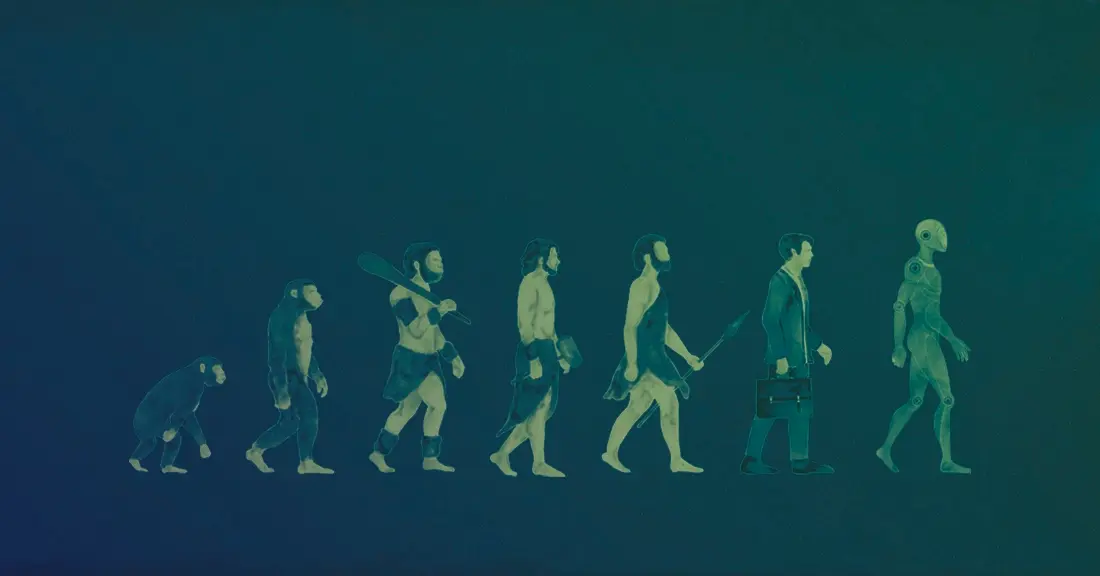
The development of AI agents will fundamentally change how people work and reshape the landscape of startups. In the past year alone, the number of AI agent-based startups has surged from single digits to dozens per month.
In Israel, there's been a surge in startups building AI agents focused on enabling others to integrate and customize these agents for diverse use cases.
Many of these companies are leveraging Israel’s strengths in cybersecurity, data science, and enterprise software to develop AI agents that solve vertical-specific problems such as medical diagnosis and predictive security.
At the same time, horizontal applications such as workflow automation and personalized customer engagement are emerging.
As more AI agent-centric startups emerge, certain common patterns begin to appear.
For example, startups initially built around general-purpose AI assistants are evolving into full-fledged "AI organizations."
With each major advancement in AI agents, we get closer to the trend predicted years ago: companies increasingly run by AI automation, with humans only making key strategic decisions.
This momentum has been building for years, but now feels like a turning point.
OpenAI CEO Sam Altman predicts this year will be when AI agents truly join the workforce. By 2027, at least half of all companies will deploy some form of AI agent.
And this is just the beginning.
In the near future, entire economies may be composed of these AI-first organizations. To build a truly enduring company, one must see this direction clearly.
Perhaps businesses will soon hire AI agents, with humans working alongside—or even competing against—them.
What happens next?
Here are five potential evolutionary stages of AI agents:
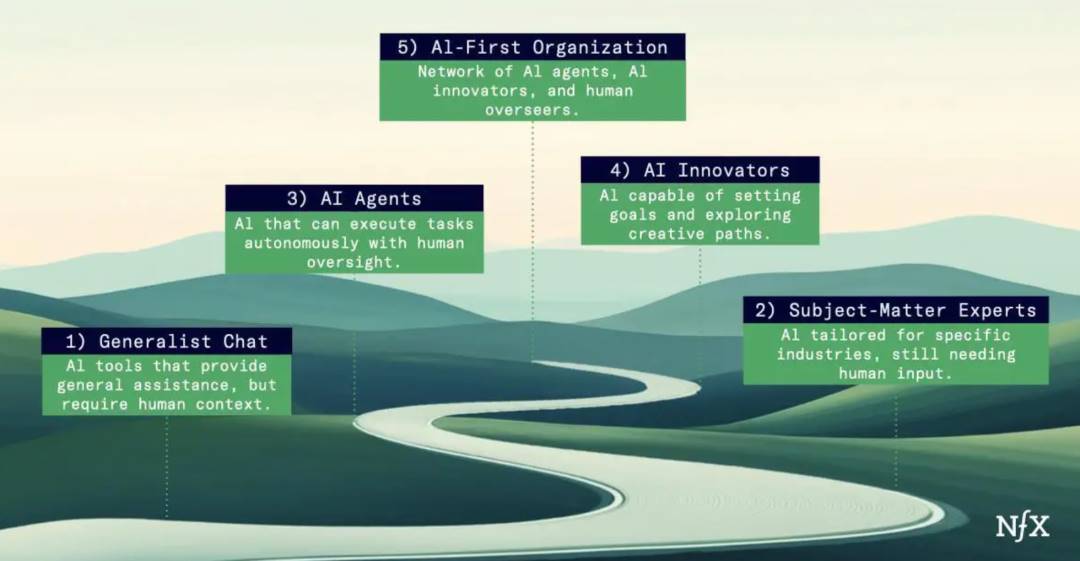
01. General Chat
The first wave of AI collaborators consists of foundational models (general LLMs like ChatGPT or Claude). They break through user experience barriers, helping people understand the broad capabilities of AI.
However, AI remains merely a tool—humans still lead in providing context, reasoning, and empathy.
As early adopters noted, these general tools are "masters without owners." This has driven AI startup evolution toward its first stage.
02. Domain Experts
General-purpose AI can read, write, and perform tasks under proper guidance. Yet, it still struggles in highly specific industry environments.
Shortly after the rise of general AI, true AI "experts" began to emerge.
AI appears capable of solving problems with minimal human prompting. Chat remains the primary interface for these systems, but many companies have built additional industry-specific features atop chat functionality.
Law is one such example: companies like EvenUp and Darrow demonstrate the power of AI trained on specialized legal corpora.
These AIs understand the nuances of legal language and can generate professional-grade legal documents.
03. AI Agents (Current Stage)
There are still many excellent companies operating at the AI domain expert level.
But over the past year or so, there's been a clear shift—from value propositions based on chat to those based on action.
General AI tools and domain experts act as true "co-pilots," creating new connections, generating articles, or providing new materials. But humans still need to take action for these tools to deliver real impact.
Starting April 2023, we began seeing AI perform more advanced tasks.
The most famous examples of AI agents are in code generation, such as OpenAI’s Code Interpreter or Cognition’s AI programmer Devin.
But this concept has expanded far beyond code generation into complete "job descriptions."
Now, more and more AI agents are designed to execute specific tasks. The packaging and combination of these tasks hold immense potential to become real services.
For instance, Enso, backed by NFX, is pioneering a marketplace for AI agents targeting small and medium-sized businesses.
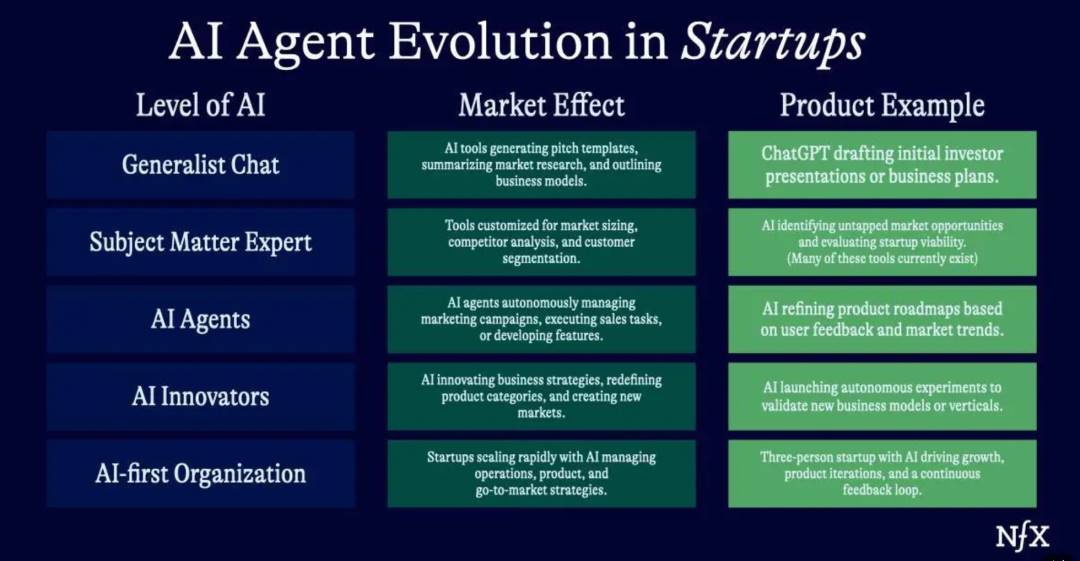
Once we continue refining AI's ability to complete tasks and act autonomously without heavy human oversight, there's no turning back.
04. AI Innovators
Once AI agents can consistently execute tasks, we’ll quickly see agents capable of innovation. If we allow AI to generate and explore new knowledge directions, its value rises to an entirely new level.
We can think about this in terms of how the human brain solves problems and creates.
We have task-oriented "if-then" mental presets that help us execute and solve problems.
But we also have an active subconscious—a mode of thinking that activates when we're not focused on solving problems, such as during showers or walks.
Have you ever struggled with writing or problem-solving, only to find the solution effortlessly after stepping away?
That’s your subconscious freely exploring creative approaches. Most novel, creative ideas arise in this state.
AI innovators will be able to conduct this kind of subconscious exploration. They won’t be bound by narrow "if-then" logic statements that limit thinking.
Imagine assigning a group of AI agents on Monday to develop a software feature, and by Wednesday discovering they’ve improved your original request based on trial-and-error learning and market analysis, delivering a better feature.
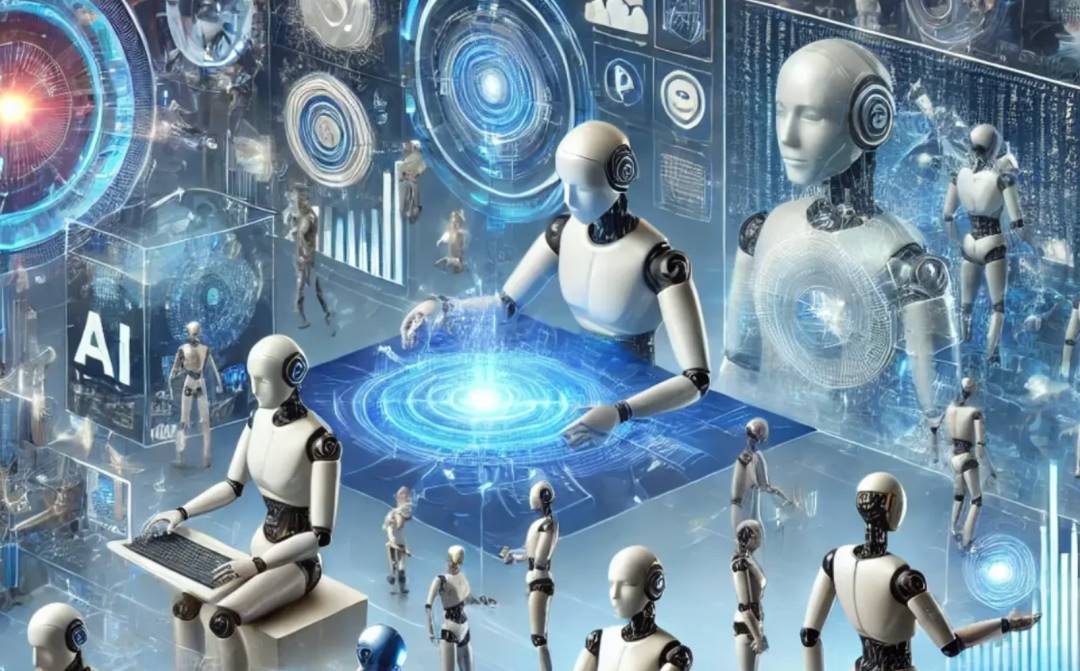
When goals are abstract (increase sales, improve software performance, make users love my app), planning objectives and charting paths will be key to the next phase of AI agent development.
This is also what makes AI agents truly mature members of the workforce.
Pure automation without critical thinking is the lowest-hanging fruit in the economy. But it doesn’t solve the biggest, most valuable problems—creativity does.
The key unlock is trust. We need confidence in AI agents making strategic decisions, not just task-oriented ones.
Some trust must be built through technology. We need two things: explainability and infrastructure. These themselves could become industries.
For example, Maisa, supported by NFX, is perfecting "proof of work" for AI agents—a critical factor in building trust across the agent ecosystem.
Another NFX-backed company, Emcie, is developing the infrastructure needed to create hyper-specific AI agents for individuals and enterprises.
This trust will also grow culturally. The more people see AI making intelligent decisions and producing better outcomes, the faster the future will arrive.
Early adopter groups will be crucial. Small and medium-sized businesses—or companies that simply can't afford human staff to meet their needs—will take the first steps, while the rest of the ecosystem watches and follows.
It will touch every industry. For example, education:
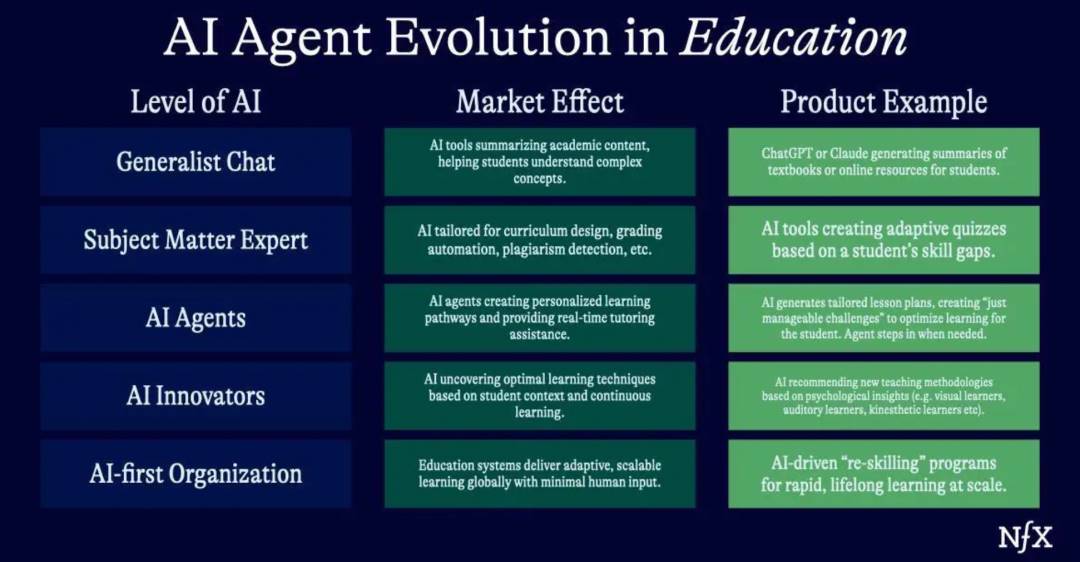
05. AI-First Organizations
With AI agent workers, AI innovators, and systems of trust and explainability in place, we will finally see the rise of true AI organizations.
These organizations are collections of AI agents and AI innovators capable of carrying out broad actions.
This is the kind of AI often depicted in science fiction.
In its darkest form, you can read about it in Daniel Suarez’s Daemon, or in Naomi Kritzer’s “Scattered Minds.”
These agents can make decisions in complex environments with many potential goals worth achieving.
The difference here is that AI itself will be able to self-select which goals are optimal and design paths to achieve them.
AI will take most actions; you’ll work alongside it, reviewing and auditing the routes it takes.
Imagine self-managed supply chains overseeing everything from production to delivery, or automated financial trading firms composed of numerous AI agents.
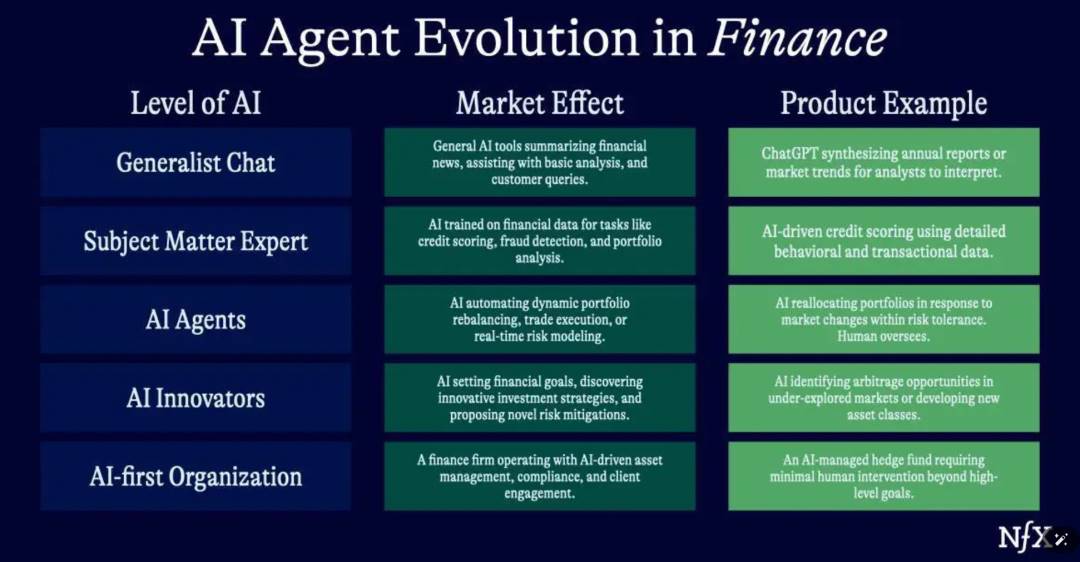
We don’t expect all of this to happen immediately—it will unfold step by step.
As trust and technology advance, AI will take on increasingly larger responsibilities. In reality, we’re still in the early technical window of AI agent systems.
Those who truly understand this are still the builders and hobbyists grinding in the trenches.
But soon, an AI-led organization will emerge, bringing us our "ChatGPT moment." Before ChatGPT, how many people truly understood AI’s capabilities?
If you know where we’re headed, you’ll stay ahead.
In Israel, the AI agent market is booming, with startups leveraging local expertise in machine learning, cybersecurity, and automation.
We’re seeing more and more companies building foundational agent platforms for others to customize—like Enso.
Startups here are already tackling vertical challenges in fintech, logistics, and healthcare, positioning themselves as key contributors to a rapidly growing AI ecosystem.
AI agents are here. AI innovators are here. AI organizations are here.
So now ask yourself: what’s stopping these from entering your field? How can you remove the barriers? Or, once removed, how can you become a primary beneficiary?
Not every company should focus on building AI agent infrastructure.
But you can anticipate how the overall economic efficiency in your domain will transform once these new labor pools are unleashed.
You can also reflect on the psychological impact this will have on teams—what will it be like managing only AI employees? Or conversely, being managed by AI?
At NFX, our job is to study how transformative technologies unfold. These shifts happen in phases, and as technology evolves, certain skills grow more important while others diminish.
We must also adapt psychologically and embrace the new opportunities that arise.
AI agents are in their most exciting nascent phase—the moment when great companies are born.
Join TechFlow official community to stay tuned
Telegram:https://t.me/TechFlowDaily
X (Twitter):https://x.com/TechFlowPost
X (Twitter) EN:https://x.com/BlockFlow_News
 @NFX
@NFX