Quickly Understand the Berachain Whitepaper: What's So Great About the Dual-Token and PoL Mechanism?
TechFlow Selected TechFlow Selected
Quickly Understand the Berachain Whitepaper: What's So Great About the Dual-Token and PoL Mechanism?
You can rest assured, there really is a bear on this chain.
 Navigating Web3 tides with focused insights
Author: knower
Compiled by: TechFlow

Berachain has officially launched. To help everyone better understand it, I've summarized its content briefly.
For a long time, we’ve seen many Layer 1 and Layer 2 blockchains attempt to solve the "blockchain trilemma"—the trade-off between decentralization, security, and scalability—in various ways, focusing heavily on technical performance, especially reducing transaction costs and increasing throughput. These two factors directly determine the user experience of a blockchain.
While these issues are indeed critical for blockchain scalability, until now we haven’t seen innovative economic models introduced at the protocol level—until today.
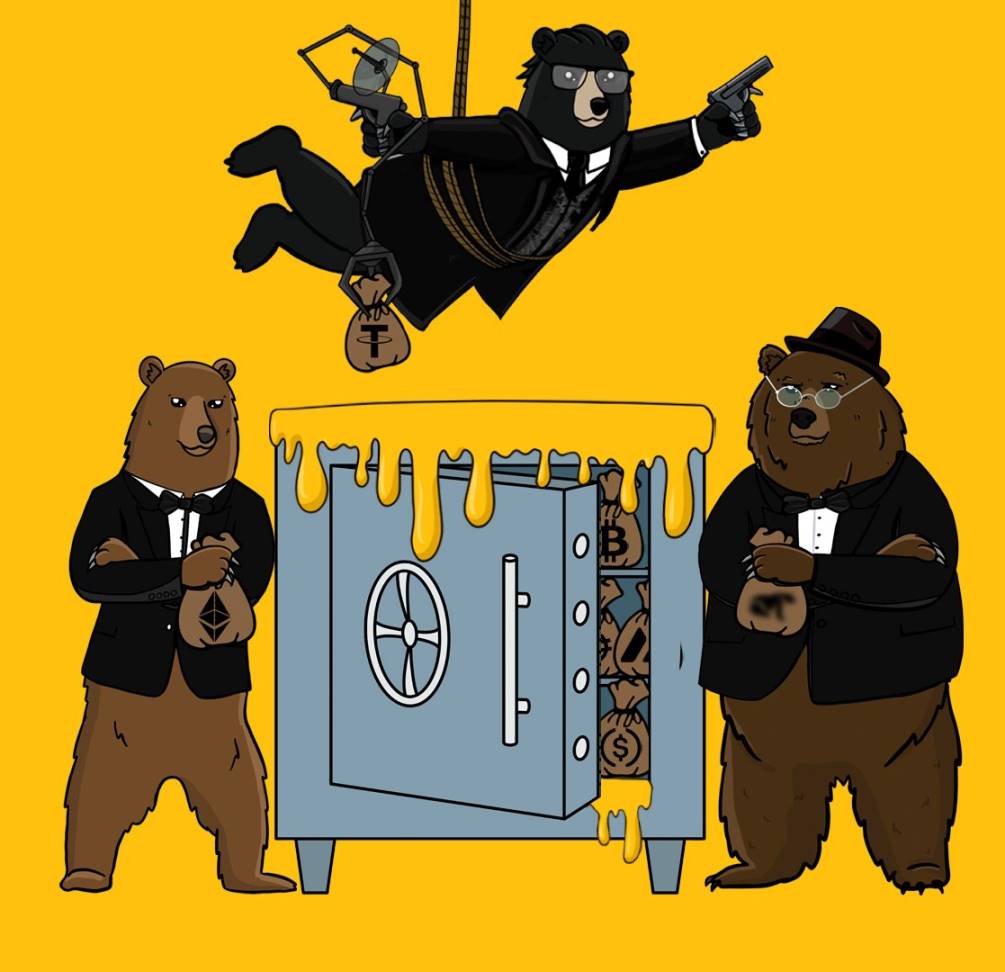
We’re excited to release this Honeypaper and explain what makes this L1 unique: how its architecture opens new directions in blockchain economics, how it works under the hood, and how these components interact synergistically. Also, rest assured—this chain does have a bear (Berachain’s mascot).
Berachain is designed to align incentives among key on-chain stakeholders, including decentralized applications (dApps), users, and validators.
More importantly, the chain's design allows applications built and used on it to create value for the chain itself through mechanistic means, while the chain can in turn empower those applications.
Berachain was inspired by observations of existing L1s and L2s—many chains over-invest in economic security without efficiently utilizing these resources. Instead of following this industry norm that makes it easy for validators to profit, Berachain innovatively introduces a dual-token system: BGT and BERA. This design ensures rewards are directed toward actual on-chain needs rather than being distributed passively.
All of this is enabled by Berachain’s unique consensus mechanism: Proof-of-Liquidity (PoL). If you’ve followed Berachain’s blog posts, you may already be familiar with PoL.

(Original image from knower, compiled by TechFlow)
This is essentially how PoL works, though explaining it more simply makes it easier to grasp.
Under the PoL model, users and dApps are prioritized over validators, but all three must collaborate to build a more secure and economically cooperative blockchain network.
As previously mentioned, excessive spending on economic security often creates an unhealthy relationship between new chains and validators. This leads to a lack of shared incentives among major stakeholders. If users and dApps—the core components of an L1 blockchain—cannot fairly benefit from their economic output, then paying validators purely for security becomes counterproductive.
The biggest difference between Berachain’s PoL and other consensus mechanisms lies in how rewards are distributed. In PoL, most rewards flow into application reward vaults rather than going directly to validators’ accounts. This isn't to downplay the importance of validators, but rather to drive the kind of economic innovation we’ve described by adjusting the reward distribution mechanism.
On Berachain, applications can use reward vaults to incentivize various user behaviors. For example, they can attract more liquidity into specific pools or leverage unique on-chain user behavior patterns to optimize economic activity.
Additionally, Berachain adopts a delegated proof-of-stake (dPoS) model combining BERA staking with BGT delegation. This design ensures validators don’t just passively earn rewards but must actively engage with other key stakeholders in governance and ecosystem development.
Under the PoL model, interaction between validators, dApps, and users is crucial for the ecosystem’s healthy development. Market dynamics naturally encourage users and dApps to align with the most active validators, driving efficient network operations.
However, most proof-of-stake (PoS) blockchains typically have only one native token. This forces users to use the same token for transaction fees, staking, and governance. Such a single-token model may fail to meet diverse user needs and struggles to encourage healthy long-term token holding behavior.
A more ideal design separates these distinct functions into independent tokens, meeting varied user demands and encouraging long-term holders to make choices beneficial to the ecosystem.
In Berachain, this multi-token system is realized through BERA and BGT. BERA serves as the gas and staking token, primarily used to pay network transaction fees. Users can also stake BERA to cover validator activation costs. BGT, on the other hand, is the governance and economic incentive token. It is non-transferable and can only be obtained by staking qualifying assets in reward vaults according to PoL standards.
This dual-token design not only makes Berachain’s economic model more flexible but also better satisfies the diverse needs of users and the ecosystem, promoting healthier long-term economic behaviors.
In simple terms, the separation of BERA and BGT ensures all stakeholders have direct skin in the game, and in an economic system like Berachain’s, those who participate more actively tend to receive greater returns.
BGT enables voting on governance proposals and can be redeemed 1:1 for BERA (though by design, BERA cannot be converted back into BGT). Additionally, users can delegate their BGT to validators, participating in the validator’s economic activities and receiving corresponding incentives.
A validator’s BGT yield is directly tied to the amount of BGT delegated to them, as well as how effectively they utilize that delegated BGT. This creates an interesting dynamic mechanism that accelerates user adoption of the application layer through newly issued incentives.
When the growth rate of BGT delegation incentives falls below the BGT issuance rate, users can choose to burn BGT and redeem it for BERA. Increased redemptions reduce the circulating supply of BGT, creating a feedback loop of supply and demand interactions that ultimately helps the system achieve greater stability.
If you’ve read this far, you might be curious about Berachain’s mathematical model. Like any whitepaper, the honeypaper includes mathematical formulas. While they may look complex, they form the essential foundation for how Berachain operates and how the dynamic components of the PoL model function.
The PoL model defines the issuance schedules for BERA and BGT, as well as the block production mechanism. Validator rewards are based on their participation in PoL, expressed as a variable rate dependent on a validator boost factor. The block production mechanism selects N validators from the active set, chosen proportionally to the amount of BERA they have staked.
If you're interested in the math and want to dive deeper, here’s what the formulas look like:
Below is the formula used to calculate how much BGT is generated per block, which depends on a validator’s boost value x. The boost value x is a ratio between [0,1], representing the percentage of total BGT allocation assigned to a given validator.

-
B (Base Reward Rate): The fixed BGT reward a validator receives for successfully producing a block.
-
R (Reward Rate): The amount of BGT that must be allocated to the reward vault before applying the boost coefficient.
-
a (Boost Coefficient): Adjusts the impact of the boost value on reward vault allocation. A higher boost coefficient increases the influence of the boost value on reward distribution.
-
b (Convexity Parameter): Adjusts sensitivity of reward allocation to boost values. A higher convexity parameter imposes harsher penalties on validators with low boost values.
-
m (Minimum Reward): Sets a floor for reward vault allocations. A higher minimum reward ensures even validators with low boost values still receive some rewards.
Alright, enough technical details—for now, let’s explore the real-world value brought by Berachain’s dual-token system and PoL model.
The Honeypaper dedicates a section to potential real-world applications of PoL, such as real-world assets (RWAs), automated market makers (AMMs), and Layer 2 solutions (L2s).
PoL holds particular significance in DeFi, especially in how effectively it aligns the interests of users and dApps. However, PoL’s potential extends beyond DeFi—other domains can benefit too.
Real-world assets (RWAs) have long been considered one of blockchain’s “holy grails.” If we believe traditional finance participants will eventually transact using our tokens and interact with us on-chain, a range of products closer to traditional finance will gradually emerge.
For instance, if you want to tokenize tangible off-chain assets like real estate or government bonds into ERC-20 tokens, asset issuers could use the reward vault to identify and incentivize asset originators. These reward vaults—and users depositing assets into them—could also benefit from secondary market liquidity and validator incentives.
Assume Berachain has a built-in decentralized exchange (DEX). Users could permissionlessly create new liquidity pools. These pools would not only earn native on-chain rewards but also receive BGT incentives.
Sounds complicated? Simply put, dApps can apply via governance to establish reward vaults atop these liquidity pools—all powered by PoL. This mechanism easily solves the “cold start problem” many dApps face when launching on new chains, while also fostering efficient collaboration among validators.
Depending on their stage of development, dApps can choose to offer BGT or native rewards above or below market value to attract different types of on-chain users. Compared to traditional PoS liquidity pools, PoL-based pools (with reward vaults) offer finer-grained control—a level of flexibility previously unattainable.
The Honeypaper also touches on other interesting topics, such as how incentive markets and reward vaults get whitelisted. If you’re interested, feel free to explore further—but the above should suffice for now.
Beras can’t read or write, so if you’ve made it this far, it’s nothing short of a miracle. If you’d like to learn more firsthand, check out the honeypaper.
Join TechFlow official community to stay tuned
Telegram:https://t.me/TechFlowDaily
X (Twitter):https://x.com/TechFlowPost
X (Twitter) EN:https://x.com/BlockFlow_News
 @knowerofmarkets