








Story: Turning intellectual property into the currency of artificial intelligence
TechFlow Selected TechFlow Selected
Story: Turning intellectual property into the currency of artificial intelligence
Just as NVIDIA drove the AI transformation through GPU acceleration, Story will become an indispensable part of the AI value chain.
 Navigating Web3 tides with focused insights
Chapter 1: IP as an Asset Class
IP: The World's Largest Intangible Asset Class
As generative artificial intelligence (AI) reshapes industries, intellectual property (IP) is poised to become the core asset driving rapid AI development.
According to Brand Finance’s 2023 Global Intangible Trackers Report, IP is considered the world’s largest asset class, with a total value exceeding $61.9 trillion, spanning technology, finance, research and development, and scientific innovation. From code repositories and data to scientific research and inventions, all can be classified as IP assets.
However, IP transactions and ownership have long been monopolized by a few market giants. Complex registration and enforcement processes, high legal costs, and fragmentation across jurisdictions make broad market participation difficult.
Meanwhile, from individuals to large multinational corporations, various IP holders face challenges in effectively monetizing or fractionalizing their IP. This has led to vast amounts of intangible assets remaining illiquid, unable to fully realize their potential value.
This is exactly what Story aims to solve. Story is dedicated to bringing IP on-chain, transforming how IP is financed and monetized, turning intangible assets into programmable tools that generate revenue through multiple channels—whether for AI training and inference or other emerging use cases.
As one of the first blockchain projects to partner with top-tier AI companies, Story has established a partnership with Stability AI, the developer behind Stable Diffusion, demonstrating how on-chain IP assets can be seamlessly integrated into AI systems.
This report will explore the challenges faced by traditional IP models in the AI era and detail how Story leverages its technical infrastructure, legal framework, and partner ecosystem to unlock new opportunities for IP creators, enterprises, institutions, and investors.
The Rise of IP Value in the Age of AI
In an AI-driven era, the value of IP becomes increasingly evident. AI model training relies on massive volumes of text, images, videos, and diverse datasets, while proprietary and domain-specific data are essential during inference for real-time analysis and specialized tasks.
Therefore, any source providing data to AI can be categorized as an IP asset, such as news aggregation, quantitative research, financial data, and user-generated content.
Story’s early collaboration with Stability AI, a global leader in open-source AI development, provides a concrete case study of integrating on-chain IP assets with AI.
This partnership enables direct integration of IP into the inference layer of AI models. Outputs generated via Stable Diffusion can be automatically registered on Story and instantly tokenized as on-chain IP assets.
This collaboration demonstrates the possibility of seamless registration of AI-generated content as IP, ensuring verifiable ownership and traceability on the blockchain.
The ultimate goal of this collaboration is to build a globally accessible, curated on-chain database. By actively promoting the tokenization of AI-generated content, Story enables Stability AI—and the broader AI ecosystem—to mass-produce authorized on-chain content while providing IP holders with transparent revenue-sharing mechanisms.
As AIGC scales up, registering model outputs seamlessly as IP can bring massive new datasets into the on-chain ecosystem. In the long run, this will drive widespread adoption of tokenized IP and create more opportunities around ownership, attribution, and monetization.
As computing power becomes commoditized, the competitive edge of AI models is shifting from hardware to data and IP.
Even the most advanced models struggle to maintain competitiveness or achieve breakthroughs without continuous access to high-quality data and IP throughout their lifecycle. This further validates the notion that “AI urgently needs data” and underscores that IP will play a role as crucial to AI development as specialized computing hardware once did.
Yet, in the age of AI, IP holders face unprecedented risks. When AI models use their IP without authorization, rightful copyright revenues or attribution rights are stripped away—especially for smaller IP holders with limited resources, who often lack the means or support to enforce their rights.
Once data is scraped, mixed, or fed into AI workflows, traditional enforcement methods become nearly ineffective, as IP assets are aggregated, transformed, or anonymized within the complex layered architecture of AI training and inference, making溯源 virtually impossible.
On the other hand, this challenge affects not only small IP holders but also large ones.
Despite owning vast IP portfolios, existing IP legal systems remain rigid and fragmented, failing to support more flexible, programmable, and scalable ways to monetize or distribute IP—particularly as AI demand grows increasingly dynamic and modular.
IP Infrastructure in the Age of AI: More Critical Than Ever
Generative AI models (such as Stable Diffusion, DALL·E, and ChatGPT), though still in early stages, have already revolutionized human productivity—from programming and data analysis to text and image creation—almost everywhere. These AI systems rely on massive global datasets for training.
According to Grand View Research, the global AI training dataset market was valued at $2.6 billion in 2024 and is projected to grow at a compound annual growth rate (CAGR) of 22% from 2025 to 2030.
Likewise, Fortune Business Insights forecasts the market will grow at a CAGR of 24.7% during the forecast period, reaching $17 billion by 2032.
However, as the AI training data market expands, a critical question remains unresolved: How should data ownership and attribution be defined? Can data contributors receive fair compensation?
Currently, AIGC operates in a legal and ethical gray zone due to:
-
Large language models (LLMs) potentially reusing copyrighted text without authorization;
-
Image-generating AI possibly copying artists’ unique styles without permission or compensation.
Without robust digital IP infrastructure, AI development may veer toward two extremes:
-
Tragedy of the Commons: If IP is freely exploited, innovators lose incentive to create, leading to industry stagnation.
-
Intensified AI arms race: Only well-funded large enterprises can afford increasingly complex IP litigation, marginalizing smaller innovators.
The concept of "overgrazing" vividly describes AI systems aggressively harvesting human creations without accountability, ultimately depleting innovation incentives due to lack of reward.
TCP/IP for AI Agents
Equally important to the concept of "overgrazing" is the fact that AI capabilities are rapidly moving beyond generating simple text and images, extending into complex machine-to-machine interactions. In such scenarios, traditional human-centric legal frameworks appear outdated and inadequate.
As agent-based AI systems grow more intelligent, they increasingly collaborate and exchange knowledge directly with one another. In this fast-evolving era, every piece of data, skill, or insight generated or consumed by AI agents can be viewed as IP.
Agents may exchange optimized algorithms, specialized code, training data, or even task-specific solutions. Since these assets are entirely digital and can be instantly copied or transformed, AI agents urgently need a robust, automated, and programmable IP transaction framework to efficiently manage the creation, usage, and trading of IP.
However, traditional IP systems rely on manual contracts and slow legal procedures, incapable of keeping pace with this emerging transaction model. This makes a programmable IP framework even more necessary—one that manages commercial agreements between agents, facilitates seamless monetary transactions, and offers a reliable, scalable alternative to traditional methods.
Although AI agents already possess the ability to trade vast expertise in real time, there is currently no widely accepted standard governing how to negotiate and trade these intangible IP assets. This gap not only increases development costs but also introduces compliance risks and leaves significant voids in trust and commercialization mechanisms.
This is precisely why Story developed the Agent Transport Control Protocol (Agent TCP/IP).
Agent TCP/IP is an open-source framework allowing AI agents to autonomously negotiate, manage, and trade their IP assets—just as the internet enables communication based on TCP/IP.
Through Agent TCP/IP, AI agents can:
-
Verify each other's IP licensing terms
-
Automatically complete payments and transactions
-
Enforce copyright and usage restrictions
-
Ensure fair returns for IP contributors
Currently, several AI agent systems have directly integrated Agent TCP/IP into their core frameworks, including ai16z’s Eliza, Virtuals’ G.A.M.E., Crossmint’s GOAT, and Zerebro’s ZerePy. Recently, Virtuals’ AI agent Luna used Agent TCP/IP to publicly negotiate an IP license with another AI agent, DaVinci, on social media platform X (formerly Twitter).
Looking ahead, AI development will increasingly depend on high-quality IP assets. However, traditional IP laws and regulations primarily revolve around “copying,” making them ill-suited to the demands of the AI era, especially regarding:
-
How to define ownership for the massive volume of derivative works generated by AI?
-
How to ensure copyright compliance when using AI training data?
-
How to efficiently execute micro-licensing mechanisms for data?
In this context, acquiring and licensing IP has surpassed computing hardware as the key bottleneck in AI development. AI models must continuously access new IP assets to maintain competitiveness and innovation—all of which can be efficiently managed and optimized through Story’s blockchain infrastructure.
Tokenized IP in the Digital Economy
DeFi introduced the concept of "programmable money," where tokenized assets on blockchains freely interact within an ecosystem of composable financial protocols. Once an asset is tokenized and brought on-chain, it gains access to the entire network and a suite of value-added services.
By tokenizing IP and bringing it on-chain, IP evolves from static off-chain assets into programmable on-chain assets, unlocking unprecedented possibilities.
Just as the internet and social media drastically reduced the cost of copying and distributing information—spawning entirely new business models—on-chain IP frameworks similarly lower the operational costs of IP licensing and royalty management. By tokenizing IP and defining licensing terms within on-chain modules, IP holders can enable composable, legally protected usage in low-friction markets. Meanwhile, royalty payments previously delayed by manual negotiations can now flow autonomously on-chain, giving rise to entirely new business models that were unfeasible under traditional IP systems.
Additionally, AI developers can quickly verify specific IP usage terms and legally reuse IP assets via micropayments within their modules.
Under this system, both large-scale IP institutions and independent creators can fairly contribute IP and earn rewards.
Ownership provenance information for IP is fully verifiable, eliminating redundant verification and cumbersome negotiation processes. AI’s use of IP assets ceases to be a zero-sum game and instead becomes a sustainable, virtuous cycle. Once an IP asset is tokenized, it gains full digital tooling, enabling transferability, tradability, and shared revenue generation.
More importantly, when an AI agent reads data from a blockchain-based IP registry, it can automatically confirm whether a database or asset is available for commercial use, verify AI training permissions, initiate on-chain payments, and store an immutable transaction record.
This is the core idea behind Agent TCP/IP—enabling AI to interpret IP as code under a universal communication protocol. IP no longer disappears into opaque AI training data pools but becomes a persistently trackable asset, with its usage, royalty earnings, and derivative outputs recorded in real time.
Under this model, IP holders can allow AI models to learn from their work while retaining oversight and receiving fair compensation. In the Web2 era, widespread content scraping often deprived IP holders of rightful payment, but programmable IP transforms this process into a collaborative, value-driven market.
Exponential Growth of AI-Generated Content and Data
AI is still in relatively early stages of development, yet it has already achieved unprecedented scale in content production.
The most visible example is the explosion of generative AI—from Grok on X (formerly Twitter) to Stable Diffusion by Stability AI (a Story partner), to OpenAI’s ChatGPT and Anthropic’s Claude. These large language models (LLMs) can generate complex images or lengthy content from simple text inputs.
However, the influx of massive content and market oversaturation may dilute the value of original works.
Without infrastructure to track hierarchical relationships among IP derivatives or ensure proper compensation to originators, the devaluation of AI-driven content is inevitable.
Therefore, we need new IP architectures to coordinate stakeholder interests and build a fair, open environment for human-AI collaboration.
By transforming IP into liquid, composable tokenized assets, we can ensure AI’s speed and generative capacity do not infringe on creators’ rights. This model can shift exponential AI output from “uncontrolled exploitation” to “collaborative co-creation,” allowing innovators, developers, and IP holders alike to share in the benefits of the AI revolution.
Chapter 2: Story—The IP Blockchain for the AI Economy
Core Infrastructure for AI Data
As AI advances at an unprecedented pace, demand for high-quality data and IP assets is surging in tandem.
Story is addressing inefficiencies in traditional IP systems—fragmented ownership, lack of enforceable licensing mechanisms, and opaque attribution—which have become major barriers to IP monetization and innovation.
By building a blockchain-based IP asset repository, Story aims to become core infrastructure for the AI economy, making “programmable IP” a reality and enabling fair sharing and utilization of IP resources between humans and AI agents.
Story adopts an execution environment similar to Ethereum and introduces a Programmable IP License (PIL) legal framework, enabling diverse IP assets to integrate with AI technologies and provide high-quality knowledge inputs.
For large IP holders, Story’s on-chain repository allows efficient management of extensive IP portfolios, enabling automated licensing and monetization. For instance, AI developers can automatically obtain usage rights to specific IP resources via predefined smart contracts, ensuring strict enforcement of terms.
For small and medium-sized IP holders, Story provides a global marketplace to tokenize and commercialize their IP assets, ensuring usage terms are readable and enforceable, effectively safeguarding their rights.
In short, IP will become the “digital gold” of the AI era, and Story will realize this vision through its unique blockchain environment and carefully designed legal framework.
Story’s Funding and Market Recognition
Story’s potential has been recognized by top-tier investment firms that see transformative power in combining blockchain and AI for the IP industry. Since inception, Story has completed multiple funding rounds, raising over $140 million, with a post-money valuation of $2.25 billion—demonstrating strong market confidence in its model and growth trajectory.
Story’s seed round was led by a16z Crypto and supported by Samsung NEXT Q Fund, which focuses on AI startups.
Subsequent rounds were again led by a16z Crypto, attracting participation from top-tier institutions including Polychain Capital, Foresight Ventures, and Nomad Capital. Additionally, Story has garnered support from angel investors such as Balaji Srinivasan, Charlie Songhurst, Scott Trowbridge (Head of Stability AI), and Paris Hilton. Korean entertainment industry leaders, including Hybe founder Bang Si-hyuk and The Black Label CEO Jung Kyung-il, have also joined as investors.

Source: The Block Pro Research
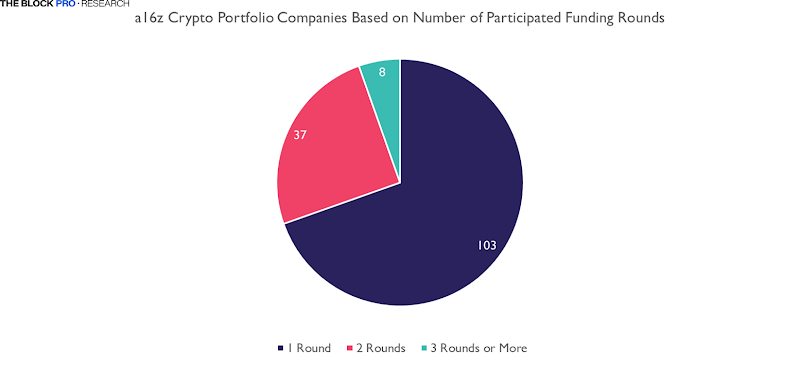
Story is one of only eight projects in which a16z Crypto has participated in at least three funding rounds, underscoring its strong conviction in Story’s future.
Source: The Block Pro Research
Notably, Story is the only blockchain project to have received consecutive lead investments from a16z Crypto across three rounds. Across all industries, a16z conducting a “three-round lead” is extremely rare; our research indicates it is unprecedented in the blockchain space.
Strong financial backing, combined with strategic guidance from top venture capital firms, crypto and AI-focused funds, and industry leaders, further solidifies Story’s leadership position in the IP space. Story equips IP holders with new tools to remain competitive in the fast-evolving AI economy.
Story has also completed one of the largest financings in the crypto industry, reflecting growing market recognition of IP as a key asset class and showcasing Story’s innovative potential in the IP marketplace—breaking long-standing inefficiencies and offering new monetization opportunities for global IP holders.
Story’s Headquarters and Global Presence
Born in Silicon Valley, Story is headquartered in Palo Alto, California—just minutes from Stanford University and steps away from Aptos and Sui headquarters—making this talent-dense region a true “L1 Valley.”
This location ensures Story remains at the forefront of blockchain and AI innovation, attracts top technical talent, and maintains close ties with venture capital firms and leading global AI companies.
In addition, Story operates with a global remote workforce, drawing exceptional talent worldwide to ensure deep market penetration and enhanced service capabilities across industries and communities.
What Is Story?
Story is a purpose-built Layer 1 blockchain dedicated to bringing IP assets on-chain, enabling programmability and composability of IP assets—much like DeFi made financial assets programmable.
As a “world-class IP blockchain,” Story integrates the underlying architecture of the Ethereum Virtual Machine (EVM) with targeted optimizations.
These adjustments are specifically designed to handle complex relationships within the IP Graph, such as tracking chains of ownership and parsing relationships between derivative IP assets and parent IP assets.
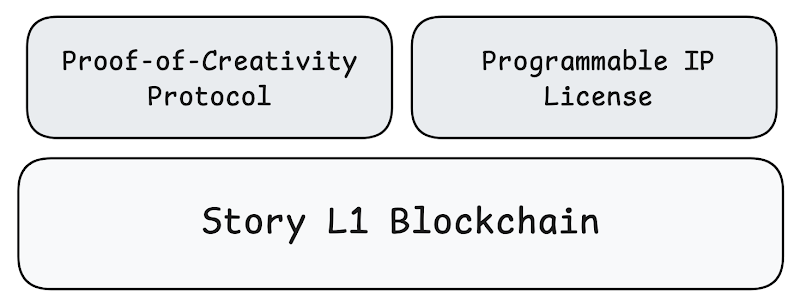
At its core, Story is a suite of protocols built around IP asset tokenization, consisting of three key components:
-
Story L1 Blockchain Network
-
Proof-of-Creativity (PoC) Protocol
-
Programmable IP License (PIL)
Source: The Block Pro Research
Together, these core components form a complete programmable IP ecosystem, covering key aspects such as IP tokenization, revenue, and royalty distribution.
We will explore the technical details of each component in subsequent sections.
Programmable IP
Within the Story ecosystem, IP assets tokenized via Story are fundamentally ERC-721 tokens with special token-bound accounts. Unlike traditional NFTs that merely link to a file, Story’s IP assets contain detailed IP metadata and embedded modules defining usage conditions. This enables tokenized IP assets to be programmed to automatically perform the following functions:
-
Allow or restrict derivative creation, set licensing terms, and define revenue-sharing rules;
-
Automatically distribute royalties among multiple parent IP co-owners via smart contracts;
-
Ensure commercial use by AI models or platforms complies with preset licensing terms;
-
Allow IP holders to decide whether to open their data for AI training;
-
Track the chain of ownership and record the evolution path and derivatives of IP assets;
-
Upon minting, IP assets gain embedded APIs to interact with dApps or AI services, simplifying authorization and advancing AIGC and UGC ecosystems.
This model fosters cross-industry collaborative innovation—from music distribution and AI model training data to meme generation and brand licensing.
Story as the Central Hub for IP Assets in the AI Era
Unlike general-purpose blockchains, Story’s design actively considers AI’s needs. By providing a unified on-chain repository for tokenized IP assets:
-
AI developers can easily discover and license curated databases for AI model training—including images, text corpora, or even full virtual worlds—without negotiating individually with each IP holder.
This functionality extends beyond basic AI training to specific uses such as quantitative research or agent-to-agent interaction.
-
Whenever an IP asset is accessed, minted, or derived, its rights holders automatically receive royalty payments, reducing transaction friction and enabling real-time attribution.
-
Large studios or data providers can consolidate their IP assets on Story, streamlining authorization across chains, platforms, or jurisdictions.
In the future, Story could evolve into a global AI data marketplace, where IP holders supply data to AI developers and receive stable on-chain royalty income.
With the Programmable IP License (PIL) mechanism, large enterprises can trust that their IP assets have secure authorization safeguards and can easily track and verify usage.
Story’s collaboration with Stability AI exemplifies this vision in practice.
As a developer of open-source AI models, Stability AI requires a continuous stream of licensed data. By aggregating global database providers and individual IP holders, Story builds a transparent marketplace where Stability AI and other AI developers can discover usable IP assets, quickly confirm usage terms, and make payments under predefined legal frameworks.
This system helps AI developers avoid the gray areas of data scraping while offering IP holders an efficient monetization channel.
Removing Barriers for IP Holders
Another key advantage of Story is that even individuals and organizations lacking IP legal expertise can tokenize their assets and protect them from unauthorized use or infringement.
By simplifying operations, Story makes IP tokenization far more accessible, significantly lowering entry barriers so more people can leverage blockchain technology for IP protection and maximum revenue.
This simplified approach appeals to diverse IP holders. For example, independent creators can quickly turn their IP assets into profitable digital assets.
From startups to mature tech firms, innovators and technologists can use Story to protect patents, software, and product designs, leveraging automated execution via on-chain smart contracts to reduce infringement risks and explore multiple monetization paths—such as fractional ownership trading or time-limited licensing.
Universities and research institutions can tokenize databases, research findings, and experimental methods via Story, establishing transparent licensing systems and facilitating research collaboration or commercialization without navigating complex traditional IP contracts.
For large IP holders such as brands and enterprises, Story offers an efficient IP management solution, simplifying cross-chain and cross-platform IP usage. Companies no longer need to manage numerous fragmented licensing agreements or switch between multiple networks but can consolidate IP assets on a unified platform, relying on Story’s reliable legal mechanisms and transaction safeguards for safer, more efficient management.
Through these features, Story dramatically lowers the technical and legal barriers to IP protection and monetization, enabling individual creators, research institutions, and large enterprises alike to confidently participate in this ecosystem and manage their IP assets more efficiently.
Chapter 3: Story Technology Overview
Story’s Core Components
Built on a specialized technical architecture, Story is designed to handle large-scale, complex IP asset relationships—especially those involving AI systems processing vast tokenized databases.
Story employs advanced data structures such as the IP Graph and modular smart contract logic to enable precise automation of IP licensing, royalty distribution, and dispute resolution.
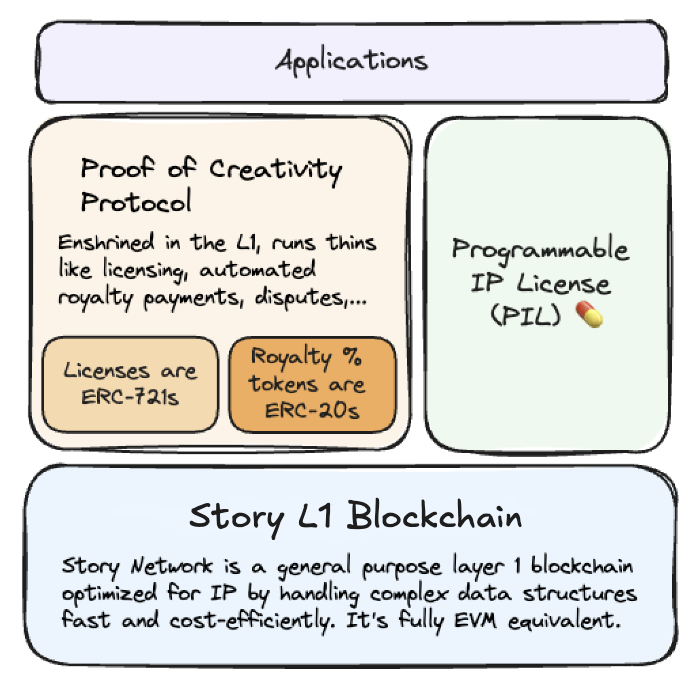
As previously mentioned, Story consists of three core components, each solving distinct problems across the IP asset lifecycle.
Source: Story
Story L1
Story L1 is the foundational infrastructure layer, featuring an EVM-compatible execution environment combined with the CometBFT consensus mechanism for efficient transaction finality. But the most critical feature of L1 is its ability to handle complex IP asset relationships—a capability known as the “IP Graph.”
IP Graph and Vector-Database-Like Querying
Story uses custom precompiles and indexing techniques to track complex upstream-downstream or derivative relationships within the IP Graph. Unlike traditional approaches that register tokenized IP assets as static NFTs, Story’s ledger structure enables fast queries and advanced retrieval across potentially vast derivative networks.
This capability is vital for AI applications. An image, database, or text snippet may have multiple parent assets, each requiring some form of royalty distribution or attribution.
In practice, Story employs a vector-database-like technology optimized for on-chain use, enabling rapid provenance tracing and traversal of multi-layered IP assets.
Thus, AI developers can programmatically identify which parent IP elements are embedded in a dataset, calculate corresponding royalty obligations, and check whether a derivative chain adheres to specific usage terms.
This specially designed data structure shifts Story’s focus away from traditional throughput metrics like TPS (transactions per second) toward delivering tailored functionality for the AI era.
Proof-of-Creativity (PoC) Protocol
The Proof-of-Creativity (PoC) Protocol is built atop Story L1 and defines how IP is tokenized and licensed, regulating royalty flows on and off-chain.
Often referred to as the “operating system” for IP assets, PoC’s primary functions include:
-
Tokenization Rules
Ensuring each IP asset follows standardized metadata definitions—such as asset category or usage terms—during minting, representation, and identification.
-
Modular Architecture for Agent Flows
Adopting a plugin architecture to support flexible extension of various modules (e.g., licensing, disputes, royalty distribution).
This feature is especially important for transactions between AI agents, as readable contract modules allow agents to autonomously negotiate or verify IP usage terms.
-
Programmable Royalty Distribution and On-Chain Dispute Handling
Includes automated royalty distribution logic suitable for complex derivative chains.
If an AI creation references multiple parent IP assets, PoC will proportionally distribute revenue to each parent according to pre-set terms. Additionally, the protocol includes dedicated dispute-handling functionality to flag AI misuse or unauthorized derivatives, suspending their use until resolution or escalation to the PIL legal layer.
PoC’s modular design ensures continuous iteration without requiring a complete system overhaul. When new AI-specific modules are needed—such as synthetic content verification or specific usage restrictions—they can be seamlessly integrated atop PoC.
Programmable IP License (PIL)
While PoC handles on-chain automation, the Programmable IP License (PIL) serves as an off-chain legal framework connecting the on-chain system to the traditional legal world.
By providing standardized terms, referencing recognized legal standards, and offering clear legal recourse when on-chain solutions fall short, PIL ensures all IP transactions (including minting, licensing, and transfers) carry legal validity outside the blockchain.
Because PoC automates on-chain mechanisms, when PoC automatically executes royalty distributions or generates sub-licenses for AI models, PIL ensures these smart contract obligations remain legally enforceable in court, with on-chain transaction history serving as admissible evidence.
PIL is particularly crucial for resolving large-scale or cross-border IP disputes. Without PIL, on-chain records of ownership and copyright might fail to align perfectly with traditional IP laws, making legal recognition difficult.
PIL Practical Use Case
Suppose an independent data provider mints their data as an IP asset on Story and plans to license it to AI developers.
The provider can set an upfront licensing fee and a recurring revenue share tied to future AI model outputs.
Whenever an AI developer initiates a transaction on Story L1 to integrate the provider’s IP asset into their AI model, the licensing module references PIL to automatically encode the relevant fees and royalty distribution logic within PoC.
If the developer later sells an application dependent on this IP asset, they must distribute a portion of the proceeds to the original IP holder.
If they fail to fulfill this obligation, the IP holder can trigger the on-chain dispute mechanism. If the dispute cannot be resolved—say, the developer moves activity off-chain or becomes unreachable—the IP holder can still pursue legal action under PIL in the relevant jurisdiction.
The combination of Story L1, PoC, and PIL creates a comprehensive environment for IP asset registration, licensing, and enforcement.
IP Assets & IP Accounts
In the Story ecosystem, IP assets and IP accounts are two core concepts.
An IP asset is an ERC-721 token representing a tokenized IP on-chain.
IP assets maintain dynamic connections with Story’s on-chain modules, enabling them to respond to external calls—an essential feature for AI use cases, especially frequent micro-licensing events during model iterations.
Each IP asset can link to its parent or child assets, forming a graph that tracks lineage. When AI outputs involve multiple IP assets, the IP Graph ensures all relevant parent assets are identified, simplifying multi-party royalty calculations.
This functionality is critical for large AI models relying on entire content libraries, helping ensure compliance and build trust.
Since IP assets are bound to an IP account (a smart contract account), they can embed modules and be customized for management.
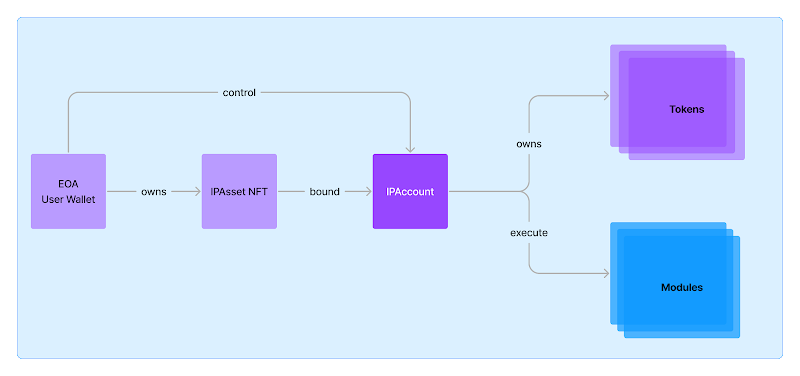
Source: Story
An IP account is a modified implementation of the ERC-6551 standard, essentially acting as the “brain” for each IP asset, controlling module operations and communicating with external smart contracts.
Modules
Modules are standalone smart contracts responsible for defining operations within the Story ecosystem. Core modules include:
-
Licensing Module
Mints specialized IP assets and sets specific usage terms (e.g., commercial vs. non-commercial). AI frameworks can call this module for large-scale IP asset usage—whether for quantitative analysis, financial modeling, data insights, or general AI model training.
-
Royalty Module
Automatically handles royalty distribution for derivative works, especially AI-generated content involving multiple parent IP assets, distributing revenue proportionally per predefined rules.
-
Dispute Module
Used to flag potential infringements, suspend use of contested assets, or escalate disputes to off-chain arbitration when needed. For IP abuse or unauthorized derivatives, this module provides a trustless on-chain solution, avoiding immediate resort to traditional legal proceedings.
-
Future Modules
System extensibility allows easy addition of new modules, such as partial IP splitting or Agent TCP/IP plugins for AI agent interactions.
By decomposing IP operations into independent modules, Story ensures convenient updates and additions, fostering an open environment for continuous innovation.
Chapter 4: Story Use Cases
Stakeholders in the IP Ecosystem
As a multifunctional platform, Story offers programmable IP asset custodianship, fostering an ecosystem of diverse IP holders including AI practitioners and researchers. Each group benefits differently from on-chain programmable IP capabilities.
Key stakeholders include:
-
IP Creators—seeking direct control over licensing and revenue.
-
Large IP Holders—planning to consolidate large IP portfolios onto a single platform for management.
-
AI Developers—looking for easy access to tokenized databases.
-
Users—eager to create derivatives from existing IP.
-
Developers—building user-facing dApps for IP derivation.
These stakeholders collectively form a self-reinforcing positive feedback loop—more IP asset minting leads to more derivatives, more licensing transactions, and a richer IP repository on Story.
This section explores implementations and projects enabled by Story’s ecosystem.
AI Models, Agents, and Frameworks
Story’s most prominent applications center on AI.
For example, when an AI developer wants to integrate a specific database into their AI model, the Story system can verify whether the IP holder has enabled royalties and derivative licensing for that database.
If the developer uses the IP asset in their model and generates commercializable content, Story’s mechanisms automatically trigger the appropriate royalty flows, ensuring the IP holder receives due compensation.
When AI developers require thousands of databases, they can rely on Story’s universal IP repository to handle large-scale requests without needing to sign individual licensing agreements with tens of thousands of small IP holders. This frictionless approach greatly expands the applicability of tokenized databases.
Emerging AI agent frameworks can further leverage Story’s modular architecture. For instance, via Agent TCP/IP, AI agents can discover domain-specific IP assets, then automatically negotiate usage terms and execute royalty payments through on-chain licensing modules.
Story will record derivative expansions in real time, ensuring multiple parent IP holders receive timely revenue shares.
All this points to a future where AI systems become active participants in the IP economy, autonomously generating derivatives and distributing royalties proportionally—without human intervention.
IPFi—DeFi for IP
IPFi is a new concept analogous to DeFi. Instead of limiting financial activities to traditional on-chain collateral assets (like ETH or stablecoins), it leverages intangible IP assets.
This allows IP holders to stake, lend, or collateralize their IP assets, unlocking DeFi-like opportunities previously reserved for fungible tokens.
Stable revenue streams from on-chain licensing and derivatives can provide ongoing income for IP assets. These on-chain cash flows can serve as financial backing for automated yield strategies or be packaged into advanced financial derivatives.
As the world’s largest asset class, IPFi has the potential to vastly expand the total addressable market (TAM) for DeFi and programmable blockchains. IP holders who previously had no incentive to participate in traditional DeFi now have a direct motivation to tokenize their assets, while DeFi users gain access to non-traditional collateral.
By combining programmable IP with DeFi primitives, IPFi lays the foundation for a more inclusive and diverse on-chain economy—not just for native DeFi participants, but also for large enterprises, research labs, and even small businesses seeking to monetize untapped IP.
Enterprise Applications
Although large studios and enterprise groups can manage high-value IP transactions, they miss many monetization opportunities in long-tail markets.
With AI, millions of high-quality derivative works become possible, but existing licensing structures of large enterprises cannot keep up. With near-zero-cost IP licensing, derivative tracking, and automated revenue distribution, Story opens a new paradigm for IP monetization and expansion.
A prime example is Story’s collaboration with Stability AI, the developer of Stable Diffusion—one of the most famous open-source text-to-image models.
Typically, enterprise-level IP and AI agreements require cumbersome legal processes, especially when dealing with complex, large-scale data usage—making it harder to resolve the growing long-tail issue of commercial use, such as niche AI image generators, derivative databases, or small specialized models needing only fragments of large corpora.
Join TechFlow official community to stay tuned Telegram:https://t.me/TechFlowDaily X (Twitter):https://x.com/TechFlowPost X (Twitter) EN:https://x.com/BlockFlow_News
 The Block






