Interview with Azuki Founder Zagabond: Building a Community-Driven Anime Universe, Three Key Components Power the Flywheel Effect
TechFlow Selected TechFlow Selected
Interview with Azuki Founder Zagabond: Building a Community-Driven Anime Universe, Three Key Components Power the Flywheel Effect
Why did Animechain choose the anime industry as its entry point, and how will it leverage anime to open up a whole new growth space for NFTs?
 Navigating Web3 tides with focused insights
Author: Nancy, PANews
Having weathered market cycles, breakthrough is an unavoidable keyword for NFTs. As Azuki celebrates its third birthday, it has set its sights on an open anime universe to win back users' hearts. On January 23, Animecoin (ANIME), a project co-developed by Azuki as a core contributor, will officially launch on major cryptocurrency exchanges. As NFT utility increasingly transcends the simple profile-picture narrative and expands into more diverse real-world applications, why has Animechain chosen the anime industry as its entry point—and how will it leverage anime culture to unlock new growth potential for NFTs?
Recently, PANews conducted an exclusive interview with Zagabond, founder of Azuki. In the conversation, Zagabond offered in-depth analysis on the evolution and challenges within the anime industry, highlighting how Animechain aims to solve core pain points such as lack of fan loyalty and unequal revenue distribution for creators—ultimately delivering more immersive and interactive experiences for anime fans. He also reflected on Azuki’s marketing strategies, both successes and lessons learned, while reaffirming the commitment to building on Ethereum and expanding its ecosystem.
Community at the Core: Animecoin’s Three-Component Flywheel Model
"In 2022, Azuki began building an open anime universe, pioneering decentralized brand creation. Now, through the Animecoin Foundation, we're writing the next chapter of anime—Anime's season has arrived." Since the announcement of the Animechain network in March 2024, new developments have recently emerged: the official release of ANIME’s tokenomics and the upcoming TGE (Token Generation Event) on January 23.
According to ANIME’s tokenomics, 50.5% of the total supply will be allocated to the community—37.5% to the Azuki community as early supporters of the Animecoin ecosystem, and 13% to the DAO treasury for funding initiatives approved by AnimeDAO governance proposals.
Zagabond emphasized during the interview, "Animecoin is a community-driven movement—with no allocation for venture capitalists." He added that the Animecoin Foundation, as an independent entity, leads the development of Animechain, oversees the AnimeDAO governance process, and is dedicated to growing the Animecoin ecosystem. It will use its allocated funds to support initial and ongoing operations, grant programs, and other initiatives aimed at bridging Animecoin with the broader global anime industry. Azuki serves as a core contributor to the Animecoin Foundation, supporting its mission to manage and grow the Animecoin ecosystem.
Explaining the rationale behind Animechain, Zagabond stated that anime has evolved from subculture to mainstream pop culture. Luxury fashion brands like Chanel and Burberry are collaborating with anime franchises; athletes quote anime in post-game interviews; and rappers like Megan Thee Stallion sample anime soundtracks. Despite this cultural rise, structural issues persist in the anime industry. Fans spend heavily in crypto but receive little recognition or reward for their loyalty. Meanwhile, due to Japan’s unique anime financing model, many animators and IP holders do not earn proportionate returns.
Anime 2.0 presents a unique opportunity: cryptocurrency can revolutionize fan engagement by unifying fragmented fan activities on-chain, enabling IP owners to accurately measure fan loyalty and unlock new revenue streams for highly engaged communities.
The “Full Stack ANIME” framework supports this vision by creating a flywheel effect—each component fuels the growth of the others. The network becomes increasingly valuable and self-sustaining as more users and developers join.
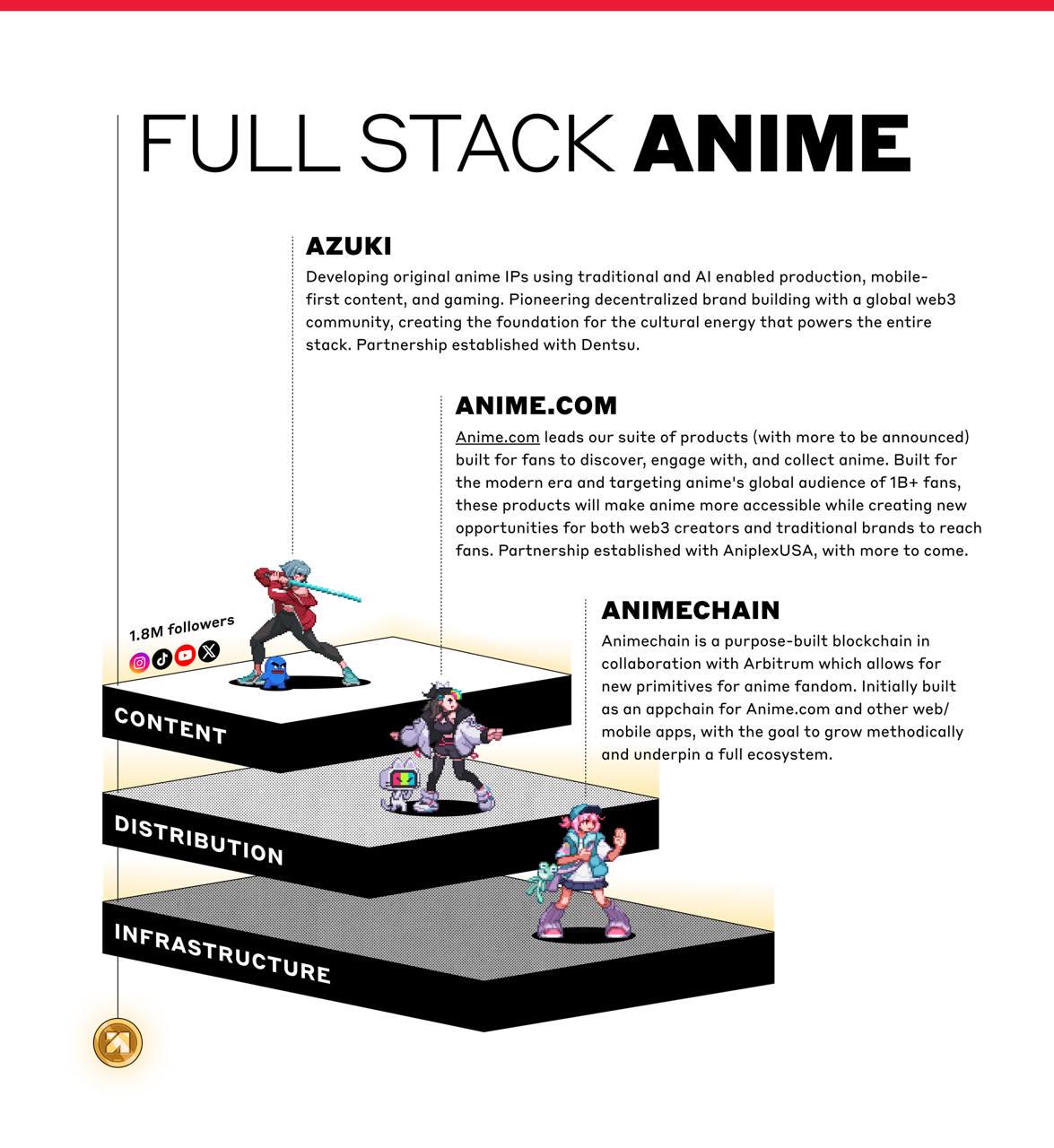
Full Stack ANIME consists of three key components: blockchain infrastructure, consumer platforms, and intellectual property (IP):
Dedicated Infrastructure (Animechain): Animechain is an L3 blockchain built using Arbitrum Orbit technology, with Animecoin serving as the custom gas token. This setup simplifies the experience for Web2 anime fans—they only need to understand and acquire one token (reducing complexity around managing multiple tokens)—and enables gasless transactions for seamless onboarding.
Consumer Platforms & Products (Anime.com): Consumer-facing products are essential to triggering the flywheel and increasing value. A large user base attracts more teams to build on the network, which in turn draws more users. Anime.com aims to do for the anime industry what Discord did for gaming—become the dominant social layer across the entire anime ecosystem.
Content & IP (Azuki): IP development provides the cultural energy that powers the entire system. The IP layer connects all components and unites the community around shared enthusiasm for Animecoin.
Notably, Zagabond shared that Azuki has already established deep collaborations in the anime space. For example, Azuki has partnered with Dentsu, a leading Japanese anime production studio. The first episode of Azuki’s animated anthology series *Enter the Garden*, titled *The Waiting Man*, was produced by renowned creative producer Tsuguro Taro, known for works such as *Code Geass* and the *One Piece Film Red* movie, and features voice acting by prominent talents including Sugita Nobuhiko (*Gintama*), Kito Aoi (*Demon Slayer*), and Fukuyama Jun (*Code Geass*). Additionally, Azuki collaborated with Aniplex USA to launch a digital collectibles experience for the *Fate/strange Fake* IP on Anime.com. More anime partnerships will be announced this year, with several ongoing discussions expected to be shared soon.
Commitment to Ecosystem Expansion: Prioritizing Ethereum-Based Development
"As a brand, Azuki represents resilience, growth, and innovation. We’re proud to have overcome numerous challenges and remain standing strong in Web3. The fact that our community trusts us and builds alongside us—the open anime universe—is the greatest validation we could ask for," Zagabond told PANews.
As a veteran NFT project, Azuki initially gained fame through its distinctive Japanese aesthetic, resonating strongly with anime enthusiasts. However, today’s NFT projects face multiple headwinds: overall market downturns, oversaturation, and user fatigue. Like others in the space, Azuki has had to reflect on past missteps and explore new viable paths to better align with audience needs.
For instance, regarding the execution of the Azuki Elementals launch—particularly in marketing and communication—Zagabond admitted there was room for improvement. "Previously, we emphasized mystery and surprise in product launches. But as the market matured, this approach became less effective. Elementals taught us important lessons about transparency and expectation management. I still stand by our decision to expand the Azuki universe, but we’ve since refined our methods to better meet community expectations, ensuring clearer communication and deeper community involvement."
Nonetheless, Zagabond affirmed that expanding the Azuki ecosystem remains a correct strategic direction—one validated by the influx of vibrant new community members through Elementals. Azuki Elementals embodies the team’s vision to broaden the Azuki universe by creating a more accessible gateway into the Garden. With Elementals, Azuki achieved something unprecedented—it remains the most complex hand-drawn PFP series to date, unmatched in artistic intricacy and trait combinations.
On the topic of multi-chain NFT ecosystems, with many projects now expanding to alternative chains, Zagabond stated, "My crypto journey began in 2017, when the blockchain landscape was much simpler. While working at 0x, I contributed to the development of matcha.xyz, a DEX aggregator. We foresaw a multi-chain future early on, and today that vision has become reality. Each chain hosts its own active community and distinct culture. Azuki has found its home on Ethereum, where its core story and IP naturally align with the chain’s values—technological optimism and decentralization. This alignment is so fundamental that I often describe Azuki as the 'crypto anime layer'—we’re not just building on Ethereum; we’re embodying its philosophy."
"I like to compare Azuki’s growth strategy to that of a fashion brand. The strongest brands first establish a solid identity and loyal fanbase in their home market before pursuing international expansion. Right now, Ethereum is our home—we still have much to accomplish here." That said, Zagabond hinted that Azuki may consider strategic expansions to other chains in the future—but only when the timing is right and fully aligned with its vision.
Driven by shifting market demands, platform competition, and evolving narratives, the NFT landscape is undergoing profound transformation. Projects like Azuki are preserving their unique cultures while enhancing practical utility and investment value through strategic expansion into industries like anime. This trend suggests that deeper exploration of real-world applications is opening up new pathways for NFT asset liquidity and value realization.
Join TechFlow official community to stay tuned
Telegram:https://t.me/TechFlowDaily
X (Twitter):https://x.com/TechFlowPost
X (Twitter) EN:https://x.com/BlockFlow_News
 PANews