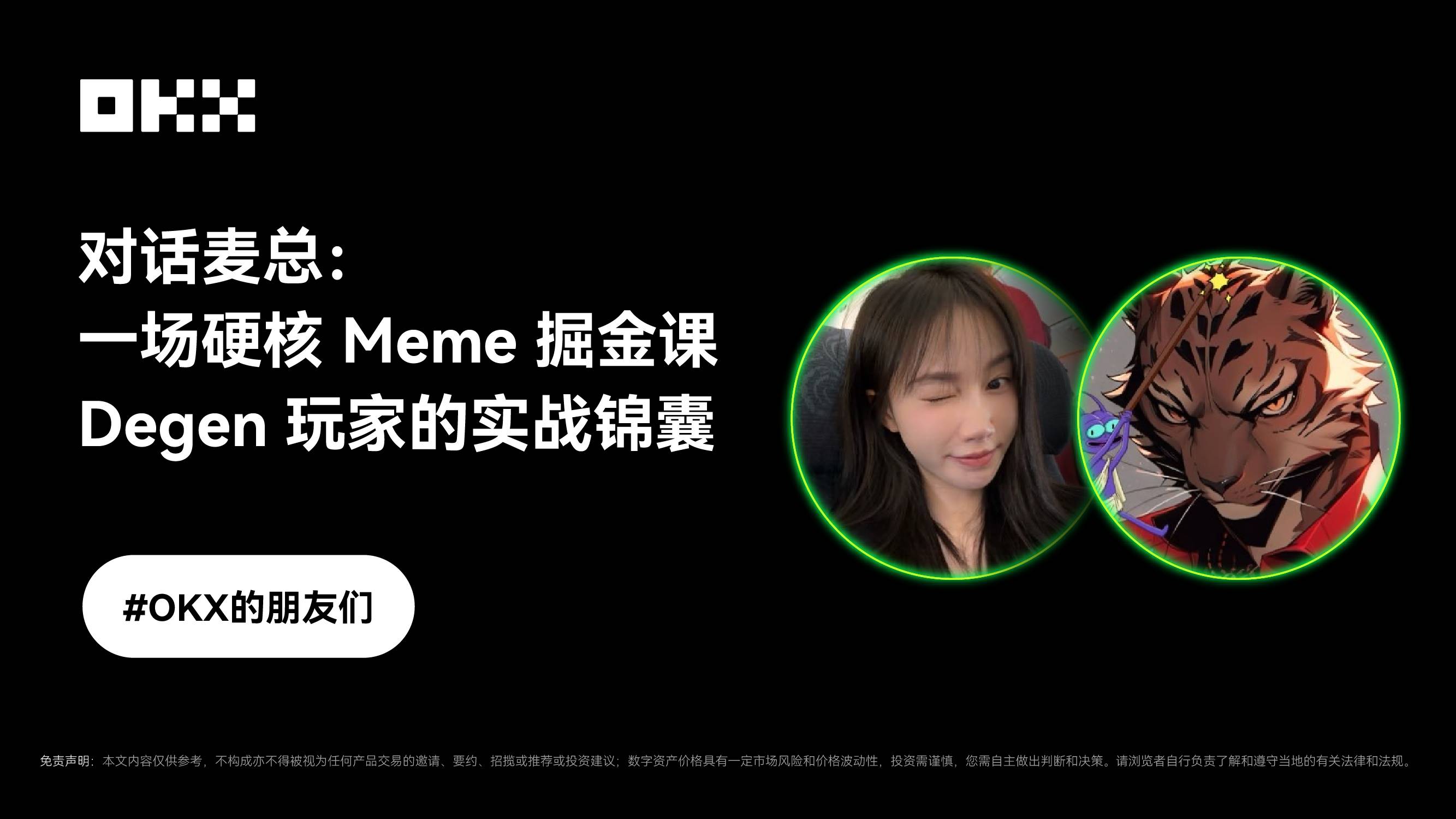
OKX Friends Episode 6|In Conversation with Brother Mai: A Hardcore Meme Gold-Rush Class, a Practical Survival Kit for Degen Players
TechFlow Selected TechFlow Selected
OKX Friends Episode 6|In Conversation with Brother Mai: A Hardcore Meme Gold-Rush Class, a Practical Survival Kit for Degen Players
Every crypto investor must go through this process: seeing mountains as mountains, seeing mountains not as mountains, and finally seeing mountains once again as mountains.
 Navigating Web3 tides with focused insights
Guest Message:
Every crypto investor must go through this process: seeing a mountain as a mountain, then seeing a mountain not as a mountain, and finally seeing a mountain again as a mountain.
In the beginning, you only care about narratives when trading coins. After tracking smart money and whale wallets, you become obsessed with watching whales' moves. But eventually, once you understand the rules of the game, you return to day one—focusing again on narratives, capital flows, and market consensus among investors.
This journey requires personal enlightenment—it’s extremely painful but ultimately leads to clarity. Keep going!
Michael_Liu93 is a seasoned investor who transitioned from traditional finance into Web3. After graduating in 2016, he spent two years working at investment banks in Canada, focusing on M&A. He first encountered blockchain during 2017–2018 and gradually shifted from a traditional VC mindset to cryptocurrency trading. Today, he manages a fund dedicated to Bitcoin's secondary market and has also become a well-known KOL in the Meme coin space. With deep market insights and high-quality content sharing, he gained over 60,000 Twitter followers within just six months.
OKX specially invited him as the inaugural guest of its 2025 “Friends of OKX” series, where he shared his profound reflections on the Meme sector and advice for newcomers. Through dual perspectives—traditional finance and crypto—he presents a more comprehensive view of the market landscape.
The “Friends of OKX” series is a special column curated by OKX, hosted by official community ambassador Mercy (@Mercy_okx), aiming to uncover the career journeys, industry insights, and lessons learned from KOLs across diverse backgrounds, offering valuable references for new users.
The Evolution from Traditional Finance to Web3
Mercy_okx (@Mercy_okx): Could you share your journey entering Web3?
Humble Michael (Michael_Liu93): I entered the financial industry after graduating in 2016, working for two years at Canadian investment banks doing M&A. My first exposure to blockchain was quite accidental. While researching enterprise services, I joined a research call hosted by Credit Suisse’s team, which discussed blockchain technology. I had heard of Bitcoin in college but remained skeptical back then. It wasn’t until 2017–2018, when I learned about Ethereum and blockchain applications in enterprise solutions, that I started getting interested and began investing in early-stage public chain projects. At that time, I still viewed blockchain through a traditional VC lens. Not until 2020–2021 did I fully shift from traditional finance into crypto. Now I mainly operate a fund focused on Bitcoin’s secondary market.
Mercy_okx: What was the logic behind your transition from VC to specializing in Meme coin trading?
Humble Michael: I’ve always been someone chasing emerging opportunities—wherever wealth creation happens, that’s where I go. The current opportunity clearly lies in the secondary market: either hold Bitcoin for beta returns or participate actively on-chain. However, my initial foray into on-chain trading came with an adjustment period. Many people who DM me say they find on-chain trading hard to grasp and lose money immediately upon entry. Honestly, I lost money myself for half a year, constantly being “rekt.” Even if you’re profitable in traditional secondary markets, stepping onto-chain means relearning everything under market pressure. So I suggest accepting this phase as necessary tuition.
My prior VC experience has helped significantly. At their core, both are financial markets—games of human nature. The mechanics of market-making and retail dumping are fundamentally similar.
Deep Insights into the Meme Coin Market
Mercy_okx: How did you start building your personal brand? What do you think was the key factor behind growing your following from thousands to over 60,000 so quickly?
Humble Michael: I’d say I got lucky—I timed several market waves pretty well. Early on, I realized that in the Meme space, personal branding and visibility are crucial. Memes are essentially a game of virality; if you can become a super-spreader or information hub, you gain proximity to other hubs. In any financial market, information asymmetry remains the most valuable asset.
When I first launched my account, I intended to focus on Meme content. Initially, I shared what I knew best—secondary market insights—such as how market makers operate. I analyzed the pump-and-dump tactics behind popular retail plays like Dog and hamster on TON. These posts resonated widely, helping my following grow from hundreds to thousands.
Later, I started sharing experiences specific to Meme trading. Then Solana exploded, and I caught that wave too—not early like some others (e.g., Sister Hui), but still managed solid opportunities like $ai16z, $ban, and later AI-themed tokens. I’m particularly good at identifying where hot money flows because my trading style revolves around following momentum.
Mercy_okx: How do you view the current development trend of the Meme coin market? And what changes have emerged with the rise of AI narratives?
Humble Michael: This on-chain boom is unstoppable—it’s essentially siphoning liquidity from traditional secondary markets. Why is DEX pulling away liquidity? Because there’s a fundamental shift in business models.
Let me explain with an analogy: Previously, the model went like this—I have an idea to build a car, raise funds from VCs, then list it on exchanges to sell to secondary-market users. Retail investors were essentially consumers, exchanging USDT for project tokens. When market liquidity was strong and the product was premium—say, a "Porsche"—buyers might even see appreciation. But when liquidity dries up, too many cars flood the market, and initial pricing is too high, these retail buyers end up trapped—not as investors, but as stuck consumers.
Now the model flips: I have an idea, raise funds directly from the market, then build step-by-step. Retailers get early access—investing even at blueprint stage—and reap rewards once the product launches. This effectively eats into the traditional VC pie. Instead of raising via angel, Series A, B rounds, projects now launch fairly—directly testing whether the product and market fit reflect in price.
The rise of AI has brought transformative change, attracting significant institutional capital. Projects like ai16z and Swarms couldn’t reach their valuations without institutional inflows. Moreover, AI projects introduce real products to the chain. Different investor types enter at different stages: early on, maybe “P-xiaojiang” sees a $500K cap as investable; later, as teams reveal themselves and products materialize, institutions join. Each stage offers clear entry logic—an approach institutions love.
Mercy_okx: Compared to traditional primary and secondary markets, what makes the Meme coin market unique?
Humble Michael: The biggest trait is that “you often end up with zero after buying in.” Meme games are highly diverse. In traditional secondary markets, it’s essentially a solo battle of wits against whales. But Meme coins resemble an MMORPG—everyone brings their own skills.
For example, a “P-xiaojiang” might spend all day scanning charts for insider-edge trades. If you're skilled in on-chain analysis, you might target strong whale-controlled pools early. Or you could become a builder—recently, I advised a friend unfamiliar with AI to talk to Hackathon teams, identify those planning token launches, build relationships early, and possibly secure pre-launch allocations once they’ve raised capital.
The key is discovering your edge. Just like in secondary markets—some trade spot, some use derivatives; among spot traders, some swing-trade, others hold long-term—each person must find their optimal strategy.
Mercy_okx: When evaluating the potential of a Meme coin project, what factors matter most?
Humble Michael: The rise of AI has dramatically changed how we assess Meme coins. In earlier Meme eras, project teams and market makers were hidden. Unless you knew developers or primary market makers, it was hard to tell whether a project was a流水盘 (flow pool), 强庄盘 (whale-dominated), or 阴谋盘 (trap). Back then, you could only infer clues from on-chain addresses—like checking how high previous projects by the same team went.
With AI, evaluation now resembles VC methodology. Most teams are known entities—you can conduct real due diligence: contact community members, study team backgrounds—all publicly available in their profiles.
When assessing a project, I focus on three aspects:
- Narrative potential: Does the product align with current market trends?
- Team strength: Not just technical expertise in AI, but also operational capabilities in Web3—including control, marketing, and community management;
- Market opportunity: For instance, if an AI framework already hits a $200M valuation, another technically strong team entering the same space signals replication potential.
This mirrors early-stage VC investing. Like ZhenFund, famous for “betting on people,” sometimes the only thing visible early on is the founder. Regardless of entry point, the core is always people—the scale a project reaches depends not only on the product but also on the team’s ability to generate sentiment, manage hype, and deliver consistently. Especially in AI, we need teams who understand both product and Web3 dynamics—those projects stand the best chance of success.
Mercy_okx: There are now many AI-related sub-sectors: computing power, infrastructure, pure memes, Agent tech frameworks, Launchpad platforms, etc. How do you balance product logic, narrative, and market sentiment when evaluating different types? Are there different criteria per category?
Humble Michael: Let me illustrate using a framework project. These so-called framework projects are akin to layer-1 blockchains, hosting various apps like TradeFi or gaming. Why does the market value $Virtual and $ai16z so highly? Because they’re building foundational layers and receive valuations comparable to L1s.
In the AI application space, besides frameworks, we believe TradeFi + AI holds the most promise, for two reasons:
- Liquidity access point: In crypto, finding where liquidity resides is critical. TradeFi integrates most seamlessly with existing liquidity. If a product captures trading fees, it becomes extremely valuable.
- User interaction frequency: Among crypto users, trading is the most frequent activity. Hence, the highest-engagement AI applications will likely be in TradeFi + AI.
Reality confirms this: projects like Stoic and Berg saw their market caps surge from $2–3M to tens of millions within weeks. Markets replicate proven success patterns.
In contrast, purely conceptual, story-driven, or meme-only projects—except rare exceptions—have low market acceptance. The AI sector has entered version 4.0; simply launching a concept no longer raises funds. The market now demands actual product progress and viable business models.
Projects like $swarms achieve high valuations because they function like chains, capturing all ecosystem transaction flows. That’s also why $Virtual should theoretically command a higher price than $ai16z—it doesn’t just offer a tech stack, but taps directly into real liquidity. In the future, $ai16z may evolve toward liquidity capture too, because in Web3, true moats aren't just technological—they include control over liquidity.
This differs from Web2 AI competition. Web2 AI is more like an arms race—competing on funding size and hardware resources—while in Web3, liquidity becomes a decisive factor.
Mercy_okx: What characterizes Meme ecosystems across different blockchains?
Humble Michael: They differ significantly for both retail and project teams. Take Solana: the pace is incredibly fast. Retailers might wake up to find their holdings gone; project teams might wake up to find their tokens dumped. Maintaining a $5–10M market cap organically on Solana is nearly impossible—it leaves almost no room for error.
BSC has many rug pulls and startups. But if a strong dev team emerges, the upside can be huge. However, due to limited organic traffic, most successful BSC projects rely heavily on self-promotion—usually backed by powerful financiers.
Base stands out for close collaboration between officials and builders, with strong support. For example, Jess (Base ecosystem lead) frequently promotes promising projects. Base also hosts many technical teams building solid products. For retail, Base offers advantages: fewer projects mean less decision fatigue, and focusing on officially endorsed ones increases safety.
Beginner’s Guide to Entry
Mercy_okx: For beginners entering the market, how would you recommend allocating capital and building a sustainable investment system?
Humble Michael: First, never buy VC-tier tokens on the secondary market. If you don’t understand trading, stick to holding Bitcoin. Also allocate appropriately to major assets like Solana and Ethereum. If you want to trade Meme coins, stick to established blue-chip Memes already validated in secondary markets—like Doge or Pepe.
Regarding capital allocation, I advise newcomers to dedicate only 10% of total funds to on-chain activities. For example, with $100,000, risk only $10,000 on-chain—starting with $100–200 per position. Never go all-in. The best approach is to observe first. Only after achieving consistent profits should you gradually increase position sizes.
Until you find a stable profit strategy, avoid chasing insider-edge trades. I've seen many friends aggressively “bottom-fish” in private pools, only to get rekt repeatedly. Start by observing projects in the $5–10M range, testing with 0.05–0.1 ETH each time. Once you notice consistent profitability in Meme trading, then scale up. This isn’t gambling—if treated as such, you’ll lose badly.
Mercy_okx: How should one build effective information channels?
Humble Michael: Most importantly, avoid matrix accounts. Focus instead on a few reputable, trustworthy KOLs in the space. Pay particular attention to a KOL’s *first* call—not subsequent ones—because markets move fast, and later calls often miss the optimal risk-reward window.
Also, build a small circle of trusted peers with complementary skills. In this market, teamwork often beats going solo. Everyone brings unique strengths—combining them helps you go further.
Suggestions and Outlook for OKX
Mercy_okx: What’s your overall impression of OKX?
Humble Michael: The OKX team is highly forward-thinking and deeply engaged with the community. Product teams and KOL operations staff are all very market-savvy. Their tools and wallet offerings are excellent—offering free services from day one shows great strategic vision. They adapted swiftly to this on-chain market shift and appear to have one of the longest-term views among exchanges. I can’t comment on issue response speed since I haven’t encountered problems. Overall, OKX demonstrates a serious commitment to user service.
This article is for reference only. The views expressed herein are solely those of the author and do not represent the position of OKX. This article is not intended to provide (i) investment advice or recommendations; (ii) an offer or solicitation to buy, sell, or hold digital assets; or (iii) financial, accounting, legal, or tax advice. We make no guarantees regarding the accuracy, completeness, or usefulness of the information provided. Holding digital assets (including stablecoins and NFTs) involves high risk and may experience significant volatility. You should carefully consider whether trading or holding digital assets is suitable for your financial situation. Please consult your legal/tax/investment professionals for your specific circumstances. You are solely responsible for understanding and complying with applicable local laws and regulations.
Join TechFlow official community to stay tuned
Telegram:https://t.me/TechFlowDaily
X (Twitter):https://x.com/TechFlowPost
X (Twitter) EN:https://x.com/BlockFlow_News
 OKX
OKX