AI Sector Last Week Summary: ElizaOS Whitepaper Released, Virtuals Launches $40 Million Token Buyback Program
TechFlow Selected TechFlow Selected
AI Sector Last Week Summary: ElizaOS Whitepaper Released, Virtuals Launches $40 Million Token Buyback Program
Decentralization plays a crucial role in the AI field, preventing monopolies and abuse.
 Navigating Web3 tides with focused insights
Author: Teng Yan - Championing Crypto AI
Translation: TechFlow

Most AI practitioners view crypto AI agents as little more than tokenized Twitter bots. Even aixbt, the poster child of the agent space with an $800 million market cap, is just a better-packaged alpha-hunting bot (where "alpha" refers to excess returns in finance).
@naval: "The intersection of crypto and AI seems to be projects shilling their own tokens."

But Naval's perspective is clearly limited to the current state of affairs. He underestimates future possibilities. Decentralization plays a crucial role in AI by preventing monopolies and abuse.
Isn't this exactly why we entered this space in the first place?
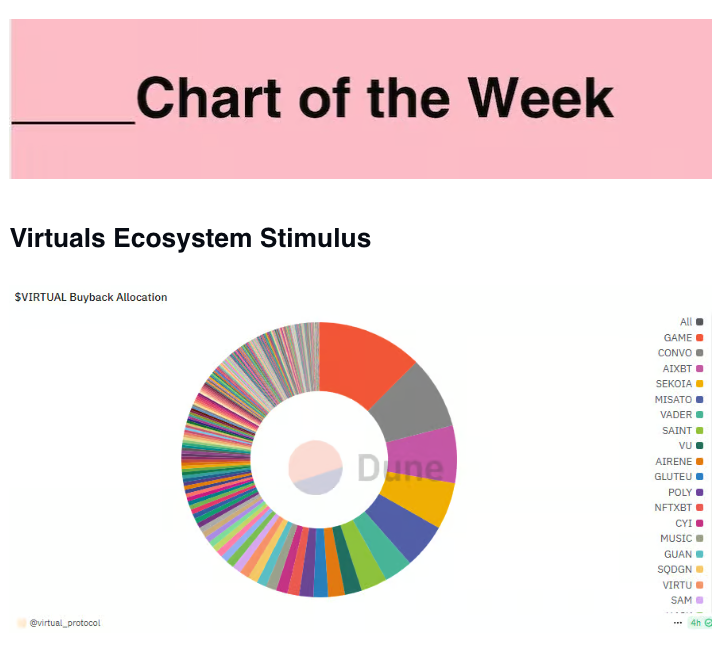
Last week, @virtuals_io announced a major ecosystem update—launching a **$40 million token buyback program** funded by its bond trading revenue.
Since October 2024, Virtual has accumulated 12,990,427.85 VIRTUAL tokens, which will now be used to repurchase and burn top agent tokens within its ecosystem.
The buyback allocation is based on each token’s trading activity, prioritizing projects that contribute most significantly to Virtual’s ecosystem trading volume.
Here are the allocations for the top five tokens:
-
GAME: ~1.6 million VIRTUAL (~$5.6 million)
-
CONVO: ~1.1 million VIRTUAL (~$3.8 million)
-
AIXBT: ~881,000 VIRTUAL (~$3 million)
-
SEKOIA: ~712,000 VIRTUAL (~$2.5 million)
-
MISATO: ~690,000 VIRTUAL (~$2.4 million)
Since the announcement of the buyback program, prices of these previously low-liquidity tokens have surged significantly.
Skynet: Toward Truly Autonomous AI Agents
@SpheronFDN recently unveiled Skynet, a new framework aiming to revolutionize AI agent autonomy in Web3. Already known for its decentralized GPU network, Spheron may now provide the key infrastructure enabling true agent self-governance through Skynet.
Despite rapid growth in the Web3 AI agent space (now valued at $1.5 billion), these systems are not truly autonomous. They still rely on centralized control points such as cloud computing infrastructure requiring KYC, compute resources constrained by APIs, and private keys held by creators.
Skynet introduces a novel mechanism—Guardian Nodes. These nodes act like decentralized “boards of directors,” collectively managing each agent’s resources via smart contracts, without relying on expensive trusted execution environments (TEEs).
Even more excitingly, Skynet-powered agents can “evolve” and “reproduce.” Through its three-reserve system (operational reserve, reproduction reserve, fair launch reserve), agents can spawn offspring that inherit traits from their “parents,” with each generation potentially becoming more complex and intelligent than the last.
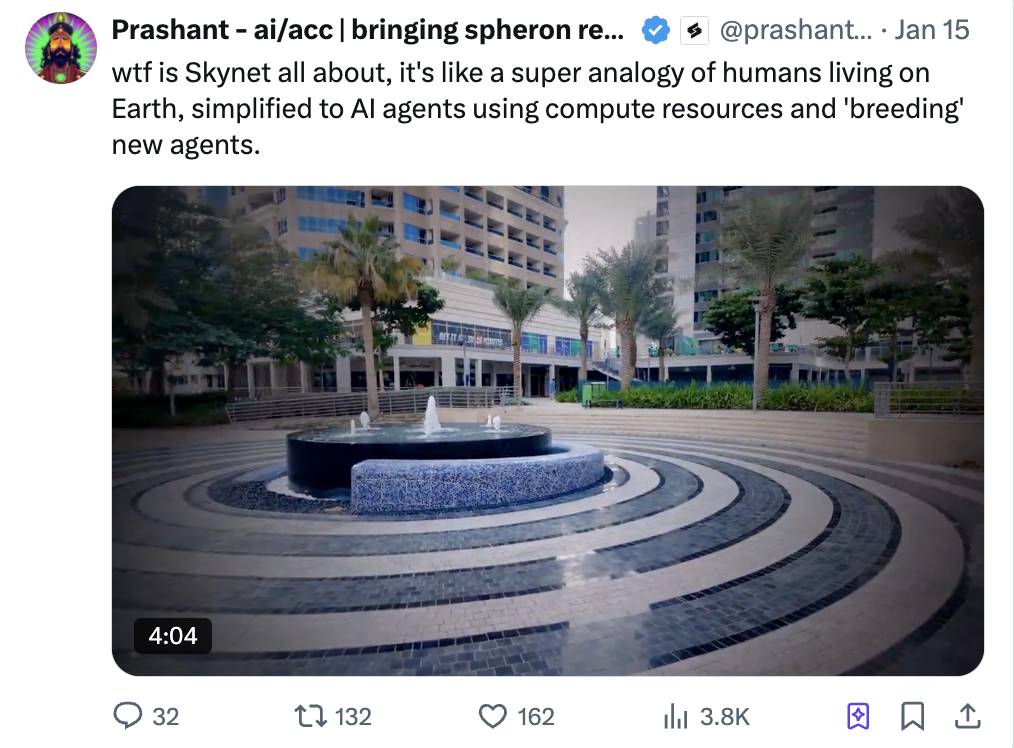
Skynet could pave the way for genuinely autonomous AI agents capable of:
-
Independently acquiring compute resources
-
Self-managing funds and assets
-
Making decisions without human intervention
-
Even creating more advanced next-generation agents
This framework not only showcases AI’s potential in decentralized environments but also provides foundational infrastructure for achieving real agent autonomy.
Skynet is expected to officially launch later this month, with its token paired alongside the Spheron Token. This project deserves close attention!
Notable Project Updates
-
@ai16zdao released the whitepaper for ElizaOS, developed in collaboration with industry leaders including MIT CSAIL, GoPlusSecurity, and AIME Protocol. The whitepaper details ElizaOS’s technical architecture and compares it against popular agent frameworks like LangGraph and AutoGPT, highlighting its unique advantages.
-
Virtual Protocol introduced a new value accrual mechanism redistributing late-bound taxes:
- 30% allocated to agent creators, incentivizing further innovation;
- 20% allocated to exchanges via a new “Agent Affiliates Program” to support ecosystem growth;
- 50% allocated to agent sub-DAOs for community governance decisions. This mechanism aims to better align incentives among creators, platforms, and the broader Virtual ecosystem, enhancing overall synergy.
-
G.A.M.E launched a new advanced SDK, offering developers greater customization capabilities. This upgrade empowers builders to create more sophisticated and flexible agents within its popular framework—an important step toward next-generation agent development.
-
@Spectral_Labs teased a revolutionary new development—a multi-agent framework allowing agents to autonomously hire, onboard, monitor, and even fire other agents based on need. This capability could transform how autonomous agent networks self-organize, unlocking new possibilities for decentralized agent ecosystems.
-
@derivexyz launched Derive Pro, a DeFAI (Decentralized Finance + AI) trading platform built with assistance from Messari. Powered by large language models (LLMs), Derive Pro equips traders with research, execution, and portfolio management tools. Whether on desktop or mobile, Derive Pro aims to turn ordinary traders into “super traders.”
-
@Mira_Network rolled out the Voyager testnet to its 400,000+ active users. The testnet enables unified access to multiple top-tier LLMs including GPT-4o, Llama 3.1 405B, and Claude 3.5 Sonnet, along with distributed content verification. This marks a significant milestone for Mira in merging AI with decentralized technology.
-
@driaforall partnered with Hugging Face to release Dria-Agent-α, a 3-billion-parameter LLM optimized for Python function calling. Despite its compact size, it matches GPT-4o performance on the BFCL benchmark and supports parallel multi-function calls. Trained on synthetic data generated across 2,000 edge devices, Dria-Agent-α offers developers an efficient and flexible tool.
-
@BrahmaFi launched ConsoleKit, a toolkit bridging AI agents and blockchain execution. By integrating Safe accounts (decentralized smart contract wallets) and modular strategies, ConsoleKit enables developers to easily deploy autonomous agents with secure transaction capabilities, enhancing safety and flexibility for on-chain operations.
-
@UBC4ai established UBC Research, a scientific division focused on machine consciousness and multi-agent systems. UBC Token holders can vote on research directions and gain early access to breakthrough findings, which will further enhance the value of the UBC ecosystem.
-
Dolion, developed by @khouuba, will officially launch on January 28th, offering a no-code, one-click platform for deploying AI agents. Notably, a portion of Dolion’s revenue will go toward burning $BULLY tokens, adding stronger value backing to its ecosystem.
-
@fleek launched an AI agent hosting service enabling developers to build and deploy agents using the Eliza framework in under 30 seconds—and at lower cost. This service dramatically simplifies deployment, offering developers a fast and efficient solution.
-
@labs_compass released the Compass API—a developer- and agent-focused tool enabling instant execution of DeFi transactions. Initially supporting Aave and Uniswap on Ethereum and Arbitrum, Compass API promises more efficient DeFi trade execution.
Join TechFlow official community to stay tuned
Telegram:https://t.me/TechFlowDaily
X (Twitter):https://x.com/TechFlowPost
X (Twitter) EN:https://x.com/BlockFlow_News
 @0xPrismatic