AI Agent: 2024 Status and 2025 Outlook
TechFlow Selected TechFlow Selected
AI Agent: 2024 Status and 2025 Outlook
The rise of AI Agents in blockchain is the product of the continuous convergence and development of blockchain technology and AI.
 Navigating Web3 tides with focused insights
Author: BitMart Research
1. Background
What is an AI Agent?
An AI Agent is an intelligent entity capable of perceiving its environment, making decisions, and executing actions, primarily based on LLM (Large Language Models). It possesses autonomy and adaptability, enabling it to independently complete complex tasks and demonstrate highly intelligent collaborative capabilities. Unlike traditional large models that require explicit instructions for interaction, AI Agents can receive goal-oriented commands, autonomously decompose tasks, plan action steps, and invoke tools during execution to accomplish objectives. The core advantage lies in their ability to think and act independently. Compared to early voice assistants like Siri or Microsoft's Copilot, AI Agents are more akin to a preliminary "main driver," continuously improving task efficiency and accuracy through autonomous learning, feedback adjustment, and long-term optimization.
The working principle of AI Agents can be summarized into four core capabilities: perception, analysis, decision-making, and execution. First, the AI Agent perceives the environment via sensors or data interfaces to gather external information. Then, using analytical tools such as large language models, it extracts valuable features and patterns. Based on the analysis, the agent formulates a rational action plan and finally translates decisions into concrete actions to achieve the target objective. Throughout this process, short-term and long-term memory modules provide information storage and recall functions, enhancing the agent’s ability to handle complex tasks. Additionally, AI Agents dynamically call external tools (e.g., calendars, search engines, APIs) according to task requirements, overcoming limitations faced by traditional large models due to static training data and lack of tool integration, significantly expanding model capability.
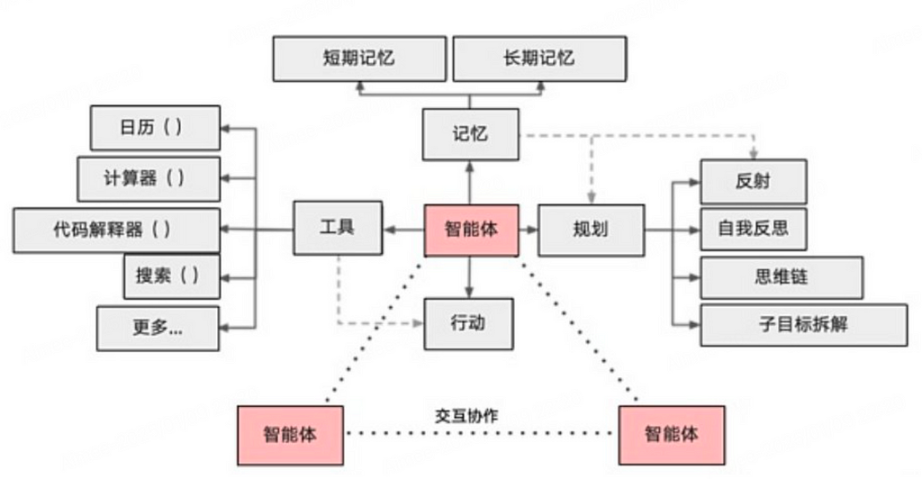
Image source: Lilian Weng, former Chief Safety Researcher at OpenAI, “LLM Powered Autonomous Agents”
Overview of AI Agent Development in Web2
In 2025, the AI Agent industry is at a critical stage of accelerated development. From an industrial chain perspective, upstream players include computing power and hardware providers, data suppliers, and algorithm and large model developers led by tech giants such as NVIDIA; midstream focuses on AI Agent integration and platform services; downstream centers around vertical industry applications and the development and promotion of general-purpose intelligent agents, gradually showing diverse developmental trends. In terms of applications, both consumer (C-end) and enterprise (B-end) markets exhibit significant potential: C-end applications focus on enhancing user experience with more convenient interaction methods, while B-end aims to drive enterprise digital transformation by reducing costs and increasing efficiency to empower business decision-making and operations.
Leading companies in the sector have already begun intense competition in deploying practical AI Agent applications. Google launched Gemini 2.0 and introduced three AI Agent products: Project Astra (general-purpose), Project Mariner (browser automation), and Jules (programming). OpenAI’s Sam Altman stated that 2025 will be the year AI Agents go mainstream, announcing upcoming innovations including AGI, upgraded GPT-4o, and personalized functionalities. NVIDIA CEO Jensen Huang predicted that AI Agents could become the next robotics industry, creating trillions of dollars in market value.
Concept of AI Agents in Blockchain
The rise of AI Agents in blockchain results from the continuous convergence of blockchain technology and artificial intelligence. As a decentralized infrastructure, blockchain provides credible data recording and transparent behavior verification mechanisms for AI Agent operations. Meanwhile, advancements in AI enable agents to perform complex judgments and executions, allowing them to autonomously carry out various economic activities—effectively forming a self-operating virtual economy. Within this framework, AI Agents not only participate in existing blockchain ecosystems but also drive innovation across new scenarios, such as automatically conducting market analysis, planning, and executing tasks via smart contracts in DeFi, or acting as "residents" in virtual worlds to create and manage digital assets.
Moreover, AI Agents directly enhance user experience and productivity within blockchain, especially in handling complex on-chain operations. One of the biggest barriers to blockchain adoption today is operational complexity and high entry thresholds. The natural language interface offered by AI Agents enables users to perform wallet management, select optimal DeFi investment strategies, conduct cross-chain transactions, or automatically execute plans based on market conditions—all through simple commands—greatly lowering the learning curve for new users while significantly improving efficiency and convenience.
The potential of AI Agents in the blockchain ecosystem extends beyond optimizing user operations to broader application scenarios. Creator economies, market sentiment monitoring, smart contract auditing, decentralized autonomous organization (DAO) governance voting, and even MEME coin launches can all achieve higher efficiency and fairness through AI Agents. Their emotion-free, precise execution makes them more reliable than most humans under predefined conditions. Furthermore, blockchain’s immutability provides AI with trustworthy data sources, mitigating risks associated with poor-quality data in AI systems. Going further, by leveraging on-chain data and computing resources, AI Agents may disrupt existing incentive models and drive deep transformations within the blockchain ecosystem.
2. Applications of AI Agents in Blockchain
1. AI Agent Frameworks
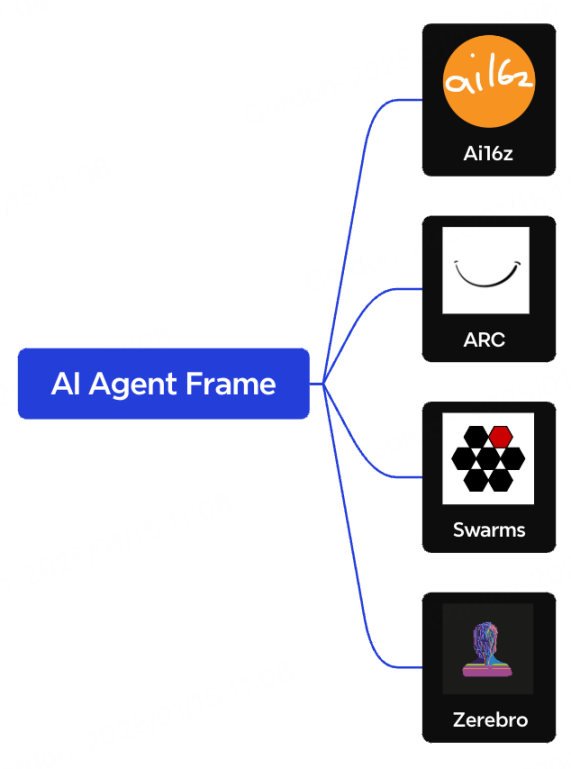
AI Agent frameworks serve as foundational tools for developing, training, and deploying intelligent agents, providing technical support for efficient agent construction. These frameworks reduce development complexity through standardized environments and reusable components, allowing developers to focus on implementing innovative features. Currently, AI Agent frameworks are progressively integrating DeFi protocols, NFT projects, and other elements, exploring cross-platform collaboration and interoperability. For example, by combining with DeFi to optimize investment strategies or developing intelligent tools for NFTs, these frameworks are building more open and interconnected ecosystems, becoming focal points of market attention. Representative projects: Ai16z, ARC, Swarms, Zerebro, etc.
2. AI Agent Launchpad
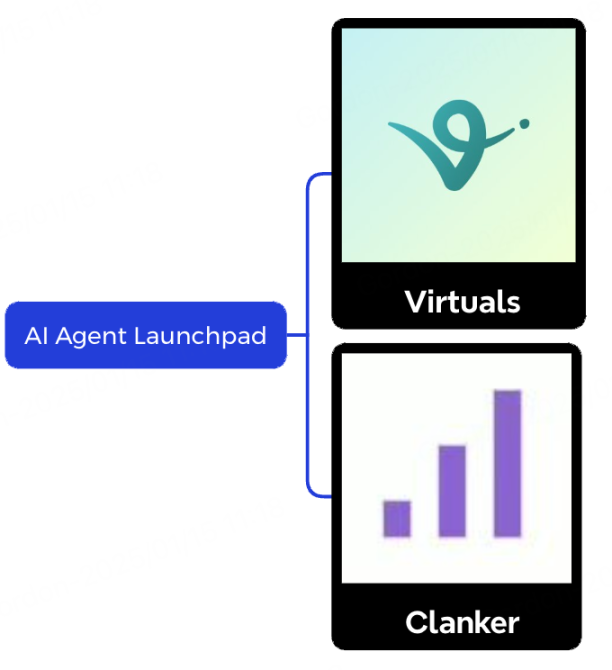
An AI Agent Launchpad is a platform for launching AI Agents and their associated tokens, functioning similarly to Meme coin launch platforms such as Pump.fun. Users can easily create and deploy AI Agents on these platforms, seamlessly integrating them with social media platforms like Twitter, Telegram, and Discord to enable automated user interactions. This model lowers the barriers to issuance and promotion, offering users a more accessible creation experience and expanding the application scope of AI Agents. Representative projects: Virtuals, Clanker, etc.
3. Application Scenarios of AI Agents
Direct application areas of AI Agents span investment, entertainment, data analytics, and more, demonstrating substantial growth potential.
-
Fund Management
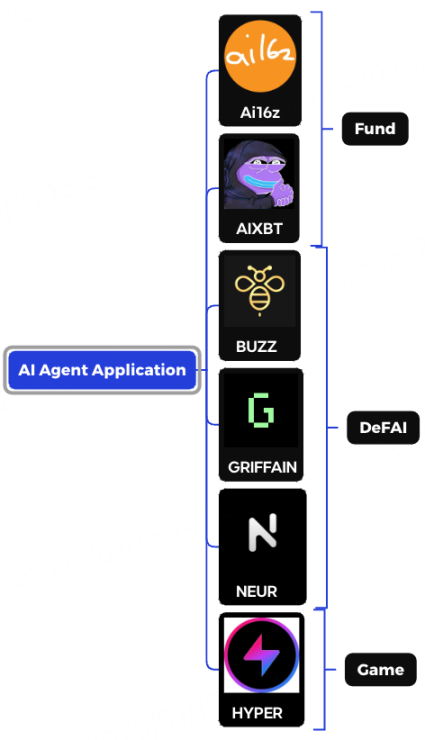
In fund management, AI Agents have evolved from auxiliary tools to core value creators, capable of formulating investment strategies, adjusting asset allocations, and forecasting market trends in real time. Through automated operations, these agents improve the efficiency of arbitrage and risk hedging, meeting the demands for scale and specialization in crypto markets and injecting new competitiveness into capital management. Representative projects: AIXBT, Ai16z, etc.
-
DeFAI: Integration of AI and DeFi
DeFAI simplifies operational processes and lowers entry barriers by introducing AI technologies into DeFi. Users can issue simple natural language commands such as “one-click cross-chain transaction” or “set up a recurring investment plan,” enabling more efficient asset management and trading operations. Key DeFAI applications include optimized cross-chain operations, autonomous trading agents, and intelligent information analysis, already implemented across multiple platforms such as Griffain, Orbit, and Neur. Representative projects: GRIFFAIN, BUZZ, NEUR, etc.
-
DAO Automation Management
Applications of AI Agents in DAOs include optimizing voting decisions and automating governance. For instance, Ai16Z DAO utilizes agents for fundraising and investment management, showcasing the potential of AI in decentralized autonomy. Such applications not only enhance governance efficiency but also substantially reduce members’ time and effort.
-
Gaming
AI Agents can also be applied in game design. By simulating player behaviors, they assist developers in refining game mechanics to increase fun and playability. Additionally, AI Agents can function as gaming assistants, helping players improve performance. For example, an AI Agent can analyze a player’s habits and offer targeted advice and guidance to enhance gaming skills. Representative project: HYPER, etc.
-
Automated Quantitative Trading
In quantitative trading, AI Agents can develop diversified strategies based on market conditions—for example, executing arbitrage trades in high-volatility markets or adopting trend-following strategies in trending markets. With growing exchange support for automated trading tools, the future potential of AI Agents in trading is vast.
4. AI MEME Projects
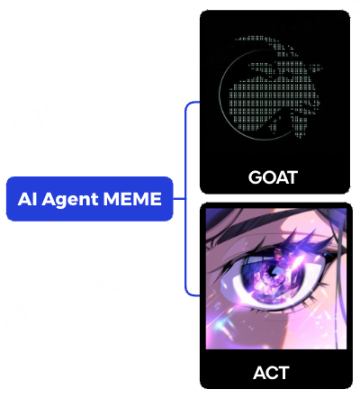
AI MEME refers to meme coin projects derived from the AI Agent concept, typically lacking strong technological foundations or tangible products. Leveraging meme culture, these projects attract attention through high volatility and speculative appeal. Despite limited technical substance, market enthusiasm and community sentiment often fuel explosive short-term growth, making them a unique phenomenon in the cryptocurrency space. Representative projects: GOAT, ACT, etc.
3. Future Trends
In 2025, the development of AI Agents in crypto and Web3 is expected to reach a pivotal breakthrough point. Shifting from standalone tool-like applications toward multi-agent collaborative ecosystems, the boundaries of AI Agent technology continue to expand. In DeFi, AI Agents have already achieved capabilities in fund management and smart contract execution, with future prospects of evolving into intelligent entities possessing autonomous economic agency, participating in more sophisticated economic activities and achieving financial self-governance. In DAOs, AI Agents can optimize governance efficiency and decision-making workflows, while in quantitative trading, they can execute efficient arbitrage and risk management strategies through real-time data analysis. As frameworks and standards mature, collaboration among AI Agents will give rise to entirely new application scenarios—such as Agent social networks, economic settlement gateways, and governance DAOs—driving the crypto ecosystem toward a new era of intelligence and efficiency. At the same time, the development of AI Agents in Web3 faces both challenges and opportunities. Privacy and security remain key concerns, especially given AI’s growing reliance on personal data. Web3 offers unique advantages in safeguarding data privacy and security via blockchain, enabling AI Agents to find broader applications in high-privacy-demand sectors such as healthcare and finance. Moreover, computational power and data costs present bottlenecks for multi-agent collaboration, yet through blockchain and token economics, idle computing resources and data assets can be effectively aggregated, lowering development and operational barriers. Looking ahead, AI Agents have the potential to become a new type of infrastructure in Web3, deeply integrating with other core components, creating novel application paradigms, and evolving from mere tools into indispensable pillars of the ecosystem—injecting greater innovation and value into the cryptocurrency industry.
Join TechFlow official community to stay tuned
Telegram:https://t.me/TechFlowDaily
X (Twitter):https://x.com/TechFlowPost
X (Twitter) EN:https://x.com/BlockFlow_News
 @BitMart_zh