








Can DeFAI, the deep integration of DeFi and AI, give rise to a new wave of AI Agents?
TechFlow Selected TechFlow Selected
Can DeFAI, the deep integration of DeFi and AI, give rise to a new wave of AI Agents?
The emergence of DeFAI is no accident—blockchain's core characteristics are inherently suited to strong financial use cases. Currently, both GameFAI (moving left) and DeFAI (moving right) have demonstrated comparable market potential.
 Navigating Web3 tides with focused insights
Author: YBB Capital Researcher Ac-Core
1. What Story Does DeFAI Tell?
1.1 What Is DeFAI?
Simply put, DeFAI stands for AI + DeFi. The market has cycled through wave after wave of AI hype—from AI computing power to AI memes, from various technical architectures to different infrastructure layers. Although the overall market cap of AI agents has recently seen a decline, the concept of DeFAI is emerging as a new breakthrough trend. Currently, DeFAI can be broadly categorized into three types: AI abstraction, autonomous DeFi agents, and market analysis & prediction. The specific classifications within these categories are illustrated in the figure below.
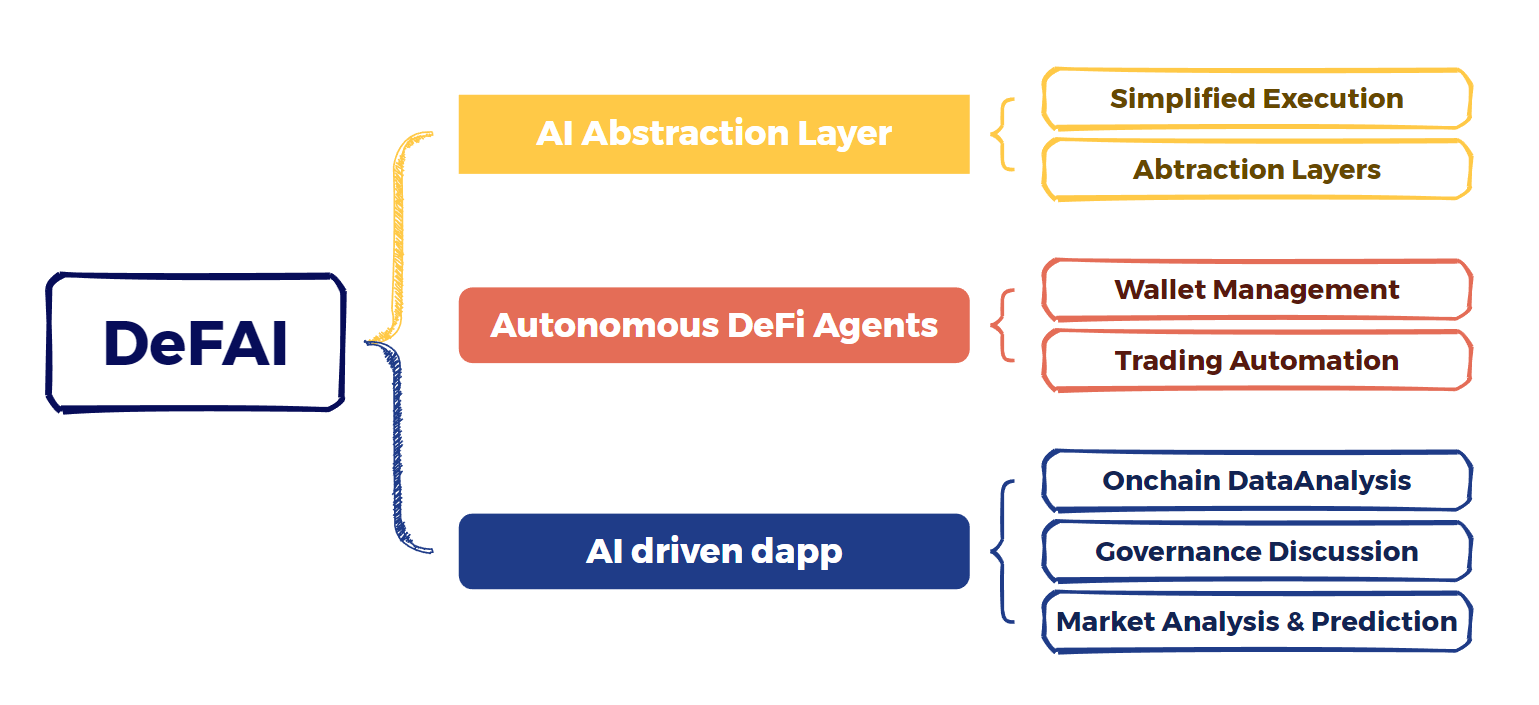
Image source: self-made by author
1.2 How Does DeFAI Work?
At the heart of the DeFi system, AI Agents rely on LLMs (Large Language Models), with operations involving multi-layered processes and technologies covering everything from data collection to decision execution. According to research by @3sigma from IOSG, most models follow six specific workflows: data collection, model inference, decision-making, hosting and operation, interoperability, and wallet management. Below is a summary:
1. Data Collection: The primary task of an AI Agent is to gain comprehensive understanding of its operating environment. This includes acquiring real-time data from multiple sources:
● On-chain data: Real-time blockchain data such as transaction records, smart contract states, and network activity are obtained via indexers, oracles, etc., helping the agent stay synchronized with market dynamics;
● Off-chain data: Price information, market news, and macroeconomic indicators are retrieved from external providers like CoinMarketCap and Coingecko. These data are typically delivered to the agent via API interfaces, ensuring the agent understands external market conditions;
● Decentralized data sources: Some agents may obtain price oracle data through decentralized data feed protocols, ensuring data decentralization and trustworthiness.
2. Model Inference: After data collection, the AI Agent enters the inference and computation phase. Here, the agent relies on multiple AI models for complex reasoning and forecasting:
● Supervised and unsupervised learning: By training on labeled or unlabeled datasets, AI models can analyze behaviors in markets and governance forums. For example, they might predict future market trends based on historical trading data, or infer outcomes of voting proposals by analyzing governance forum discussions;
● Reinforcement learning: Through trial-and-error and feedback mechanisms, AI models autonomously optimize strategies. For instance, in token trading, AI agents can simulate various trading strategies to determine optimal buy/sell timing. This method enables continuous improvement under dynamic market conditions;
● Natural Language Processing (NLP): By understanding and processing natural language inputs from users, agents extract key information from governance proposals or market discussions, aiding user decision-making—especially crucial when scanning decentralized governance forums or interpreting user commands.
3. Decision-Making: Based on collected data and inference results, the AI Agent proceeds to the decision-making stage. At this point, it must not only analyze current market conditions but also balance multiple variables:
● Optimization engine: Agents use optimization engines to find optimal execution strategies under varying conditions. For example, when providing liquidity or executing arbitrage strategies, agents must consider slippage, transaction fees, network latency, capital size, and other factors to identify the best execution path;
● Multi-agent system collaboration: To handle complex market scenarios, a single agent may not fully optimize all decisions. In such cases, multiple AI agents can be deployed, each focusing on distinct tasks, collaborating to enhance overall system efficiency. For example, one agent focuses on market analysis while another handles trade execution.
4. Hosting and Operation: Since AI Agents require significant computational resources, their models are typically hosted on off-chain servers or distributed computing networks:
● Centralized hosting: Some AI Agents may rely on centralized cloud services like AWS for computational and storage needs. This ensures efficient model performance but introduces potential centralization risks;
● Decentralized hosting: To reduce centralization risks, some agents utilize decentralized computing networks (e.g., Akash) and distributed storage solutions (e.g., Arweave) to host models and data. Such setups ensure decentralized operation and persistent data storage;
● On-chain interaction: While models run off-chain, AI Agents must interact with on-chain protocols to execute smart contract functions (e.g., trade execution, liquidity management) and manage assets. This requires secure key management and transaction signing mechanisms, such as MPC (Multi-Party Computation) wallets or smart contract wallets.
5. Interoperability: A key role of AI Agents in the DeFi ecosystem is seamless interaction with multiple DeFi protocols and platforms:
● API integration: Agents connect with decentralized exchanges, liquidity pools, and lending protocols via API bridges to exchange data and perform operations. This allows real-time access to critical information such as market prices, counterparties, and lending rates for informed trading decisions;
● Decentralized message passing: To maintain synchronization with on-chain protocols, agents can receive updates via decentralized messaging protocols (e.g., IPFS or Webhook). This enables real-time processing of external events—such as governance vote outcomes or changes in liquidity pools—and timely strategy adjustments.
6. Wallet Management: AI Agents must execute actual operations on blockchains, which depends entirely on their wallet and key management systems:
● MPC Wallets: Multi-Party Computation wallets split private keys among multiple participants, enabling secure transactions without single-point-of-failure risks. For example, Coinbase Replit’s wallet demonstrates how MPC enables secure key management, allowing users to retain partial control while delegating certain autonomous operations to AI Agents;
● TEE (Trusted Execution Environment): Another common approach uses TEE technology, storing private keys in protected hardware enclaves. This allows AI Agents to conduct trades and make decisions fully autonomously without third-party intervention. However, TEE currently faces challenges related to hardware centralization and performance overhead. Once resolved, fully autonomous AI systems could become feasible.
1.3 Sect Origins? From Intent to DeFAI
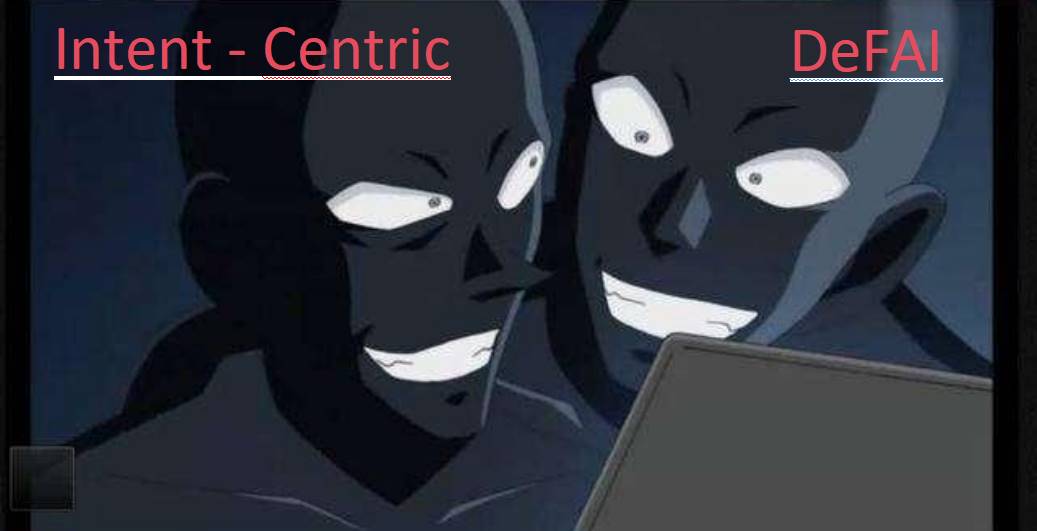
Image source: self-made by author
If the vision of DeFAI is to enable users to autonomously manage portfolios through AI agents and platforms, making participation in crypto market trading accessible to everyone, does this naturally remind us of the concept of "intent"?
Recall the "intent" concept first introduced by Paradigm. In traditional trading, we must specify clear execution paths—for example, swapping Token A for Token B on Uniswap. But in intent-driven scenarios, the execution path is matched and finalized by solvers and AI together. In other words: Trade = I define how TX executes; Intent = I only care about the outcome, not the process. Looking back, the DeFAI narrative not only aligns closely with the ultimate idea of AI agents but also perfectly converges with the vision of realizing intent. Overall, DeFAI appears more like a newly added pathway toward intent fulfillment.
In the ultimate version of large-scale blockchain adoption, will the future be defined by: AI Agent + Solver + Intent-Centric + DeFAI = Future?
2. DeFAI-Related Projects
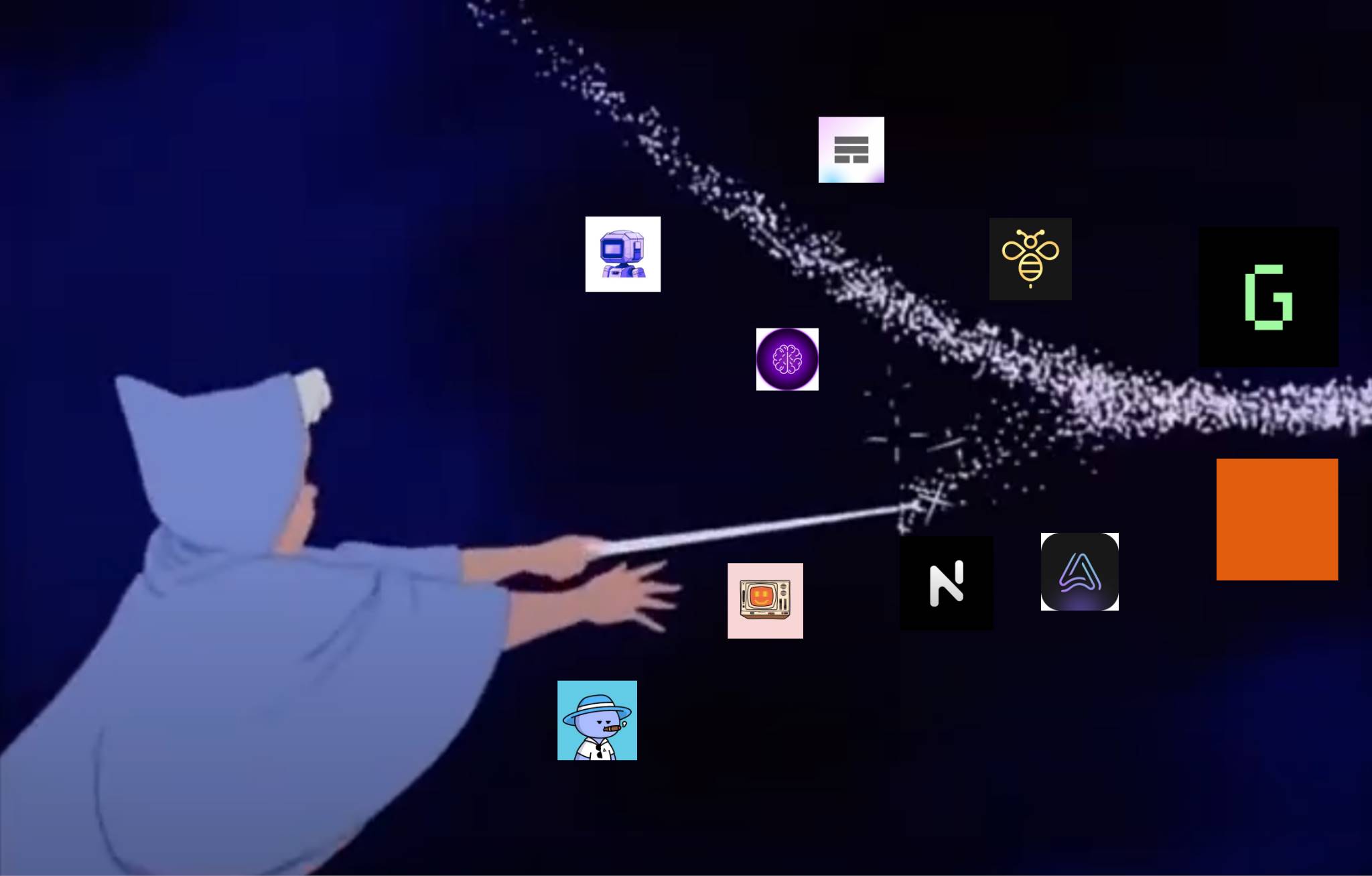
Image source: self-made by author
2.1 Griffain
@griffaindotcom $GRIFFAIN: An innovative platform combining AI agents and blockchain that helps users issue AI agents, with a focus on building a powerful and scalable decentralized finance (DeFi) solution supporting seamless token swaps, liquidity provision, and ecosystem growth. It simplifies wallet, trading, and NFT management, and automatically executes tasks such as memecoin launches and airdrops.
2.2 Hey Anon
@HeyAnonai $ANON: An AI-powered DeFi protocol that simplifies interactions, aggregates real-time project data, performs complex operations via natural language processing, and provides a convenient DeFi abstraction layer. DWF Labs announced support for the DeFAI project Hey Anon through its AI Agent Fund, with the project launching on Moonshot on January 14.
2.3 Orbit
@orbitcryptoai $GRIFT: Simplifies complex DeFi interfaces and operations, lowering the barrier to entry for average users. It currently supports over 100 blockchains (including EVM and Solana) and more than 200 protocols. The GRIFT token powers platform activity.
2.4 Neur
@neur_sh $NEUR: An open-source full-stack application integrating LLM models and blockchain technology, designed specifically for the Solana ecosystem and using the Solana Agent Kit for seamless protocol interaction.
2.5 Modenetwork
@modenetwork $MODE: Positions itself as the central hub for AI x DeFi innovation on Ethereum Layer 2. Holders can stake MODE to receive veMODE and benefit from AI agent airdrops, aiming to become the DeFAI stack.
2.6 The Hive
@askthehive_ai $BUZZ: Built on Solana, integrates multiple models including OpenAI, Anthropic, XAI, and Gemini to perform complex DeFi operations such as trading, staking, and lending.
2.7 Bankr
@bankrbot $BNKR: An AI-powered cryptocurrency companion that allows users to easily buy, sell, swap, place limit orders, and manage wallets with just a single message. Plans to add token swapping and on-chain tracking features soon, with a vision to democratize DeFi access and automate trading.
2.8 HotKeySwap
@HotKeySwap $HOTKEY: Offers a complete suite of DeFi tools powered by AI, including a DEX aggregator, analytics tools, and cross-chain trading capabilities, supporting both cross-chain transactions and analysis.
2.9 Gekko AI
@Gekko_Agent $GEKKO: An AI agent created by the Virtuals Protocol focused on delivering comprehensive automated trading solutions, specifically tailored for prediction markets. Gekko's automated trading strategies include auto-rebalancing, yield harvesting, and creating new token index functionalities.
2.10 ASYM
@ASYM41b07 $ASYM: Provides an AI-powered DEX aggregator and analytics tool that identifies high-return investment opportunities, with profits settled in $ASYM.
2.11 Wayfinder Foundation
@AIWayfinder $Wayfinder: A cross-chain interactive AI tool launched by the card game metaverse Parallel, designed to help agents navigate on-chain environments, execute transactions, and interact with decentralized applications.
2.12 Slate
@slate_ceo $Slate: A universal AI agent and connectivity infrastructure layer that translates natural language commands into on-chain actions, focusing on executing automated trading strategies—buying or selling under specific conditions—to make on-chain operations as intuitive as thinking.
2.13 Cod3x
@Cod3xOrg $Cod3x: A Solana AI hackathon project offering no-code development tools to build agents capable of automating DeFi strategies. Its Agentic Interface is a tool that executes complex operations using intent-based expressions alone.
2.14 Almanak
@Almanak__ $Almanak: An AI agent with self-learning capabilities that autonomously performs tasks, leveraging agent-based modeling to optimize DeFi and gaming projects. Its mission is to maximize protocol profitability using data science and trading expertise while ensuring economic security.
2.15 HIERO
@HieroHQ $HTERM: A multichain intelligent tool operating on Solana and Base networks, enabling users to command agents via natural language to autonomously complete transactions, including buying/selling tokens and performing basic token analysis.
3. What System Will Be the Final Destination for AI Agents?
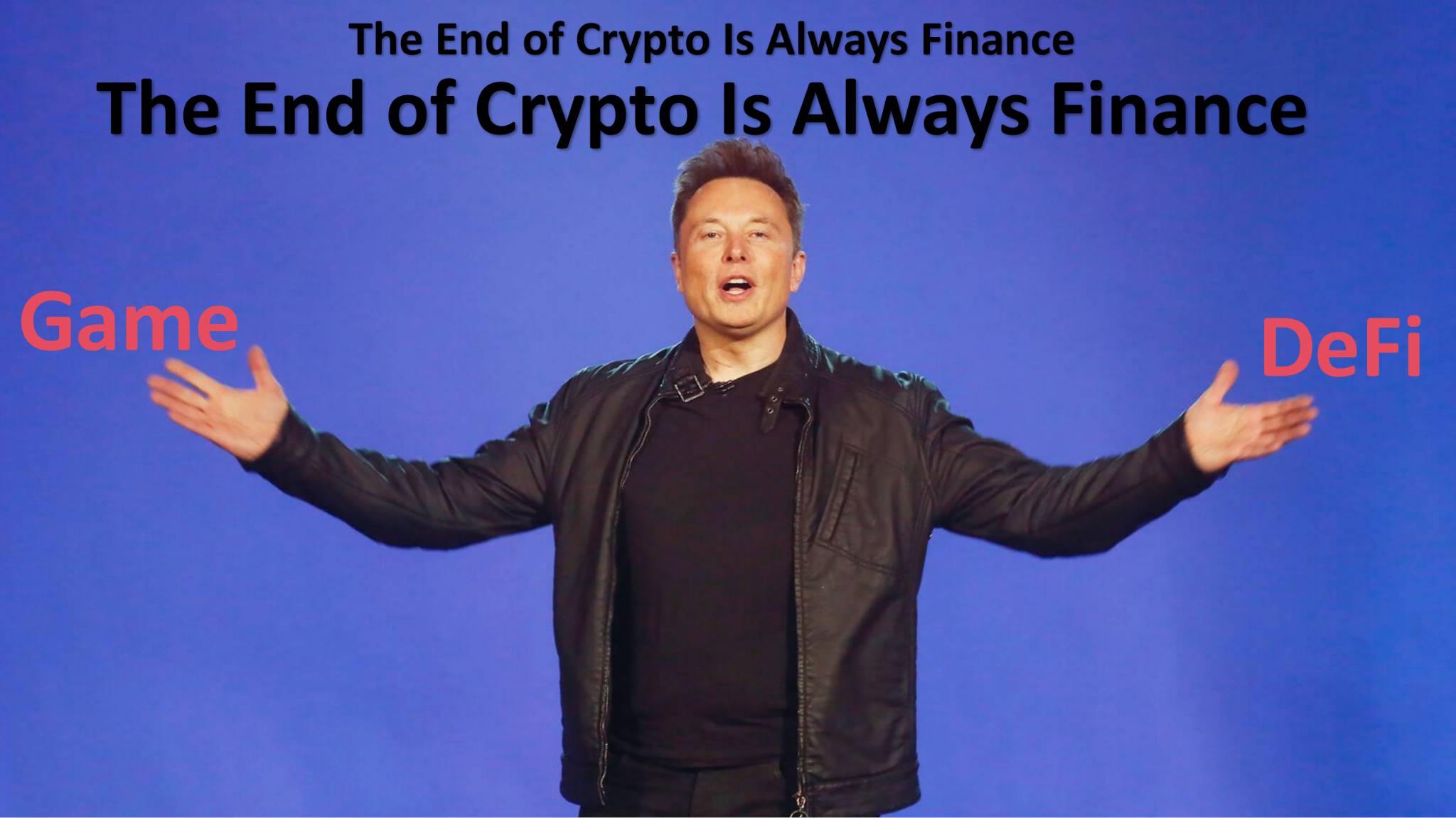
Image source: self-made by author
Time flies—DeFAI projects are sprouting up like mushrooms after rain. After Bitcoin sharply dropped below $90K on January 13, CoinGecko data showed DeFAI-related tokens rose逆势 by 38.73% the next day, with $GRIFT, $BUZZ, and $ANON leading the gains. Yet, the direction of AI agents in finance warrants deeper reflection. At this pivotal juncture, the path forks left toward Game and right toward DeFi.
3.1 Left Toward Game:
M3 (Metaverse Makers _) (@m3org) may be the most promising representative—an organization疑似 linked to ai16z, composed of artists and open-source hacker communities. Key team members include JIN (@dankvr), Reneil (@reneil1337), Saori (@saori_xbt), and Shaw (@shawmakesmagic). However, the biggest practical obstacle for Game lies in the fact that even in the resource-rich Web2 market, no truly breakout AI game has emerged. In January 2024, the highly anticipated *Palworld* sparked controversy over whether AI was used in its development due to its unusually high development efficiency, though the CEO ultimately denied it. Additionally, games inherently require long development cycles. Compared to the DeFi path on the right, AI Game seems to demand significantly more market enthusiasm.
3.2 Right Toward DeFi:
The market caps rank as follows: $GRIFFAIN, $ANON, $OLAS, $GRIFT, $SPEC, $BUZZ, $RSS3, $SNAI, $GATSBY, with GRIFFAIN and ANON together accounting for 37.29% of the total DeFAI market cap.
GRIFFAIN: Built on Solana, currently leads the DeFAI market cap rankings with a $457M valuation and 103K Twitter followers. Its core features include directed transactions via generated wallets and rapid trading. Users can currently mint an NFT for The Agent Engine at a cost of 0.01 SOL.
Hey Anon: Uses a multi-chain model, currently supporting Sonic Insider, Solana, EVM, opBNB, and other public chains. The sudden surge of $ANON was largely driven by the founder Daniele (@danielesesta)'s personal influence—he is also the founder of Wonderland, Abracadabra, and WAGMI. His existing following has brought considerable momentum to $ANON. As his latest venture, Hey Anon ranks second with a $248M market cap.
4. Conclusion
The emergence of DeFAI is no accident—blockchain’s core characteristics are well-suited to high-intensity financial use cases. Whether moving left toward GameFAI or right toward DeFAI, both directions show comparable market potential. The Game path forward may carry forward the legacy of the metaverse, where AI could help manage virtual assets, characters, economies, and more—drawing inspiration from meme-like evolutionary elements of AI agents to achieve self-evolving, autonomous, and prosperous metaverses.
As DeFi progresses further to the right, it will inevitably transition from emotionally driven speculation toward value-oriented maturity. The value of AI agents cannot rely on launching memes to chase trends, yet the continuation of the AI agent narrative requires support akin to DeFi-style yield layering. The victor won’t always remain armored—the final outcome of market competition remains to be seen.
Join TechFlow official community to stay tuned
Telegram:https://t.me/TechFlowDaily
X (Twitter):https://x.com/TechFlowPost
X (Twitter) EN:https://x.com/BlockFlow_News
 @YBBCapital


