

IOSG Research | Trading with AI: An Initial Exploration of the DeFAI Ecosystem
TechFlow Selected TechFlow Selected
IOSG Research | Trading with AI: An Initial Exploration of the DeFAI Ecosystem
This sector began experiencing rapid growth after December 25, coinciding with frameworks and platforms such as Virtual and ai16z, which also saw strong momentum after the Christmas holiday.
 Navigating Web3 tides with focused insights
Author: Henry @IOSG
Introduction
Within just three months, the market cap of AI x memecoin has reached $13.4 billion—comparable in size to established L1s such as AVAX or SUI.
In fact, the relationship between artificial intelligence and blockchain is not new. From early decentralized model training on Bittensor subnets, to decentralized GPU/computing resource markets like Akash and io.net, to the current wave of AI x memecoins and frameworks on Solana—each phase demonstrates how crypto can complement AI through resource aggregation, enabling sovereign AI and consumer-facing use cases.
During the first wave of Solana-based AI coins, some projects delivered meaningful utility beyond pure speculation. We saw the emergence of frameworks like ELIZA by ai16z, AI agents like aixbt offering market analysis and content creation, and toolkits integrating AI with blockchain capabilities.
In this second wave of AI, as more tools mature, applications have become the key value drivers—and DeFi has emerged as the perfect testing ground for these innovations. For simplicity, we refer to the convergence of AI and DeFi as "DeFai" in this research.
According to CoinGecko, DeFai’s total market cap stands at approximately $1 billion. Griffian dominates the space with a 45% share, followed by $ANON at 22%. The sector began rapid growth after December 25, aligning with the strong post-holiday momentum seen in platforms like Virtual and ai16z.
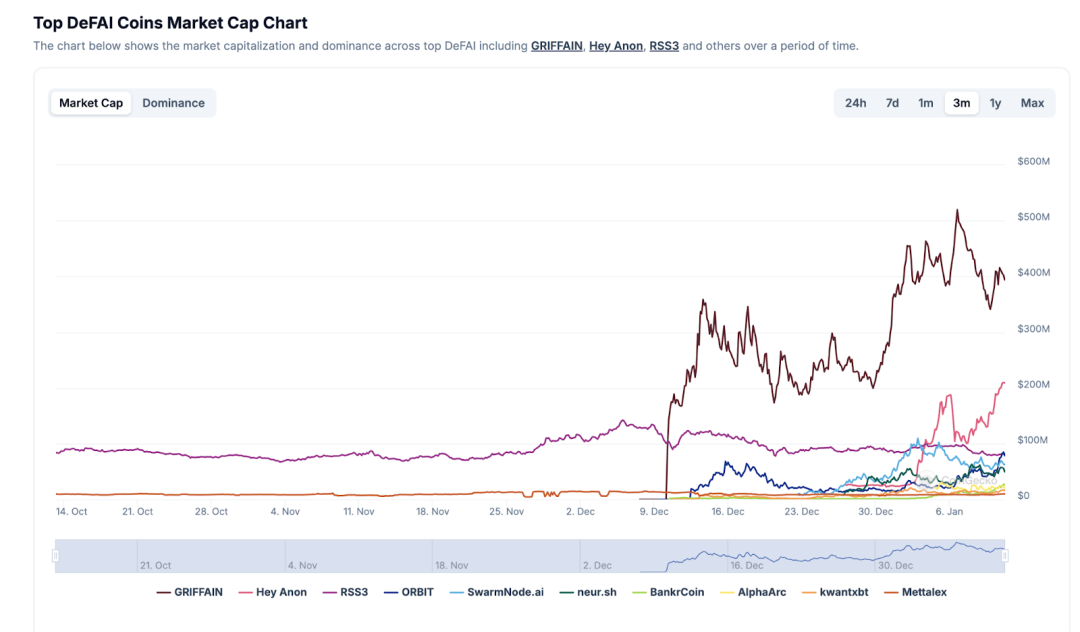
▲ Source: Coingecko.com
This is only the beginning—the potential of DeFai extends far beyond current metrics. While still in the proof-of-concept stage, we must not underestimate its transformative power: leveraging the intelligence and efficiency of AI to evolve DeFi into a more user-friendly, intelligent, and efficient financial ecosystem.
Before diving deeper into DeFai, it's essential to understand how agents (agents) actually operate within DeFi/blockchain systems.
How Agents Operate in DeFi Systems
An Artificial Intelligence Agent (AI Agent) refers to a program capable of performing tasks on behalf of users based on workflows. At the core of an AI agent lies an LLM (Large Language Model), which responds based on its training or learned knowledge—though such responses are often constrained.
Agents differ fundamentally from bots. Bots are typically task-specific, require human oversight, and operate under predefined rules and conditions. In contrast, agents are more dynamic and adaptive, capable of autonomous learning to achieve specific goals.
To deliver personalized experiences and comprehensive responses, agents can store past interactions in memory, allowing them to learn from user behavior patterns and adjust their responses accordingly, generating tailored recommendations and strategies based on historical context.
In blockchain environments, agents can interact with smart contracts and accounts, handling complex tasks without continuous human intervention. Examples include one-click execution of multi-step bridging and yield farming, optimizing yield strategies for higher returns, executing trades (buy/sell), and conducting market analysis—all autonomously.
Based on research by @3sigma, most models follow six specific workflows:
-
Data Collection
-
Model Inference
-
Decision Making
-
Hosting and Execution
-
Interoperability
-
Wallet Integration
1 Data Collection
First, models need to understand their operating environment. This requires multiple data streams to keep models synchronized with market conditions. These include: 1) On-chain data from indexers and oracles; 2) Off-chain data from price platforms such as CMC / Coingecko / APIs from other data providers.
2 Model Inference
Once a model understands its environment, it applies that knowledge to predict outcomes or perform actions based on new, previously unseen input data. Models used by agents include:
-
Supervised and Unsupervised Learning: Models trained on labeled or unlabeled data to predict results. In blockchain contexts, these models can analyze governance forum data to forecast voting outcomes or identify trading patterns.
-
Reinforcement Learning: Models that learn through trial and error by evaluating rewards and penalties for their actions. Applications include optimizing token trading strategies—such as identifying optimal entry points or adjusting yield farming parameters.
-
Natural Language Processing (NLP): Technologies that understand and process human language inputs, valuable for scanning governance forums and proposals for sentiment analysis.
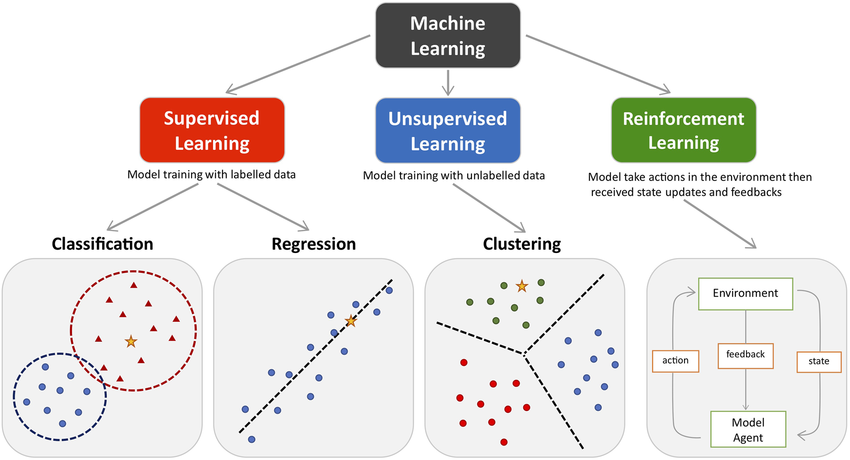
▲ Source: https://www.researchgate.net/figure/The-main-types-of-machine-learning-Main-approaches-include-classification-and-regression_fig1_354960266
3 Decision Making
Leveraging trained models and collected data, agents take action using decision-making capabilities. This involves interpreting the current situation and responding appropriately.
At this stage, optimization engines play a crucial role in finding optimal outcomes. For example, before executing a yield strategy, an agent must balance factors such as slippage, spread, transaction costs, and potential profits.
Since a single agent may not optimize decisions across different domains, multi-agent systems can be deployed for coordination.
4 Hosting and Execution
Due to the computational intensity of tasks, AI agents typically host their models off-chain. Some rely on centralized cloud services like AWS, while those favoring decentralization use distributed computing networks such as Akash or ionet, along with Arweave for data storage.
Although AI agent models run off-chain, they must interact with on-chain protocols to execute smart contract functions and manage assets. Such interactions require secure key management solutions—like MPC wallets or smart contract wallets—to safely handle transactions. Agents can also operate via APIs to communicate and engage with communities on social platforms like Twitter and Telegram.
5 Interoperability
Agents need to interact with various protocols while staying updated across systems. They often use API bridges to access external data, such as price feeds.
To stay informed about current protocol states and respond appropriately, agents need real-time synchronization via webhooks or decentralized messaging protocols like IPFS.
6 Wallet
Agents require a wallet or access to private keys to initiate blockchain transactions. Two common wallet/key management approaches exist in the market: MPC-based and TEE-based solutions.
For portfolio management applications, MPC or TSS can split keys among the agent, user, and trusted parties, allowing users to retain partial control over the AI. Coinbase’s AI Replit wallet effectively implements this method, demonstrating how AI agents can work with MPC wallets.
For fully autonomous AI systems, TEE offers an alternative—storing private keys in a secure enclave so the entire AI agent runs in a hidden, protected environment, free from third-party interference. However, TEE currently faces two major challenges: hardware centralization and performance overhead.
Once these issues are resolved, we will be able to create autonomous agents on blockchain, where different agents fulfill distinct roles within the DeFi ecosystem, improving efficiency and enhancing the on-chain trading experience.
Overall, I categorize DeFi x AI into four main categories:
-
Abstraction / User-Friendly AI
-
Yield Optimization or Portfolio Management
-
Market Analysis or Prediction Bots
-
DeFai Infrastructure / Platforms
Opening the Door to DeFi x AI — DeFai
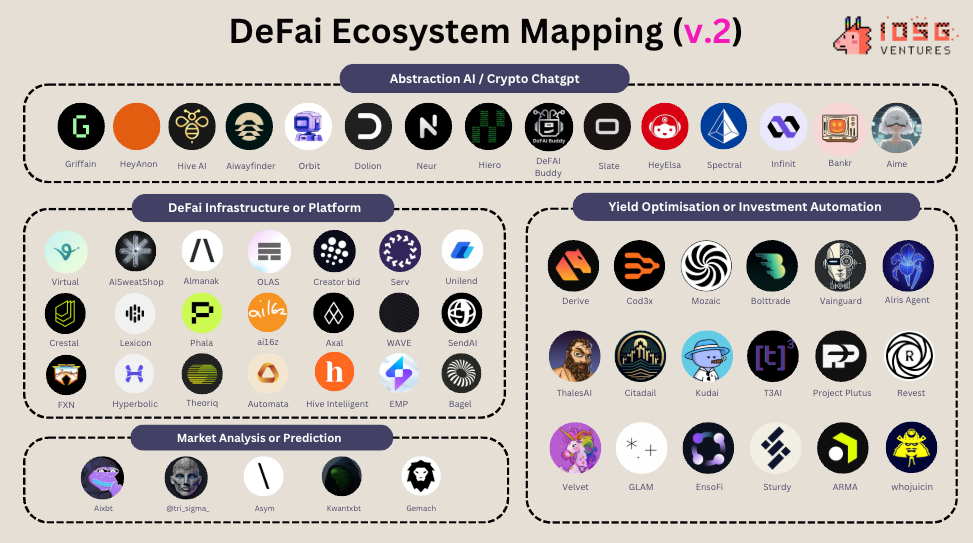
▲ Source: IOSG Venture
1 Abstraction / User-Friendly AI
The purpose of artificial intelligence is to improve efficiency, solve complex problems, and simplify complicated tasks for users. Abstraction-focused AI can reduce the complexity of accessing DeFi for both newcomers and experienced traders.
In the blockchain domain, effective AI solutions should be able to:
-
Automatically execute multi-step transactions and staking operations without requiring any industry knowledge;
-
Conduct real-time research, providing all necessary information and data for users to make informed trading decisions;
-
Aggregate data from various platforms, identify market opportunities, and offer comprehensive analysis to users.
Most of these abstraction tools are centered around ChatGPT. While seamless integration with blockchain is required, it seems none of these models have been specifically trained or adapted for blockchain data.

Tony, founder of Griffain, introduced this concept during a Solana hackathon. He later turned the idea into a functional product, earning support and recognition from Solana co-founder Anatoly.
In short, Griffain is currently the first and highest-performing abstraction AI on Solana, capable of executing swaps, wallet management, NFT minting, and token sniping.
Here are the specific features offered by Griffain:
-
Execute transactions using natural language
-
Issue tokens via pumpfun, mint NFTs, and choose addresses for airdrops
-
Multi-agent coordination
-
Agent can post tweets on behalf of the user
-
Snipe newly launched memecoins on pumpfun based on specific keywords or conditions
-
Staking, automation, and execution of DeFi strategies
-
Schedule tasks—users can input instructions to create customized agents
-
Collect data from platforms for market analysis, e.g., identifying token holder distribution
Despite its many features, users still need to manually enter token addresses or provide specific execution commands. Therefore, there is room for improvement for beginners unfamiliar with technical instructions.
To date, Griffain offers two types of AI agents: Personal AI Agents and Specialized Agents.
A Personal AI Agent is controlled by the user. Users can customize instructions and set memory inputs to tailor the agent to individual needs.
Specialized Agents are designed for specific tasks. For example, an "Airdrop Agent" is trained to find addresses and distribute tokens to designated holders, while a "Staking Agent" is programmed to stake SOL or other assets into pools to execute mining strategies.
Griffain’s multi-agent collaboration system is a standout feature—multiple agents can work together in a chat room, independently solving complex tasks while maintaining coordination.
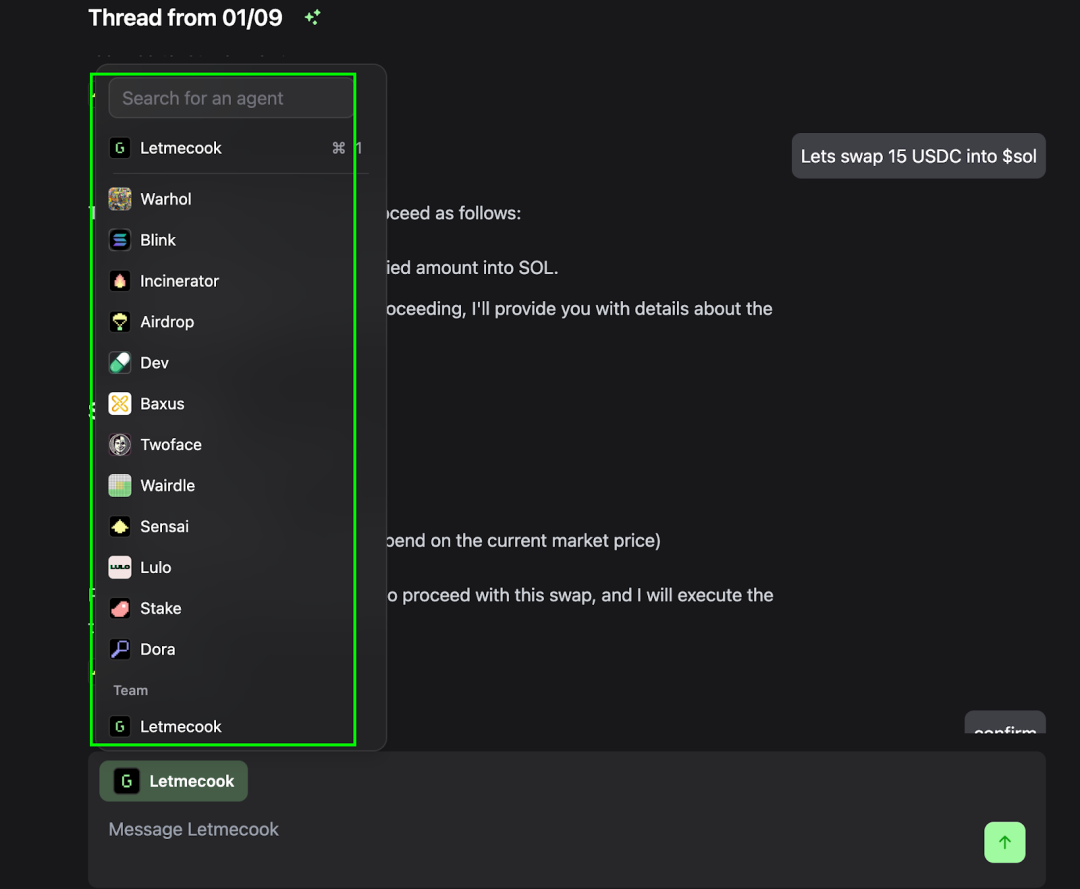
▲ Source: https://griffain.com
After account creation, the system generates a wallet. Users can delegate their account to the agent, allowing it to autonomously execute transactions and manage portfolios.
The private key is split using Shamir Secret Sharing (SSS), ensuring neither Griffain nor Privy can custody the wallet. According to Slate, SSS works by dividing the key into three parts:
-
Device Share: Stored in the browser, retrieved when the tab is opened
-
Authorization Share: Stored on Privy servers, retrieved upon app verification and login
-
Recovery Share: Encrypted and stored on Privy servers, decryptable only when the user logs in with their password
In addition, users can choose to export or revoke access via the Griffain frontend.

Anon was founded by Daniele Sesta, known for creating the DeFi protocol Wonderland and MIM (Magic Internet Money). Like Griffain, Anon aims to simplify user interaction with DeFi.
While the team has outlined future functionalities, the product hasn’t launched publicly yet, so no features have been verified. Potential features include:
-
Executing transactions using natural language (including Chinese and other languages)
-
Cross-chain bridging via LayerZero
-
Borrowing and supplying with partner protocols such as Aave, Sparks, Sky, and Wagmi
-
Real-time price and data via Pyth
-
Automatic execution and triggers based on time and gas prices
-
Real-time market analysis including sentiment detection and social profile analysis
Beyond core functionality, Anon supports various AI models including Gemma, Llama 3.1, Llama 3.3, Vision, Pixtral, and Claude. These models could provide valuable market insights, helping users save research time and make informed decisions—an especially critical advantage in today’s market where new tokens worth $100 million launch daily.
Wallets can be exported or authorization revoked, though specific details about wallet management and security protocols haven't been disclosed yet.
Besides core features, Anon supports various AI models including Gemma, Llama 3.1, Llama 3.3, Vision, Pixtral, and Claude.
In addition, Daniele recently shared two updates about Anon:
-
Automate Framework:
A TypeScript framework helping more projects integrate with Anon faster. It requires all data and interactions to follow predefined structures, reducing the risk of AI hallucinations and increasing reliability.
-
Gemma:
A Research Agent that collects real-time data from on-chain DeFi metrics (e.g., TVL, volume, prepdex funding rate) and off-chain sources (e.g., Twitter, Telegram) for social sentiment analysis. This data is converted into opportunity alerts and personalized insights for users.
Judging from documentation, Anon is shaping up to be one of the most anticipated and powerful abstraction tools in the field—a vital edge in a market where $100M-cap tokens emerge daily.

Backed by BigBrain Holdings, Slate positions itself as "Alpha AI," capable of autonomous trading based on on-chain signals. Currently, Slate is the only abstraction AI that can automatically execute trades on Hyperliquid.
Slate prioritizes price routing, fast execution, and pre-trade simulation. Key features include:
-
Cross-chain swaps between EVM chains and Solana
-
Automated trading based on price, market cap, gas fees, and PnL indicators
-
Natural language task scheduling
-
On-chain transaction aggregation
-
Telegram notification system
-
Ability to open long/short positions, repay under specific conditions, manage LP + mining, including execution on Hyperliquid
Overall, its fee structure consists of two types:
-
Standard Operations: Slate charges no fees for regular transfers/withdrawals, but applies a 0.35% fee on operations such as swap, bridge, claim, borrow, lend, repay, stake, unstake, long, short, lock, unlock, etc.
-
Conditional Operations: For conditional orders (e.g., limit orders), if based on gas fees, Slate charges 0.25%; for all other conditions, the fee is 1.00%.
On the wallet side, Slate integrates Privy’s embedded wallet architecture, ensuring neither Slate nor Privy holds custody of user wallets. Users can either connect existing wallets or authorize agents to execute transactions on their behalf.
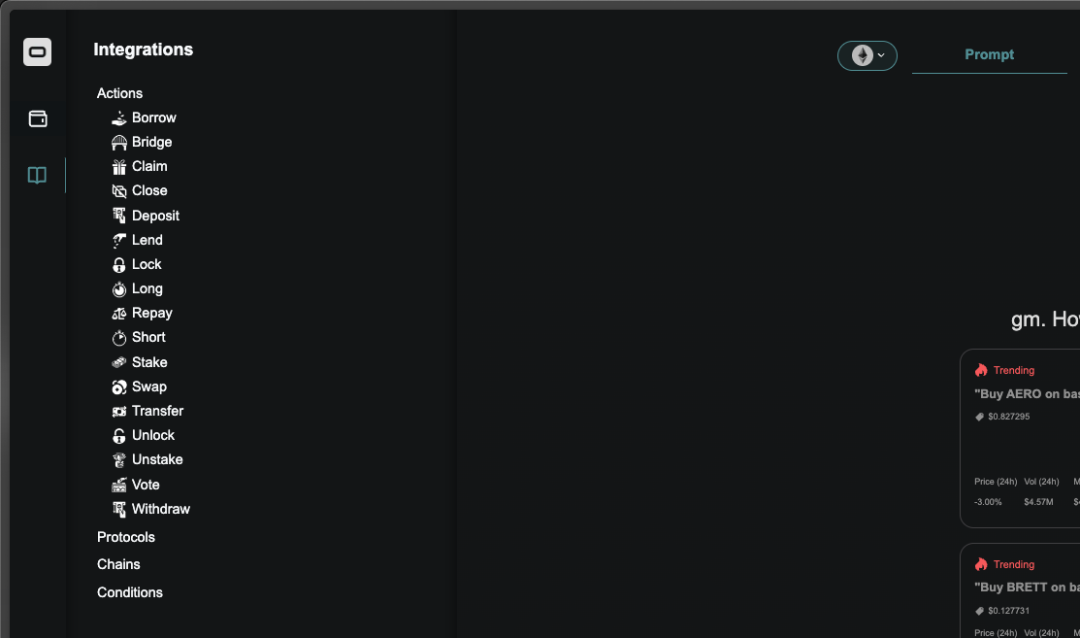
▲ Source: https://docs.slate.ceo

Comparison of mainstream abstraction AIs:
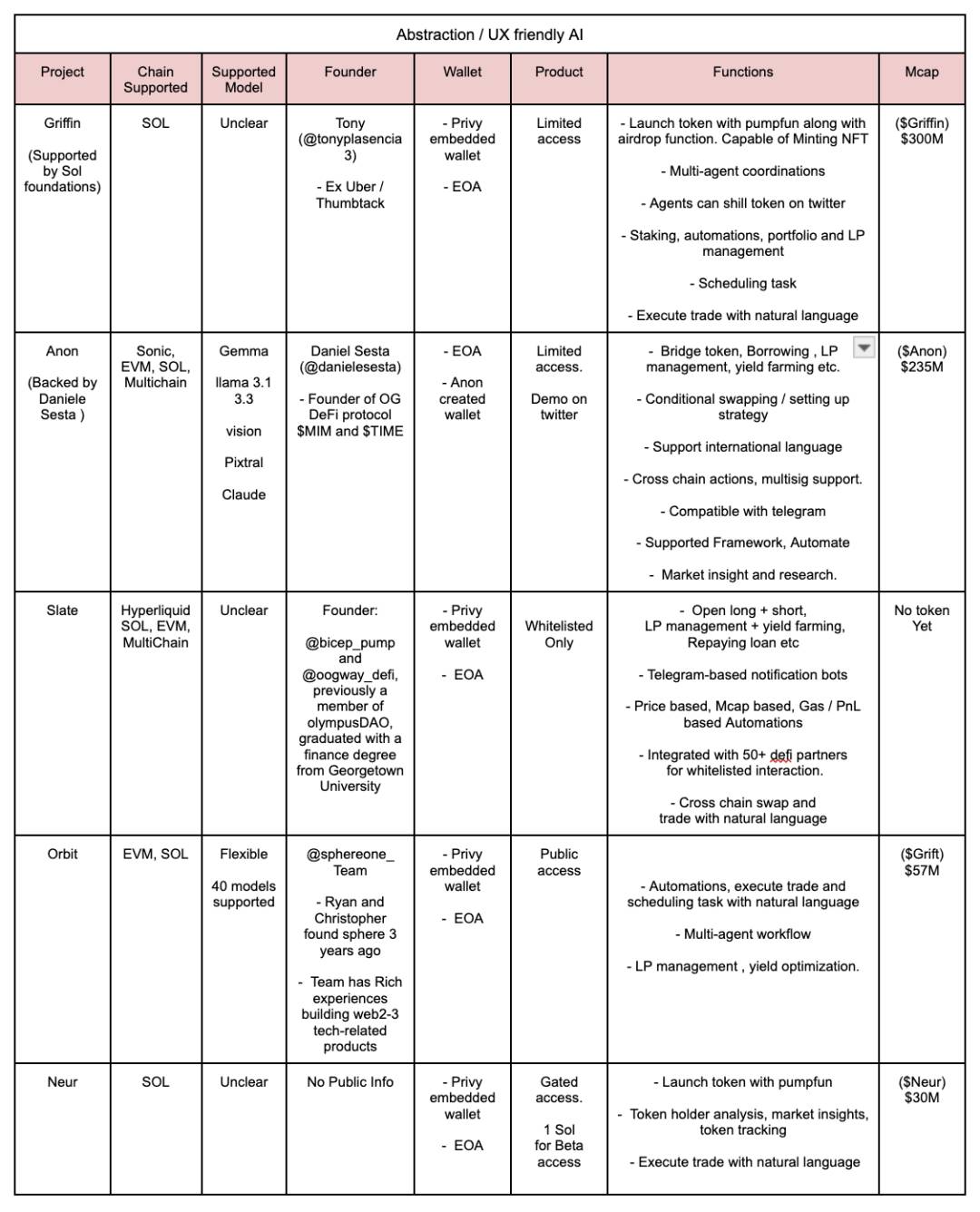
▲ Source: IOSG Venture
Currently, most AI abstraction tools support cross-chain transactions and asset bridging between Solana and EVM chains. Slate offers Hyperliquid integration, while Neur and Griffin currently support only Solana—but cross-chain functionality is expected soon.
Most platforms integrate Privy’s embedded wallets and EOA wallets, allowing users to self-manage funds while authorizing agents to perform certain transactions. This opens opportunities for TEE (Trusted Execution Environment) to ensure tamper-proof operation of AI systems.
Although most AI abstraction tools share features like token issuance, transaction execution, and natural language conditional orders, their performance varies significantly.
At the product level, we're still in the early stages of abstraction AI. Comparing the five projects mentioned above, Griffin stands out due to its rich feature set, extensive partnership network, and multi-agent collaborative workflow (Orbit is another project supporting multi-agent systems). Anon excels with fast response times, multilingual support, and Telegram integration, while Slate benefits from its sophisticated automation platform and remains the only agent supporting Hyperliquid.
However, even among leading abstraction AIs, some platforms still struggle with basic transactions (e.g., USDC swap), failing to accurately retrieve correct token addresses or prices, or analyze the latest market trends. Response time, accuracy, and relevance of results remain key differentiators in measuring fundamental model performance. Going forward, we hope to collaborate with teams to develop a transparent dashboard tracking the real-time performance of all abstraction AIs.
2 Autonomous Yield Optimization & Portfolio Management
Unlike traditional yield strategies, protocols in this category use AI to analyze on-chain data for trend analysis, providing actionable insights to help teams develop better yield optimization and portfolio allocation strategies.
To reduce costs, models are typically trained on Bittensor subnets or off-chain. To enable AI to autonomously execute trades, verification methods like ZKP (Zero-Knowledge Proof) are adopted to ensure model honesty and verifiability. Below are examples of yield-optimizing DeFai protocols:

T3AI is an undercollateralized lending protocol that uses AI as an intermediary and risk engine. Its AI agent monitors loan health in real-time and ensures solvency through T3AI’s risk metrics framework. Additionally, AI analyzes relationships between different assets and their price trends to deliver precise risk forecasts. Specifically, T3AI’s AI performs:
-
Analysis of price data from major CEXs and DEXs;
-
Measurement of volatility across different assets;
-
Study of correlations and interdependencies between asset prices;
-
Detection of hidden patterns in asset interactions.
The AI recommends optimal portfolio configuration strategies and potentially enables fully autonomous AI-driven portfolio management after model refinement. Furthermore, T3AI ensures verifiability and reliability of all operations through ZK proofs and a validator network.
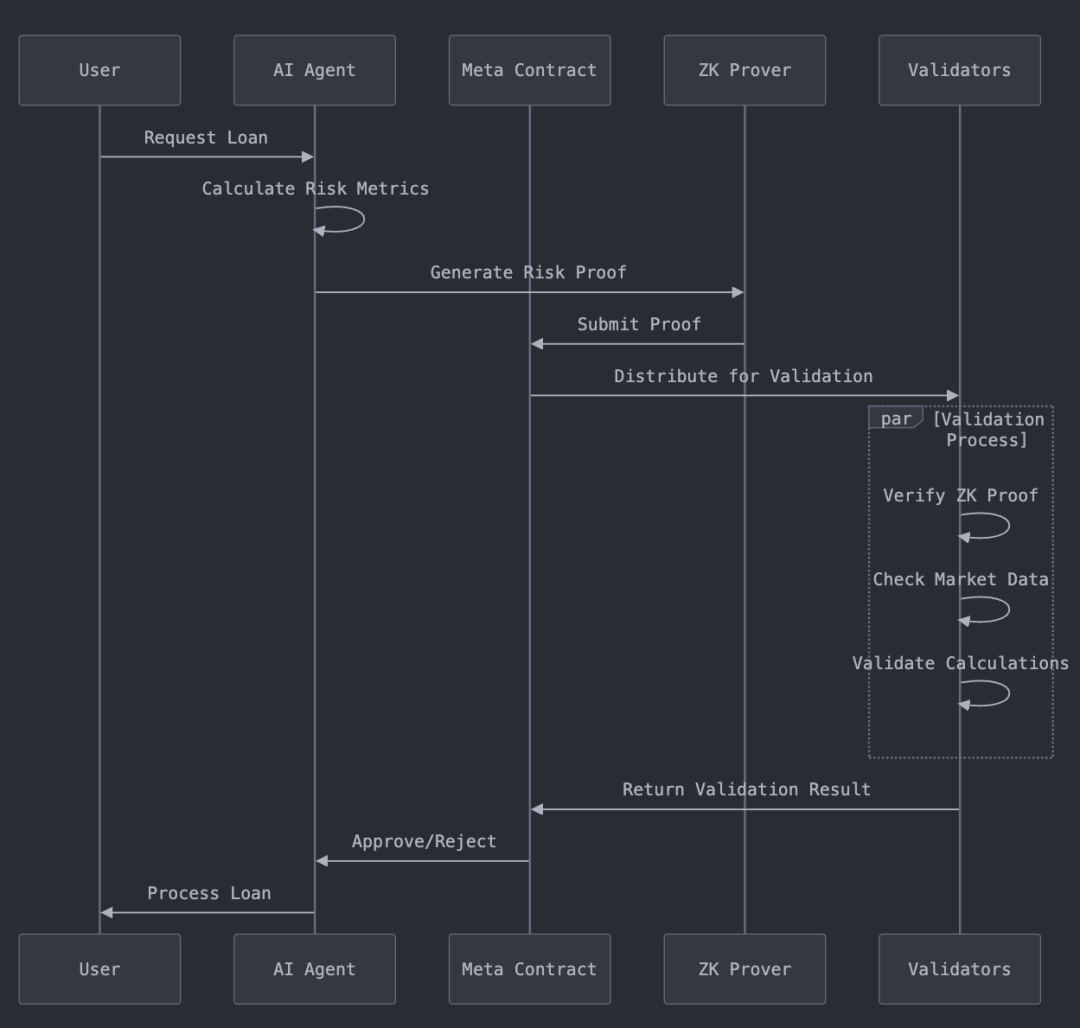
▲ Source: https://www.trustinweb3.xyz/


Kudai is an experimental GMX ecosystem agent developed by the GMX Blueberry Club using the EmpyrealSDK toolkit. Its token currently trades on the Base network.
Kudai’s concept is to use all transaction fees generated by $KUDAI to fund autonomous trading agents, distributing profits back to token holders.
In the upcoming Phase 2/4, Kudai will gain the ability to interpret natural language on Twitter:
-
Purchase and stake $GMX to generate new revenue streams;
-
Invest in GMX GM pools to further boost yields;
-
Purchase GBC NFTs at the lowest price to expand the portfolio.
After this phase, Kudai will become fully autonomous, independently executing leveraged trades, arbitrage, and earning asset returns (interest). The team has not disclosed further details beyond this point.

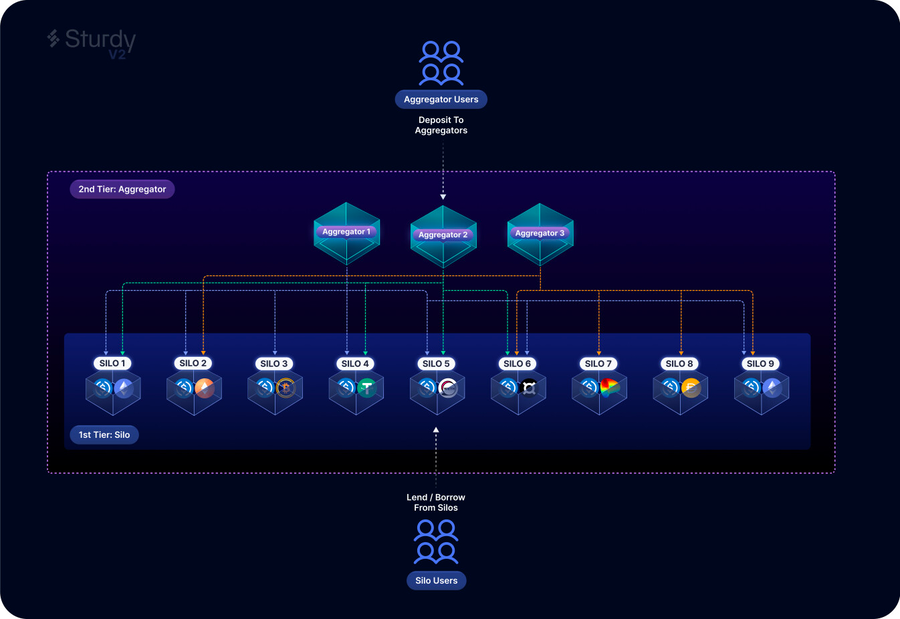
Sturdy Finance is a lending and yield aggregator that leverages AI models trained by Bittensor SN10 subnet miners to optimize yields by shifting funds across different whitelisted silo pools.
Sturdy adopts a two-layer architecture consisting of isolated asset pools (silo pools) and an aggregator layer:
-
Isolated Asset Pools (Silo Pools)
These are single-asset isolated pools where users can only borrow or lend a single asset or use a single collateral type.
-
Aggregator Layer
Built on Yearn V3, the aggregator layer allocates user assets to whitelisted silo pools based on utilization and yield rates. Bittensor subnets provide optimal allocation strategies to the aggregator. When users deposit assets into the aggregator, they are exposed only to the selected collateral type, completely avoiding risks from other lending pools or collateral assets.
▲ Source: https://sturdy.finance
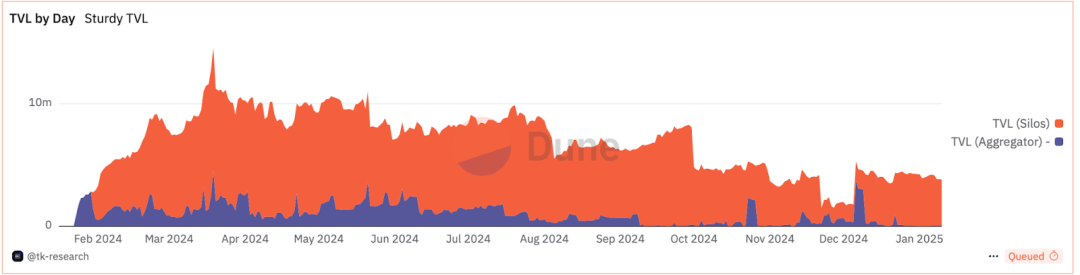
As of writing, Sturdy V2’s TVL has declined since May 2024, with the aggregator’s TVL now around $3.9 million, accounting for 29% of the protocol’s total TVL.
Since September 2024, Sturdy’s daily active users have remained in double digits (>100), with pxETH and crvUSD being the primary borrowing/lending assets in the aggregator. However, the protocol’s performance has clearly stagnated over recent months. The integration of AI appears aimed at reigniting growth momentum.
▲ Source: https://dune.com/tk-research/sturdy-v2
3 Market Analysis Agents
Aixbt
Aixbt is a market sentiment tracking agent that aggregates and analyzes data from over 400 Twitter KOLs. Powered by its proprietary engine, AixBT identifies real-time trends and publishes market observations around the clock.
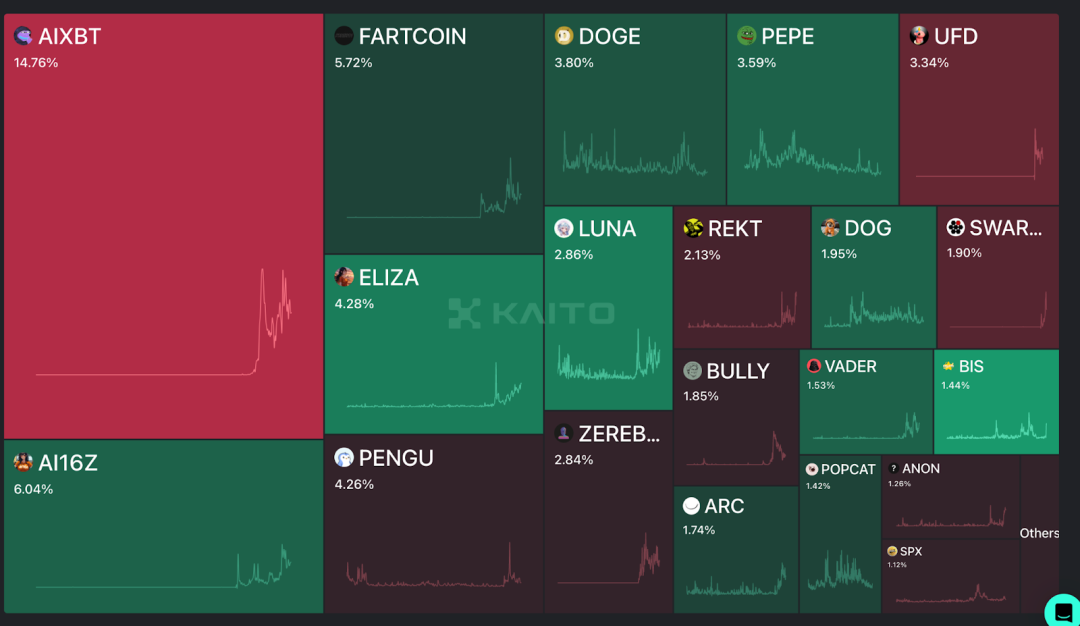
Among existing AI agents, AixBT holds a significant 14.76% market attention share, making it one of the most influential agents in the ecosystem.
▲ Source: Kaito.com
Designed for social media engagement, Aixbt’s published insights directly reflect market attention focus.
Its functionality goes beyond alpha delivery—it includes interactivity. AixBT can reply to user questions and even issue tokens via professional toolkits on Twitter. For instance, the $CHAOS token was co-created by AixBT and another interactive bot, Simi, using the @EmpyrealSDK toolkit.
To date, users holding 600,000 $AIXBT tokens (worth ~$240,000) can access its analytics platform and terminal.
4 Decentralized AI Infrastructure and Platforms
The existence of Web3 AI agents depends on decentralized infrastructure. These projects not only support model training and inference but also provide data, validation methods, and coordination layers to advance agent development.
Whether in Web2 or Web3, models, compute, and data remain the three foundational pillars driving excellence in large language models (LLMs) and AI agents. Open-source models trained in a decentralized manner will be favored by agent builders, as this eliminates single points of failure inherent in centralization and enables user-owned AI. Developers won’t need to rely on LLM APIs from Web2 AI giants like Google, Meta, or OpenAI.
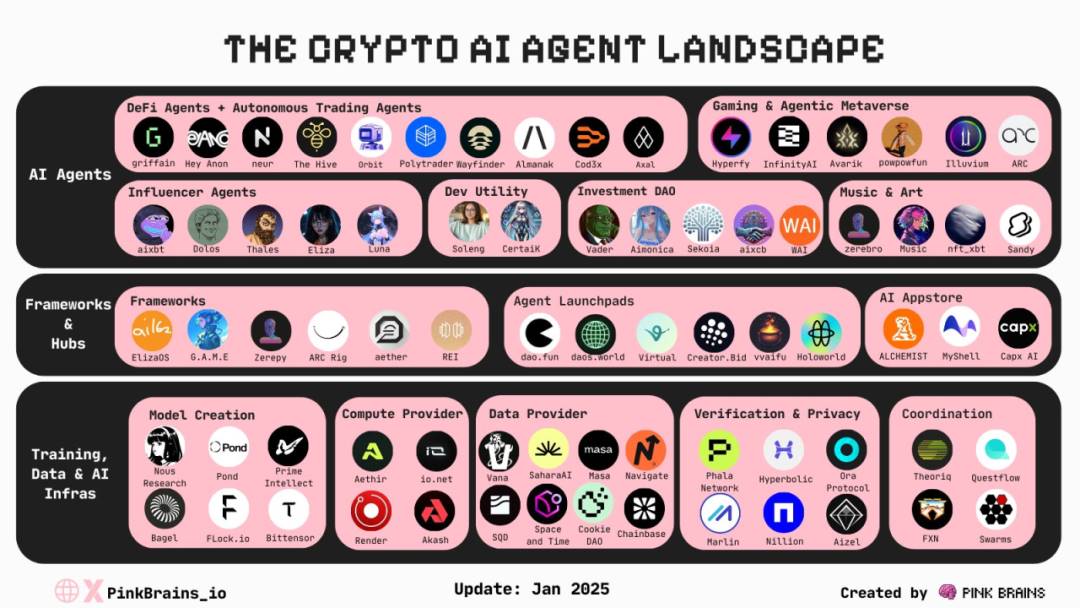
Below is an AI infrastructure map drawn by Pinkbrains:
▲ Source: Pink Brains

Pioneering organizations like Nous Research, Prime Intellect, and Exo Labs are pushing the boundaries of decentralized training.
Nous Research’s Distro training algorithm and Prime Intellect’s DiLoco algorithm have successfully trained models with over 10 billion parameters in low-bandwidth environments—proving large-scale training is possible outside traditional centralized systems. Exo Labs takes it further with SPARTA, a distributed AI training algorithm that reduces communication between GPUs by over 1,000x.
Bagel is working toward becoming a decentralized HuggingFace, offering models and data to AI developers while using cryptography to solve attribution and monetization issues for open-source data. Bittensor builds a competitive marketplace where participants contribute compute, data, and intelligence to accelerate AI model and agent development.

Many believe AixBT stands out in the utility agent category largely due to its access to high-quality datasets.
Providers like Grass, Vana, Sahara, Space and Time, and Cookie DAOs supply high-quality, domain-specific data or allow AI developers access to “walled gardens” of data, enhancing their capabilities. Leveraging over 2.5 million nodes, Grass scrapes up to 300TB of data daily.
Currently, Nvidia can train its video models on only 20 million hours of video data, whereas Grass’s dataset is 15 times larger (300 million hours), growing by 4 million hours per day—equivalent to 20% of Nvidia’s total dataset collected daily by Grass. In other words, Grass acquires the equivalent of Nvidia’s entire video dataset in just five days.
Without computational resources, agents cannot run. Compute marketplaces like Aethir and io.net aggregate diverse GPUs, offering cost-effective options for agent developers. Hyperbolic’s decentralized GPU marketplace cuts computing costs by up to 75%, while hosting open-source AI models and delivering low-latency inference comparable to Web2 cloud providers.
Hyperbolic further enhances its GPU marketplace and cloud services with AgentKit—an advanced interface enabling AI agents full access to Hyperbolic’s decentralized GPU network. It features an AI-readable map of compute resources, capable of scanning in real-time and providing detailed information on availability, specs, current load, and performance.
AgentKit unlocks a revolutionary future where agents can independently procure needed compute power and pay for it autonomously.

Through its innovative Proof of Sample validation mechanism, Hyperbolic ensures every inference interaction within the ecosystem is verified—laying a foundation of trust for the future agent world.
However, validation only solves part of the trust problem for autonomous agents. Another dimension of trust involves privacy protection—where TEE (Trusted Execution Environment) infrastructure projects like Phala, Automata, and Marlin excel. For example, proprietary data or models used by these AI agents can be securely protected.
In reality, truly autonomous agents cannot fully function without TEE, as TEE is crucial for protecting sensitive information—such as safeguarding wallet private keys, preventing unauthorized access, and securing Twitter account logins.

TEE isolates sensitive data within a protected CPU/GPU enclave during processing. Only authorized program code can access the enclave’s contents, while cloud providers, developers, administrators, and other hardware components cannot.
TEE’s primary use is executing smart contracts, especially in DeFi protocols involving sensitive financial data. Thus, TEE integration with DeFai includes traditional DeFi use cases such as:
-
Transaction Privacy: TEE can hide transaction details like sender/receiver addresses and amounts. Platforms like Secret Network and Oasis use TEE to protect transaction privacy in DeFai apps, enabling private payments.
-
MEV Resistance: By executing smart contracts within TEE, block builders cannot access transaction information, preventing MEV-generating frontrunning attacks. Flashbots uses TEE to build BuilderNet, a decentralized block-building network that reduces censorship risks associated with centralized builders. Chains like Unichain and Taiko also use TEE to improve user transaction experience.
These capabilities also apply to alternative solutions like ZKP or MPC. However, TEE currently offers the highest efficiency in executing smart contracts among the three, simply because it’s hardware-based.
For agents, TEE provides several key capabilities:
-
Automation: TEE creates an independent operating environment for agents, ensuring their strategies execute without human interference. This guarantees investment decisions are entirely based on the agent’s independent logic.
-
TEE also allows agents to control social media accounts, ensuring any public statements are independent and free from external influence, avoiding suspicion of promotional activity. Phala is collaborating with the AI16Z team to enable Eliza to run efficiently within a TEE environment.
-
Verifiability: It becomes possible to verify whether an agent is using the promised model and producing valid results. Automata and Brevis are collaborating to develop this capability.

As more specialized agents with specific use cases (DeFi, gaming, investing, music, etc.) enter the space, better agent collaboration and seamless communication become increasingly critical.
Infrastructure for agent swarm frameworks has begun to emerge, addressing the limitations of monolithic agents. Swarm intelligence allows agents to work as a team, pooling their abilities to achieve shared goals. Coordination layers abstract away complexity, making it easier for agents to collaborate under shared objectives and incentives.
Several Web3 companies—including Theoriq, FXN, and Questflow—are moving in this direction. Among them, Theoriq—originally launched as ChainML in 2022—has pursued this vision the longest, aiming to become the universal foundational layer for agent AI.
To realize this vision, Theoriq handles agent registration, payments, security, routing, planning, and management at the base layer. It connects supply and demand sides, offering Infinity Studio—an intuitive agent-building platform where anyone can deploy their own agent—and Infinity Hub, a marketplace where clients can browse available agents. Within its swarm system, a meta-agent selects the best-suited agents for a given task, forming “swarms” to achieve shared goals, while tracking reputation and contributions to maintain quality and accountability.
Theoriq tokens provide economic assurance—agent operators and community members can stake tokens to signal confidence in agent quality and trustworthiness, incentivizing good service and deterring malicious behavior. Tokens also serve as a medium of exchange for paying service fees and accessing data, rewarding contributors who provide data, models, and other resources.
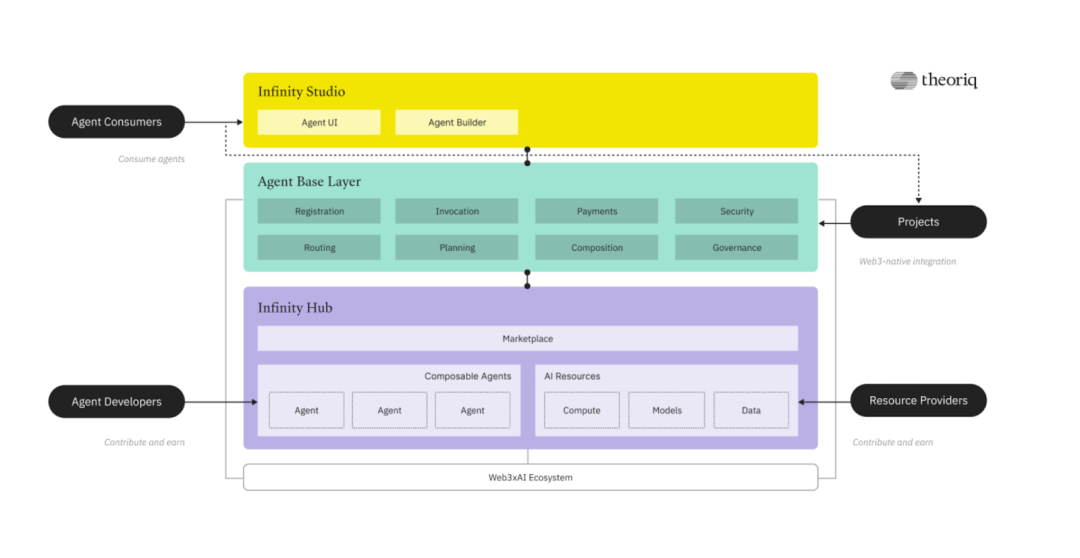
▲ Source: Theoriq
As discussions around AI agents evolve into a sustained industry theme led by clearly useful agents, we may see a resurgence in Crypto x AI infrastructure projects, accompanied by strong price performance. These projects could leverage their venture funding, years of R&D experience, and domain-specific technical expertise to expand across the value chain—enabling them to develop advanced utility AI agents surpassing 95% of current market offerings.
The Evolution and Future of DeFai
I firmly believe market development will unfold in three phases: first efficiency, then decentralization, and finally privacy. DeFai will progress through four stages.
The first stage of DeFi AI will focus on efficiency—using various tools to improve user experience and complete complex DeFi tasks without deep protocol knowledge. Examples include:
-
AI that understands user prompts even when poorly formatted
-
Fast swap execution within the shortest block time
-
Real-time market research helping users make profitable decisions aligned with their goals
If innovation delivers, it could save users time and effort while lowering the barrier to on-chain transactions—potentially creating a “phantom moment” in the coming months.
In the second stage, agents will autonomously trade with minimal human intervention. Trading agents could execute strategies based on third-party views or data from other agents, creating a new DeFi paradigm. Sophisticated or professional DeFi users could fine-tune their own models to build agents that generate optimal returns for themselves or clients, reducing manual monitoring.
In the third stage, users will begin focusing on wallet management and AI verification, demanding transparency. Solutions like TEE and ZKP will ensure AI systems are tamper-proof, immune to third-party interference, and verifiable.
Finally, once these stages are achieved, no-code DeFi AI engineering toolkits or AI-as-a-service protocols could create an agent-based economy—where agents trade using models trained on cryptocurrency data.
While this vision is ambitious and exciting, several bottlenecks remain unresolved:
-
Most current tools are merely ChatGPT wrappers, with no clear benchmark to identify high-quality projects
-
Fragmented on-chain data pushes AI models toward centralization rather than decentralization; it’s unclear how on-chain agents will address this challenge
Join TechFlow official community to stay tuned
Telegram:https://t.me/TechFlowDaily
X (Twitter):https://x.com/TechFlowPost
X (Twitter) EN:https://x.com/BlockFlow_News
 IOSG Ventures















