Solana Comprehensive Report: The Apple of the Web3 Era? No, It's Far More Than That
TechFlow Selected TechFlow Selected
Solana Comprehensive Report: The Apple of the Web3 Era? No, It's Far More Than That
Solana's vision is often compared to Apple, as it values the coordination between software and hardware and focuses on performance and user experience.
 Navigating Web3 tides with focused insights
Author: FourPillars
Translation: BlackShibawolf
Key Takeaways
-
Solana stands out in the blockchain integration landscape by prioritizing simplicity and composability, distinguished by its parallel processing, low fees, and fast transaction speeds.
-
Despite challenges, Solana’s ecosystem is rapidly recovering, regaining market share through a range of facilities aligned with its vision.
-
Solana is embracing several innovative applications built on its unique and developer-friendly infrastructure, particularly in retail-focused areas such as DePIN, mobile devices, and payments.
-
Moreover, institutional applications across the ecosystem are becoming increasingly sophisticated. Notably, major institutions have joined the Solana network through innovations like payment SDKs, SPE, and token extensions.
-
Solana’s vision is often compared to Apple due to its emphasis on hardware-software coordination and focus on performance and user experience. However, Solana places greater emphasis on novel software experiences rather than convenience delivered via hardware, raising expectations for what it can achieve.
* This report is an updated version based on a comprehensive report initially released in March 2024.
1. Introduction
Historically, infrastructure markets have been seen as capital-intensive industries that often follow winner-takes-all or few-dominant patterns. Similarly, even nearly nine years after Ethereum—the first smart contract platform—launched, competition among virtual machines (VMs) remains a central theme in the blockchain space. As debates continue over VM trends and diverse infrastructure needs, various VMs will clearly keep evolving, driving further growth in the blockchain market.
Solana, represented by its Solana Virtual Machine (SVM), is making a significant impact in the market. While the blockchain space appears to be moving toward a modular ecosystem centered around Ethereum, Solana has played a pivotal role in highlighting the distinct advantages of integrated blockchains—simplicity, accessibility, and speed. Additionally, Solana is actively driving off-chain user adoption of blockchain by focusing on areas such as DePIN (decentralized physical infrastructure networks), mobile devices, and payments.
As the saying “Solana is no longer a meme coin; OPOS (Only Possible on Solana)” gains traction, this article delves into Solana’s development trajectory—how it quickly regained market share, analyzes the drivers behind its recovery, its distinctive qualities, and key lessons we can draw from its journey.
2. Solana's Diverse Narratives
2.1 Pioneer of Integrated Blockchains
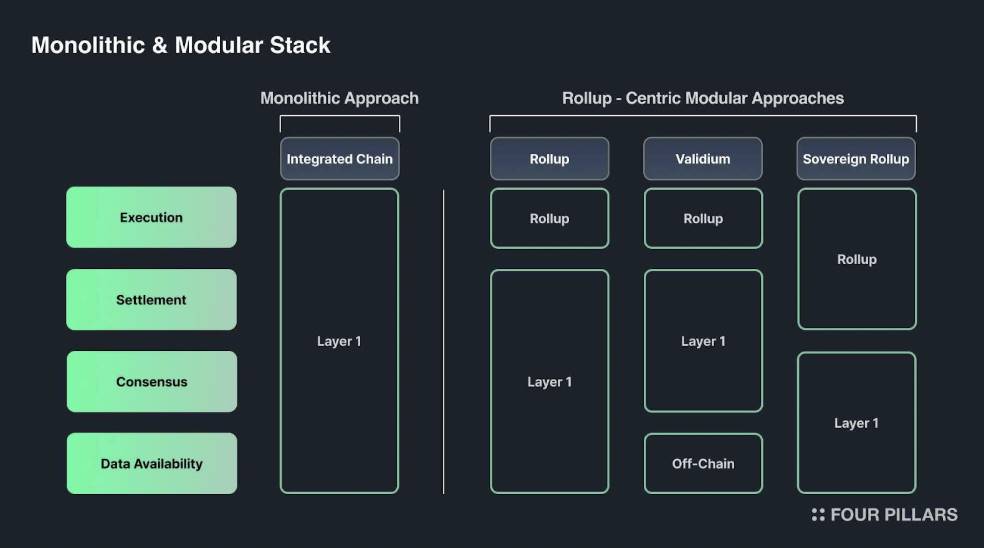
As Ethereum shifted its roadmap toward a rollup-centric scaling approach, the concept of modular blockchains quickly gained attention, with related projects dominating market share. The core idea behind modular blockchains is to assign functions of consensus, execution, settlement, and data availability to different protocols, overcoming the limitations of integrated blockchains through improved scalability and flexible governance.
However, the most critical drawback of this modular structure is complexity. Considering the process where a single transaction passes through multiple protocols, this complexity introduces 1) continuous compatibility and dependency checks, 2) increased communication costs, and 3) difficulty in quickly identifying and resolving unpredictable issues. Who can confidently claim such a system will operate stably? For infrastructure to be stable and sustainable, its essence must remain simple.
Solana excels here, effectively leading the integrated blockchain space. To ensure a moderately decentralized network with fast transaction speeds, Solana prioritizes simplicity and composability, building its own unique tech stack. Since launch, Solana has consistently developed its ecosystem, attracting a broad user base and fostering a vibrant community. By contrasting its proprietary tech stack with modular approaches, Solana has successfully differentiated itself from the Ethereum ecosystem.
This demonstrates that Solana’s monolithic/integrated approach is effective and meaningful within the industry. It raises awareness of real-world use cases and challenges the idealism and academic tone often emphasized in Ethereum circles. This influence has already impacted—and will continue to drive—the emergence and development of many other integrated blockchains (e.g., Sui, Aptos, Monad).
2.2 Enabling Success for Product-Oriented Entrepreneurs
The simplicity and composability championed by Solana aren’t merely about superficial performance improvements through expensive hardware, but about designing a network whose performance approaches that of a single node by optimizing and simplifying software and communication technologies.
This is especially important for creating a developer-friendly environment. In integration, developers can more efficiently utilize resources because Solana simplifies development, eliminates complexity factors such as choosing which tech stack to build on, and ensures that different smart contracts can communicate, exchange data, and execute operations seamlessly. Furthermore, features like localized fee markets—enabled by low latency, low fees, and parallel processing—(allowing different domains or applications to have independent fee structures) eliminate communication inefficiencies caused by bottlenecks in individual applications.
In addition, Solana offers a suite of built-in features within its simple tech stack, such as configurable token standard libraries, cross-chain interoperability, and RPC for token balance queries without relying on external indexers, enabling applications to collaborate tightly like a team and form a vibrant ecosystem.
Beyond that, Solana provides a range of support programs offering technical, financial, and operational assistance to developers. In short, Solana is creating an ideal environment for product-oriented developers, enabling the ecosystem to grow robustly according to Solana’s core values.
2.3 Advancing the Breakthrough Between Off-Chain and On-Chain
While blockchain technology may not be convenient to use, it holds the potential to deliver unique value to the real world, enough to justify its inconveniences—this is why so many people are drawn to build this ecosystem. However, blockchain’s value can only be realized through widespread adoption. Understanding this, Solana focuses on practicality rather than blindly pursuing initial ideals like decentralization. The vision of the Solana ecosystem centers on “real-world utility.”
Solana currently focuses on three main areas: DePIN, mobile, and payments. These share the commonality of being closely tied to real-world infrastructure. DePIN leverages blockchain technology to create decentralized networks for maintaining and operating physical infrastructure, forming a strong narrative around Solana. Solana’s low fees and high processing speed make it ideal for capital-intensive industries such as computing, storage, telecommunications, mapping, and data centers. The development of DePIN and payments will greatly promote using Web3 capabilities to build real-world infrastructure and become primary ways for off-chain users to bring their activities and assets onto Solana’s on-chain environment. Through mobile devices like Saga (or Seeker) and various consumer apps, off-chain users can naturally accumulate on-chain experience using various on-chain asset classes (such as RWA).
In summary, the Solana ecosystem not only pushes the boundaries between off-chain and on-chain but also makes each space more meaningful.
3. Solana's Dramatic Resurgence
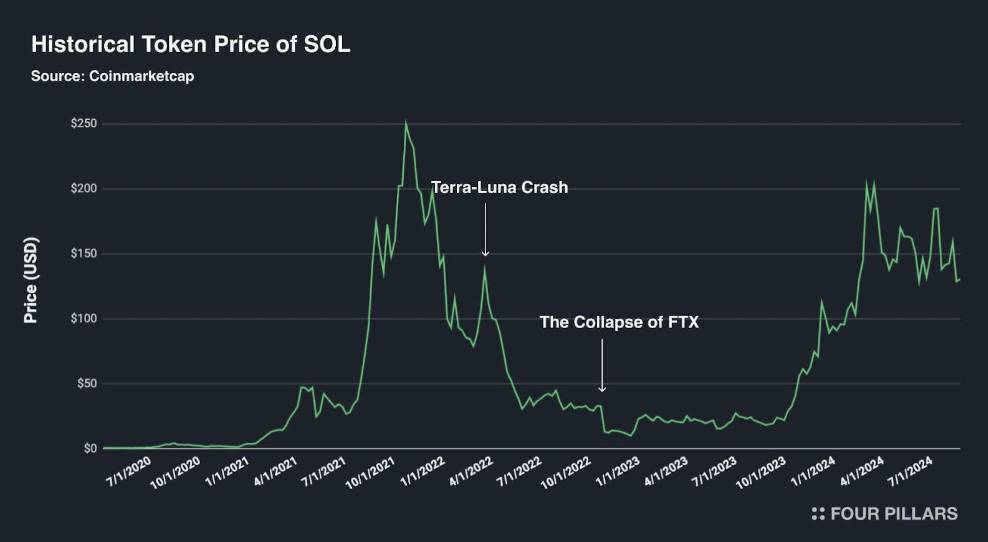
The crypto industry has experienced explosive growth in a short time, capturing global attention. Rapid development comes with intense volatility, now familiar to industry insiders. Yet, Solana has faced exceptionally pronounced fluctuations.
Especially during the peak of the blockchain frenzy in 2021–2022, Solana benefited from the support of FTX—the world’s second-largest crypto exchange—and its founder Sam Bankman-Fried (SBF), quickly rising to become the fourth-largest ecosystem by market cap (excluding stablecoins). But the good times didn’t last—FTX’s collapse dealt a devastating blow to the Solana ecosystem, causing SOL’s price to plummet 97% from its peak.
Despite this severe setback, Solana has shown remarkable resilience, reclaiming its former influence. With active participation from developers and companies, the Solana ecosystem has become stronger than ever. Solana’s phoenix-like rebirth stems from its unwavering vision and rapid execution capability.
3.1 A Primer on Solana
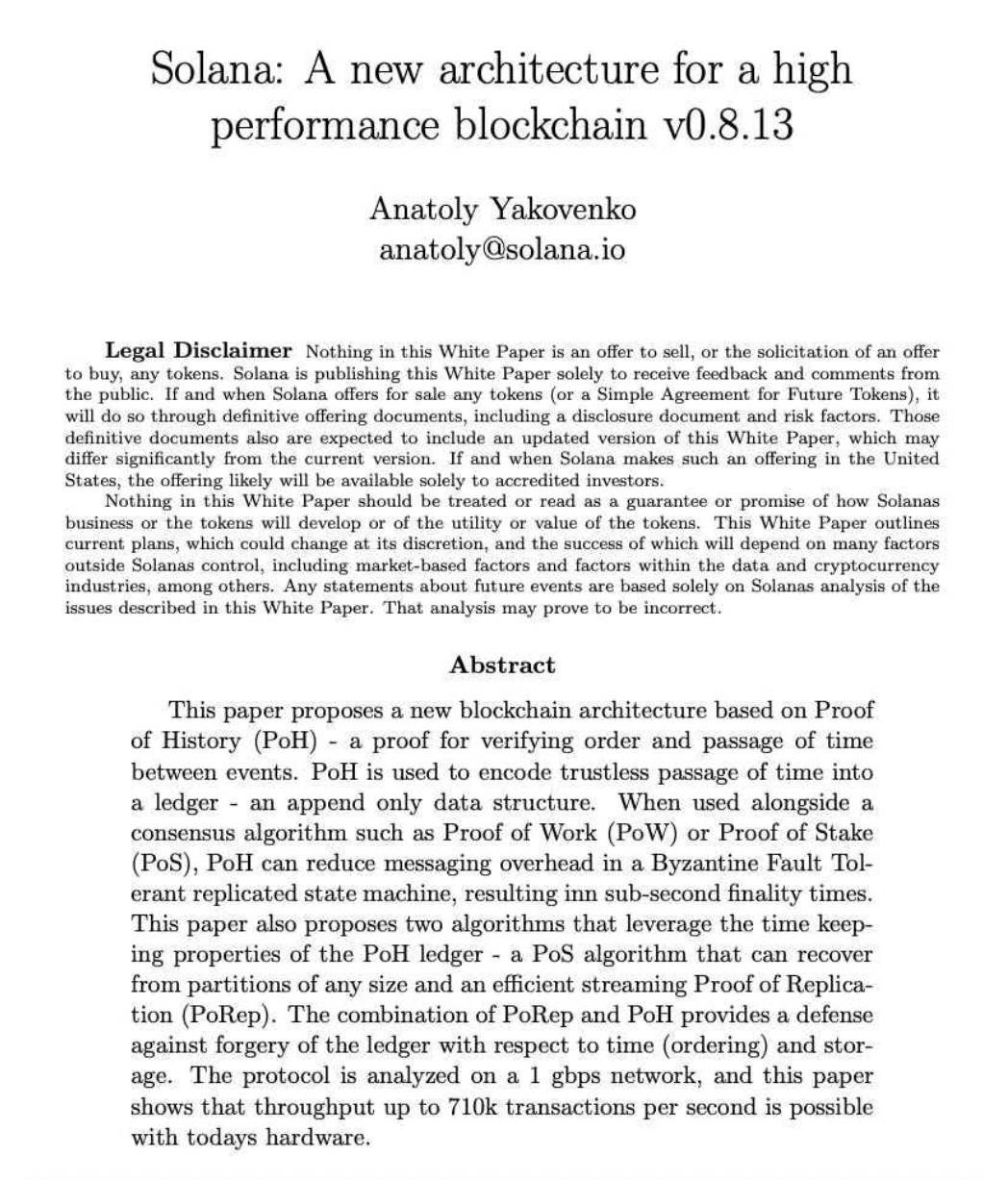
Source: Solana Whitepaper
"A monolithic, globally synchronized state machine achieving consensus at the speed of light"
Solana traces back to late 2017 when Anatoly Yakovenko, drawing from his experience at Qualcomm, began researching blockchain technology and identified a major problem: existing blockchains struggled to scale mainly due to the lack of a universally trusted, globally synchronized clock to record transaction timestamps.
Hence, Anatoly proposed a new method—using the properties of the SHA-256 hash function to establish a tamper-proof time sequence—to solve the time synchronization issue in blockchain consensus. He believed traditional blockchains were inefficient because nodes required extensive communication to agree on transaction times, order them, and finalize transactions. Thus, he proposed a simpler solution: if every validator could independently verify a shared global clock, network synchronization could be simplified, and transactions could be processed almost instantly upon arrival.
This idea eventually became Proof of History (PoH), aligning with Solana’s hypothesis that if software doesn’t hinder hardware, overall network performance can scale linearly with hardware improvements. Today, Solana handles thousands of transactions per second with block times recorded at 400–500 milliseconds, far surpassing existing blockchains.
Ultimately, Solana adopted this technical approach to achieve two goals: a scalable platform capable of handling high usage, and composability between applications. Through its integrated blockchain design with a shared, globally synchronized state, developers can write programs (i.e., smart contracts) more easily, reducing application development complexity and allowing them to fully focus on improving end-user experiences.
3.2 Standing Firm Against Adversity: How Challenges Were Overcome
Solana’s development philosophy, use of multithreading for parallel transaction processing, and consistently outstanding network performance have played a crucial role in building a community centered around pragmatic developers. Additionally, the peak of blockchain narratives, combined with the DeFi and NFT boom driving demand for fast transactions and low fees, positioned Solana as a true competitor to Ethereum.
Solana’s development philosophy, use of multithreading for parallel transaction processing, and consistently outstanding network performance have played a crucial role in building a community centered around pragmatic developers. Additionally, at the height of blockchain hype, the surge in demand for fast transactions and low fees driven by the DeFi and NFT boom made Solana a genuine competitor to Ethereum.
However, FTX’s collapse temporarily disrupted this momentum. At the time, Solana was closely associated with Sam Bankman-Fried (SBF), who publicly supported the Solana ecosystem and pioneered several projects, including the decentralized exchange (DEX) Serum. With SBF’s backing, FTX grew into the world’s second-largest centralized exchange, increasing his influence within the Solana ecosystem. Ultimately, FTX collapsed due to improper financial management and accounting practices, including misappropriating company assets and customer deposits to fund his hedge fund Alameda Research. Consequently, the Solana ecosystem, heavily reliant on FTX, also faced collapse.
Although the Solana ecosystem appeared broken, developers who believed in its vision remained steadfast. In response, Solana’s first step was to rebuild community trust by addressing technical issues to enhance network stability and developer-friendliness.
3.2.1 Technical Level
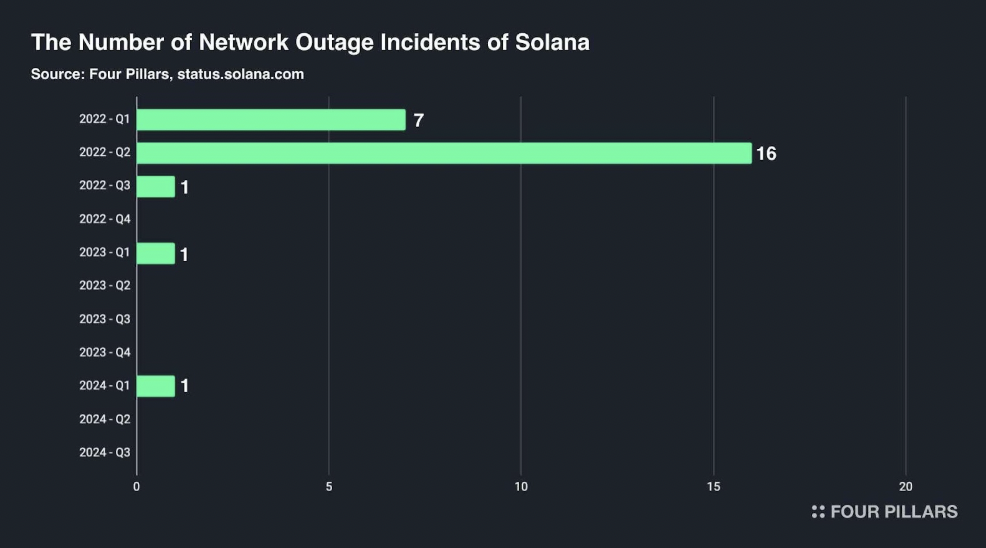
The Solana network long suffered frequent outages due to susceptibility to spam attacks. This stemmed from Solana’s fundamental design—its use of low fixed fees and a pre-scheduled leader node system to boost communication speed. To address these issues, Solana has implemented several improvements, including introducing QUIC (Quick UDP Internet Connections), stake-weighted QoS (Quality of Service), and localized fee markets.
QUIC (Quick UDP Internet Connections)
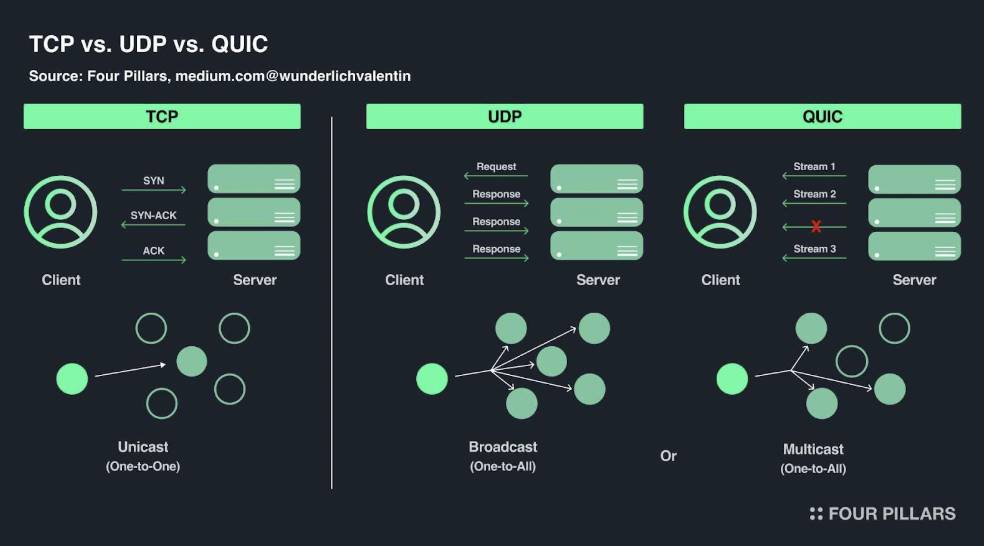
The Solana network initially used a custom UDP protocol for communication between RPC and leader nodes. While UDP simplifies communication and accelerates transmission, it has drawbacks:
-
Lack of reliability: UDP cannot confirm whether packets are successfully transmitted, thus failing to guarantee message delivery.
-
Difficulty identifying sources: UDP cannot identify packet source IP addresses, making it hard to trace malicious behavior.
-
Vulnerability to spam attacks: UDP lacks effective network control mechanisms, making it susceptible to flooding by massive spam traffic, affecting network stability.
While UDP suits continuous services (like live streaming), these issues make it unsuitable for blockchain environments requiring high security and stability.
To resolve these issues, Solana adopted Google’s QUIC protocol. QUIC is a new communication protocol based on UDP, retaining UDP’s benefits while fixing its flaws:
-
Higher reliability: QUIC adds confirmation mechanisms to verify packet transmission success, ensuring reliable message delivery.
-
Stronger security: QUIC simplifies TCP’s connection and handshake process (where nodes verify identity and establish fast, secure connections), enhancing network security.
-
Higher efficiency: QUIC only retransmits lost packets within a stream while continuing others, significantly improving network efficiency.
Stake-Weighted QoS (Quality of Service)
When network traffic exceeds capacity, QoS prioritizes specific types of traffic. Previously, Solana’s leader nodes used UDP, processing transactions strictly by arrival order regardless of source. With QUIC adoption, leader nodes can now identify requesting IP addresses, allowing Solana to set priority levels for specific connections.
The core of stake-weighted QoS policy is setting traffic limits based on the amount of SOL staked. In other words, a validator node’s maximum packet count is proportional to the number of SOL tokens it stakes on the Solana network. Transactions exceeding a validator’s preset limit are more likely to be dropped by leader nodes.
This approach is expected to achieve the following effects:
-
Prevent malicious validators from launching spam attacks.
-
Encourage validators with high transaction processing demands to stake more SOL, enhancing Solana’s network security and increasing demand for SOL tokens.
Localized Fee Markets
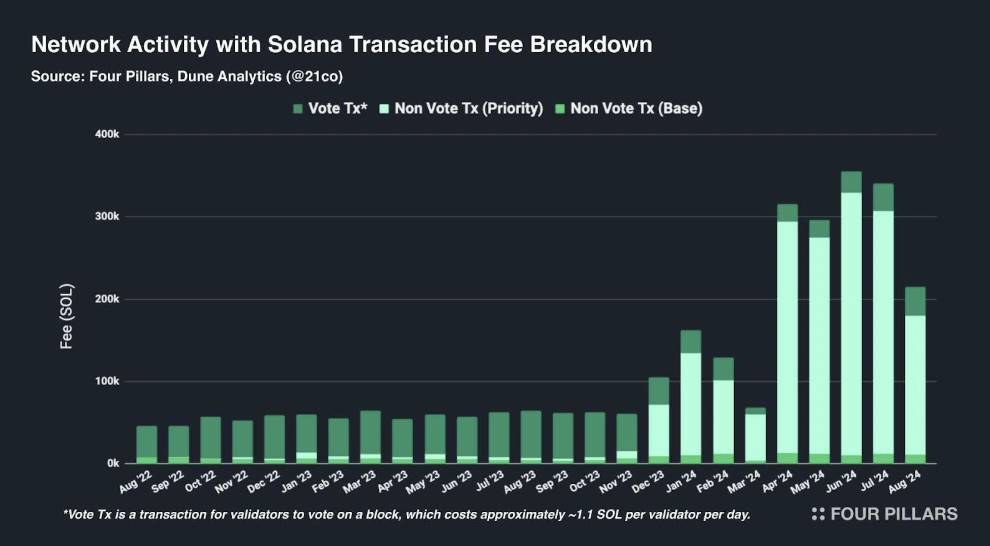
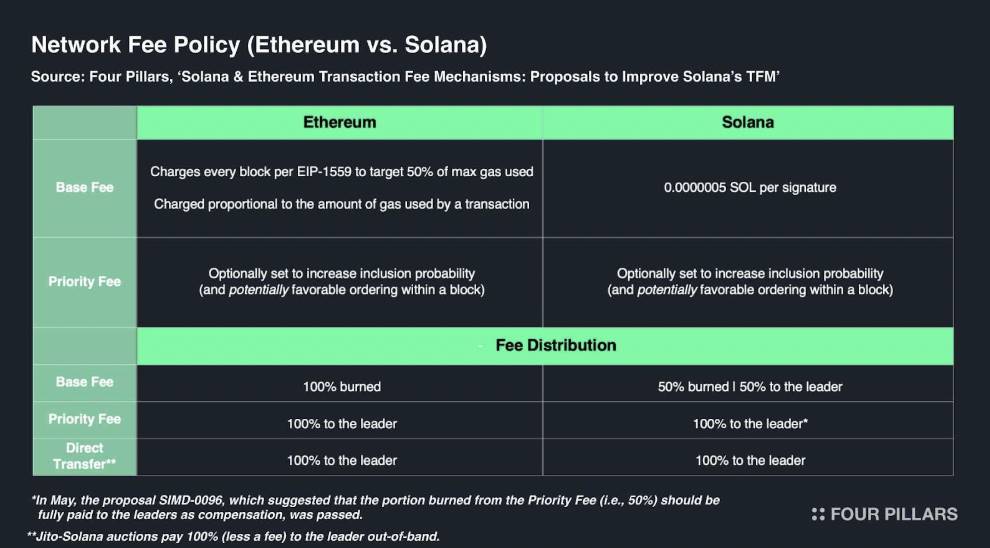
While Solana maintains fixed transaction fees (miner/gas fees) to preserve its consistent affordability advantage, intense block space competition can lead to transaction failures or users sending excessive spam transactions to ensure success, congesting the network. To improve this, discussions emerged within the Solana ecosystem about introducing a localized fee market system.
In a localized fee market system, users are allowed to add extra fees to prioritize faster transaction processing. This mechanism effectively deters spam activity and improves network efficiency.
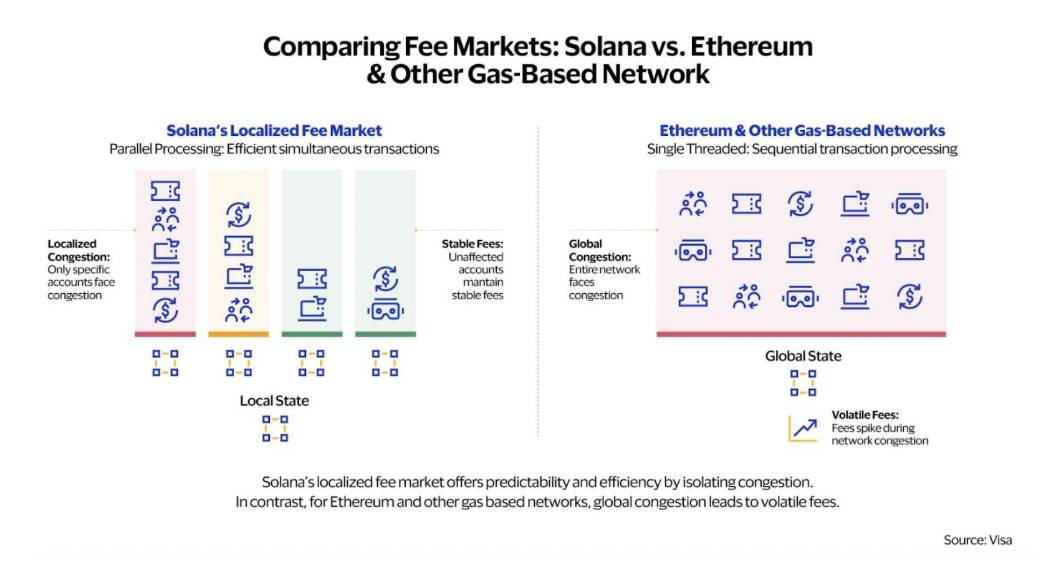
Source: Visa
Rather than implementing a network-wide localized fee market, Solana took it further by adopting a localized approach. This restricts fee markets to specific applications or markets, minimizing the impact of surging demand on the entire network. This feasibility arises because each Solana transaction specifies which account states it modifies, allowing simultaneous processing.
For example, even if minting fees for a specific NFT spike due to high demand, it won’t affect fee markets for unrelated accounts like token transfers. Currently, localized fee markets are limited to specific applications such as trading markets and automated market maker (AMM) pools. Each program account is capped at 25% of the total max CUs per block (i.e., 12 million CUs).
* Reference: Maximum compute units per transaction is 1.4 million CUs.
3.2.2 Ecosystem and Operational Management Level
Besides technical efforts, Solana regained market attention and trust by actively expanding into fields suited to its tech stack and cultivating a developer-centric community.
Strengthening Community Cohesion
The Solana community actively provides developers with resources and support through platforms like the Foundation, hackathons, and Superteam Earn, adhering to the principle that "developer benefit is key to ecosystem sustainability."
During this process, LamportDAO community-created meme coin BONK airdropped 5% of its tokens to developers who stayed in the Solana ecosystem, supporting collective rebuilding. This meme coin helped unite the Solana community; as developers rebuilt, BONK gained popularity, peaking at a 15,680% increase from its lowest price. BONK’s price rise created a virtuous cycle, sparking market interest in Solana and its ecosystem, leading to a proposal to airdrop 30 million BONK tokens to Saga mobile device users, further boosting attention.
Protocols like Jito (MEV solution client and staking platform), Pyth Network (oracle network), and Jupiter (decentralized exchange) then announced airdrop strategies, continuously stimulating market interest in Solana. Other ecosystem protocols such as Tensor, marginfi, Zeta, and Parcl introduced points systems, generating anticipation for future airdrops and injecting vitality into the ecosystem.
These cases exemplify how respecting community culture combined with excellent product design can revitalize an ecosystem.
Connecting to Web2 Infrastructure Strategy
As blockchain hype faded post-2021–2022, a major question remained: “What is blockchain’s purpose?” Hence, major L1s began defining their identities more clearly and actively exploring “real-world utility” strategies. At this juncture, Solana rapidly rolled out and led several innovative initiatives—not just responding to questions but actually linking real-world infrastructure with on-chain solutions, attracting significant market attention.
Source: solanamobile.com
Among these innovations, DePIN and mobile devices stand out. As mentioned earlier, DePIN uses blockchain’s decentralization to maintain and operate physical infrastructure, and Solana leads here, pioneering the DePIN field and crafting its narrative. This isn’t just about showcasing Web3 replacing or supplementing real infrastructure—it’s about building a gateway for off-chain users into the Web3 world to experience its applications.
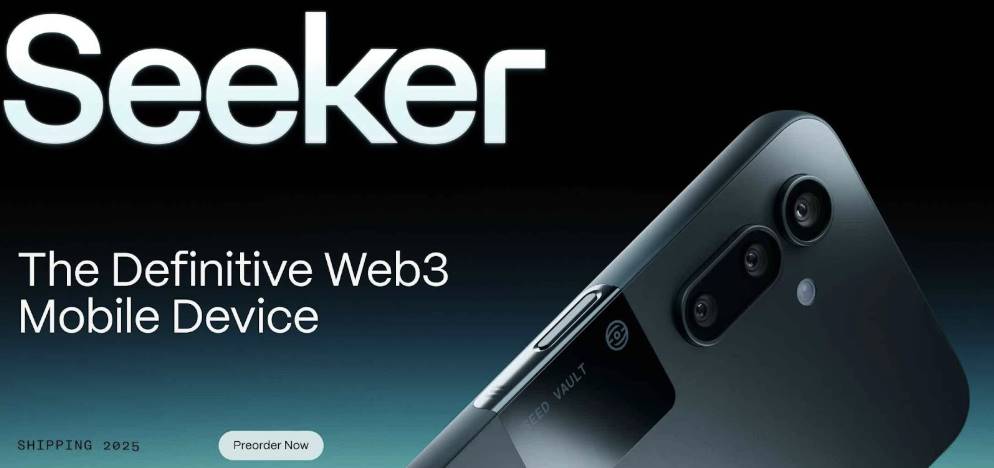
To give these users a holistic Solana ecosystem experience, Solana launched the Saga series of mobile devices, featuring app stores and multiple functions. The first Saga device launched in 2022 had modest sales initially but sold out by December as BONK news and ecosystem vitality spread. The second product, “Seeker,” was unveiled at TOKEN 2049 on September 19, 2024, and will launch in H1 2025, receiving over 140,000 pre-orders by September 19.
* Solana Mobile unveiled “Seeker,” the second Saga series product, at TOKEN 2049 on September 19, 2024.
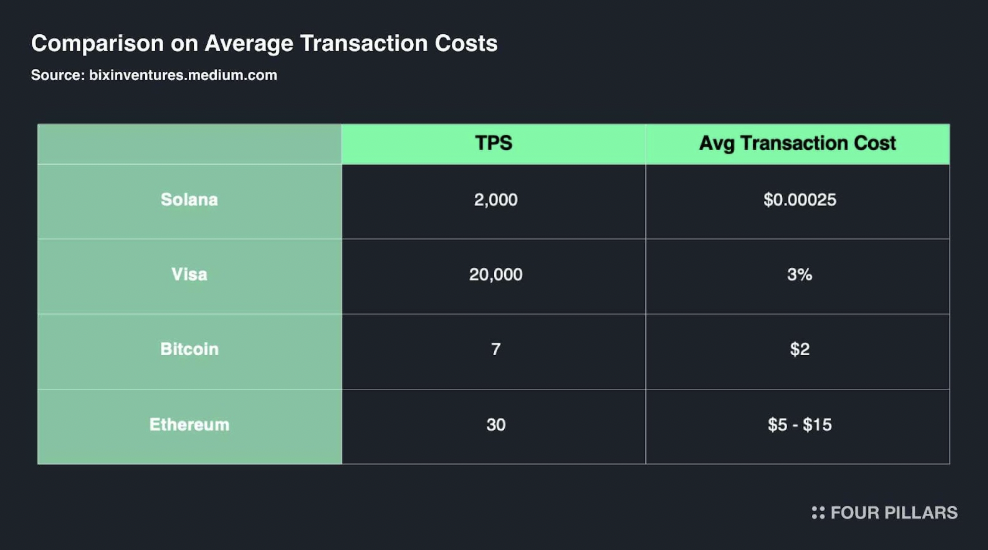
The second key area is payments. Using crypto assets based on peer-to-peer (P2P) blockchains for payments is often seen as a vital use case to solve traditional finance challenges like intermediaries, high fees, and slow transactions. Leveraging its multithreaded parallel processing, fast speed, and low costs, Solana is gradually establishing itself as the most suitable blockchain for crypto payments. Solana is actively strengthening innovation in this area (e.g., token extensions) to make blockchain transactions as intuitive and simple as credit card payments. Circle’s USDC has long been Solana’s official partner; PayPal and Paxos’ PYUSD began operating on Solana in May. Visa announced incorporating Solana into its stablecoin payment infrastructure, and Solana Pay—an open-source platform launched in February 2022—enables various apps to build crypto payment functionality. Solana Pay plugins are already integrated into platforms like Shopify, Citcon, and Checkout.com.
Measures to Enhance User Diversity and Validator Decentralization
Solana believes diversified validator clients enhance network stability and security, thus bolstering resilience through various validator client programs. Client diversity reduces the risk of single-point failures from software bugs, as issues in one client may not affect others.
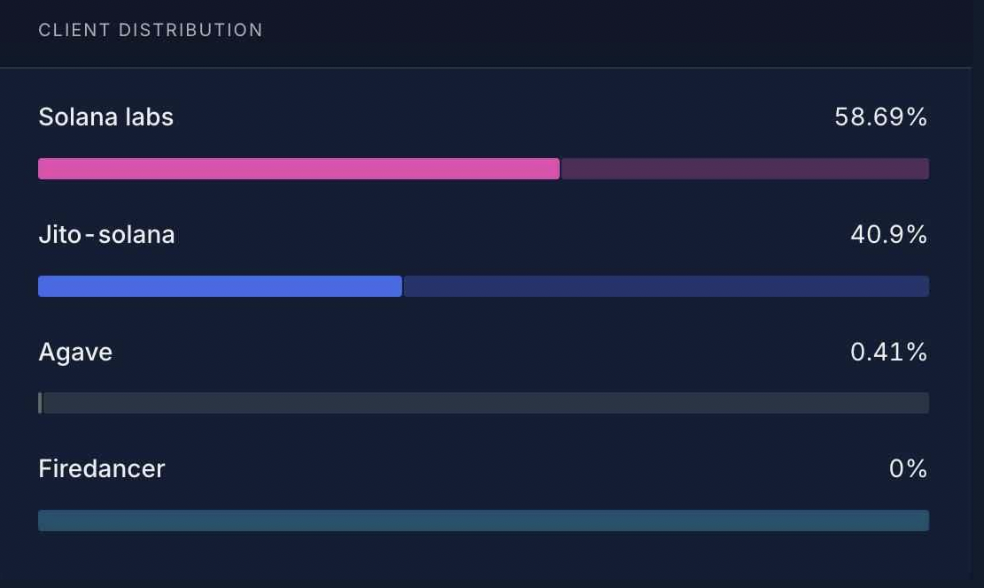
Solana initially had only one client developed by Solana Labs, but with Jito Labs releasing the second client Jito-Solana in August 2022, diversification began. Additionally, Jump Crypto’s independent validator client Firedancer (based on C/C++) has released its test version.
A lightweight client called Tinydancer has also attracted wide attention, enabling low-cost transaction verification. Especially given that Solana nodes typically require high hardware specs*, this client helps reduce misunderstandings that “true decentralization hasn’t been achieved.” Optimizing hardware specs to boost Solana’s network performance is crucial; Vitalik mentioned in his “Endgame” essay that instead of lowering hardware requirements for block-producing nodes, decentralizing and separating lighter block validation** roles better achieves scalability, security, and censorship resistance.
* Recommended specs for running a Solana node include: (source: helius.dev)
-
At least 12-core CPU, 2.8GHz clock speed
-
128/256GB RAM (RPC nodes may need more RAM for custom database indexing)
-
2–4 NVMe drives of at least 1TB each
-
10 Gbps network
** Ethereum’s PBS (Proposer-Builder Separation) architecture is also based on this premise.
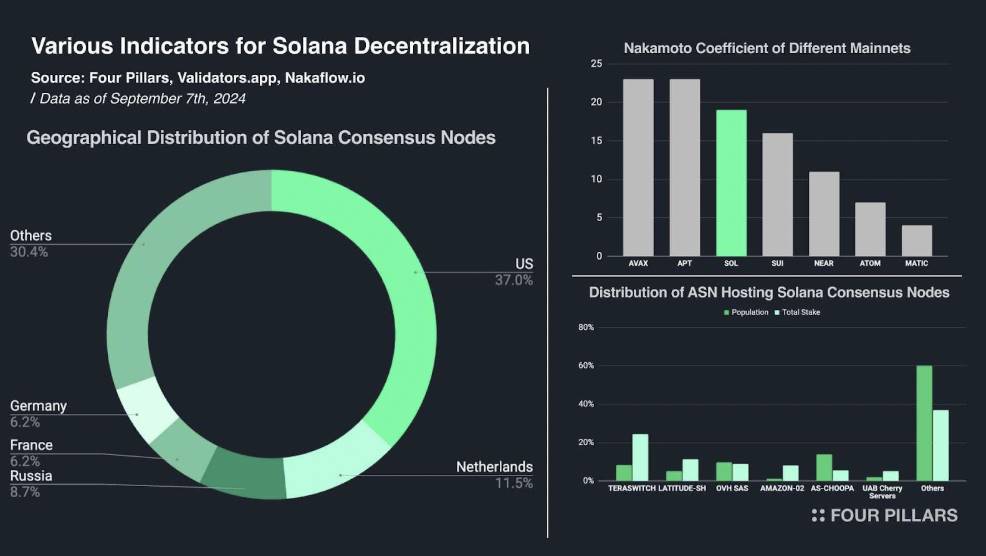
Although running a Solana node requires high-spec hardware, the roughly 1,300 Solana consensus nodes are geographically widely distributed. Moreover, the Nakamoto Coefficient—measuring the minimum number of validators needed to disrupt the blockchain—remains stably around 20. While most nodes are concentrated in the U.S., Solana continuously optimizes software and hardware per Moore’s Law, making node-running hardware more affordable and promoting geographical distribution and decentralization. It also runs delegation programs compliant with decentralization standards, encouraging token holders to delegate SOL to validators across regions, reducing risks of over-concentration in a single region. This shows Solana is steadily progressing toward decentralization.
As one of the few blockchains with multiple independent validator clients (besides Ethereum), Solana continues advancing decentralization and seeking network stability.
Solana not only consolidated internally but also actively expanded its commercial influence. These efforts provided ample highlights to attract institutional investors—Ark Invest CEO Cathie Wood publicly expressed positive views on Solana’s vision, and Grayscale’s Solana Trust surged 869%. In sum, Solana has proven its strong potential to revitalize a seemingly crisis-stricken ecosystem through consistent vision and rapid execution.
4. Solana’s Multiple Pillars
This section explores each element of Solana’s tech stack, which firmly supports its consistent vision and drives ecosystem recovery.
4.1 Tech Stack Committed to Composability and Efficiency
4.1.1 Programming Language
Source: Solana
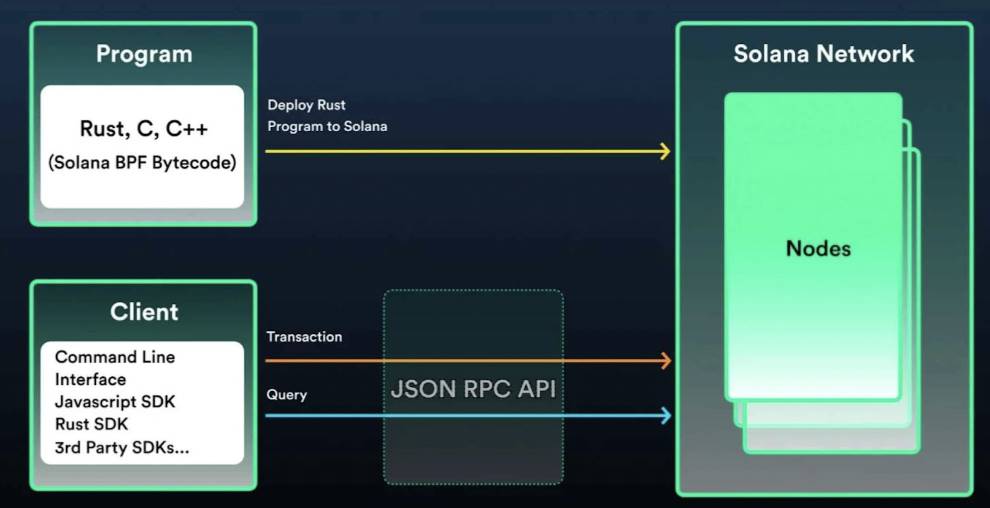
On the surface, Solana aims to lower transaction fees and shorten block times, but technically, its mission is optimizing software for hardware. To achieve this, Solana carefully chose its programming language (i.e., smart contracts) and ultimately adopted Rust. Rust supports parallel processing, memory safety, low-level control, and a powerful type system. Rust’s type system checks data types during compilation, preventing type mismatches and ensuring code safety and predictability.
However, Solana’s ultimate goal is to create an environment where all LLVM* (originally Low-Level Virtual Machine, now a compiler suite) languages can interoperate. Therefore, although Rust is the primary language for Solana app development, we can still use LLVM to convert code written in other languages (like C or C++) into machine code executable on Solana.
Clients interacting with the Solana network can use various JSON RPC API-based SDKs, such as those for Java, C#, Python, Go, or Kotlin.
* LLVM is a highly modular compiler and toolchain technology suite that enables efficient, high-quality code optimization across various hardware platforms, making it a preferred development environment for skilled technologists.
4.1.2 Core Innovations
Solana employs eight core technologies to ensure extreme speed throughout the process from user transaction submission to block generation. To better understand these technologies, let’s briefly introduce how Solana’s consensus mechanism works.
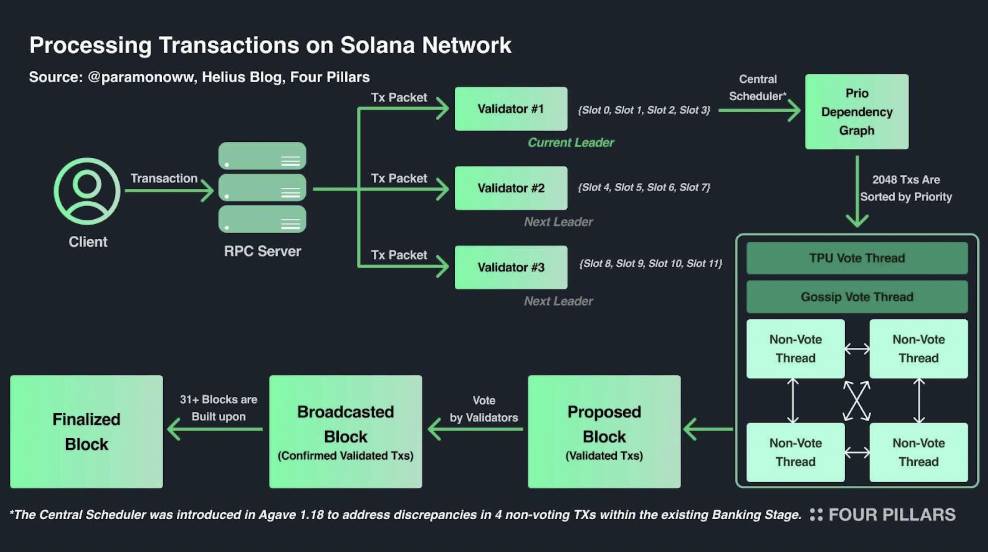
a. Transaction signing and RPC node receipt – Users sign transactions via wallets and send signed transactions to RPC nodes.
b. Leader node selection – Simultaneously, leader node selection is based on stake weight delegated by token holders; validators rotate according to the “leader schedule.”*
c. Transaction processing and timestamping – During transaction processing, transactions are categorized as sequential or parallel and assigned to different threads (six threads total: two dedicated to vote transactions, four others prioritized by the “central scheduler”). Leader nodes use Proof of History (PoH) to timestamp transactions for ordering.
d. Block creation – The leader node starts creating a block using its PoH sequence.
e. Block propagation – The newly generated block is sent to replica nodes (other validators) in the network.
f. Transaction validation – Replica nodes use their PoH sequences to validate transaction order and compliance with network rules. Since transaction order relies on the PoH sequence (i.e., global clock), nodes don’t need point-to-point communication.
g. Block finalization – Once transaction ordering and validation are complete, the block is added to the blockchain. Then, the next leader node is selected, and the cycle restarts.
* Solana has a “leader schedule” allowing leaders to be determined one epoch ahead, ensuring blocks aren’t delayed or outdated.
** The Central Scheduler, introduced in v1.18, handles priority sorting and processing of all transactions, reducing complexity and overhead.
*** Refer to the “Proof of History” section below for a better understanding.
Proof of History (PoH)
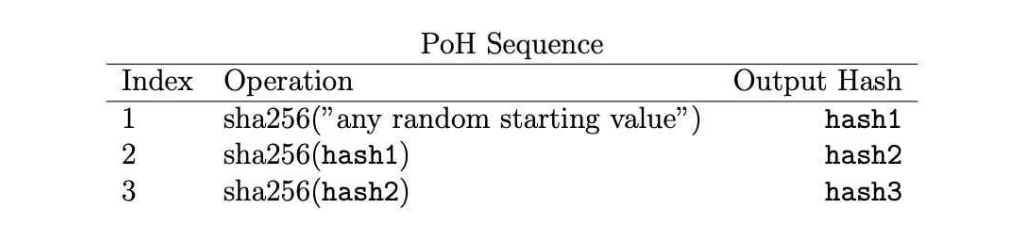
As previously mentioned, PoH’s core lies in each validator producing and holding a “global clock,” enabling reference to all transaction orders. For instance, by hashing the previous hash value (e.g., hash1) to generate the next (e.g., hash2, i.e., sha256(hash1)), it intuitively indicates hash1 precedes hash2. Solana calls this process a “sequence.”
Source: Solana Whitepaper
In other words, this continuous hashing data structure acts like a time (global time) stamp, proving time has elapsed. Since each validator can independently generate and hold this evidence, they don’t need to communicate with others to confirm time passage, allowing leader validators to rotate quickly without additional coordination. This is precisely why Solana achieves shorter block times than other blockchains by applying PoH.

Source: Solana Whitepaper
Generating this sequence requires single-core processing since it references the prior output hash, but verification can use multi-core processing due to its simple logic—just hash computation. Thus, it fulfills Solana’s philosophy: “Each node’s validation scales linearly with hardware.”
Therefore, PoH is more like a global clock data structure or a verifiable delay function (VDF) implemented via continuous hashing, rather than a consensus algorithm. In reality, Solana uses Tower BFT DPoS (Byzantine Fault Tolerant Delegated Proof of Stake) as its consensus algorithm.
Tower BFT DPoS (Byzantine Fault Tolerant Delegated Proof of Stake)
Tower BFT can be viewed as a PoH (Proof of History)-optimized version of PBFT (Practical Byzantine Fault Tolerance). It uses PoH as a “global clock” to predetermine transaction order, focusing solely on consensus, drastically reducing message transmission burden and latency. Validators reach consensus via Tower BFT as follows:
Validators vote approximately every 400ms on the ledger version they deem correct,* abandoning versions considered incorrect, eliminating the need for point-to-point (P2P) node communication. With each successive vote, the waiting time to rollback* increases exponentially. This means as most validators continuously vote for a PoH sequence, rolling back becomes increasingly difficult. For example, if all validators voted 35 times within 14 seconds (14,000ms / 400ms = 35 slots), the rollback time limit would reach about 435 years (2^35 × 0.4 / 3600 / 24 / 365), making rollback virtually impossible.
Thus, only the “heaviest sequence”*** remains on the blockchain, as most validators vote for it, making it hardest to rollback, and validators voting for it receive rewards. Simply put, thanks to PoH, validators in Tower BFT can calculate timeout times independently without P2P communication, ensuring timely voting, maintaining network liveness, and reducing fork risks.
* Vote weight depends on each validator’s stake amount in the network.
** “Rollback” refers to reverting the blockchain state or transaction records to a prior state, usually to undo erroneous or invalid transactions.
*** “Heaviest sequence” refers to the sequence receiving the most validator votes.
Gulf Stream
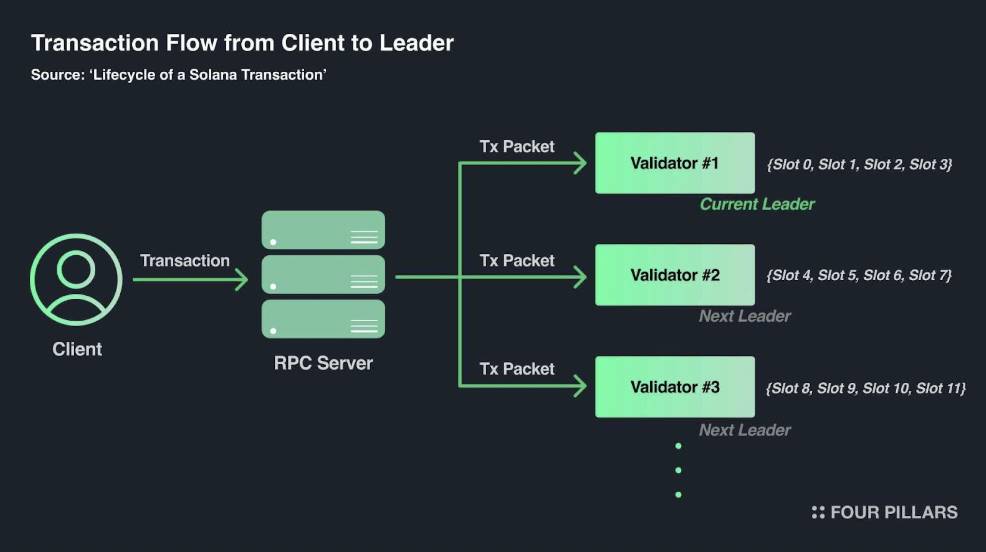
Unlike other blockchains, Solana doesn’t need a public mempool* to store user transactions due to its high transaction processing speed and relatively ample block space. Additionally, user-initiated transactions are encoded into QUIC streams and directly sent to the next designated “leader” validator. This method, known as “Gulf Stream,” accelerates leader rotation and enables early transaction execution, reducing memory burden on other validators.
* Public mempool stores unconfirmed transactions temporarily. When users initiate transactions, they’re broadcast to network nodes and added to each node’s mempool. Miners select transactions from the mempool, pack them into new blocks, and add them to the blockchain.
Solana’s Parallel Smart Contract Execution Environment (Sealevel) & Horizontally Scalable Account Database (Cloudbreak)

Sealevel is Solana’s core technology enabling multithreaded parallel processing—a feat unattainable by EVM or WASM-based execution environments. Sealevel uses “instructions” in transactions to enable parallel processing; transactions contain arrays of accounts holding Solana’s global state information. Transactions are pre-classified based on each account’s read/write status for parallel processing.
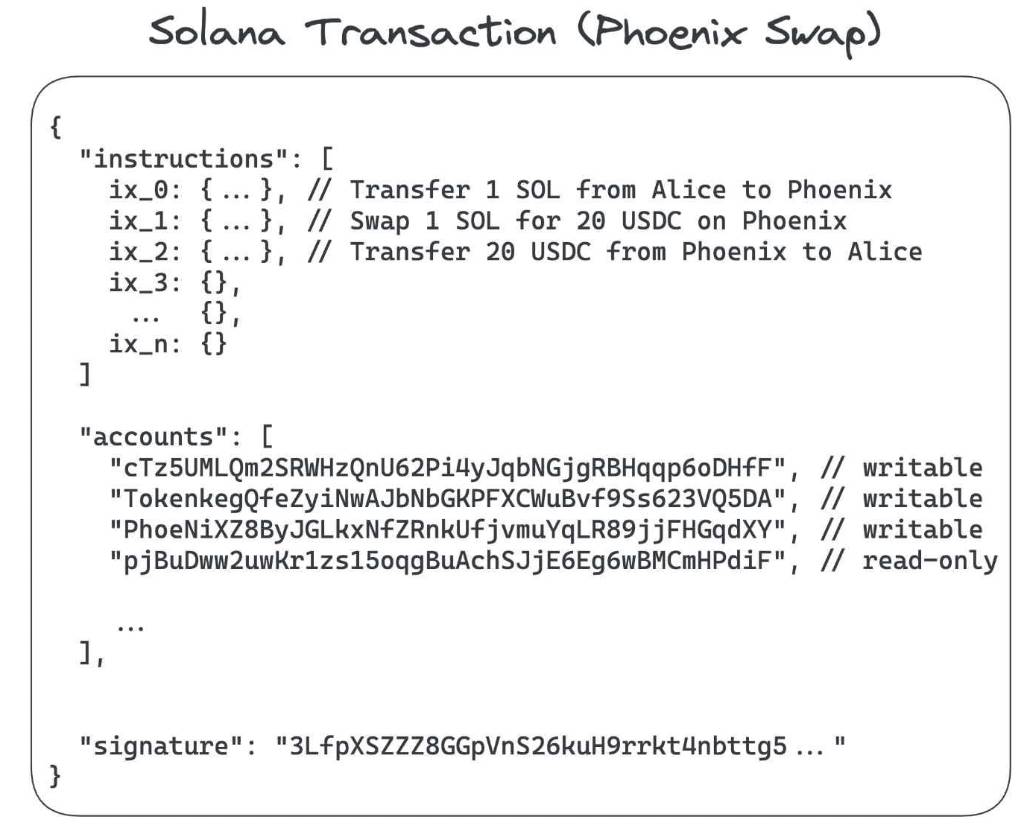
Source: Lifecycle of a Solana Transaction
Incidentally, organizing an account database for simultaneous multi-threaded read/write access is extremely difficult—even for traditional databases. To solve this, Solana developed Cloudbreak technology, partitioning account data structures in specific ways to maximize SSD performance, enjoying the speed advantages of sequential operations, and employing memory-mapped files for enhanced efficiency.
* As previously noted, this parallel processing logic in Sealevel is also why Solana’s localized fee market is feasible.
Pipelining
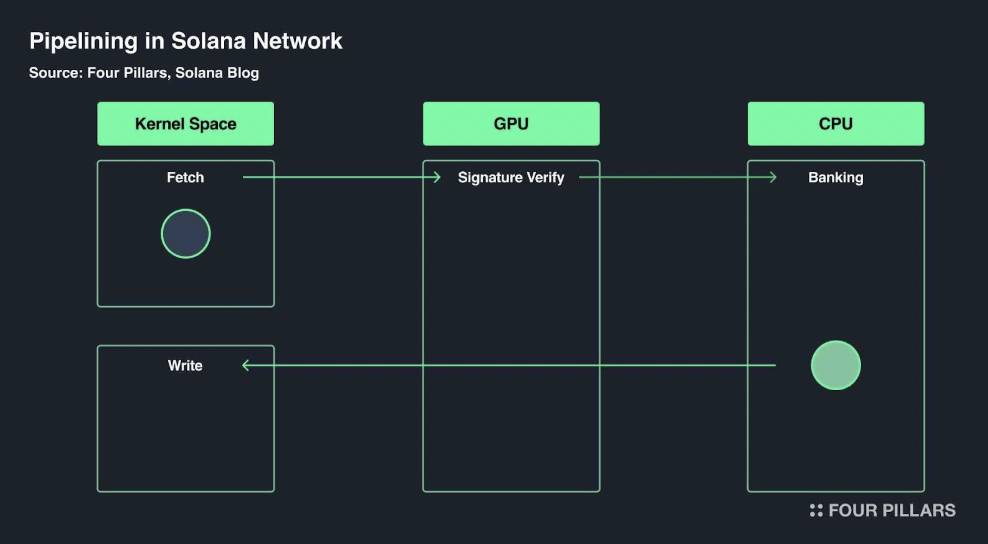
In the Solana blockchain, pipelining is a technique dividing input data streams (i.e., QUIC packets pre-received by the next leader) into multiple hardware components for simultaneous processing.
Pipeline processing flow:
-
Data first enters kernel space, then moves to GPU for parallel signature verification.
-
After GPU verifies signatures, data goes to CPU for transaction processing.
-
Meanwhile, kernel space prepares the next batch of data, and CPU writes processed data to the blockchain before forwarding it to the next block.
Through pipelining, Solana maximizes hardware resource utilization, improves efficiency, and accelerates block validation and transmission.
Structured Network Topology (Turbine)
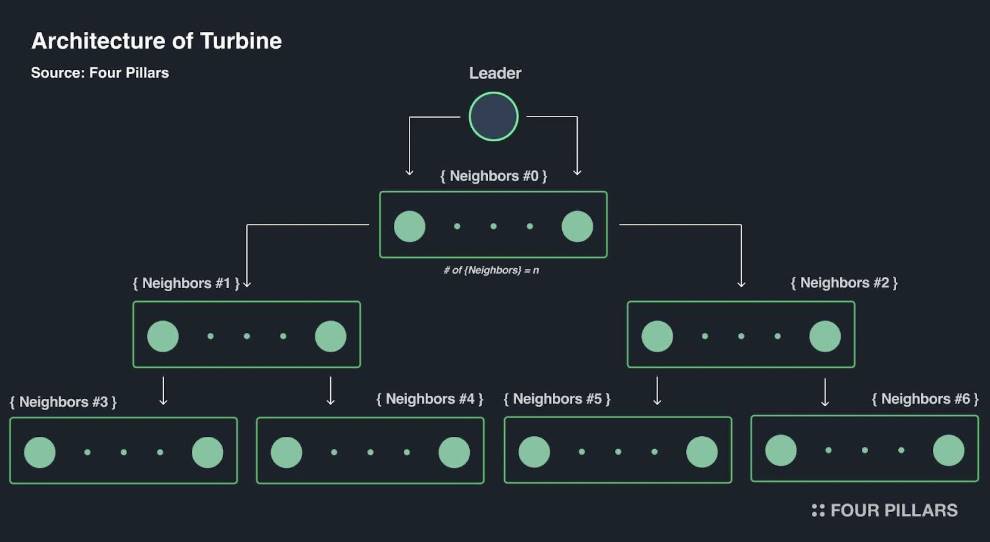
After transaction processing, the leader node must transmit the updated “state” to every validator. Sending large data packages individually to all validators would be highly inefficient. To solve this, Solana uses Turbine technology, similar to BitTorrent. Briefly, the leader node splits QUIC packets (optionally using erasure coding) into smaller chunks and distributes them to validators in a layered structure.
For example, suppose a 128MB block. To handle it, the leader splits it into 2,048 64KB small packets, sending them first to some validators. After receiving, these validators relay the packets to other “neighboring” validators. Initially receiving validators are chosen from nodes with higher SOL stake weights. Validators pass part of their received data to the next layer of neighbors. This architecture allows the leader’s initial data to expand rapidly like a snowball to more validators as layers deepen. As neighbor group sizes grow, steps needed to connect the entire network decrease logarithmically, enabling fast data transmission.
Especially, if a few high-tier validators act maliciously (e.g., eclipse attack), it could significantly impact the whole network. Hence, the network adopts a method of sending packets via different random paths each time to reduce such attack risks.
Archiver (Ledger Replicator)
Solana’s Archiver stores about 4PB (petabytes) of data generated annually by the network. They can be seen as “lightweight clients,” not needing full Solana ledger downloads but storing only parts of data, allowing a broad range of validators with varying hardware requirements to participate.
When Archivers receive allocated data from the network, their job is verifying data authenticity via “Proof of Replication (PoRep)” technology, based on Filecoin. Archivers announce their storage space to the network and can earn up to 3% inflation rewards by storing and validating allocated data.
4.2 Diversified Clients Committed to Reliability and Scalability
The aforementioned core technologies enable Solana’s fast transaction processing, parallel execution, and low latency, making it an ideal infrastructure for app development. However, Solana’s high throughput also poses challenges for network stability, such as handling MEV bots or spam attacks. To address these, Jito, Solana’s second client, launched in August 2022, specifically tackling inefficient MEV extraction and centralized liquid staking protocols, helping stabilize the network and promote decentralization.
Beyond that, Solana’s client diversification is expected to expand further with Jump Crypto’s Firedancer release. Firedancer enhances performance through advanced software optimization; Tinydancer is a lightweight client allowing more users to verify transactions with lower hardware requirements; Sig uses the low-level language Zig; and Agave, developed by Anza, offers another alternative. These new clients will further improve Solana’s network reliability and scalability.
4.2.1 Jito-Solana
Source: jito.network/blog
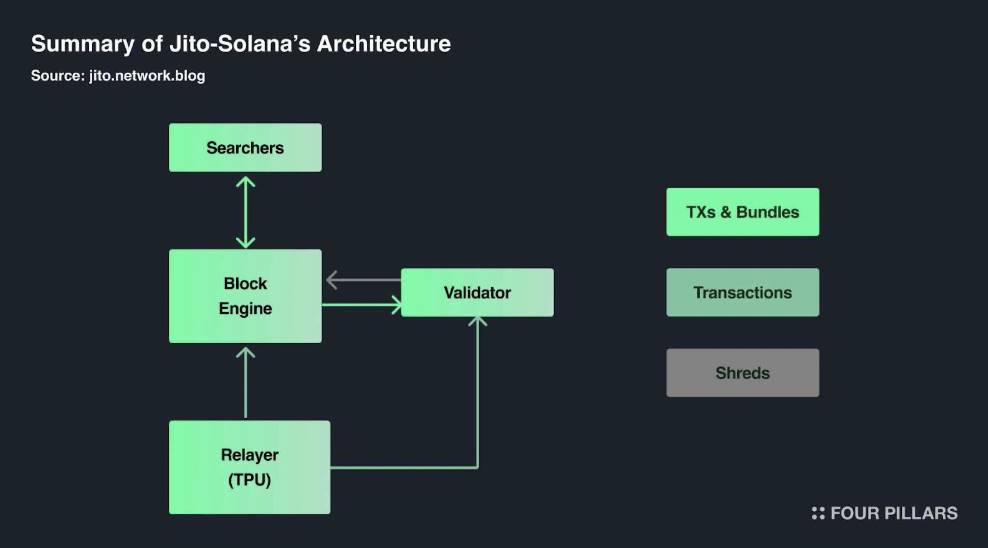
Jito-Solana launched an MEV market similar to Ethereum’s Flashbots MEV-boost solution, aiming to help searchers extract maximum extractable value (MEV) on the Solana network. However, due to Solana’s unique design (no public mempool, primarily first-come-first-served transaction processing, and much faster block times than Ethereum), Jito-Solana operates differently.
To adapt to Solana’s unique characteristics, Jito’s MEV client introduced a virtual transaction pool, auctioning every 200ms to smoothen MEV extraction. In Jito-Solana, searchers can view and simulate transactions via the Block Engine. After building the most profitable transaction bundle, they connect via a dedicated pipeline to the leader node. Since bundle and block auctions occur off-chain, failed attempts don’t significantly congest the network.
Source: explorer.rated.network
Since its August 2022 launch, Jito-Solana’s adoption has steadily grown, reaching about 40% by September 7, 2024.
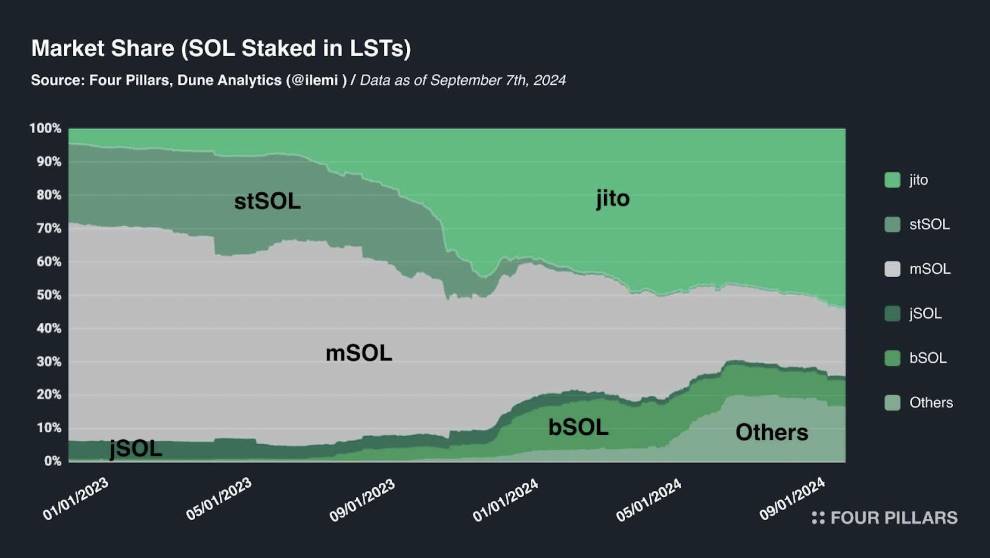
Besides MEV solutions, Jito launched a liquid staking mechanism (JitoSOL), distributing MEV earnings to users and promoting DeFi ecosystem expansion.
* Block Engine charges a 5% fee on MEV profits allocated to validators or JitoSOL stakers. According to this analytics dashboard, validators' cumulative tips reached ~1,471,989 SOL by September 7, 2024, while Jito Labs earned ~77,473 SOL.
4.2.2 Firedancer
Firedancer is a brand-new Solana validator client developed by Jump Crypto, completely rewriting Solana Labs’ original client in C. Its goal is to enhance performance through software optimization while increasing validator client diversity in the Solana ecosystem. Currently, Firedancer has been tested on testnet using a hybrid client named “Frankendancer,” combining the latest runtime and consensus modules of the existing client with Firedancer’s architecture.
Firedancer’s first demo occurred at Breakpoint in November 2022, showcasing its ability to process 1.2 million transactions per second (600k de-duplicated). On September 21, 2024, Firedancer’s second version demonstrated again its capability to process 1 million transactions per second in a controlled environment and announced it’s now live on mainnet in “non-voting mode.”* The Firedancer team stated they’ll move it to production level after adding more features, optimizations, and completing security audits.
* That is, although Firedancer participates in transaction communication on Solana mainnet and exchanges messages via gossip protocol, it currently doesn’t directly generate blocks.
Source: Syncracy
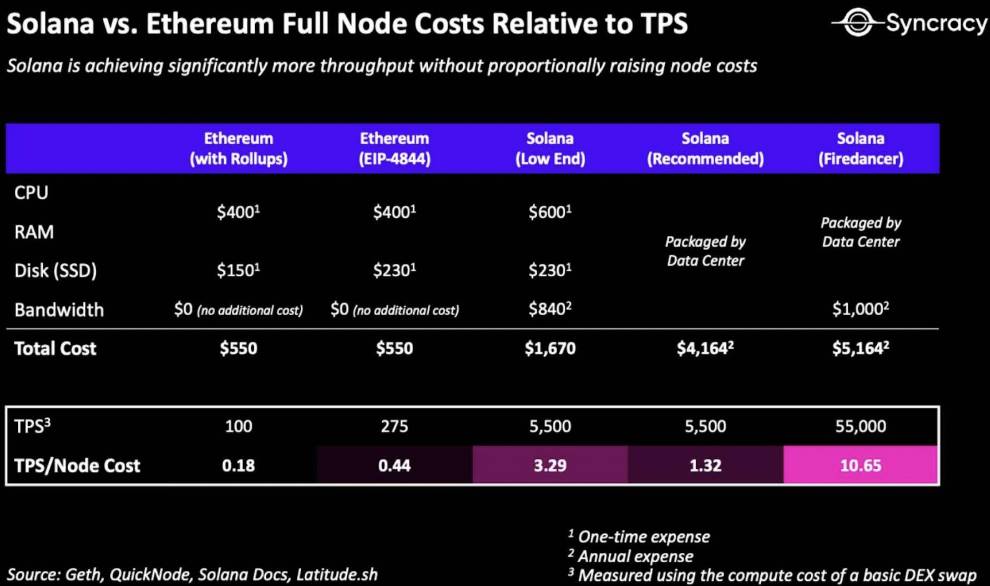
According to Syncracy’s "Solana Thesis - The Fastest Steed Reborn from Ashes" report, using Firedancer might slightly increase node operating costs, but its throughput of ~55,000 transactions per second achieves a very competitive “transactions per second / node cost” ratio.
The main architectural difference between Firedancer and existing clients is that Firedancer adopts a modular design, splitting each program into many independent “Tiles” modules for optimization. This design helps Firedancer avoid downtime possible in the current Solana network due to specific feature errors or upgrades and allows more flexible module-by-module optimization and upgrades.
** Finally, note that we must observe when Firedancer officially launches. If its performance is significantly superior to existing clients, node operators might favor Firedancer, potentially weakening client diversity in practice.
4.2.3 Tinydancer
Source: Tinydancer
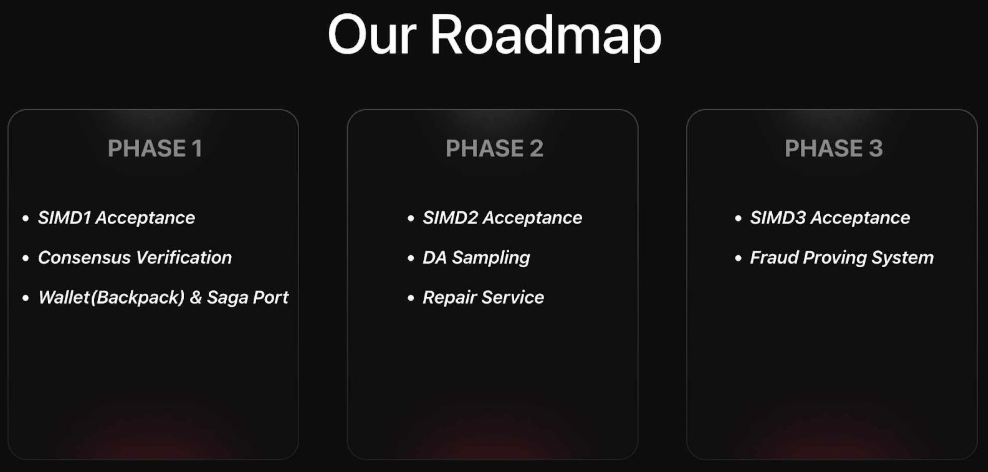
Solana’s lack of lightweight client functionality forced users to run full nodes for state verification, limiting its validation capability. To solve this, the under-development lightweight client Tinydancer enables low-cost transaction verification without downloading entire blocks or executing full transactions. When detecting suspicious transactions, it alerts dependent full nodes.
With rising hardware demands for running Solana nodes, introducing lightweight clients like Tinydancer could become a crucial milestone enhancing Solana’s node operation accessibility and verifiability.
Although Tinydancer’s final design is still being refined (its SPV client successfully launched on testnet in May), whether Solana can truly provide practical verification capabilities to a broader user base and achieve “decentralization through affordable verification” remains to be seen.
4.2.4 Agave & Sig
Additionally, Anza’s Agave improves existing Solana network performance by forking Solana Labs’ client and actively supports other clients (like Firedancer). Syndica’s team is developing the Sig client, written in the low-level language Zig, emphasizing readability and simplicity.
In short, ensuring blockchain network client diversity is crucial—it eliminates single-point failure risks from relying on one client software and allows various experiments in different environments (e.g., programming languages) to optimize network performance. While we must observe how emerging and existing clients will further enhance Solana’s performance and scalability, such initiatives are undoubtedly positive developments for the network.
4.3 Frameworks and Standards Committed to Simplicity and Flexibility
Besides the robust tech stack mentioned above, Solana provides developers with rich toolkits and standards to support efficient and effective development of various applications on the Solana platform.
The Solana Program Library (SPL) is a collection of on-chain programs developed by the Solana team and community, serving as a standard library for Solana developers. It includes pre-built programs and utilities like token creation and management (SPL Token Program), token swaps, lending protocols, etc., facilitating decentralized app development on the Solana blockchain.
The Anchor framework is especially popular among new developers or those wanting to prototype and deploy apps quickly. It offers a Rust-based DSL, IDL, testing framework, and a full suite of security tools.
The GameShift framework focuses on simplifying blockchain game creation, supporting features like in-game NFT markets.
UI frameworks like Scaffold and Wallet-Adapter allow developers to easily build front-end pages and integrate wallets within the Solana ecosystem.
Additionally, logging tools like Geyser, Sologger, and IronForge, richer program testing environments via BankRun.js, and a web-based IDE called Solana Playground are available. Numerous other documents, frameworks, and tools exist within the Solana ecosystem for developers.
Given the breadth of these frameworks, the following focuses on standards and sub-frameworks highlighting Solana’s uniqueness or worth anticipating.
4.3.1 Token Extensions
Ethereum provides an environment allowing free proposals of various token standards, whereas Solana is less flexible in extending standard functionalities due to its single SPL token standard, which has more built-in logic constraints. However, as blockchain evolves, enterprise demand for complex token functionalities meeting regulatory, legal, or compliance requirements grows rapidly. Thus, Solana and the Anza team developed a new set of protocol-layer token standards called “Token Extensions.”
The core of this new standard is adding configurable features to existing SPL tokens, supporting various use cases without extra libraries. Token Extensions come in two types: 1) Mint Extension and 2) Address Extension.
Mint Extensions expand token functionality, such as Transfer Hooks (automatically executing programs upon token transfer based on set conditions), Transfer Fees (directing fees to specified accounts), richer Metadata, non-transferable tokens, and confidential transfers. Address Extensions include account management features like Immutable Owner (preventing reassignment of account ownership) and Default Account State (requiring specific project interactions to use the account and assets).
A detailed research report covers these features and use cases. Functionally, Token Extensions realize standards discussed or adopted in Ethereum’s ERC standards but still don’t cover Ethereum’s entire standard scope. However, the key difference lies in implementation at the protocol layer rather than the application layer. Though seemingly simple, this brings huge advantages—developers can freely configure Token Extensions and build apps quickly without worrying about cross-application compatibility. (We’ve observed Ethereum’s ERC-4337 account abstraction standard, deployed at the application layer, gaining increasing popularity, with entities using ERC-4337 in increasingly fragmented ways.)
Token Extensions have yielded significant results. As mentioned earlier, thanks to Token Extensions, PayPal successfully launched on Solana in May. Additionally, Libre Capital used Token Extensions to launch institutional funds on Solana, allowing Solana users to access diverse fund products like Hamilton Lane’s SCOPE Fund, Brevan Howard’s flagship fund, and BlackRock ICS money market fund within the on-chain environment.
4.3.2 Executable NFTs (xNFTs)
Users familiar with blockchain activities may have experienced the complexity and inconvenience of connecting wallets to third-party websites to interact with different applications or manage assets. This standard allows executable code to be injected directly into assets, eliminating this security vector and turning assets into single, extensible applications with multiple functions.
xNFTs, developed by Coral for the Solana blockchain, represent “executable” assets or code. Briefly, code implemented via xNFT plugins transforms into functional Web3 application assets.
Coral developed “Backpack,” a unified wallet environment where xNFTs can organically collaborate. In other words, all Web3 apps built as xNFTs can essentially run within the Backpack wallet. Thus, Backpack users can seamlessly experience various integrated apps (i.e., xNFTs) within this super-app-like wallet without additional separate connections or conversions.
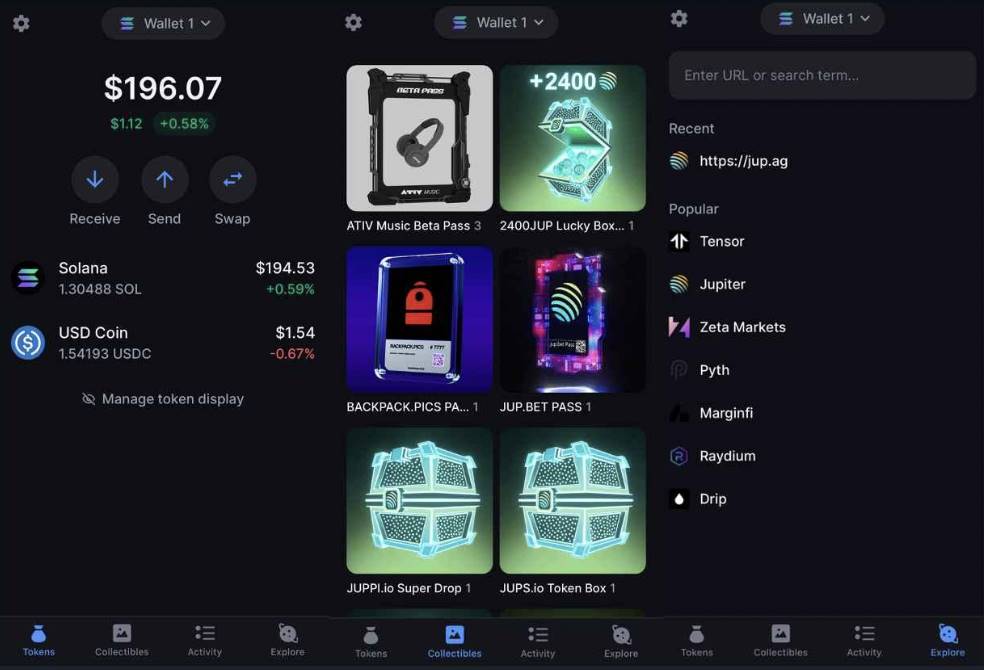
Source: Backpack Mobile App
Currently, about 90 apps have been released in xNFT format, covering gaming, NFTs, DeFi, and more. Backpack and the xNFT standard are fully open-source, developed on React architecture. If more xNFT apps launch and support multiple blockchains in the future, these standards could bring significant UX innovations to the decentralized app market.
4.3.3 Programmable NFTs (pNFTs)
In NFT trading, royalties are crucial for compensating creators, enabling them to continue creating. However, consumers often prefer buying assets at the lowest price, naturally favoring lower royalties. Examples of this “royalty dilemma” appear in past market share battles like OpenSea vs. Blur or Yawww vs. Magic Eden.
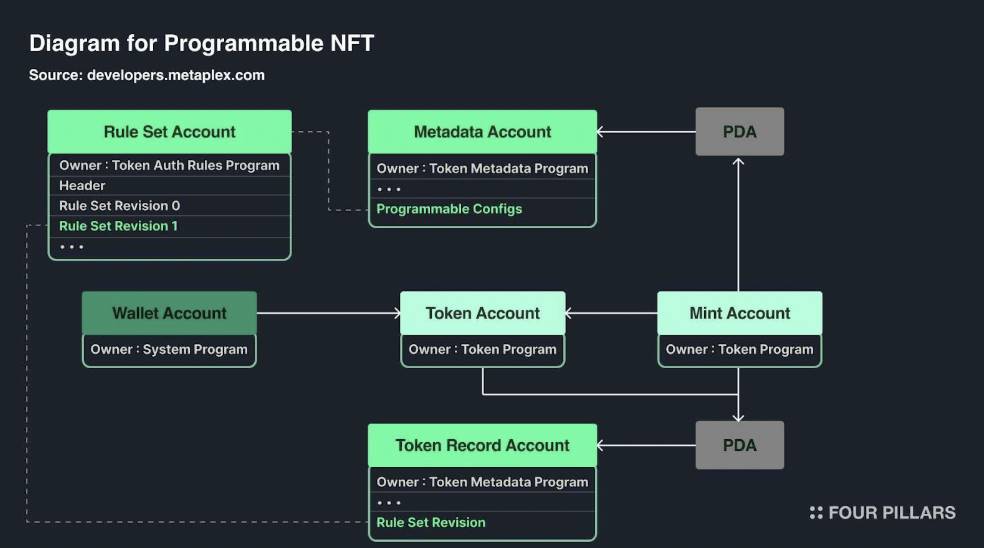
To address this, the Metaplex team launched a new standard called Programmable NFTs (pNFTs) in February 2023. The core concept of pNFTs is allowing developers to set custom rules that must be satisfied before specific operations on the pNFT can be executed. In other words, if developers implement NFTs as pNFTs (or migrate existing NFTs to pNFTs), they can indirectly enforce royalty mechanisms by specifying which programs are allowed to transfer their NFTs.
4.3.4 State Compression (cNFT)
Storing data on the Solana network requires opening a token account and paying rent. While the cost of publishing small amounts of data may be negligible, it becomes problematic with large volumes. To solve this, Solana Labs’ account compression technology, combined with Metaplex’s Bubblegum program, introduced the “State Compression” solution.
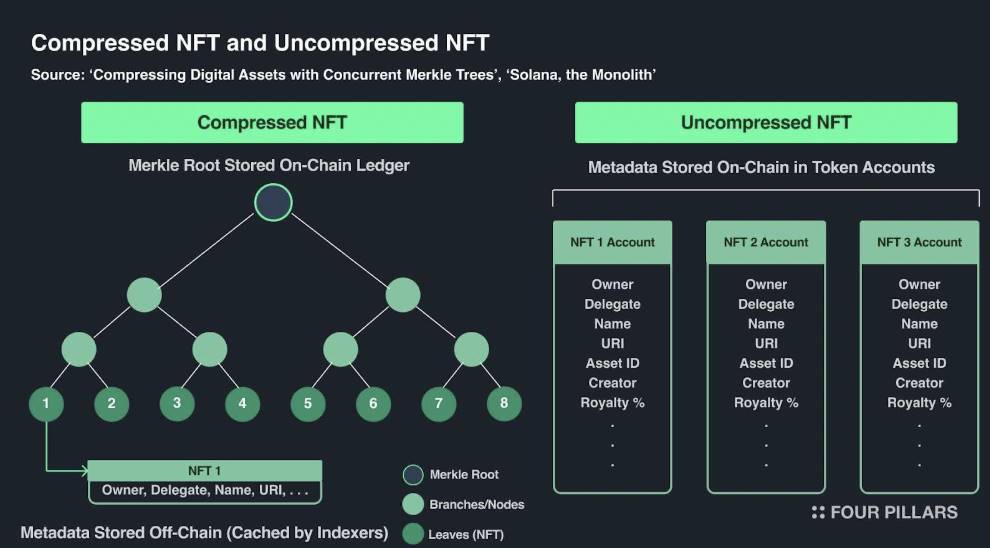
State Compression uses a Merkle tree structure to hash metadata of each asset at leaf nodes, apply this structure, and store the resulting root hash atop the ledger. This allows cheaper blockchain ledger space instead of expensive account space to securely store data—especially suitable for NFTs due to its bulk information management nature.
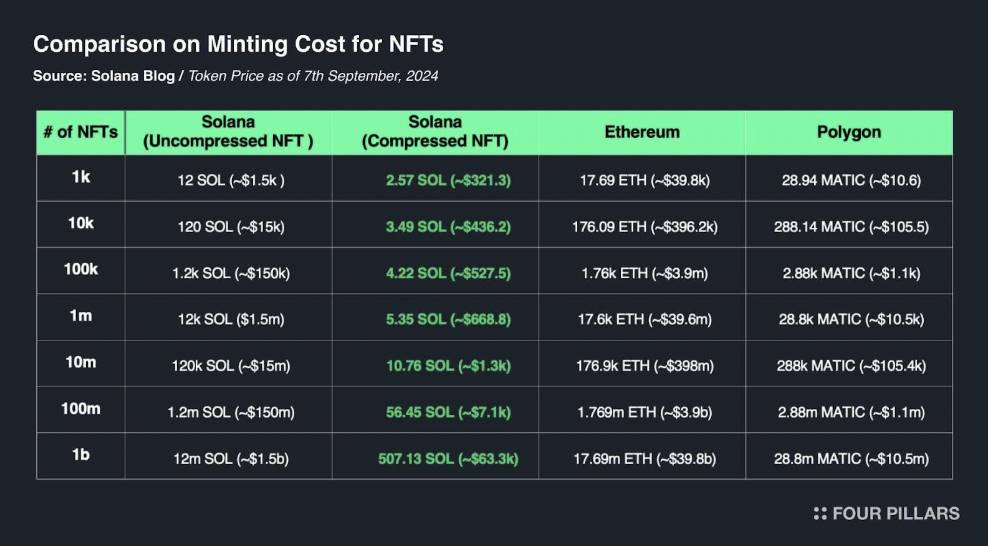
Thus, compressed NFTs (cNFTs) follow the same metadata architecture as uncompressed NFTs, but they themselves aren’t SPL tokens; they only contain identifiers for potential decompression, used in future decompression processes. Converting cNFTs to standard Solana NFTs is a one-way process enabled by Metaplex’s Bubblegum program.
However, since cNFT data is stored off-chain, a separate program is needed to define interaction methods, and this process relies on RPC providers, potentially incurring extra costs. Therefore, modifying cNFTs can be complex and costly, such as requiring cryptographic proof of permission to change off-chain data.
4.3.5 ZK Compression Technology
Source: zkcompression.com
ZK Compression, developed jointly by Light Protocol and Helius teams, combines zero-knowledge proofs (ZKPs) with state compression to reduce state size. This technology focuses on dramatically lowering operational costs for data and accounts on the Solana network and creating an environment for developing more complex ZK-friendly applications (e.g., authentication protocols).* Briefly, state compression inserts compressed states into transactions via Merkle tree structures, while ZK compression includes ZK-SNARK-based proofs** in transactions.
Similar to state compression, ZK compression generates proofs off-chain, while proof verification occurs on-chain. Once verified, the proof is treated as a regular account and can update state via related transactions.
* ZK Compression officially launched on Solana mainnet on September 18, 2024.
** In contrast, Merkle proof size increases logarithmically with account count (log₂(N)), while ZK-SNARK proof size remains constant regardless of account numbers—giving ZK compression a clear advantage when handling large account volumes. For N=8, log₂(8)=3; for N=1024, log₂(1024)=10; meanwhile, ZK-SNARK proof size stays fixed.
4.3.6 Solana Permissioned Environments (SPE)
Source: solana.com
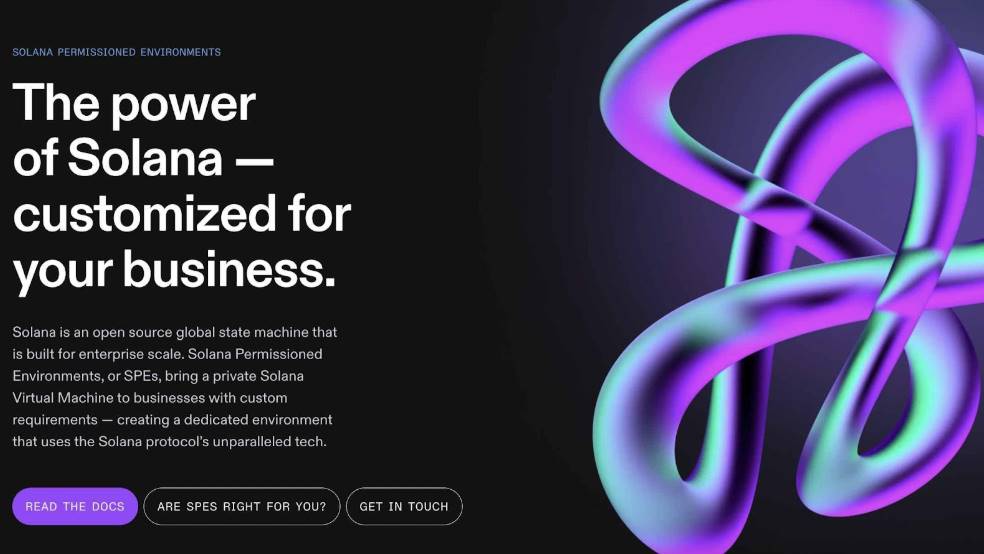
Due to SVM’s superior transaction processing capabilities compared to other L1s, more projects want to build ecosystems on the SVM execution environment without sharing Solana’s composability, ledger data, or other infrastructure components. This architecture, often called “app chains,” can be established by forking SVM either permissionlessly or permissioned.
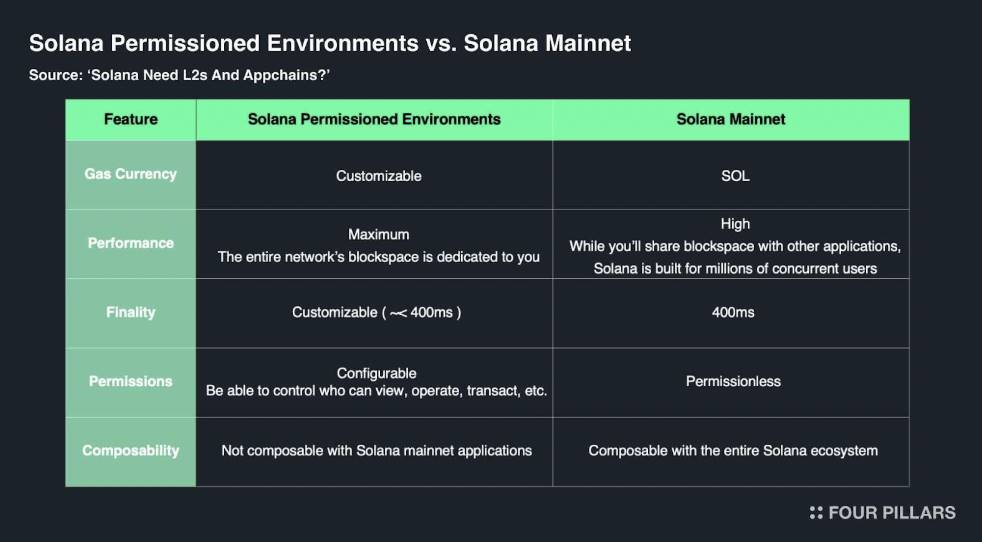
Solana provides a framework called SPE (Solana Permissioned Environments) for the latter, catering to specific enterprise use cases, especially those with unique business, security, and regulatory requirements. By leveraging SPE, enterprises can customize their infrastructure stack, including consensus mechanisms, validator configurations, gas tokens, etc.
Notable projects using SPE include:
Cube.Exchange: A hybrid exchange achieving off-chain order matching via MPC technology and on-chain settlement.
Pyth Network: An oracle solution aggregating various financial data to provide real-time pricing and benchmarks.
Rimark: An RWA (real-world assets) project.
4.3.7 Solana Pay
Source: Solana Pay Docs
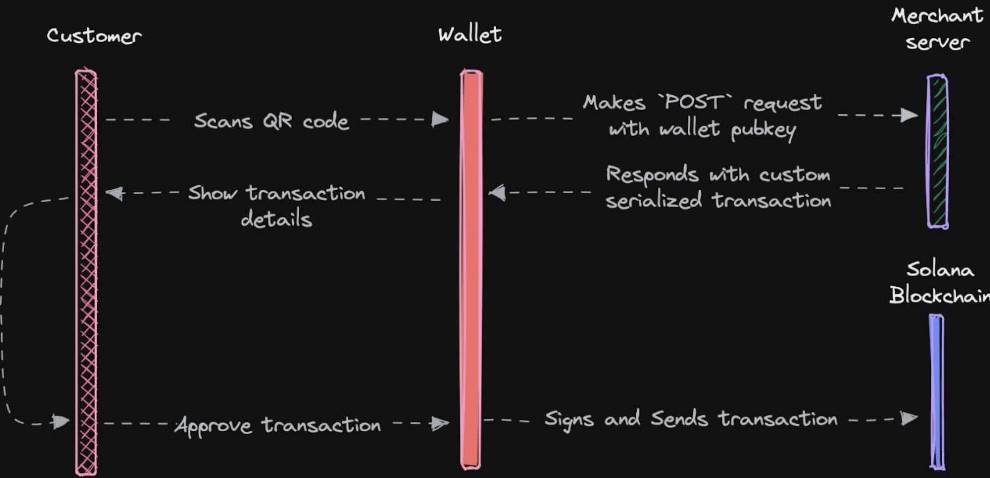
Solana Pay is an open-source JavaScript library focused on simplifying cryptocurrency payment processes on the Solana blockchain. It uses URL formats for token transfers, enabling merchants or developers to accept SOL or SPL token payments directly without intermediaries. Solana Pay offers various integration options, including payment links, “Pay Now” buttons, or QR codes.
Source: Yash Agarwal
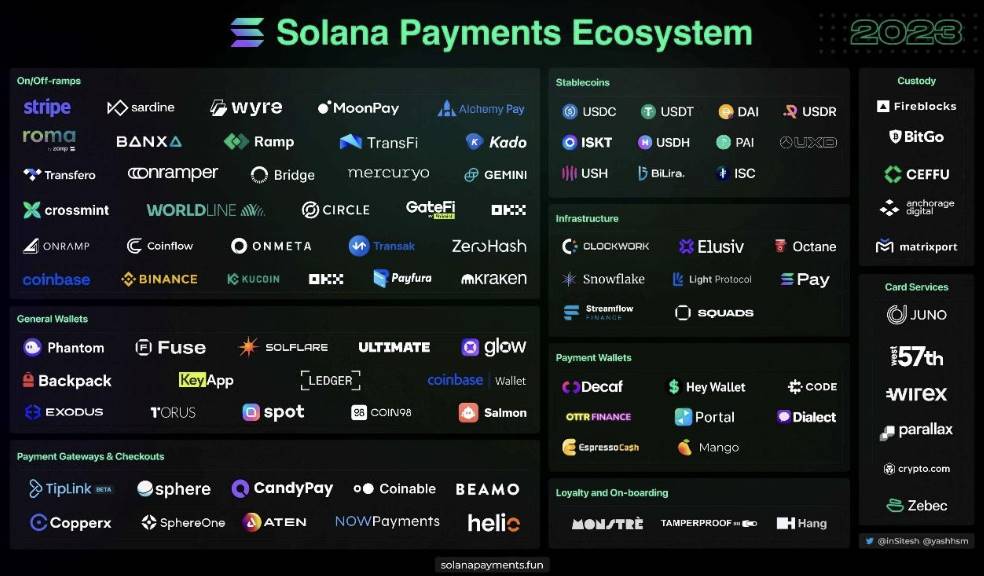
As previously mentioned, Solana Pay plugins are integrated into platforms like Shopify, Citcon, and Checkout.com and adopted by over 100 businesses and projects.
4.3.8 Solana Mobile Stack (SMS)
Source: SMS Docs
Solana Mobile Stack (SMS) is an open-source SDK provided by the Solana Foundation, designed for developing apps on Saga and Seeker series mobile devices. SMS includes the following main components:
Solana dApp Store: A dedicated store for decentralized applications, letting users easily explore and use various apps and rewards, with the ultimate goal of community-managed content.
Mobile Wallet Adapter: A standardized interface enabling smooth communication between apps and Solana wallets in mobile environments. Developers integrating once can easily connect multiple compatible mobile wallets. Currently, it supports only Android and Chrome on mobile (Android only).
Seed Vault: Designed to work with “wallet” apps, this suite secures users’ private keys and other critical information. All apps downloaded on mobile devices can share the same seed—Seed Vault was co-developed by Solflare and Seeker teams and built into Seeker series devices.
Solana Pay for Android: A payment system using the Solana blockchain, enabling users to easily pay with Solana-related cryptocurrencies (e.g., SOL, SPL) in mobile environments. Currently supporting only Android SDK, it executes Solana Pay requests via QR codes, NFC taps, messages, and web browser interactions to capture Solana Pay URLs.
Besides these kits, SMS documentation provides SDKs in various languages/frameworks
Join TechFlow official community to stay tuned
Telegram:https://t.me/TechFlowDaily
X (Twitter):https://x.com/TechFlowPost
X (Twitter) EN:https://x.com/BlockFlow_News
 Four Pillars