
2024 Crypto AI Sector Narrative Evolution: From Decentralized GPU, Data, and Other Infrastructure to AI Agent
TechFlow Selected TechFlow Selected
2024 Crypto AI Sector Narrative Evolution: From Decentralized GPU, Data, and Other Infrastructure to AI Agent
The total market capitalization of the encrypted AI asset sector has surpassed $70 billion this year, with over 600 related projects.
 Navigating Web3 tides with focused insights
Author: Xiyu, ChainCatcher
Editor: Nianqing, ChainCatcher
In 2024, the "Crypto+AI" (crypto AI) sector achieved unprecedented breakthrough growth. At the beginning of the year, this field consisted of only a handful of projects; today, it has become an independent and significant segment within the cryptocurrency market.
According to the latest data compiled by ChainCatcher, on December 7, the total market capitalization of the crypto AI sector surpassed $70 billion, peaking at over 2% of the entire crypto market, with an annual growth rate reaching as high as 400%.
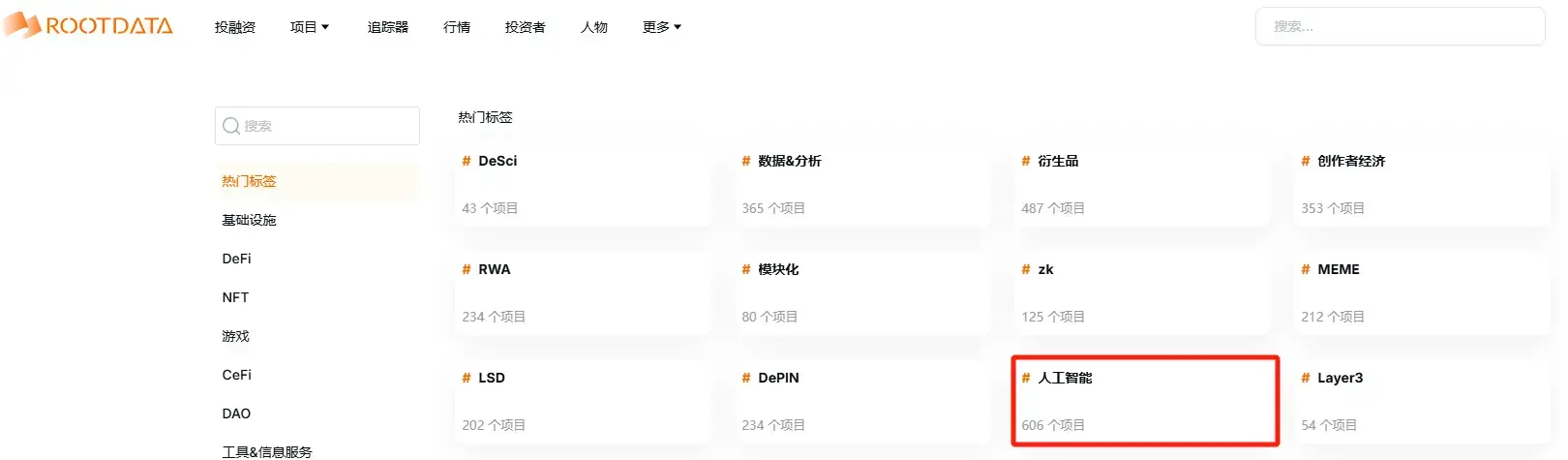
At the same time, the number of crypto AI projects has exploded, now exceeding 600, spanning multiple categories such as decentralized AI infrastructure and AI Dapps.
Looking back at 2024, the narrative around crypto AI underwent several major shifts. Early in the year, OpenAI's launch of Sora ignited speculation around crypto AI infrastructure. Later, NVIDIA’s AI conference brought decentralized GPU networks into the spotlight, prompting investors to focus on decentralized AI infrastructure. Mid-year, investment surged in the crypto AI space, with major crypto VCs announcing strategic moves and funding numerous projects, accelerating technological development and real-world applications. By year-end, the explosion of AI Agent Memes pushed the crypto AI narrative to new heights.
Crypto AI Total Market Cap Surpasses $70 Billion in 2024; Over 600 Projects Now Active
According to the latest data from CoinMarketCap, there are currently 355 tokens listed under the Crypto*AI category. On December 7, the total market cap of these assets exceeded $70 billion, briefly peaking at $70.42 billion. However, due to broader market corrections, as of December 23, the crypto AI sector’s total market cap had declined to $47 billion—though its 24-hour trading volume remained robust at $5 billion.
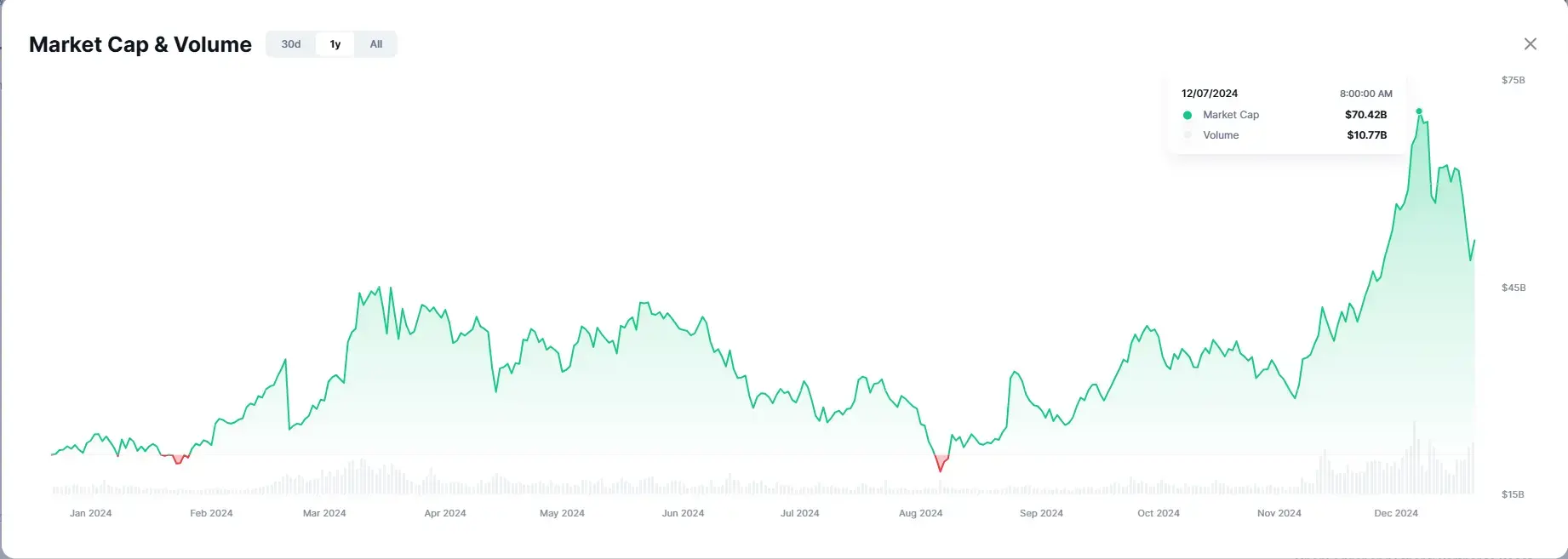
At the start of the year, the total market cap of the crypto AI sector stood at just $17 billion. Achieving more than 400% growth in less than a year once again highlights the rapid expansion and immense potential of the crypto AI domain.
Daniel Cheung, co-founder of Syncracy Capital, stated on December 12 that although the current crypto AI sector accounts for only about 1% of the overall crypto market cap, driven by the rising momentum in AI infrastructure and AI Agents, he expects the sector’s market cap could grow tenfold as the market cycle progresses.
Notably, despite the general market downturn, the total market cap of the entire crypto market reached $3.4 trillion on December 23, with crypto AI assets still accounting for nearly 1.4% (up to over 2% during peak periods), further underscoring their long-term growth potential.
2024 marked a pivotal turning point for crypto AI—from emergence to full-scale breakout. At the beginning of the year, the sector was still in its infancy, with only a few notable projects like Render (RNDR), Fetch.ai (FET), and Worldcoin leading the way. But within less than a year, the crypto AI landscape evolved into multiple sub-sectors, including decentralized GPUs, AI data platforms, AI infrastructure, and AI Agents, encompassing hundreds of projects.
According to Rootdata, a blockchain data platform, there are now over 600 crypto projects tagged with AI-related keywords—and this number continues to rise.
2024 Crypto AI Catalysts: External Forces Like OpenAI, VC Funding Surge, and AI Agent Meme Explosion
From a market cap trend perspective, crypto AI experienced two distinct peaks in 2024: the first between February and March, and the second emerging after October, marking an even stronger growth wave.
The February–March surge was primarily fueled by two landmark events in the AI world.
In February, OpenAI unveiled Sora, its groundbreaking text-to-video model, which triggered a transformative shift in the AI industry. This event also significantly boosted the price of WLD, the token of Worldcoin—an iris-recognition crypto project led by OpenAI co-founder Sam Altman—driving strong momentum across the entire crypto AI asset class. During this period, high-potential projects such as Bittensor (TAO), an incentive platform for AI models, and Arkham (ARKM), an AI-powered data intelligence platform, began attracting widespread market attention. Their rise further intensified investor enthusiasm, drawing substantial capital into this promising new frontier.
Shortly after, in March, NVIDIA's annual GTC AI conference captured global attention, propelling its market valuation to new highs and sparking a frenzy around GPU chips. The event featured prominent figures from the crypto space, including Illia Polosukhin, co-founder of Near, and Jules Urbach, founder of Render Network, reinforcing the growing synergy between crypto and AI. These developments catalyzed a surge in decentralized GPU projects, with io.net—one of the most talked-about platforms—launched during this period.
Since then, crypto AI has solidified itself as an independent vertical, with a proliferation of projects focused on decentralized GPUs, AI data, and AI infrastructure, creating abundant opportunities for innovation and investment.
The second major growth phase occurred in October, driven largely by the explosive rise of AI Agent Memes. The sudden emergence of GOAT, the token of AI Agent project Truth Terminal, sparked a wave of meme coin launches tied to AI Agents, resulting in nearly 100 AI Agent-themed tokens entering the market. This trend rapidly elevated AI Agents into a standalone niche within the crypto AI ecosystem, encompassing AI Agent meme coins, IAO (Initial Agent Offering) launchpads, and foundational infrastructure layers. For a detailed overview, refer to ChainCatcher’s November report: *Mapping the AI Agent Landscape: AI Memes, Launch Platforms, and Infrastructure*. According to Coingecko, as of December 23, the total market cap of AI Agent tokens reached $9.8 billion—approximately 20% of the overall crypto AI market cap ($47 billion)—with speculative interest continuing to build.
If OpenAI’s Sora, NVIDIA’s soaring valuation, and its AI summit served as external catalysts driving the growth of crypto AI, the AI Agent Meme boom represented an internal spark within the crypto ecosystem, accelerating adoption and visibility. Under the combined influence of these internal and external forces, the crypto AI sector has quickly risen to become an indispensable part of the digital asset landscape.
Additionally, 2024 saw an unprecedented investment surge in the crypto AI market, with top-tier institutions aggressively expanding their presence. Leading crypto VCs—including Grayscale, Delphi Ventures, Coinbase Ventures, Binance Labs, and a16z—have all made strategic investments in "Crypto+AI" initiatives.
Delphi Ventures expressed strong confidence in the convergence of crypto and AI early in the year, backing key projects such as io.net, OG Labs, and Mythos Ventures. a16z launched a $6 billion fund dedicated to AI and selected five crypto AI startups for its fall crypto accelerator cohort. In the second half of the year, Pantera Capital, Grayscale, Binance Labs, and Coinbase Ventures followed suit, launching dedicated funds or increasing allocations to the sector. As reported by Messari, in Q3 2024 alone, crypto venture capital poured over $213 million into AI projects—a 250% increase quarter-on-quarter and a 340% year-on-year jump.
For a comprehensive breakdown of how major VCs have positioned themselves in the crypto AI space, see ChainCatcher’s in-depth analysis: *2024 Crypto VC AI Investment Review: What Projects Did a16z, Binance, Coinbase, and Others Back? | Year-End Roundup*.
"Crypto for AI" Holds Greater Market Potential Than "AI for Crypto"
Currently, crypto AI products can be broadly categorized into two paradigms: "AI for Crypto" and "Crypto for AI".
The former—"AI for Crypto"—refers to leveraging AI to enhance crypto applications. It focuses on integrating AI capabilities into blockchain products to improve user experience or strengthen performance. Examples include: using AI for code optimization and security audits to automatically detect vulnerabilities in Web3 projects; deploying AI algorithms to analyze market trends and user behavior for better on-chain yield strategies; incorporating AI chatbots to answer user queries and enhance engagement; and utilizing AI Agents to streamline on-chain interactions such as automated trading and portfolio management, making crypto participation more accessible.
"Crypto for AI", on the other hand, emphasizes using blockchain technology to empower the AI industry by addressing structural challenges through decentralization. For instance, blockchain’s combination of privacy and transparency can help resolve data security and confidentiality issues during AI model training; tokenization allows communities to collectively own or access AI models via decentralized governance; and blockchain-based token economies can aggregate idle computing power into efficient, open markets—reducing AI training costs and improving resource utilization.
In essence, the core strength of Web3 lies in its decentralized architecture, powered by token economics, self-executing smart contracts, and distributed systems. This framework ensures clear data ownership while enhancing business model transparency and efficiency through incentive mechanisms. This serves as a powerful remedy for persistent problems in the AI industry—such as opaque data sourcing and unclear monetization models—aligning perfectly with the broader vision that “AI enhances productivity, while Web3 optimizes production relationships.”
As a result, industry experts widely agree that “Crypto for AI” offers far greater market potential than “AI for Crypto.” This trend is increasingly motivating insiders from the traditional AI sector to explore blockchain solutions to overcome existing technical and economic barriers.
Building a Crypto AI Ecosystem Around the Three Pillars of AI: Data, Compute, and Algorithms
Based on the three core components driving large AI models—data, compute, and algorithms—the crypto AI ecosystem can be further segmented into infrastructure and application layers across these domains. Data forms the foundation for training and refining AI models; algorithms represent the mathematical logic powering AI systems; and compute refers to the computational resources required to execute these algorithms—all three being essential for continuous model iteration and improvement.
The current landscape of crypto AI product offerings includes the following:
On the **data** front, crypto AI data projects focus on collection, storage, and processing. To ensure data diversity and richness, some projects use token incentives to encourage users to share private or proprietary data. For example, Grass rewards contributors for providing browsing data; Sahara AI tokenizes AI training datasets and operates a dedicated data marketplace; Vana aggregates data pools to offer tailored datasets for AI applications. For data labeling, decentralized platforms like Fraction AI (which raised $6 million on December 18), Alaya AI, and Public AI provide high-quality annotated datasets, improving reinforcement learning and fine-tuning processes. For secure and permanent storage, Filecoin and Arweave offer decentralized solutions.
On the **compute** side, training and running advanced AI models require massive GPU resources. As model complexity grows, so does demand for high-performance GPUs—leading to supply shortages, rising costs, and longer wait times. Decentralized GPU networks address this by creating open marketplaces where individuals (including Bitcoin miners) can contribute idle GPU capacity to perform AI workloads and earn tokens in return. Key players include Akash, Render, Gensyn, io.net, and Hyperbolic. Projects like Exabits and GAIB go a step further by tokenizing physical GPUs, transforming them into liquid digital financial assets and enhancing the mobility and accessibility of computational power.
Regarding **algorithms and models**, decentralized AI algorithm networks function as open marketplaces connecting diverse AI models with specialized capabilities. When a query is submitted, the network selects the optimal model to generate a response. Bittensor exemplifies this model, organizing AI models into subnets to deliver high-quality outputs. Pond uses a competition-based scoring system to identify top-performing decentralized models and incentivizes contributors by tokenizing each model, thereby fostering innovation and continuous improvement in AI algorithms.
Thus, the crypto market has already established a vibrant ecosystem centered around the three pillars of AI—data, compute, and algorithms.
What Are the Outlook and Opportunities for Crypto AI in 2025?
Since the rise of AI Agent Memes in October, related products have become the new darlings of the crypto AI market. For instance, Talus Network, which raised $6 million in a $150 million-valued round in November, is building a dedicated framework and infrastructure specifically for AI Agents.
Moreover, the AI Agent Meme trend has not only created fresh speculative excitement but also shifted market focus from foundational areas like decentralized data and GPU infrastructure toward AI Agent applications. Tokens like ai16z have already surpassed a $1 billion market cap, and the momentum shows no signs of slowing.
In recent 2025 outlook reports published by leading firms—including a16z, VanEck, Bitwise, Hashed, Blockworks, Messari, and Framework—there is broad consensus on the continued growth of the intersection between crypto and AI, with particular emphasis on the expected breakout of AI Agent-related products in 2025.
Meanwhile, mainstream AI developments continue to gain steam. On December 23, Elon Musk’s AI company xAI announced a new $6 billion funding round, catapulting its valuation to $40 billion and further fueling optimism across the AI sector.
Narratively, OpenAI is transitioning from GPT models toward general-purpose AI Agents. Reports indicate that OpenAI plans to launch a new AI Agent product called “Operator” in January 2025, capable of autonomously performing complex tasks such as coding, travel booking, and e-commerce purchases. Much like Sora did in early 2024, Operator is expected to ignite another wave of excitement across both AI and crypto markets. Additionally, NVIDIA’s annual AI summit is scheduled for March 2025, once again positioning it as a focal point for both industries.
Each major update from Web2 AI giants like NVIDIA and OpenAI tends to reignite interest in the AI sector, attracting fresh capital and amplifying momentum in the crypto AI space.
On the policy front, U.S. President-elect Donald Trump has appointed David O. Sacks, former PayPal executive, as White House lead for artificial intelligence and cryptocurrency affairs. A seasoned investor with dual expertise in both crypto and AI—including stakes in Multicoin and various AI startups—Sacks is expected to advocate policies that support the integration of AI and blockchain technologies, potentially accelerating regulatory clarity and institutional adoption.
Join TechFlow official community to stay tuned
Telegram:https://t.me/TechFlowDaily
X (Twitter):https://x.com/TechFlowPost
X (Twitter) EN:https://x.com/BlockFlow_News
 ChainCatcher 链捕手