2024 NFT Awards: From Leading Meme Trends to Coin Launches Completing the "Final Dance"
TechFlow Selected TechFlow Selected
2024 NFT Awards: From Leading Meme Trends to Coin Launches Completing the "Final Dance"
Writing and suddenly crying, crying and then laughing again—this is the most authentic portrayal of NFT players this year.
 Navigating Web3 tides with focused insights
Text: Wenser, Odaily Planet Daily
As the year draws to a close, the crypto industry is also entering its own "year-end review season." Compared to trending sectors such as AI, Meme, and DeSci, NFTs have undoubtedly seemed somewhat downcast. If not for the recent launch of PENGU tokens by the chubby penguin project, many might be questioning whether an NFT bull market ever truly existed.
Looking back at 2024 as a whole, it has been nothing short of tumultuous for the NFT sector. Despite this, NFTs still undeniably hold a place in the crypto market—serving as a trendsetter and a constant presence throughout. In this article, Odaily Planet Daily will walk readers through a series of representative events from the 2024 NFT landscape, revisiting this emotionally charged year filled with both love and frustration toward NFTs.
First Half of 2024: A Dreamy Start and the "King of Memes"
Reflecting on early 2024, many NFT enthusiasts would describe it as a "dream start."
Following a wave of speculation around BTC-native NFTs, market sentiment briefly warmed up. Projects like Node Monkeys and Puppet Monkeys reached prices as high as 0.5 BTC—an astonishing figure even today, especially considering Bitcoin's new all-time high of $108,000. To put it bluntly, for many Bitcoin inscription collectors, NFT traders, and later Rune speculators, constant chasing and FOMO likely resulted in “the harder you try, the more you lose,” whereas simply holding BTC might have yielded better returns.
Nevertheless, fueled by positive catalysts such as the impending approval of Bitcoin spot ETFs, the stage was finally set for what could be called "NFT’s 2024 moment." The first act featured an Ethereum-based NFT project—Tinfun.
January: Tinfun – A Top Chinese-Speaking NFT KOL’s IP Dream
As a leading KOL in the Chinese-speaking NFT community, the launch of Tinfun represented a labor of love for Laser Cat (Leishe Mao). Backed by an alpha-focused community and featuring oriental ink-wash aesthetics paired with a martial arts-themed narrative, Tinfun quickly drew significant attention.
After Azuki’s massive success, countless Chinese-speaking NFT fans hoped for an authentic representation of "Eastern aesthetics" that could rally its own dedicated following within the crypto world and prove once and for all: "Cultural wave from China reigns supreme!" Given the preview images released by the team, Tinfun appeared capable of fulfilling this ambition, raising widespread expectations. Additionally, Tinfun's mini-games gained popularity among the community, particularly during the festive Lunar New Year period when entertainment demand surged. Moreover, Tinfun introduced a minor innovation to the minting process—the so-called "send-first minting" model—which eliminated gas wars and saved users from excessive transaction fees during high-demand launches.
Thanks to these favorable factors, TinFun received over 10,000 ETH (approximately $22.8 million) in deposits within less than 24 hours of its public sale on January 7. By January 8, participation had reached 25,000 ETH—2.5 times the original target—prompting an early end to the sale. The overwhelming inflow sparked skepticism among some international influencers, who speculated that Laser Cat might pull a rug pull. After all, in crypto’s trustless dark forest, human nature often fails under temptation.
But Laser Cat and his team clearly weren’t cut from that cloth. As he stated plainly: “I may fail, but I will never run.”
Post-launch airdrops and secondary market trading initially triggered strong FOMO, pushing floor prices above 0.8 ETH. However, after the reveal, concerns emerged regarding artistic quality and homogenization. Coupled with Tinfun’s ambitious yet uncertain IP development roadmap, the project ultimately succumbed to the classic NFT fate of a spiraling floor price decline.
According to data from NFTGo, Tinfun currently trades at a floor price of around 0.11 ETH, with an average sale price near 0.5 ETH, while holder count has dwindled to approximately 1,400 addresses.
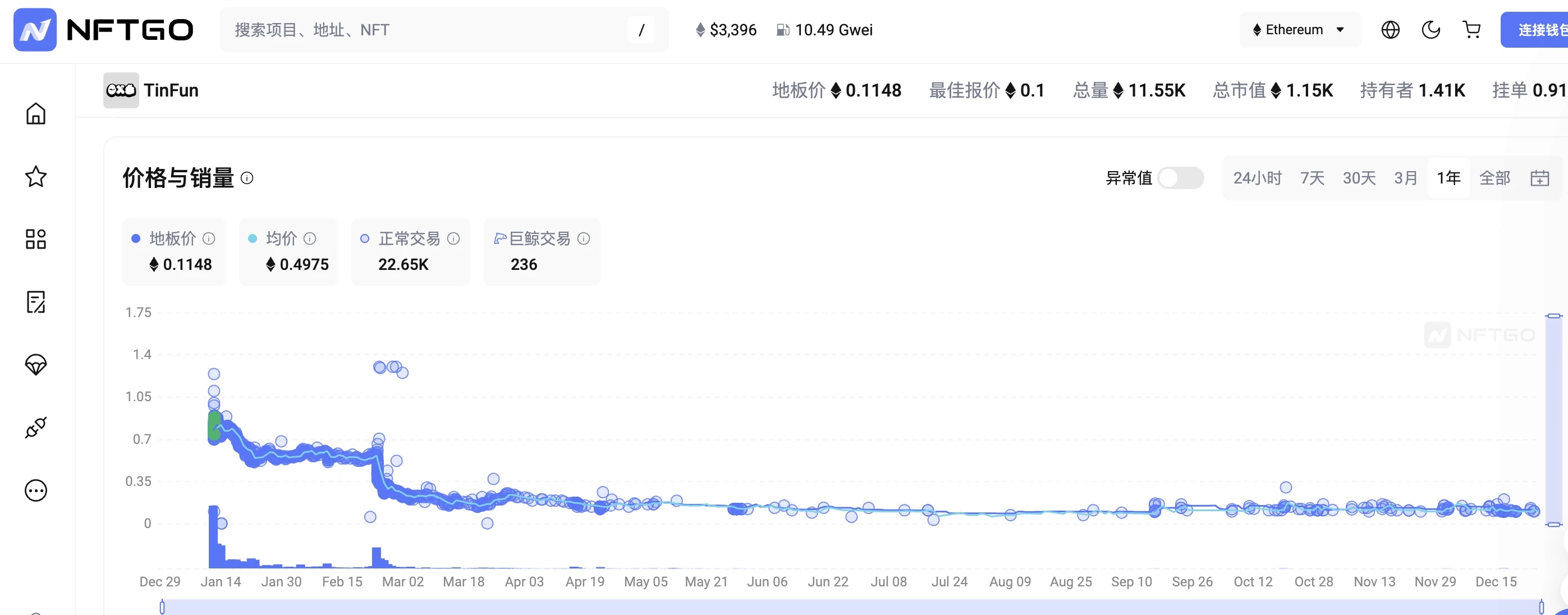
Tinfun floor price information, source: NFTGo
Notably, influenced by Blur’s third campaign and anticipation around Blast airdrops, Tinfun held a community vote in early March to migrate the project to the Blast chain. Some holders later earned Blast ecosystem golden points through various Blast-related activities. However, in terms of direct NFT value return, the benefits were minimal at best.
In hindsight, Tinfun illustrates a critical reality: NFT projects remain trapped in the "liquidity trap," unable to escape the downward spiral affecting token or NFT prices in crypto markets—especially when pursuing long-term IP development, which proves even more challenging.
February: Nobody – An NFT Community Under the “Stephen Chow Halo”
If Tinfun gave NFTs a strong start in 2024, then Stephen Chow’s NFT project Nobody emerged as another celebrity-backed sensation riding the momentum.
The project spanned over half a year. Initially named Moonbox—a nod to the iconic movie prop from Chow’s classic film Journey to the West: Conquering the Demons—it was later rebranded as Nobody to strengthen community identity. Community members even created songs and artworks inspired by the name. Following Tinfun’s successful “send-first minting” model, Nobody adopted the same approach and completed its launch successfully.
More impressively, post-launch, Nobody’s floor price surged nearly fivefold, briefly exceeding 0.9 ETH on February 5, with trading volume reaching 2,500 ETH—triggering massive FOMO and sustained buying pressure. Admittedly, many NFT players, conditioned by past experiences where celebrity NFTs turned out to be scams or cash grabs, hesitated to participate and thus missed the explosive rally entirely.
Of course, those who missed the upside also avoided the painful downside.
Despite Stephen Chow himself visiting the Nobody Discord server to interact with holders, creating an X account to promote the project and solicit feedback, and prominent Hong Kong NFT figure and Memeland founder 9GAG CEO Chen Zhan Cheng (@9gagceo.eth) purchasing Nobody #889 for 19.52 WETH as a show of support, the project followed the typical trajectory: after the post-reveal backlash, prices steadily declined, eventually falling below its initial mint price of 0.19527 ETH by mid-March before fading into obscurity.
Per NFTGo data, Nobody now has a floor price of about 0.054 ETH and roughly 3,000 holders. As for Stephen Chow’s X account, the last update dates back to June 1, promoting a short drama series titled “9527 Theater.”

Nobody NFT floor price information, source: NFTGo
Thus, another entry is added to the growing list of failed celebrity NFT ventures—even the “King of Comedy” and legendary actor Stephen Chow couldn’t break the curse.
March: BOME – A Meme Coin Craze Sparked by an NFT Artist
By March, specific NFT projects had largely lost their luster—but as the theme song of *Ultraman Tiga* goes: “A new storm has arrived; how can we stand still?”
While the market basked in Bitcoin breaking new highs, a meme coin frenzy quietly brewed—one ignited by an NFT artist.
Darkfarms 1 fired the opening shot of “2024’s first NFT artist-led token launch.” Others may have done similar things before, but none achieved the scale or impact of his project—because this meme coin was called BOME (Book of MEME). After raising 10,000 SOL, Darkfarms 1 passed the test of integrity—he didn't abscond with the funds. Instead, he innovatively allocated substantial capital into liquidity pools, sparking a “three-day journey to Binance” phenomenon.
On March 14, shortly after launch, BOME’s market cap swiftly surpassed $50 million. Within nine hours, it exceeded $100 million, with the price rising over 30x from its initial level to surpass $0.0015.
On March 15, BOME broke $0.0025, hitting new highs. Then came a rocket-like ascent: by around midnight on the 15th, the price cleared $0.01, and market cap approached $700 million.
BOME’s surge lifted Darkfarms’ earlier NFT collection SMOWL, whose floor price jumped above 0.4 ETH—up 71.14% in one day and 713.66% over seven days. On the day of BOME’s launch, Solana’s active addresses hit a one-month peak of 1.19 million, increasing by up to 115.66% between February 14 and March 14. Driven by the BOME craze, meme token creation exploded on Solana: on March 14 alone, 8,849 new SPL tokens were issued, expected to soon surpass the previous monthly record of 9,690.
Beyond price action, BOME pioneered a novel asset issuance method—"donation-based token launches"—sparking widespread imitation. For example, NFT artist and crypto influencer Kero (@KeroNFTs) launched COCO (Little Crocodile), collecting over 42,000 SOL (worth over $7.5 million) within two hours, sending shockwaves across the market. Soon after, Satoshi (creator of Mfers), co-founder of Doodles, and others joined in, launching Meme coins like MFERSCOIN across Solana, Ethereum, and Base ecosystems.
However, this path also opened the floodgates to rampant scams. Figures like crypto influencer VT (who scammed over 20,000 BNB), veteran whale Godfrey Cheng (Huang Li Cheng, aka Maji), and Dexter behind GM.ai (which raised nearly 160,000 SOL) all profited immensely during this period.
Yet none of this would have mattered without one pivotal event: Binance listing BOME.
On March 16, Binance officially announced it would list BOME perpetual contracts (1–50x leverage, USDT-margined) at 8:30 PM (UTC+8).
The announcement sent market sentiment from frenzied to manic.
For seasoned observers, it was surreal: projects backed by years of VC funding and community rounds struggled to get listed on Binance, yet an NFT artist’s meme coin achieved what most projects couldn’t accomplish in three years—all within just three days. This bred a deep sense of disillusionment: “Why build seriously when launching a meme coin works better?” Meanwhile, Solana’s one-click launchpad pump.fun began gaining traction, cementing memes as the dominant theme of 2024—and arguably the entire cycle.
Although Binance later capitalized on heightened sentiment and ample liquidity to list several VC-backed tokens, these projects—with their high FDVs and low circulating supplies—struggled to compete. Compared to meme coins, which offered lower entry barriers, broader appeal, and cheaper access, they felt increasingly irrelevant.
To many, these supposedly serious VC projects offered less real utility than meme coins that brought joy and emotional resonance.
From another perspective, meme coins are essentially fungible tokens derived from NFT culture. We explored this idea in depth in our May article *Meme Coins: The Perfect Substitute for NFTs*, which readers are encouraged to revisit.
Other notable developments in the first half included the brief hype around the 404 Protocol, which promoted a “picture-to-token” conversion concept. Its associated token PANDORA briefly soared past $30,000 with extraordinary gains. Later protocols like 314 (see our article *Will the 314 Protocol Be the Next ERC-721?*) generated temporary interest, but ultimately faded due to unsustainable liquidity.
Three additional highlights from the first half:
-
First, leveraging Solana’s meme coin momentum, Base attracted some liquidity in March and April thanks to its low network interaction costs. NFTs briefly regained attention. Our article *Mapping the Top NFTs on Base: Who’s Up, Who’s Down, Who’s Launching a Token?* covered key projects. While no standout emerged, it did bring incremental activity to the 2024 NFT space.
-
Second, amid the U.S. presidential election year, Republican candidate Donald Trump remained active in the NFT space. He launched his first NFT series, “Trump Digital Trading Cards,” in December 2022, followed by two more in 2023: “Trump Digital Trading Cards Series 2” and the “Mugshot Edition.” These sales netted him a total profit of $7.15 million—proof that celebrity-driven NFTs can indeed generate massive revenue, even if the aftermath often leaves little behind.
-
Third, Charlotte Fang, founder of the prominent NFT collection Milady, initiated a fundraising campaign in June for a new Ethereum-based meme project dubbed CULT. It raised over $20 million in just seven hours—an astonishing testament to the market’s feverish appetite for meme coins. Yet no one expected the launch to be delayed for nearly six months.
The ripple effects of these events continued into the second half of the year.
Second Half of 2024: Internal Struggles, External Pressures, and the Token Launch Wave
As the year progressed and meme coin mania intensified, the NFT sector once again entered what felt like "garbage time."
Countless blue-chip NFT projects vanished from public view. Only a few founders—such as those behind Pudgy Penguins and Weirdo Ghost Gang—remained active on X, monitoring market trends and occasionally sharing updates or insights.
What briefly refocused limited attention back onto NFTs was the former “world’s largest NFT marketplace,” OpenSea—and its confrontation with the so-called “crypto archenemy”: the U.S. SEC.
In late August, reports surfaced that OpenSea had received a Wells Notice from the U.S. Securities and Exchange Commission (SEC)—joining the ranks of Coinbase, Lido, Bittrex, Uniswap, and Robinhood as another major crypto project under regulatory scrutiny. We analyzed the broader implications of this development in our article *OpenSea Receives SEC Wells Notice: Is the NFT Sector Already Doomed?*. Subsequent developments in the NFT space have since validated our earlier assessment.
As the industry evolved, NFTs increasingly became “identity credentials” and “rights tokens.” Their original roles as IP carriers and collectibles diminished, and the much-hyped marketing potential for Web2 brands yielded underwhelming results. Yet a new wave of market anticipation emerged: the prospect of NFT platforms or projects launching native tokens.
Besides Blast, closely tied to the NFT marketplace Blur, multi-chain NFT platform Magic Eden and the upcoming new version of OpenSea were also highly anticipated. Other potential candidates included Mocaverse (by Animoca Brands), blue-chip NFTs like Pudgy Penguins, Azuki, and Doodles.
Thus, the NFT market lingered through its garbage time, waiting—and hoping—for a new dawn.
In September, during the WLFI project launch event, U.S. presidential candidate Trump credited his shift in stance toward Bitcoin and crypto to the success of his NFT series.
At the end of October, renowned digital artist Beeple posted that “NFT speculators have left; only core enthusiasts remain.”
In November, according to CryptoSlam data, NFT trading volume reached $356 million in October 2024—a 18% month-on-month increase—breaking a seven-month downtrend. Total transaction count also rose, reaching 7.2 million in October, up 42% from 5 million in September.
By early December, as market patience wore thin, the long-awaited wave of NFT project token launches had yet to arrive. Instead came the grim news that RTFKT—the studio behind CloneX, once a blue-chip NFT selling for tens of ETH—would cease operations in January 2025.
But there was no time to mourn. Right behind came the delayed but finally arriving wave of NFT token launches:
On December 9, CULT—the meme coin project initiated by Milady founder Charlotte Fang, having raised over $20 million—officially launched, briefly reviving public memory of NFTs. See our coverage: *CULT Finally Launches: Will NFT Veterans Ride the Bull Market One Last Time or Take a Final Bow?*
On December 10, the ME Foundation announced that TGE was live—users could now claim and stake ME tokens. Claiming required downloading the Magic Eden mobile app and completing verification. Any unclaimed tokens would go to stakers.
On December 17, Pudgy Penguins officially announced that PENGU was live and available for claiming. Eligible recipients—including holders of Pudgy Penguins, Lil Pudgys, Rogs, and SBTs—had 88 days to claim. All unclaimed tokens would be permanently locked or burned after Day 88. For deeper context on Pudgy Penguins and its parent company, see our prior articles *Acquiring Frame, Building Abstract Chain, Challenging Base: Can Pudgy Penguins Lead the Consumer Economy?* and *Pudgy Penguins Prepares to Launch Token: Can PENGU, Abstract, and OpenSea Deliver Triple Returns?*
Notably, Pudgy Penguins earned broad market approval for its generous airdrop strategy—distributing PENGU not only to its own ecosystem but also to holders across Solana, other NFT collections, and even OG Ethereum wallets.
As 2024 comes to a close, the suspense around NFT token launches is gradually resolving. Upcoming contenders include OpenSea (which has established a foundation in the Cayman Islands), Azuki (whose founder claims “Animecoin will have vision, product, and real use cases unlike other meme coins”), and Doodles (whose founder has hinted at an imminent token launch). Whether they can replicate the wealth-generating magic of Pudgy Penguins and PENGU remains to be seen.
Conclusion: When NFT Narratives Lose Their Charm, Token Launches Become a Double-Edged Sword
Finally, from a data standpoint, CryptoSlam reports that global NFT sales volume for 2024 totaled approximately $8.5 billion. While far below previous peaks, buyer numbers saw a rare increase—rising over 62% to reach 7.5 million unique buyers.
Though the NFT narrative no longer holds the same allure as in 2022—no longer capable of effortlessly attracting hundreds of millions or even billions in capital—it remains an indispensable technological force in the crypto market. That said, launching a token isn’t a guaranteed win for NFT projects. It’s a double-edged sword: if executed well, with fair pricing and solid planning, it can deliver satisfying returns and universal acclaim. But if a project lacks clear direction and treats token issuance as a last-ditch effort, the outcome will likely be drowning rather than salvation.
After a phase of high hopes followed by disappointment—or more accurately, a prolonged slump—NFT markets may now be stabilizing and poised for a rebound. Whether 2025 brings a true revival depends on evolving narratives, capital flows, and shifts in market attention.
But one thing is certain: the story continues. NFTs remain the endorphin that keeps the crypto market pulsing. Money never sleeps.
Join TechFlow official community to stay tuned
Telegram:https://t.me/TechFlowDaily
X (Twitter):https://x.com/TechFlowPost
X (Twitter) EN:https://x.com/BlockFlow_News
 Odaily