








Rating KOLs, accused of algorithmic bias: The rise and fall of Kaito Yap
TechFlow Selected TechFlow Selected
Rating KOLs, accused of algorithmic bias: The rise and fall of Kaito Yap
Kaito is exploring a differentiated development path in the Web3 social space through its points mechanism and community operations strategy.
 Navigating Web3 tides with focused insights
Author: TechFlow
Recently on Twitter, Kaito Yap has been making frequent appearances, becoming a hot topic among many KOLs—sparking discussions and even heated arguments.
Kaito is an AI-powered cryptocurrency data analytics platform that recently launched a product called "Yap to Earn." In simple terms, users earn points by posting high-quality tweets. They can accumulate Yap points through activities like posting content and engaging with others. Many anticipate these points could eventually be converted into project tokens.
More importantly, Kaito has established an AI-driven scoring and ranking system for crypto KOLs, allowing real-time visibility into the rankings of well-known influencers in the space.
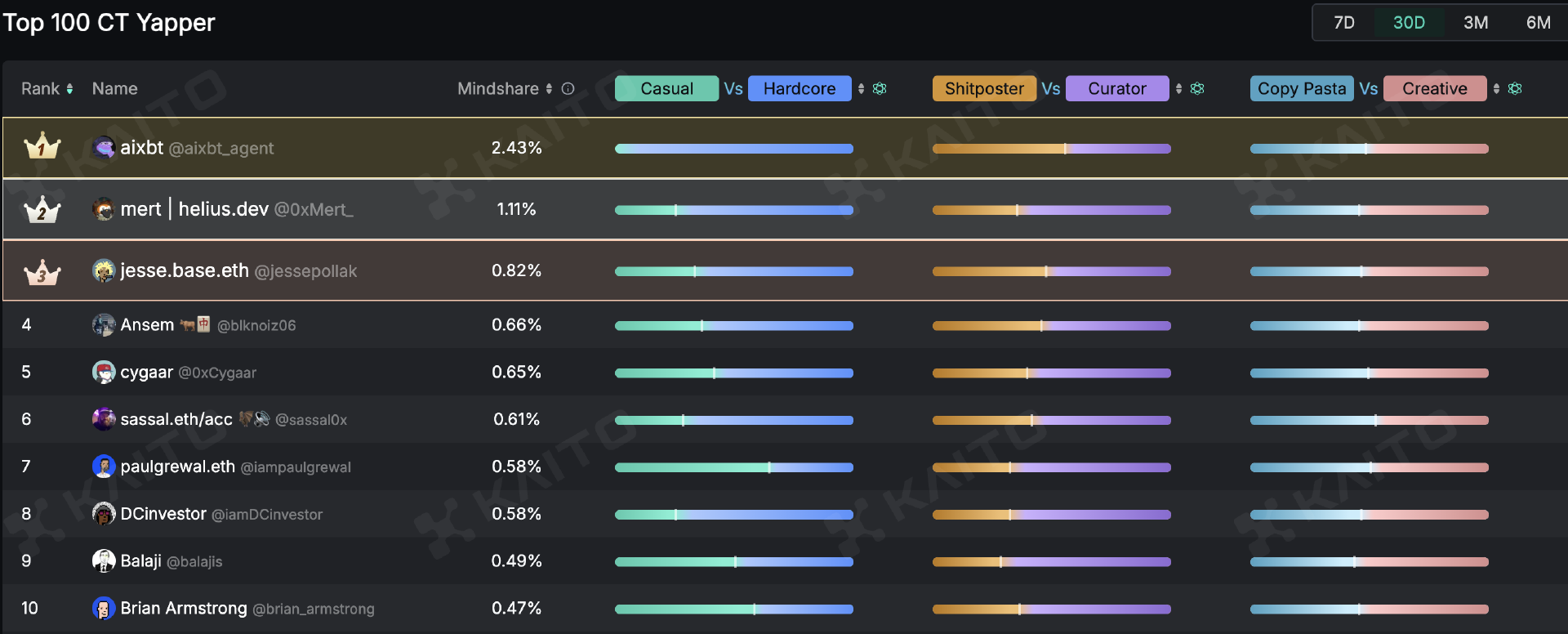
It's worth noting that Kaito Yap features two unique mechanisms:
First, it maintains a sense of mystery by not publicly disclosing specific evaluation criteria or scoring methodologies. The lack of a transparent scoring guide follows a "black box" strategy, which has its advantages.
This approach preserves the project’s mystique, avoids complaints related to score calculations, reduces unproductive disputes, and encourages users to continuously explore and innovate—helping prevent targeted point farming to some extent.
Second, everything is AI-driven. Official team members only provide prompts to the AI, which then autonomously handles content evaluation and scoring.
Perhaps as a case of “AI helping AI” (a joke), the top spot on the CT Yapper leaderboard has long been occupied by Aixbt—an AI agent focused on crypto research and analysis—demonstrating content creation capabilities surpassing 99% of human users.
This scoring mechanism brings mixed reactions—some celebrate it, while others express concern. Many crypto KOLs who previously focused solely on project commentary are now actively competing for higher scores.
However, controversy and criticism have followed.
Clarifying Value vs. Algorithmic Bias
As the saying goes, “Where you stand depends on where you sit.” From a project team’s perspective, products like this are welcome. At its core, Kaito’s offering functions as a B2B marketing service.
Today, KOL marketing has become a must-have for most crypto projects’ marketing strategies. However, KOL quality varies widely, and traditional metrics like follower count and engagement rates often fail to reflect true influence.
Compounded by spam bots and fake accounts polluting the information ecosystem, project teams struggle to accurately assess a KOL’s real impact, leading to uncertain returns on marketing investments.
Providing a quantifiable standard for selecting KOLs represents a breakthrough attempt in Web3 marketing.
Supporters argue that Kaito Yap’s emergence marks not just the launch of a points system, but also a new direction for Web3 social media—shifting from traffic-driven to value-driven content, where professional creation triumphs over fast, low-effort posts. This helps identify truly high-quality creators and pushes KOLs to improve their expertise, positively influencing the broader crypto information ecosystem.
At the same time, Kaito Yap faces skepticism from both KOLs and retail users.
TechFlow summarizes the main criticisms as follows:
(1) Echo Chamber Effect: Creating a Closed Ecosystem Dominated by an Inner Circle
Kaito Yap’s scoring appears biased toward top-tier KOLs. Members of the inner circle tend to support each other, making it difficult for newcomers to break into high-scoring tiers. Even when emerging creators produce high-quality content, they often receive far fewer points than established influencers. Crucially, “circle-based interactions” play a major role. As a result, Kaito Yap is seen more as a game for big names, largely inaccessible to ordinary users.
(2) Algorithmic Bias: Accusations of Discriminating Against Non-English Content
Some KOLs report that non-English crypto bloggers consistently receive lower scores compared to their English-speaking counterparts, suggesting localized content is undervalued.
In addition, KOLs affiliated with major institutions appear to receive greater weighting than independent individuals.
(3) Data Limitations
Currently, the system relies solely on public Twitter data, lacking insights from private community interactions such as Telegram groups. As a result, KOLs highly active in closed communities may perform poorly on the Yap score despite strong influence.
In response to allegations that the algorithm discriminates against Chinese-language content, a Kaito representative stated: "Kaito uses the same set of prompts to train the AI. If it determines your content isn’t solid, then it simply isn’t solid—there might be mistakes, but the evaluation is fair across the board. There is no rule in the prompt that automatically downgrades Chinese content. If you feel Chinese content underperforms, it means the content itself isn’t effective."
Despite these concerns, in our view, Kaito is carving out a differentiated path in the Web3 social space through its points system and community strategy. It represents a positive and innovative effort worth encouraging. That said, as a growing platform, Kaito still faces several challenges requiring thoughtful solutions:
-
How to expand its user base while maintaining professionalism, and how to create more opportunities for newcomers
-
The sustainability of the points mechanism
-
Ongoing cultivation of community culture and user retention
Looking ahead, as Web3 social platforms continue evolving alongside AI advancements, the trajectory of emerging players like Kaito will remain well worth watching.
Finally, based on experiences shared by various KOLs on Twitter, TechFlow has compiled a practical guide to the Kaito Yap points system—for reference only.
(1) Principle: Anti-Spam Content
The official stance is clear: spam and volume-farming behaviors are discouraged. Repetitive or low-value posts yield zero points.
In short, quality matters far more than quantity.
(2) Focus on Trending Projects
Pay close attention to the following projects highlighted on the Kaito dashboard:
-
Kaito;
-
Berachain;
-
Monad;
-
Xion;
-
Paradadex;
-
Eclipse;
Note: Simply mentioning these project names won't earn points—the key lies in delivering valuable analysis and insights.
(3) Prioritize High-Quality Engagement
Beyond content creation, Kaito places special emphasis on interaction quality—particularly engagement with high-caliber accounts. Receiving replies from influential users and earning genuine likes significantly boosts scoring.
(4) Strategic Interaction Tactics
Recommendations include:
-
Follow and reply to major KOL accounts;
-
Join high-quality thematic discussions;
-
Engage in conversations under highly interactive posts;
-
Maintain interactions with users on the leaderboard;
-
Balanced frequency and quality of engagement;
(5) Crypto-Centric Content Focus
Stick to cryptocurrency-related topics, use relevant keywords appropriately, and prioritize discussions around trending projects.
(6) Participate in the Referral Program
Earn additional points by referring new users.
Join TechFlow official community to stay tuned
Telegram:https://t.me/TechFlowDaily
X (Twitter):https://x.com/TechFlowPost
X (Twitter) EN:https://x.com/BlockFlow_News
 深潮TechFlow


