Delphi Digital 2025 Market Outlook: Bitcoin Still Holds Tremendous Potential, Stablecoins Poised for Continued Growth
TechFlow Selected TechFlow Selected
Delphi Digital 2025 Market Outlook: Bitcoin Still Holds Tremendous Potential, Stablecoins Poised for Continued Growth
The growth of stablecoins may bring hope for a market recovery.
 Navigating Web3 tides with focused insights
Author: Stacy Muur
Translation: TechFlow

Introduction
As the year draws to a close, various analyses and forecasts have flooded in. Recently, @Delphi_Digital released its "Year Ahead for Markets 2025" report, offering an in-depth analysis of current market conditions and forward-looking insights on trends such as Bitcoin price movements, key market dynamics, and risk factors.
Given the length of the full report, which requires significant time to read thoroughly, TechFlow has compiled and translated this summary by Stacy Muur that captures the core takeaways from the "Year Ahead for Markets 2025" report.
This article divides Delphi Digital’s report into three main parts: Bitcoin's Rise, The Myth of Altseason, and Future Market Trends. Currently, Bitcoin’s market cap stands at approximately $2 trillion, while altcoins have largely underperformed. Looking ahead, growth in stablecoins may offer hope for market recovery. At the end of the article, Stacy Muur shares her personal outlook on the 2025 crypto market, suggesting it is evolving from a "Wild West" environment into a more regulated alternative stock market. Web3-native users will continue taking high risks through speculative trading, whereas new entrants will adopt conservative risk management strategies focused on long-term value—some narratives may become marginalized.
Main Content
Bitcoin's Rise
Not long ago, a $100,000 Bitcoin price seemed like pure fantasy.
Now, that perception has completely shifted. Bitcoin currently boasts a market capitalization of around $2 trillion—an impressive figure. If Bitcoin were treated as a publicly traded company, it would rank as the sixth most valuable corporation globally.

Despite its growing prominence, Bitcoin still holds immense growth potential:
-
Bitcoin’s market cap represents only 11% of the combined market cap of MAG7 (Apple, NVIDIA, Microsoft, Amazon, Alphabet, Meta, and Tesla).
-
It accounts for less than 3% of the total U.S. equity market and about 1.5% of the global equity market.
-
Its market cap is just 5% of U.S. public debt and less than 0.7% of total global (public + private) debt.
-
The amount of money held in U.S. money market funds is triple that of Bitcoin’s market cap.
-
Bitcoin’s market value is roughly 15% of total global foreign exchange reserves. If central banks allocated just 5% of their gold reserves to Bitcoin, it would generate over $150 billion in buying pressure—three times the net inflows seen by IBIT this year.
-
Global household net worth has reached an all-time high exceeding $160 trillion—$40 trillion higher than pre-pandemic peaks—driven by rising home prices and stock market gains. This figure is 80 times larger than Bitcoin’s current market cap.
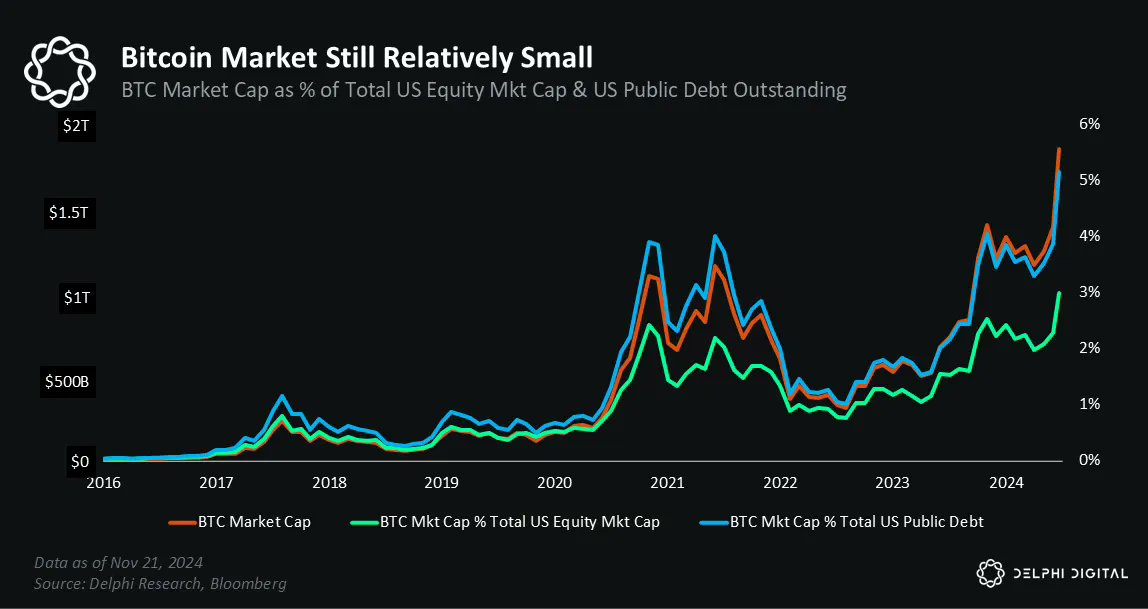
In a world where the Fed and other central banks drive annual currency depreciation of 5–7%, investors must achieve 10–15% annual returns simply to offset future purchasing power erosion.
You should know:
-
If a currency depreciates by 5% annually, its real value halves in 14 years.
-
If the rate reaches 7%, this halving occurs within just 10 years.
This is precisely why Bitcoin and other high-growth sectors are attracting increasing attention.
The Myth of Altseason
While Bitcoin hit repeated all-time highs this year, 2024 was far less kind to most altcoins.
-
$ETH failed to break past its previous all-time high.
-
$SOL did reach a new high, but only marginally above its prior peak—underwhelming given its substantial growth in market cap and network activity.
-
$ARB started strong early in the year but lost momentum as the year ended.
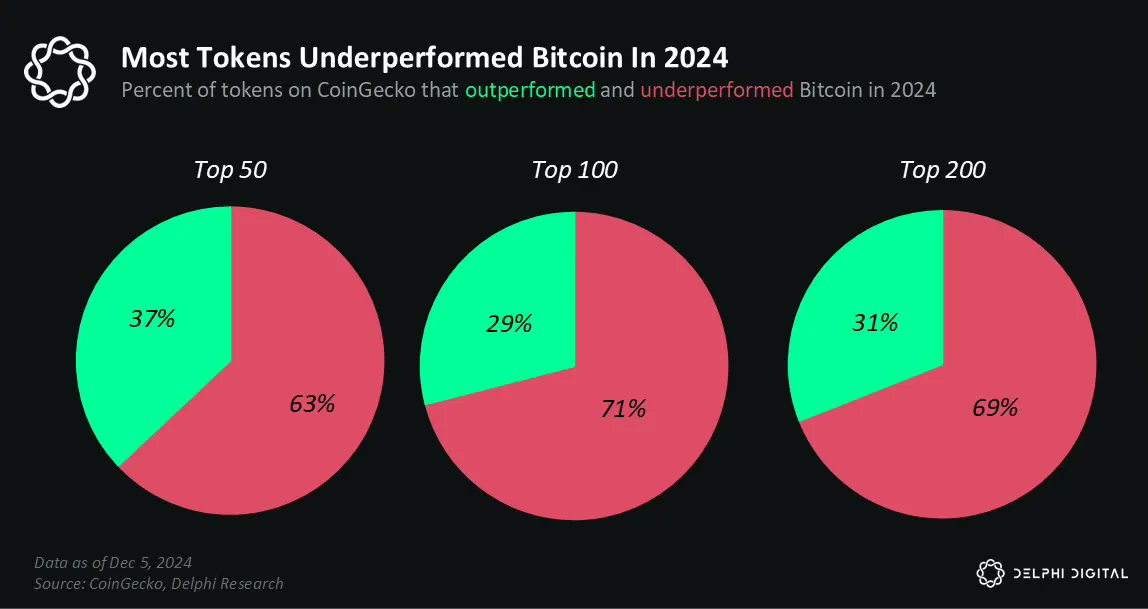
There are many similar examples. Simply review the performance data of 90% of the altcoins in your portfolio.
Why is this happening?
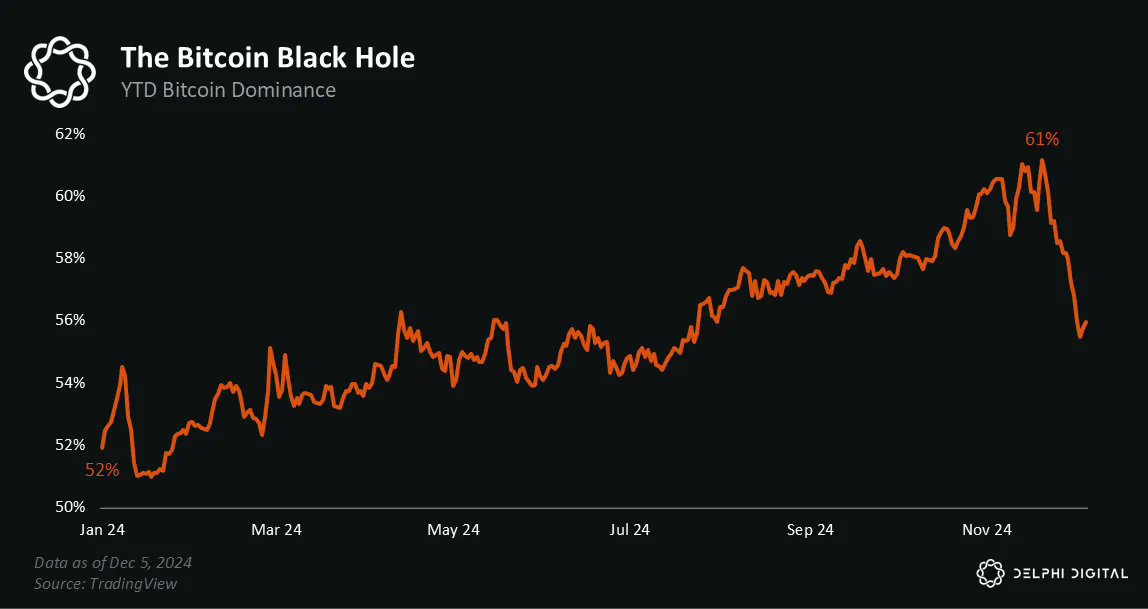
First, Bitcoin dominance is a key factor. BTC performed exceptionally well this year, driven by ETF inflows and Trump-related sentiment, rising over 130% year-to-date—the highest dominance level in three years.
Second, market divergence has emerged as a defining feature.
This cycle differs significantly from past ones. Previously, asset prices moved in tandem—when BTC rose 1%, ETH typically gained 2%, and alts surged 3%. But this cycle broke that pattern.
Although a few assets performed spectacularly, many others declined. Bitcoin’s rally didn’t lift the broader market as expected, and the much-anticipated “altseason” never materialized.
Finally, Meme coins and AI agents played a significant role.
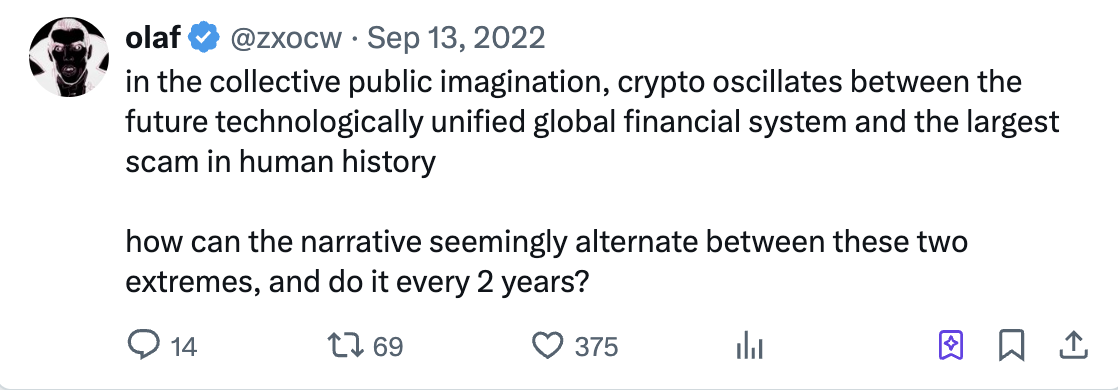
The crypto market constantly oscillates between being labeled a “Ponzi scheme” and hailed as “technology that will change the world.” In 2024, the “scam” narrative dominated.
In the public imagination, crypto swings between “a unified global financial system powered by technology” and “the biggest scam in human history”—roughly every two years.
Why does this narrative alternate so predictably every two years?
Meme Coin Super Cycle and Market Sentiment
The Meme coin supercycle reinforced perceptions of crypto as a “Ponzi scheme.” Many began questioning whether fundamentals matter at all, dismissing the space as a “casino on Mars.” These concerns aren’t entirely unfounded.
Here, I’d like to add a note.
When people say Meme coins were the top-performing assets of the year, they usually refer only to established “mainstream Memes” with large market caps and strong communities (like DOGE or SHIB). What’s often ignored is that 95% of Memes lose nearly all value shortly after launch. Yet, people still “want to believe.”
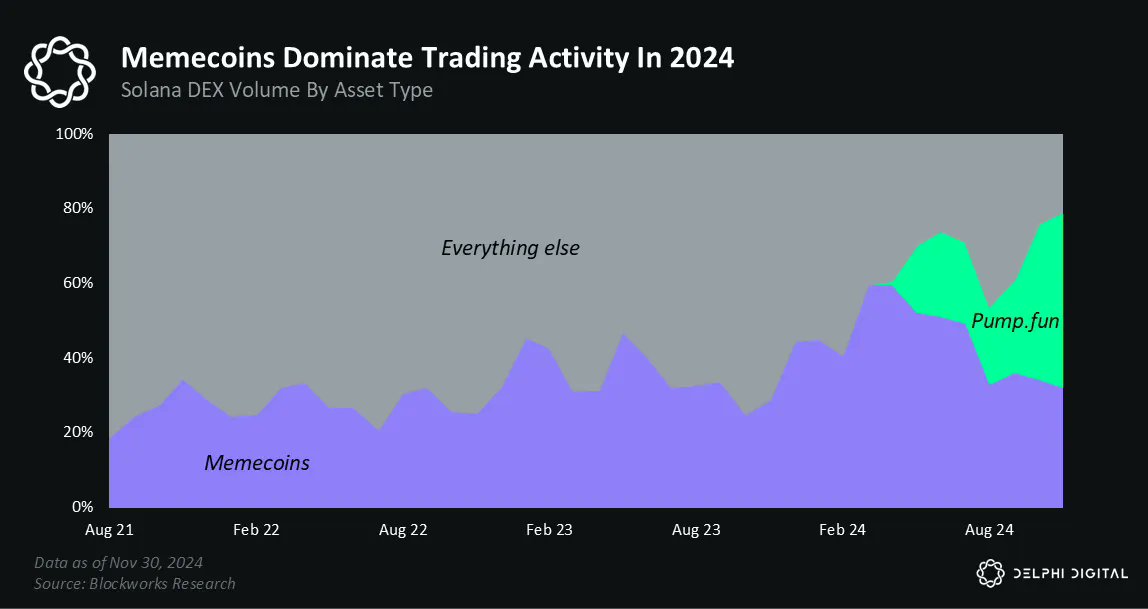
This belief redirected capital previously invested in altcoins toward Meme coins—benefiting a few while leaving most behind. As a result, capital flows concentrated in two areas: Bitcoin (institutional money) and Meme coins (high-risk bets), leaving most altcoins neglected.
Delphi believes 2025 will be a year of technology-driven transformation—technologies that truly “change the world.”
But personally, I’m not so optimistic. In 2024, numerous KOLs (key opinion leaders) focused exclusively on Meme coins emerged. When I tried creating a folder of channels dedicated to “genuine value” projects on Telegram (you can find it here), I found almost all were filled with “ape calls” (short-term, high-risk investment tips). This is the nature of attention economics—and these narratives shape market trends.
What Comes Next?
Stablecoin Growth and Credit Expansion
A major challenge facing the current market is token supply inflation. A flood of new assets has entered the ecosystem via private investments and public token launches. For example, over 4 million tokens were launched on Solana’s pump.fun platform alone in 2024. Yet, total crypto market cap grew only 3x compared to the last cycle—far below the 18x increase in 2017 and 10x in 2020.
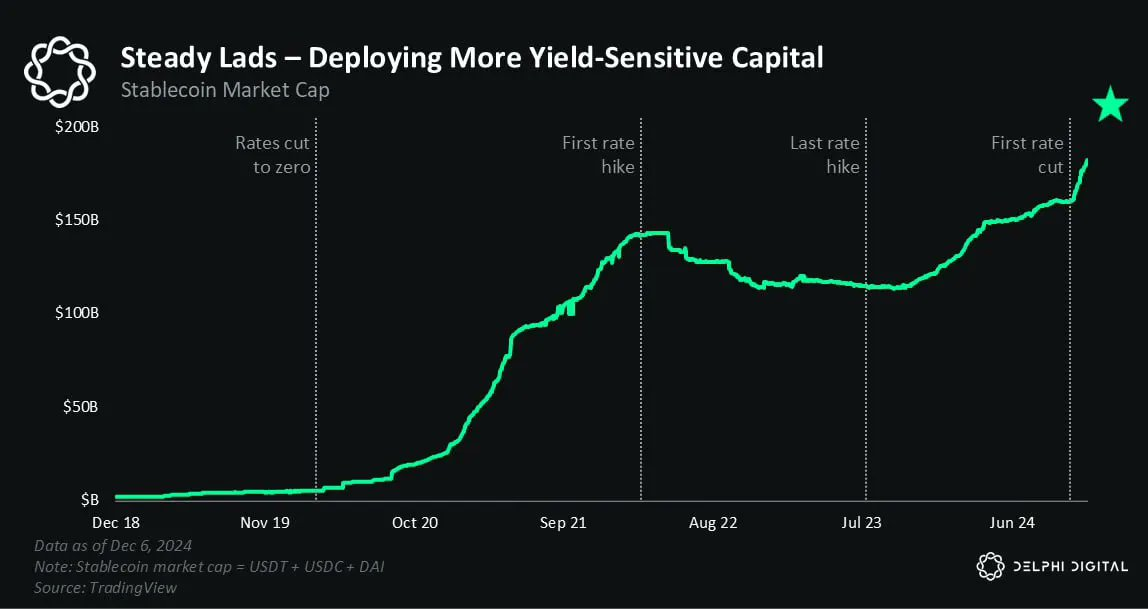
Two missing ingredients—stablecoin growth and credit expansion—are now reemerging. With declining interest rates and improving regulatory clarity, speculation is expected to revive, helping rebalance the market. Stablecoins, critical for trading and collateral use, will play a pivotal role in driving recovery.
Institutional Capital Inflows
Until last year, institutional investors remained cautious due to regulatory uncertainty. However, the SEC’s reluctant approval of spot Bitcoin ETFs marked a turning point, paving the way for institutional adoption.
Institutions generally prefer familiar investment domains. While a few might dabble in Meme coins, most will likely focus on fundamentally sound assets such as ETH/SOL, DeFi, or infrastructure projects.
Delphi predicts the next year could see a broad-based market rebound similar to previous cycles—but with greater emphasis on fundamentals. OG DeFi projects (original decentralized finance protocols), proven through multiple market cycles, may regain spotlight. Infrastructure assets (such as L1 blockchains) could also shine again. Additionally, RWA (real-world assets) and emerging fields like AI and DePIN may emerge as hotspots.
Of course, not every token will deliver triple-digit returns as before, but Meme coins will remain part of the landscape. This could mark a new beginning—a broad crypto rally driven by overall market momentum.
Note: Most institutional traders rely on options hedging strategies. Therefore, if a broad rally occurs, the assets most likely to attract institutional interest will be those with active options markets—currently primarily on Deribit and possibly Aevo.
The Case for Solana
@Solana has demonstrated remarkable resilience in its blockchain ecosystem. After suffering a 96% market cap decline following the FTX collapse, Solana made a strong comeback in 2024.
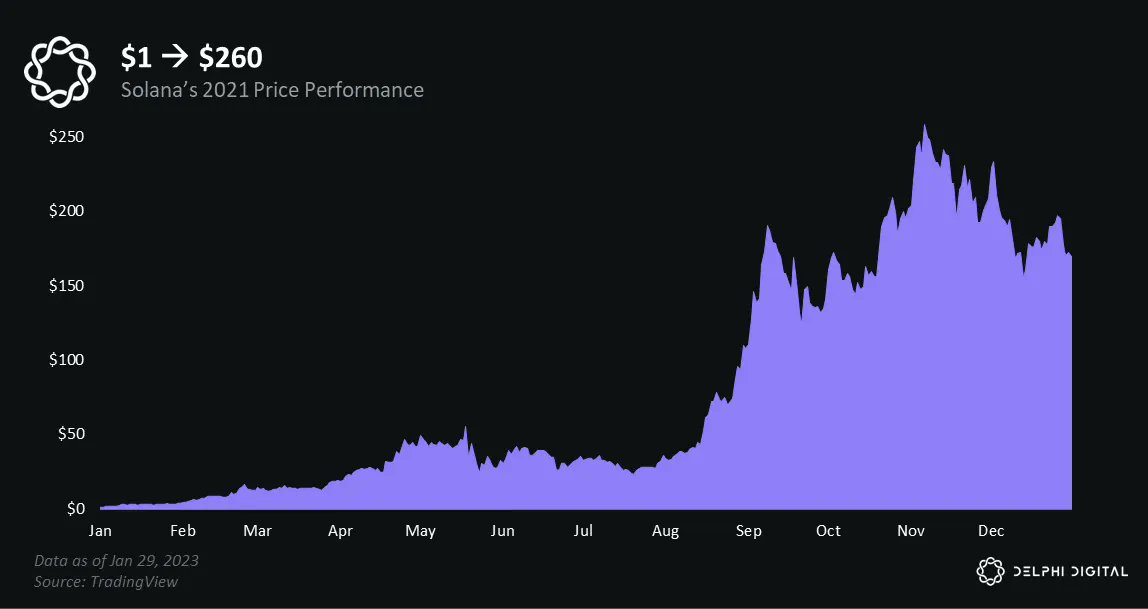
Key highlights include:
-
Developer Momentum: Through hackathons and airdrops (e.g., Jito airdrop), Solana successfully reignited developer and user engagement. This boost in participation fosters a virtuous cycle where technological innovation and user adoption reinforce each other.
-
Market Leadership: In 2024, Solana led trends across both Meme and AI application spaces. Notably, its Real Economic Value (REV—a composite metric of transaction fees and MEV) exceeded Ethereum’s by over 200%, signaling robust market vitality.
-
Outlook: Solana is positioned to challenge Ethereum’s dominance in scalability and user experience. Compared to fragmented Layer-2 solutions, Solana offers a seamless user experience and a highly centralized ecosystem, giving it a distinct competitive edge.
Stacy’s Final Thoughts
The current market may remind some of 2017–2018, when Bitcoin hit a record $20,000 right before New Year’s, only to begin declining in early 2018. However, I don’t think comparing 2018 to 2025 is appropriate. They exist in vastly different environments—the chaotic “Wild West” era is rapidly transforming into a more structured, regulated alternative stock market.
We must recognize that the crypto market extends far beyond Crypto Twitter (CT) and X platform discussions. For those not active on these platforms, their understanding and perception of the market can be entirely different.
Looking ahead to 2025, I believe the crypto market will split into two primary directions:
-
Web3 Native Users: Deeply immersed in crypto, familiar with its mechanics, and willing to take high risks—engaging in speculative plays on Meme coins, AI agents, presales, etc. Their behavior echoes the early “Wild West” days of crypto.
-
General Investors: Including both institutions and retail investors who apply disciplined risk management and favor fundamental analysis. They view crypto as an alternative to traditional equities, prioritizing long-term value over short-term speculation.
Which areas might become marginalized? Early DeFi projects, RWA (real-world assets), and DePIN protocols that fail to achieve leadership positions within their respective niches or the broader blockchain ecosystem may gradually fade from relevance. This is just my personal take.
PS: This article summarizes the key points from @Delphi_Digital's 2025 Market Outlook. For a comprehensive understanding of Delphi’s detailed predictions for 2025 and beyond, I strongly recommend reading their original research report.
Join TechFlow official community to stay tuned
Telegram:https://t.me/TechFlowDaily
X (Twitter):https://x.com/TechFlowPost
X (Twitter) EN:https://x.com/BlockFlow_News
 @stacy_muur