








The Current State and Future of Xiao Youling | I Can Feel That Everything Is Quietly Changing
TechFlow Selected TechFlow Selected
The Current State and Future of Xiao Youling | I Can Feel That Everything Is Quietly Changing
In the future, entrepreneurial thinking will shift from the internet startup mindset of "burning cash—scaling up—raising funds" to a business-minded approach of "investing—earning profits—reinvesting."
 Navigating Web3 tides with focused insights
By sleepy.mid

First of all, I truly want to thank TGE for sparking this recent NFT mini bull market. Although I didn’t receive much airdrop and the floor price of Little Ghost hasn’t risen accordingly, the transformation it brought to the entire Little Ghost community is far more meaningful. I’ve seen a reawakening of community awareness—deeply moving. Right now, as I type in front of my computer, my hands are even trembling slightly, as if time had turned back three years.
Through this article, I’d like to share some honest thoughts with you all—take off the mask, and tell you how we’ve made it through these past few years, and where we’re headed next.
First, I need to sincerely apologize to our community family. We haven’t kept the community updated on our progress or plans for too long. As a result, while the team has been extremely busy, the community hasn’t felt it; and when the community wants to help, they don’t know what the team actually needs. Our project will continue—we’ll keep building. In the future, we’ll share project updates more frequently, involve the community, and let everyone contribute their strength to push the project forward together.
Recently, the team underwent significant adjustments. We didn’t cut staff voluntarily—it was out of necessity due to cash flow pressure from the company. So right now, we urgently need support and participation from our community family.
For about the last one to two years, we’ve constantly been pitching for funding, but repeatedly hit walls. To be direct: many of our products were built purely for fundraising purposes—ManeSTUDIO being one example. When we said we wanted to build culture and IP, investors told us we needed a product first, otherwise they wouldn’t know what they were investing in. When we delivered a product, they said the sector was dead and we should change our narrative. When we pivoted and built a new product, they demanded data. When we finally had data, they claimed the market was bad. And when the market improved, they said funds were now focusing on secondary markets.
Of course, not all investors are like this. I’ve met genuinely thoughtful ones who clearly pointed out exactly where we needed improvement and why they couldn’t invest this time—but encouraged us to stay in touch and hoped to collaborate next time. Some investors, after hearing our pitch, bought a Little Ghost NFT and became part of the family, telling us they tried hard to push internally but couldn’t convince senior partners—yet still strongly supported us and offered help whenever needed. Sadly, such people are rare. Fortunately, we’ve become friends with them all.
On Business
Indeed, ManeSTUDIO was a product created under pressure to secure funding—a development driven by external forces. CutUp, on the other hand, failed to take off due to our own misjudgment. I don’t want to hide behind excuses or false promises anymore. Let me openly admit: the launch of CutUp was overly hasty. We hadn’t secured upstream and downstream supply chains, miscalculated web3 users’ demand for "neutral" cultural merchandise, and ultimately faced issues including insufficient production capacity, high production costs, and blocked sales channels. While I believe our product quality was solid, as a brand, we performed very poorly. We’ll open-source ManeSTUDIO, and for CutUp, we’ll run an event soon to give away our remaining inventory—feel free to invite friends and family to claim them. We’ll streamline our product lines and fully refocus on IP development.
Starting next year, we’ll also try a new model for IP development.
Let’s first discuss why we can’t continue with the past two years’ approach.
The first reason is the ongoing deterioration of the overall consumer market. If you’re not fully immersed in web3 and still pay attention to real life, you must have felt this. Almost all brands are cutting marketing budgets—some by half, others canceling all marketing activities for next year entirely. Several brands that had already committed to collaborations with us have suddenly canceled, which has severely disrupted our timeline.
The second reason is that although the past two years’ model helped us accumulate rich brand collaboration cases, revenue-wise, relying solely on it cannot sustain the company. The old collaboration model required us: (1) not paying brand partners for co-branding; (2) partnering only with high-profile brands to boost IP value; (3) earning money from brand partners. These three goals form an impossible triangle.
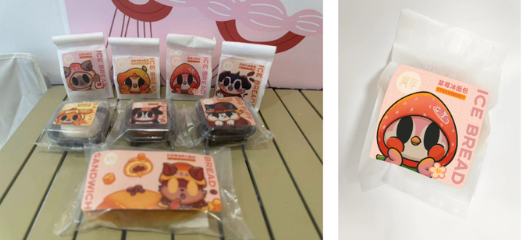
We originally planned to co-create a convenience-store bakery brand featuring OUTA as the main character. If everything had gone smoothly, you would’ve been able to buy our baked goods in over a thousand convenience stores across China by late November. But the launch has been delayed again and again, so for now, here are just two preview images. This project is still ongoing, though progress will be relatively slow.
Let me answer a key question first.
“Is the project continuing?”
Yes. We are continuing.
The current OUTA game will receive a content update during the Christmas season. Previously, the game team mentioned that releasing separate patches for minor updates would be too time-consuming, so we accumulated several updates to roll out together this time. Going forward, we’re optimizing this workflow so that continuous incremental updates can happen regularly.
What are our plans for the future?
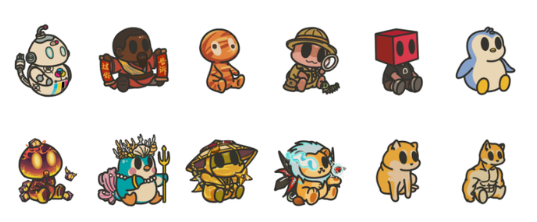
First, our goal remains building an IP: Little Ghost is at the center, with OUTA surrounding it.
Next, we aim to use mini-games as vehicles for IP promotion and operations. It’s important to clarify: our entry point is “mini-games,” not “TON,” “TG,” etc. Low investment cost + viral distribution potential are what we value most.
Moving OUTA to the TG ecosystem was a temporary decision. It won’t be limited there in the future. As a slow-paced idle game, OUTA is ill-suited to the TG environment, and we’re unsatisfied with its current performance within TG. We’re now partnering with a Web2 overseas game publisher who highly values our game. They plan to target more players through Web2 distribution channels, using more professional, systematic, and Web2-style user acquisition methods to bring OUTA in front of millions, even tens of millions, of Web2 gamers.
Additionally, we’re developing another text-based roguelike casual game starring Little Ghost, with OUTA joining the adventure. Development is over halfway complete, with a planned release around February next year. Similarly, we’ll partner with a Web2 game publisher for broad promotion, user exposure, and conversion in the Web2 space. After launching overseas, we’ll begin discussions with domestic publishers to bring the game to the Chinese market as well. We hope this model brings larger user scale and higher revenue—if validated successfully, we’ll replicate and scale it continuously.
Where will the funding come from?
As mentioned earlier, we’ve repeatedly hit roadblocks during fundraising attempts, so we no longer rely solely on investor funding—though investment would certainly help. Instead, we’re currently negotiating grant support with blockchain foundations, and discussions are already quite advanced, with cooperation expected soon and the first grant incoming shortly. We’ll also build a parallel Web3 mechanism behind the games to seamlessly onboard users into Web3, enabling them to participate in future ecosystem development without even realizing it.
Going forward, we’ll shift our entrepreneurial mindset—from the internet startup model of ["burn money → scale up → raise"] to a business owner’s mindset of ["invest → earn → reinvest"], putting our future firmly in our own hands.
Ask Me Anything
Feel free to ask me anything
Q:@koolob#17 What are the three most important things the team is currently working on, and what challenges are you facing?
A: Securing grants, developing the Little Ghost game, and updating OUTA. There are many difficulties, haha—I’ve written about quite a few in this article—but I believe there are always more solutions than problems!
Q:@luckytree.eth #4802 Are you still committed to the project? Do you still have confidence? What does the community need to do to support?
A: Absolutely, we’re continuing. Confidence is stronger than ever after adjusting our mindset. I’m researching which app or website could efficiently broadcast needs to the community, and once decided, I’ll use it to let everyone know how you can help.
Q:@Drew#1283 What is the current team structure? Future team planning? Is Li Daddy still involved, and in what role?
A: The team is now extremely lean, traveling as light as possible. Li Daddy is focused on his own startup. He’s already given so much—we have no right to expect him to keep investing further.
Q:@koolob#17 Does the current state of the OUTA game meet expectations? If not, any phase review?
A: No, it doesn’t meet expectations. Reasons include poor user experience in account and store systems due to the sudden migration, mismatch between game genre and TG ecosystem, and overestimation of traffic distribution and user payment willingness within TG.
Q:@GordonPlaying Outa, I feel it's unnecessary to require holders to stake Little Ghosts to gain related benefits—the significance is minimal, and it adds a barrier to gameplay. Additionally, player levels in Outa should correlate with the number of Little Ghosts held—the more you hold, the higher your level, making it easier to rank up in the game. This way, the number of Little Ghosts directly ties to potential airdrops. When holders believe in the airdrop value of Little Ghost tokens, they’ll naturally hold and buy more.
A: Great suggestion. However, staking is considered for more complex reasons—NFT trading happens in real-time, and without restrictions, game data integrity could be compromised.
Q: @Fengxin Suoai When will TGE happen?
A: Frankly, we currently don’t have the qualifications for TGE.
Q: @Cheng1296: 1. Why was CutUp paused for a year? Was it unprofitable? 2. How long until diamond-handed holders see returns? 3. Predict: In three years, will Little Ghost’s floor price be 1 ETH or 0.01 ETH?
A: 1. The issues with CutUp were mentioned above. 2. I don’t know, but I hope we can make it happen next year. 3. 1000 ETH!
Q: @SHIN Any plans to go global? Currently mostly known among domestic and overseas Chinese communities. 👻 Telegram OUTA is a decent stepping stone
A: Yes, we do. TG is good, but we think we can do better. We hope Web2 overseas publishing will boost our IP’s global recognition.
Q: @Rex I still can’t play the OUTA mini-game—it hasn’t been fixed. What should I do? Will not playing affect my future participation? Will NFTs still get utility? I’ve staked, but haven’t seen any associated benefits increase.
A: We’ve contacted the platform, but it’s unresolved—quite mysterious. But you should be able to participate soon! Regarding utility, it will be reflected in upcoming products. This is also something we’ll keep improving—like learning from penguins to deliver more token airdrops to everyone.
Q: @Floor Swap 1-1 DM me #928, 4844 Do you need funding support?
A: Yes, we do. But objectively, chances are low right now—year-end plus decent market conditions tend to suppress primary market investments. So we’re not counting on it. If someone steps in, great—but mostly, we’ll have to rely on ourselves.
Join TechFlow official community to stay tuned
Telegram:https://t.me/TechFlowDaily
X (Twitter):https://x.com/TechFlowPost
X (Twitter) EN:https://x.com/BlockFlow_News
 @sleepy0x13






