Y Combinator: The market size for vertical AI agents will be ten times that of SaaS
TechFlow Selected TechFlow Selected
Y Combinator: The market size for vertical AI agents will be ten times that of SaaS
The success of the SaaS industry is the best evidence for the rise of vertical AI agents.
 Navigating Web3 tides with focused insights
Compiled by: Jiang Ye, AIGC New Insights

Text: Summarized using Alibaba's Tongyi Efficiency. Thanks for corrections.
In the latest YC interview titled "Vertical AI Agents Could Be 10X Bigger Than SaaS", four seasoned YC investors—Gary, Jared, Harj, and Diana—analyze why vertical AI agents are poised to become the next major startup wave, drawing parallels with the evolution of the SaaS industry and illustrating their points with numerous real-world examples.
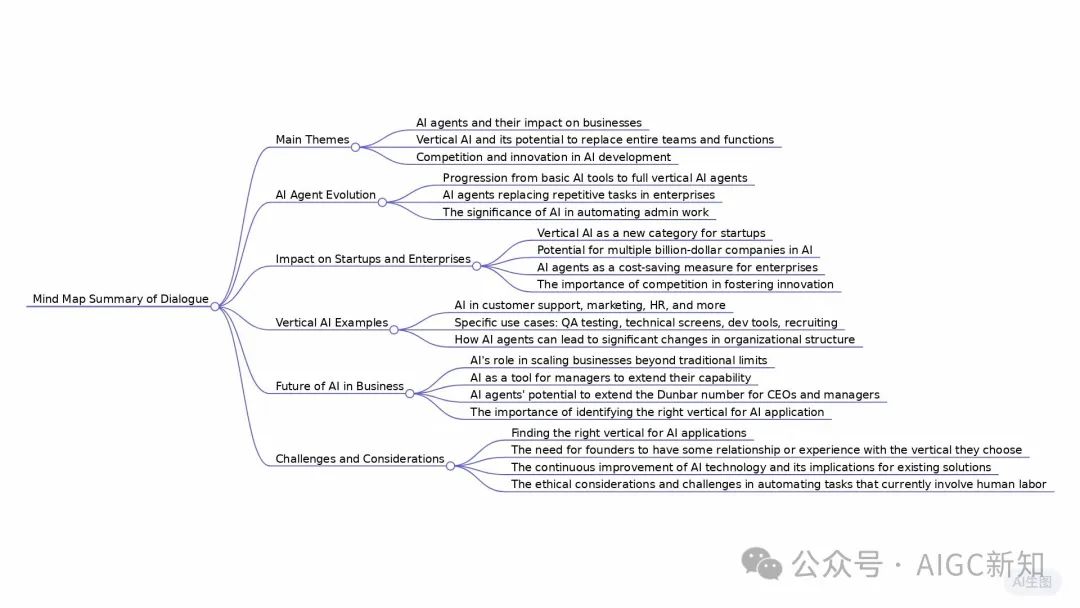
As AI models rapidly improve and compete, a new business model is emerging: vertical AI agents. In this episode of Lightcone, the hosts explore how vertical AI agents could disrupt existing SaaS companies, which use cases are most compelling, and why this category alone could spawn $300 billion companies.
1. The Success of SaaS Validates the Rise of Vertical AI Agents
Jared believes that the market size for vertical AI agents will be enormous—potentially giving rise to companies valued at over $300 billion.
He argues that the success of the SaaS industry serves as the strongest evidence for the emergence of vertical AI agents. The advent of SaaS (Software-as-a-Service) revolutionized the software industry. Previously, businesses had to purchase expensive software licenses and invest significant time and resources into installation and maintenance. With SaaS, software is hosted in the cloud, and users pay a subscription fee to access it, drastically lowering barriers to entry and reducing costs.
Jared believes vertical AI agents—as a new form of B2B software—could surpass SaaS in market scale, because they not only deliver software services like SaaS but also leverage AI to automate operations, further boosting efficiency and cutting costs.
2. LLM Technology Has Laid the Foundation for the Explosion of Vertical AI Agents
Large Language Model (LLM) technology opens up new possibilities in software development, enabling the fusion of software with human-like operations to create powerful vertical AI agents that can replace both traditional SaaS tools and manual labor.
LLMs can understand and generate human language, making them ideal for applications such as chatbots, automated content generation, and translation.
3. Why Big Tech Missed the B2B SaaS Wave?
Big tech companies missed the B2B SaaS opportunity primarily because the market is highly fragmented—each vertical demands deep domain expertise and focused attention on specific problems.
Large corporations tend to concentrate on a few massive markets rather than spreading themselves thin across many niche domains.

Gusto, a SaaS company specializing in payroll management, succeeded because it deeply understood the intricacies and regulations of its domain.
For giants like Google, developing a product similar to Gusto would require substantial investment in learning and mastering payroll-specific knowledge—an effort that simply isn’t cost-effective for them.
4. How Will AI Agents Reshape Corporate Workforce Structures?
LLM-powered applications are transforming how startups hire—soon, even solo founders may achieve rapid growth with minimal teams.
Historically, startups scaled by expanding their workforce alongside business growth. However, LLMs enable automation, significantly reducing reliance on human labor.
In recruitment, for example, Triplebyte—a company that hires software engineers—uses software to automatically screen resumes, conduct technical assessments, and perform initial interviews, greatly reducing the workload for recruiters.
5. What Is the Market Potential of Vertical AI Agents?
The market size of vertical AI agents could be ten times that of SaaS, as they can replace not only existing SaaS software but also vast amounts of manual labor.
Traditional SaaS still requires human intervention for many workflows, whereas vertical AI agents integrate software and human tasks into fully automated systems, achieving higher efficiency and lower costs.
Momentic, an AI-powered QA testing company, uses AI agents to automatically execute test cases and generate reports—completely replacing traditional QA teams.
6. Use Cases of Vertical AI Agents
The four YC investors highlighted several examples of vertical AI agent startups.

Outset: Revolutionizing surveys and questionnaires.
-
Traditional survey tools require manual question design, data collection, and analysis.
-
Outset’s AI agent automates all these steps, dynamically adjusting questions and answers based on user feedback, improving both efficiency and accuracy.
Powerhelp: Handling complex customer support workflows.
-
Traditional customer support relies on humans to answer calls, respond to emails, and resolve issues.
-
Powerhelp’s AI agent performs these tasks autonomously, offering personalized solutions based on user queries and history—boosting satisfaction and efficiency.
Salient: Automating auto loan debt collection.
-
Traditional collections involve manual calling, borrower communication, and result logging.
-
Salient’s AI agent handles all these tasks, adjusting strategies based on borrower circumstances and repayment capacity—increasing recovery rates and success.
7. AI Voice Calling Technology
AI voice calling has advanced rapidly. With improvements in text-to-voice synthesis and natural language processing (NLP), AI voice calls are now viable for complex scenarios such as debt collection, customer service, and marketing.
-
Text-to-Voice (T2V): Converts text into natural-sounding speech, allowing AI agents to converse like humans.
-
Natural Language Processing (NLP): Enables AI agents to understand user intent and emotions, responding appropriately to queries and feedback.
8. How to Choose the Right Vertical for Your AI Agent Startup?
Jared advises aspiring AI agent founders to target tedious, repetitive administrative tasks—work that consumes significant manpower and is ripe for AI disruption.
For example, Sweet Spot identified repetitive work in government contract bidding and built an AI agent to automate the process.
Full Interview Transcript

Opening
Every three months, things keep getting better. Now we’re talking about fully vertical AI agents that will replace entire teams, departments, and even companies. This progress still excites me—deeply.
There used to be only one player in town: OpenAI. But now, the base model landscape is becoming competitive. Thank goodness. Competition is fertile soil for a healthy market ecosystem—consumers get choice, founders get opportunities. This is the world I want to live in.
Welcome to another episode of *Lightcone*. I’m Gary. With me are Jared, Harj, and Diana—we’ve collectively funded startups worth hundreds of billions when they were just one or two people. Today, Jared is fired up—he’s here to talk about vertical AI agents.
Passion for Vertical AI Agents
I’m really excited because I don’t think people—especially startup founders, particularly young ones—fully grasp how big vertical AI agents will be. It’s not a new idea—some are already discussing it, and we’ve funded many—but I believe the world hasn’t yet realized the magnitude. I’ll explain why I think there will be companies worth over $300 billion in this single category.
I’ll draw an analogy with SaaS. I think many founders, especially younger ones, fail to appreciate how big SaaS truly is. They tend to view the startup world through consumer products they use. As consumers, you don’t interact with many SaaS tools—they’re built for companies. So many miss this fundamental point: if you look at what Silicon Valley has funded most over the past 20 years, it’s SaaS. We’ve produced over 300 SaaS unicorns—more than any other category. Over 40% of venture capital in that period went into SaaS.
SaaS was revolutionary. Historically, software came on discs installed locally. Then came XML HTTP requests—the missing piece that enabled rich web apps. That’s how Gmail and Google Maps emerged. Paul Graham actually pioneered this—realizing you could route HTTP requests directly to Unix commands, eliminating the need for standalone programs. His online store was essentially the first SaaS app—though primitive, since every click required a full page reload. Only after AJAX matured did SaaS take off.
This feels similar to today’s LLM moment—a new computing paradigm unlocking fundamentally different possibilities. Back then, the big question was: what do you build with this? Where does value accumulate? Where are the startup opportunities?
Parallels Between Traditional SaaS and LLMs
Looking at the list of billion-dollar companies created, I see three paths:
- Obvious consumer ideas: Things like documents, photos, email, calendars, chat—desktop functions clearly transferable to web/mobile. But incumbents like Google, Facebook, and Amazon captured nearly all value here.
- Unexpected consumer ideas: Uber, DoorDash, Coinbase, Airbnb—no one predicted these. Incumbents didn’t enter until too late, letting startups dominate.
- B2B SaaS: Around 300+ unicorns—more than the first two categories combined. Why? Because no single company can dominate every vertical. Each needs deep, narrow expertise.
Salesforce was likely the first true SaaS company. Early skepticism existed—people doubted complex enterprise apps could run in browsers. Sound familiar? Today, people say LLMs “hallucinate” or aren’t ready for serious use. But early web apps were clunky too. Visionaries like PG saw the potential. Today’s skepticism mirrors that era.
Just as SaaS opened doors for specialized players, LLMs will enable vertical AI agents. Generic AI assistants (like a universal ChatGPT) will likely be dominated by big tech—Apple, Google, etc. But the real opportunity lies in verticals where incumbents won’t—or can’t—compete.
Why Big Tech Can’t Dominate B2B SaaS
Why didn’t big companies enter B2B SaaS? Because each vertical demands obsessive focus on niche, messy details.
Take Google—why hasn’t it built a payroll competitor to Gusto? Because no one at Google deeply understands payroll regulations—and it’s not worth their time. They’d rather focus on massive markets.
Legacy ERP systems like Oracle and SAP tried to be everything for everyone—resulting in poor UX. Salesforce proved that simpler, vertical-focused SaaS could win by offering 10x better experiences.
Enterprise software often sucks because buyers (executives) aren’t users (employees). A VP might sign a $1M contract for software that frustrates daily users. This misalignment is changing with LLMs.
Now, startups can scale revenue without proportional hiring. In the past, hitting $100M ARR meant ~1,000 employees. Now, with LLMs, you might need far fewer. I advise founders to hire elite engineers who can automate bottlenecks—not just managers to grow headcount.
We’re entering an era where a 10-person team runs a unicorn. They’re writing evals and prompts—leveraging AI as force multipliers beyond code.
Examples of Vertical AI Agent Applications
Let’s look at real cases.
Aaron Cannon’s YC company Stray applies LLMs to surveys and quality assessment. Qualtrics won’t build reasoning-heavy LLM features—it’s not their focus.
Surveys serve product and marketing teams trying to understand customers. But selling AI that replaces jobs is hard—you must sell to executives, not fearful middle managers.
Another company, Mee, uses AI for QA testing. Unlike Rainforest QA—which enhanced QA efficiency but couldn’t eliminate teams—Mee’s AI replaces QA engineers entirely. No friction with threatened employees. They sell directly to engineering leaders who never needed large QA teams.
Similarly, in recruiting: tools that assist hiring face resistance from recruiters fearing replacement. But with AI, you can now automate the entire funnel. One YC company, Last Patch, handles full technical screening and initial recruiter calls—with strong traction.
For developer tools, Capillo AI built a chatbot that answers complex technical questions. Companies using it need smaller DevRel teams—because the AI learns from docs, videos, and chat histories.
Customer support: Powerhelp. Despite 100+ AI support startups, almost all offer basic chatbots. Few handle complex workflows. Powerhelp targets enterprises with 100+ support agents managing intricate processes. Less than 1% market penetration—huge whitespace.
Specialization wins. Like Giga ML, which handles 30,000 tickets daily for Zepto, replacing 1,000 agents—but only for that specific use case. Custom evals with 10,000 test cases make it irreplaceable.
Unlike monolithic platforms, vertical AI agents thrive on specificity. Just as no single SaaS fits all, no generic AI agent will dominate. Instead, thousands of hyper-specialized agents will emerge.
AI Voice Technology (Companies)
Let’s discuss voice AI—a booming subcategory.
Salient uses AI voice calls to automate debt collection. Traditionally, low-paid workers in call centers make repetitive, high-churn calls. AI handles this perfectly—Salient already works with major banks.
Vocals.ai is a voice infrastructure provider enabling fast deployment. When new APIs like OpenAI’s voice models emerge, the challenge is staying ahead. Can you keep raising the ceiling to retain customers?
Recall early LLM apps in 2023—mostly basic wrappers around ChatGPT, doing simple text generation. Most were crushed by newer GPT versions.
But progress is accelerating—every three months, capabilities improve dramatically. Now we’re building vertical agents that replace entire teams. Two years in, we’re still early—and the pace is unlike anything before.
And the base model landscape is diversifying. Claude is a major contender. Competition benefits everyone—founders and users alike.
How Founders Should Choose Their Vertical
For aspiring founders: where should you start?
Look for boring, repetitive administrative work. If you dig deep into such tasks, you’ll likely uncover a billion-dollar AI agent opportunity.
And ideally, choose something you have firsthand experience with.
One YC company built an AI agent to bid on government contracts—inspired by a friend manually refreshing a government portal. Another tackled dental billing after a founder spent a day with his dentist mother, realizing claims processing was ripe for automation.
In robotics, the profitable jobs are dirty, dangerous, and dull. For vertical AI agents, seek the “boring butter-passing” tasks—those mundane, repeatable chores no one wants to do. That’s where the next unicorns will emerge.
Join TechFlow official community to stay tuned
Telegram:https://t.me/TechFlowDaily
X (Twitter):https://x.com/TechFlowPost
X (Twitter) EN:https://x.com/BlockFlow_News
 Y Combinator