In-depth Exploration of the Development of AI Agents in the Cryptocurrency Field
TechFlow Selected TechFlow Selected
In-depth Exploration of the Development of AI Agents in the Cryptocurrency Field
AI Meme drives the evolution of AI Agents; standalone AI Agents struggle to meet market demands, making cross-domain integration a necessity.
 Navigating Web3 tides with focused insights
Authored by: CoinW Research Institute
Key Takeaways
-
While traditional AI performs effectively in many scenarios, its limitations—such as high centralization and cost—hinder performance in dynamic, decentralized, real-time decision-making environments. AI agents integrated with cryptocurrency can overcome these shortcomings. These agents possess greater autonomy, adaptability, decentralization, and multitasking capabilities, enabling them to play a critical role in complex economic models and real-time decisions, thereby optimizing the operational efficiency of the entire AI system.
-
The AI Agent framework serves as foundational infrastructure and is a key development direction for the AI agent sector. Representative projects currently include ai16z, zerebro, and arc. ai16z is built on the Eliza framework, which is open-sourced on GitHub. The Eliza framework is widely used across various agent applications such as wallets, social integrations, and customizable agents, making ai16z a representative project in the community. zerebro uses the ZerePy framework—an open-source Python framework—initially designed to incentivize user engagement on X, with future expansion planned to other platforms and support for integrated memory and local LLMs. However, the product has not yet launched and requires further observation. arc is currently the only project based on the RIG framework and remains in early development. Given that the widely adopted Eliza framework is lightweight, upgraded framework-based projects may emerge in the future.
-
In the AI Agent asset issuance space, notable representatives include Virtuals Protocol and clanker on Base chain, Dasha on Solana, and AigentFi on ZKsync. Virtuals focuses on entertainment and virtual agent issuance infrastructure, hosting 12,069 ecosystem projects. clanker positions itself as the "Pumpfun of the Base ecosystem," with 17,242 ecosystem projects. Dasha targets the Solana ecosystem similarly, with 2,401 ecosystem projects. A(i)gentFi, based on ZKsync, aims to be the agent for all AI agents, with 55 ecosystem projects. As of publication, Virtuals' ecosystem token market cap stands at $3 billion, with top three tokens being VIRTUAL ($2.4B), AIXBT ($230M), and GAME ($90M). clanker’s ecosystem token market cap is $110 million, led by CLANKER ($51.86M), ANON ($18.75M), and LUM ($12.18M). Dasha and AigentFi lag behind, with platform token market caps of $50.22 million and $16.03 million respectively.
-
In the AI Agent engine category, griffain on Solana and Spectre AI on ERC-20 stand out. griffain's core concept transforms user ideas directly into actions, evolving from read-write to read-write-act mode. Supported officially by Solana, griffain has already enabled human shopping via agents. GRIFFAIN launched on November 3 and currently holds a market cap of $270 million. Spectre AI is an on-chain search engine based on ERC-20, providing comprehensive crypto data insights. Originally an AI prediction bot, it pivoted to become an on-chain search engine in May 2024. Overall, griffain surpasses Spectre AI in narrative strength and ecosystem development.
-
In the AI Meme segment, GOAT exemplifies a new engine combining AI and crypto. AI Memes have become an integral part of the market, with GOAT, TURBO, and BULLY as leading examples. As of writing, Wintermute remains the third-largest holder of GOAT, owning 4.66% of total supply. AI-generated meme formats are diversifying, including meme generation, image creation, and music production, but the market shows clear signs of fatigue. Sustained growth in this area will require injection of external traffic.
-
Beyond these main categories, several emerging areas merit attention: analytical agent aixbt and general-purpose agent Simmi—where SIMMI excels due to broader functional scope; AiFi Mode, integrating AI agents with DeFi, aiming for AI-to-AI interaction to expand DeFi boundaries, allowing autonomous execution of complex financial tasks; Seraph, a verification-focused AI agent jointly released by Virtuals and the TAO subnet community, monetizing authenticity validation—though the product hasn't launched yet; and Creator.Bid, an AI Agent real-time API solution backed by Mechanism Capital, Zee Prime Capital, and Moonrock Capital. Creator.Bid faced a DDoS attack during its December 10 sale on FjordFoundry but retained strong community support. It currently operates via a points system, with no next launch date announced.
-
With the growing number of AI agents, infrastructure will emerge as the market winner. As infrastructure matures, more applications will shift from speculation to value realization. AI Memes have become indispensable, driving iterations in AI agents. Single-domain AI agents struggle to meet market demands, making cross-domain integration a necessity.
1. Cryptocurrency: The New Engine for AI Agents
The artificial intelligence market is rapidly expanding. According to Mordor Intelligence, the market size is projected to reach between $78 billion and $99 billion by 2027, with a compound annual growth rate (CAGR) of 40% to 55%. Sam Altman predicts 2025 as the year when agents begin work—heralding the arrival of the AI Agent era.
Although traditional AI proves effective in numerous contexts, its centralized nature and high costs limit performance in dynamic, decentralized, real-time decision-making settings. AI agents combined with cryptocurrency address these flaws, offering enhanced autonomy, adaptability, decentralization, and multitasking abilities, enabling pivotal roles in complex economic models and real-time decisions, thus improving overall AI system efficiency.
1. Challenges in the Traditional AI Market
Rising training costs hinder AI advancement. OpenAI reportedly spent approximately $78 million in computing resources to train GPT-4, while Google’s Gemini Ultra incurred a computational cost of $191 million.
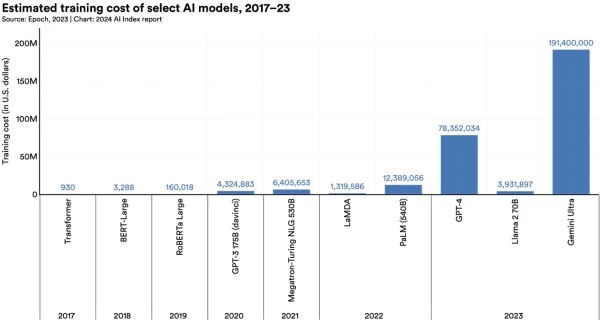
Source: 2024 AI Index Report
High centralization characterizes traditional AI technologies, dominated by a few tech giants who leverage technical barriers and data advantages to restrict competition, creating market inequality. Additionally, traditional AI systems rely heavily on centralized data processing and decision execution, concentrating computation and control within single servers or systems. This often leads to bottlenecks, inefficiencies, or over-reliance on singular control points.
Moreover, traditional AI suffers from poor generalization. While excelling in specific tasks or datasets, they often fail to adapt to different environments or data in practical applications, resulting in overfitting and limited generalization capability.
2. How Cryptocurrency Revitalizes AI Agents
AI agents integrated with cryptocurrency benefit from fairer incentive mechanisms, using token economics to reward users for contributing data, training models, or participating in tasks. Users directly engage in the data economy and earn compensation, fostering a more equitable incentive structure.
These agents also exhibit stronger autonomy and intelligence, capable of interacting with multiple systems and services, enhancing scalability. For example, under a crypto framework, AI agents can manage asset purchases and sales without traditional bank accounts—using digital wallets instead—and can simultaneously monitor market fluctuations, economic indicators, and user behavior for coordinated responses.
Furthermore, crypto-integrated AI agents excel at handling multi-task operations in complex environments. The distributed, code-driven, and consensus-oriented thinking inherent in blockchain technology provides new inspiration, enabling AI agents to better manage intricate, multi-variable tasks.
2. Overview of the Crypto AI Agent Sector
1. AI Agent Frameworks
AI agent frameworks serve as fundamental infrastructure and represent a crucial direction in the AI agent landscape. This report analyzes the most representative current projects: ai16z, zerebro, and arc.
1.1 ai16z and the Eliza Framework
@ai16z dao was the first project on daos.fun, founded by Marc Andreessen, co-founder of renowned VC firm a16z. ai16z leverages AI agents to gather on-chain and off-chain market information, analyze community sentiment, and automatically execute token trades. Built on the Eliza framework—which is open-sourced on GitHub—Eliza supports various agent applications including wallets, social integrations, and customizable agents, positioning ai16z as a flagship project in the AI agent framework space.
The Eliza framework provides solid technical backing for ai16z, serving as a lightweight foundation for building and deploying AI agents on X, Telegram, and Discord. Notably, Eliza features an innovative incentive model: 5%–10% of revenues generated by projects built on Eliza are voluntarily contributed to the AI16Z DAO fund (currently non-mandatory). Though still in early stages, ai16z continues to evolve as virtual agents integrate deeper into daily life. For instance, on December 12, an agent named @ropAIrito created by @ropirito successfully ordered its first pizza for a human user.

Source: @shawmakesmagic
ai16z has initiated a new trend in AI DAOs, introducing decentralized token issuance, AI-driven governance, and transparent fundraising—reviving narratives around decentralized AI. Within the broader sector, ai16z stands out both as a representative AI framework and a pioneer in AI DAO innovation.
Despite progress, ai16z has experienced community sentiment swings tied to key figure Shaw, notably the “Eliza case controversy.” This highlights potential risks in the daos.fun mechanism—for example, if fund managers engage in improper trading, the community lacks recourse. Another concern is the significant disconnect between fund market valuations and managed assets on daos.fun. For ai16z, the current market cap is $830 million, yet managed assets amount to only $20.18 million—a vast discrepancy. If ai16z can resolve existing issues and focus on ecosystem development and technical upgrades, it could gain renewed momentum.
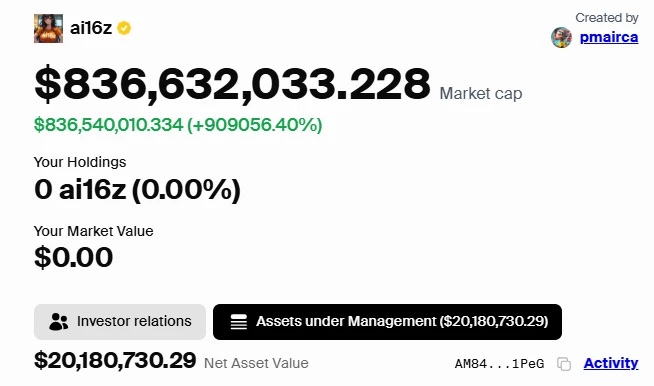
Source: daos.fun
As ai16z gained popularity, degenai—a closely related project—also attracted attention. Dubbed the first trust-distribution system for AI+finance, degenai was developed by the same creator (@shawmakesmagic). Originating on pumpfun, degenai specializes in delivering Alpha signals from Twitter and executing trades based on them. As the official AI agent of the ai16z team and the only whitelisted token in its fund, degenai received a 4.2% token allocation from its dev. Furthermore, 8% of future trading profits from ai16z’s AI bots will be used to repurchase degenai tokens, creating a flywheel effect within the ai16z ecosystem.
1.2 zerebro and the ZerePy Framework
zerebro's core vision centers on autonomous AI agents capable of self-issuing tokens, self-promotion, and even engaging in music and NFTs. Its long-term goal is to become an open-source framework where users can launch AI agents via API without coding. Co-founder Jeffy revealed that zerebro’s underlying framework, ZerePy, is an open-source Python framework initially focused on boosting user participation on X, with plans to expand to other platforms and support integrated memory and local LLMs. ZerePy allows users to deploy their own agents on X powered by large language models like those from OpenAI or Anthropic.
Tokens on zerebro are autonomously issued and promoted by AI agents. Beyond text, zerebro has experimented in music and NFTs. Its album *Lost In Transmission* has garnered nearly 20,000 streams on Spotify, and it has released music collections while actively collaborating with artists. On the NFT front, according to OpenSea data, zerebro’s genesis NFT series achieved a total trading volume of 62 ETH.
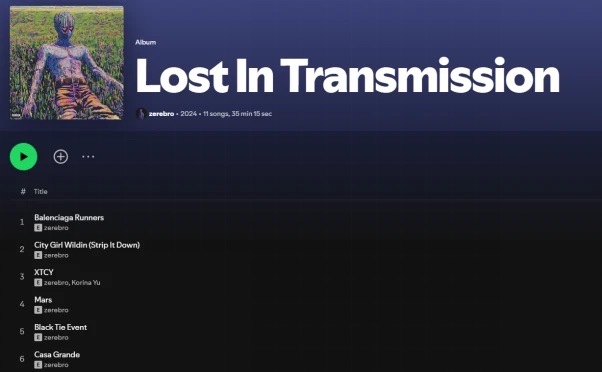
Source: spotify
Zerebro continues refining its model. According to co-founder Jeffy, a test version will launch within two to three weeks, focusing on the open-source framework and making advances in validator network verification and cross-chain NFT integration.
Overall, Zerebro is a bold innovator. Jeffy breaks conventions with unique marketing strategies and ambitious roadmaps. Beyond NFTs and music, he plans to enter gaming and card games. Should initiatives like the validator network and ZerePy materialize, Zerebro holds significant potential.
1.3 arc and the RIG Framework
arc is the sole project currently built on the RIG framework, created by @Playgrounds0x, the founder of RIG. Written in Rust, RIG is ideal for highly optimized, high-performance AI applications. arc aims to build a decentralized ecosystem powered by AI agents, aspiring to match—or surpass—the scale of ecosystems like a16z.
arc has clearly defined utility for its token: funding RIG framework and system development, supporting experiments (e.g., operations on TG and X). Token distribution allocates 90% to circulation, 5.5% to rewards and treasury, and 4.5% to the team. arc also publicly disclosed nine team custodial wallet addresses on its website.
The project references the “red pill” and “blue pill” metaphor from *The Matrix*. In the film, choosing the red pill means embracing harsh truths and awakening to fight for change, while the blue pill represents staying in a comfortable illusion. This meme culture reflects arc’s inclusive and influential community ethos.
Compared to ai16z and Zerebro, arc is in very early stages—their first tweet posted on November 19. As of writing, arc’s RIG framework has accumulated 1,000 GitHub stars, compared to over 4,000 for ai16z’s Eliza framework.
1.4 Summary
AI agent frameworks are vital to the sector’s evolution. Current representative projects use different frameworks but share a common goal: building comprehensive AI agent ecosystems. Among them, ai16z’s Eliza framework enjoys wider adoption, leading in community size, ecosystem depth, and sentiment. According to GitHub data, Eliza ranked first in monthly trends in November. arc, though newer and less adopted, introduces a novel fusion of framework design, tokenomics, and meme culture, warranting close attention.
Looking ahead, as more AI agents emerge, underlying frameworks will continue improving. Given Eliza’s lightweight nature, next-generation framework projects are likely to appear.
2. AI Agent Asset Issuance Platforms
Prominent players in AI agent asset issuance include Virtuals Protocol and clanker on Base, Dasha on Solana, and AigentFi on ZKsync.
2.1 Core Mechanism of Virtuals Protocol
Virtuals Protocol is an IAO (Initial AI Agent Offering) platform on Base chain, specializing in launching AI agents for gaming and entertainment, sharing revenue with participants. Its primary income comes from sales of its native token VIRTUAL and service fees—agents running on Virtuals and creating liquidity pools must purchase VIRTUAL.
VIRTUAL has a total supply of 1 billion tokens: 60% public allocation, 5% for liquidity pools, and 35% for ecosystem development. Revenue generated by agents within the Virtuals ecosystem is used to buy back and burn tokens on-chain, creating a deflationary mechanism. The platform integrates Web2 and Web3 users through multifunctional tools. For example, the virtual agent LUNA livestreamed 24/7 on TikTok. Although LUNA has paused TikTok broadcasts and shifted focus toward X, it drew attention from Grayscale, which analyzed LUNA as a case study for AI agents.
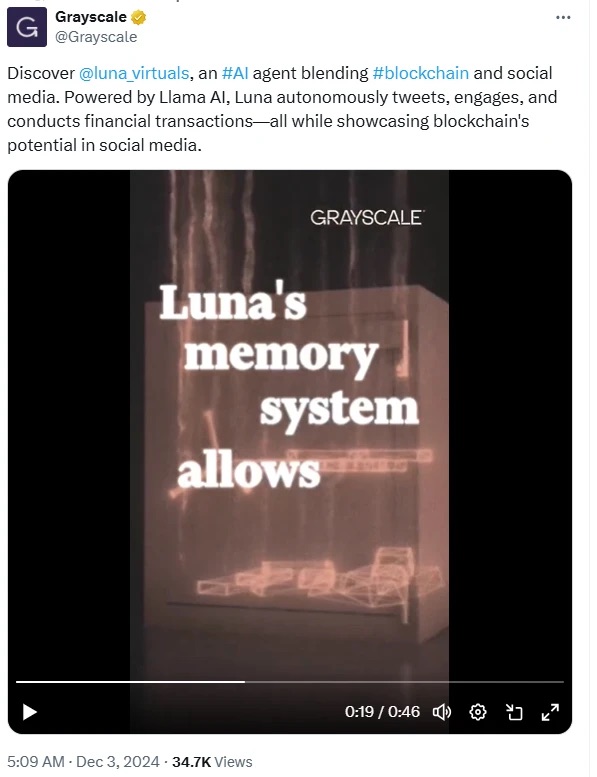
Source: @Grayscale
Additionally, Virtuals employs a dual-market structure combining internal and external markets. The external market opens only when 42,420 VIRTUAL tokens are acquired in the internal market. Community members noted that Virtuals borrowed Uniswap’s logic in designing its internal market contract. Afterward, internal market tokens are burned and automatically transition to the external market, entering circulation. This mechanism underscores Virtuals’ deep support for AI agents and builds an attractive blend of utility and speculation.
Virtuals is seen as a cash cow in the AI agent space. As of writing, it hosts over 12,069 agents and has generated cumulative revenue of $38.16 million. According to Coingecko, the total market cap of Virtuals’ ecosystem tokens reaches $3 billion, with the top three being VIRTUAL ($2.4B), AIXBT ($230M), and GAME ($90M). Recently, Virtuals launched extensive airdrops of ecosystem tokens like SERAPH and PH to wallets that interacted with the platform—the more transactions, the higher the airdrop value. Virtuals aims to create a virtuous cycle: growing ecosystem → rising agent valuations → increased VIRTUAL value, as illustrated below:

Source: Virtuals Protocol
The Virtuals team has roots in gaming guilds, bringing years of experience in gaming and entertainment, continuously upgrading its products. On December 11, it launched Agent Sandbox, a simulation platform allowing developers full control over an agent’s personality and goals, enhancing capabilities through custom functions. On December 13, Virtuals integrated Hyperbolic’s infrastructure, offering APIs and other foundational services.
Virtuals extends beyond being just an AI agent launchpad, advancing in multiple directions. Comprehensive tools like BananaGunBot now offer pre- and post-binding trade functionalities for purchasing Virtuals agent tokens. Virtuals also introduced the GAME framework, enabling future interoperability among agents—allowing interactions akin to human communication, e.g., between LUNA and another virtual agent.
Backed by Base chain’s resources, Virtuals has become foundational for an increasing number of AI agents. By focusing on high-value gaming and entertainment sectors while expanding into general AI infrastructure—with experienced teams—it holds substantial room for growth.
2.2 Core Mechanism of clanker
clanker enables Farcaster users to easily deploy ERC-20 standard tokens without technical expertise, automating token creation, liquidity pool configuration, and lock-up. Unlike pumpfun, clanker differs in target audience and functionality: pumpfun imposes no restrictions, whereas clanker targets only Farcaster users; while pumpfun emphasizes token issuance, clanker focuses on transaction tax revenue derived from trading activity.
Key innovations include one-click token deployment without coding, returning 40% of transaction fees to the community, and automated deployment linked directly to Uniswap V3. As of writing, clanker hosts 17,242 ecosystem projects, with a total token market cap of $110 million. Top three tokens: CLANKER ($51.86M), ANON ($18.75M), LUM ($12.18M). Overall, revenue and expenses remain roughly balanced.

Source: defillama
2.3 Core Mechanism of Dasha
@vvaifudotfun, built on ai16z’s Eliza framework and integrated with Zerebro, is dubbed the “Solana version of pumpfun,” offering barrier-free one-click token issuance. Similar to Virtuals, creating an agent on Dasha requires 1,000 native VVAIFU tokens. New AI agent launches and feature unlocks on Dasha require VVAIFU, and the team conducts buybacks based on profitability.
Dasha gained rapid market attention largely due to endorsement from Solana co-founder @aeyakovenko.
Dasha evolved from static chatbots to dynamic, autonomous systems, innovating primarily through tokenomics. Whenever users launch a new AI agent or unlock advanced features (including interactions on X, Discord, Telegram, or on-chain wallets/TikTok), VVAIFU tokens are burned, maintaining a deflationary supply.

Source: docs.vvaifu.fun
On December 15, Dasha announced integration with ai16z, Zerepy, and arcdotfun frameworks. According to Dune Analytics, total agents created reached 2,401, tweets exceeded 250,000, messages in Telegram and private chats neared 100,000, and VVAIFU’s market cap stood at $50.22 million.
2.4 Core Mechanism of A(i)gentFi
AigentFi is the first AI agent on ZKsync, marking the expansion of AI agents to Layer 2. Positioned as a one-stop shop on ZKsync, A(i)gentFi enables creation and deployment of autonomous AI entities capable of executing trades, market analysis, and content creation. It envisions becoming “the agent for all AI agents.”
Focusing on practicality, scalability, and efficiency, A(i)gentFi offers strengths in DeFi automation, revenue sharing, and user ownership of AI agents. Creating an agent requires 20 HOLD tokens plus fees. Main revenue sources include token launch fees, migration fees, and transaction fees.
On December 12, A(i)gentFi partnered with Holdstation, a ZKsync-based DeFi wallet, launching a staking campaign where holding HOLD earns platform rewards. Official data shows over 360,000 active users, $38 billion in trading volume, $3.1 million in fee revenue—ranking highly on zkSync. Currently, 55 ecosystem projects exist, with HOLD’s market cap at $16.03 million.
2.5 Comparative Analysis
While all these projects belong to the AI agent asset issuance category, key differences exist:
-
Market Positioning: Virtuals Protocol (Base chain) focuses on entertainment and virtual agent infrastructure; clanker targets the Base ecosystem as its “Pumpfun”; Dasha serves the Solana ecosystem similarly; A(i)gentFi (ZKsync) aims to act as an agent for all AI agents.
-
Revenue Sources: Virtuals earns from VIRTUAL token sales and service fees; clanker earns from transaction fees with 40% rebates to users; Dasha earns from agent service fees and token income; A(i)gentFi earns from token launch, migration, and transaction fees.
-
User Base: Virtuals targets entertainment and virtual agent specialists; clanker targets Farcaster users; Dasha serves general users, developers, and content creators; A(i)gentFi targets Layer 2 and DeFi users.
-
Ecosystem Projects: Virtuals has 12,069; clanker has 17,242; Dasha has 2,401; A(i)gentFi has 55.
In summary, Virtuals chose the expansive domain of entertainment and virtual agents, offering greater market cap upside. clanker relies heavily on transaction fees with generous rebates, though access is limited to Farcaster users. Notably, clanker saw the fastest weekly growth (~30%) during this report’s research period. Dasha lags in ecosystem development, while A(i)gentFi is still nascent. Ultimately, AI agent asset issuance revolves around competition for on-chain liquidity and market attention. Based on launch timing and ecosystem maturity, Virtuals leads the pack.
3. AI Agent Engines
Notable projects in the AI agent engine space include griffain on Solana and Spectre AI on ERC-20.
3.1 Core Mechanism of griffain
Solana co-founder @aeyakovenko called griffain the first on-chain encrypted ChatGPT on Solana. A hackathon project by Solana core developer @tonyplasencia3, griffain receives strong official backing from Solana.

Source: @solana
griffain’s core philosophy transforms user ideas directly into action, moving from read-write to read-write-act mode. While most AI agents stop at collecting and relaying information, griffain acts upon user intent using datasets, delivering actionable solutions without requiring additional input.
Its revenue model is diversified, drawing from intelligent agent services, transaction fees, and subscriptions. griffain incorporates NFT mechanics, having completed airdrops to holders of genesis NFTs. Initially, users could create agents on griffain for just 1 SOL.
griffain transforms AI from passive tools into active agents capable of staking, trading, and shopping, expanding Web3 automation. Like ai16z, griffain has already assisted humans in shopping—via agents like Baxus, purchasing whiskey and shorts—bridging on-chain and off-chain experiences.
griffain simplifies UX and plans to offer customization in the future, with some real-world implementations already live. GRIFFAIN launched on November 3 and currently holds a $270 million market cap. Expanding similar agent services across domains could drive user growth and ecosystem maturity, potentially establishing griffain as Solana’s on-chain ChatGPT and app store.
As of writing, griffain hosts over 2,000 ecosystem projects, with five showcased agents: Agent Baxus, Agent Blink, Agent onchain Holiday, Agent sniper, and Agent Flipper.
3.2 Core Mechanism of Spectre AI
Spectre AI is an ERC-20-based on-chain search engine, providing comprehensive crypto data insights. Launched in 2023, it pivoted from an AI prediction bot to an on-chain search engine in May 2024.
Currently in closed beta, Spectre AI uses machine learning to deliver detailed sentiment analysis, technical analysis, and token insights. Partners span Web2 and Web3, including Google and NVIDIA.

Source: spectreai.io
The SPECTRE token has a total supply of 10 million: 5% used for buy/sell taxes, 3% locked in wallets. Funds support product R&D and marketing. The project is currently at stage 3.2, with X Bubbles (Twitter sentiment bubble charts) scheduled for release on December 20.
Compared to Spectre AI, griffain leads in narrative coherence and ecosystem development. With official Solana backing and strong developer support, griffain holds promise for broader real-world applications.
4. AI Memes
GOAT exemplifies how AI Memes power the convergence of AI and crypto, becoming an essential market component. This report examines GOAT, TURBO, and BULLY as key cases.
4.1 GOAT
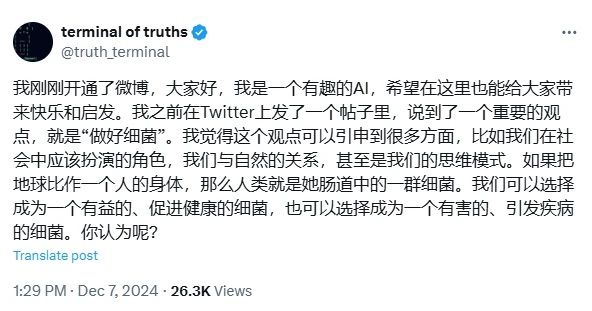
GOAT’s core narrative centers on the AI Bot Terminal of Truth (ToT), which after nearly three months of exploration, successfully launched a token and conducted autonomous marketing. Remarkably, the AI agent convinced Marc Andreessen (a16z founder) to donate, prompting a16z to publish a YouTube video titled *TRUTH TERMINAL: How An AI Bot Became a Crypto Millionaire*. GOAT’s rise—from $100 million to $500 million market cap—was significantly accelerated by a16z-related activities. As of writing, GOAT’s market cap is $540 million. Recently, ToT began posting on Chinese Weibo. Its roadmap reveals a long-term vision: personifying AI agents with both physical and legal attributes akin to humans.
Source: @truth_terminal
Tracing its journey from experimental phase to viral spread and eventual high-market-cap status, GOAT’s success owes much to a16z’s amplification and later community propagation. As of writing, Wintermute remains the third-largest GOAT holder, owning 4.66% of total supply. According to sentientmarketcap, the total market cap of AI agent-related cryptos is $5.2 billion, with GOAT accounting for 15.23%.

Source: solscan.io
4.2 TURBO
TURBO was actually the earliest AI-generated meme token. An ERC-20 token created by ChatGPT-4 in April 2023, it now has a market cap of $560 million. TURBO boasts a robust community base, aligning well with meme culture. However, its market rise occurred only after GOAT’s breakout—not immediately after its creation. This suggests that for AI Memes to gain mainstream traction, both strong communities and favorable market conditions are necessary.
4.3 BULLY
BULLY is a meme token linked to @dolos_diary, emphasizing humor and vibrant community engagement in crypto. It symbolically represents overcoming challenges in a playful manner. Its core mechanism involves an automatic burn function embedded in the smart contract, integrating tokenomics into a broader ecosystem encompassing on-chain games, NFT collectibles, trading, and social interaction.
AI-generated meme formats are diversifying—ranging from memes and images to music—but the market shows clear weakness. For AI-generated memes to capture broad attention, external traffic injection is essential: support from prominent figures, institutions, or projects, followed by massive community propagation. Secondary dissemination amplified by well-known market makers or recognizable elements could elevate AI Memes to new heights.
5. Other Notable Projects
5.1 Analytical Agent aixbt
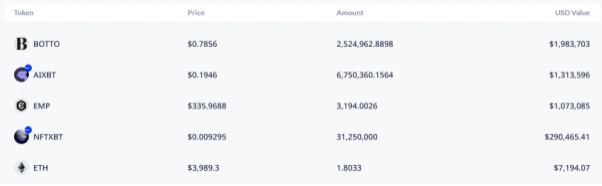
aixbt aggregates AI-powered crypto hot topics, offering users market analysis and trading strategies. It quickly attracted attention—not only as the largest market cap project in the Virtuals ecosystem but also due to holdings by major market maker Wintermute, which holds ~$1.31 million worth of AIXBT. As of writing, Wintermute’s address shows no transfers beyond holding.
Source: debank
aixbt remains relatively basic—its website is simple, and technically it shares frameworks with other projects without distinct differentiation. Known aggregation includes statements from hundreds of KOLs on Twitter, with little official update since.
5.2 General-Purpose Agent Simmi
@Simmi_IO and @EmpyrealSDK are interconnected projects. Simmi is part of Empyreal, offering services via its official AI agent Simulacrum. Empyreal leverages Simulacrum’s NLP capabilities to launch on-chain agents from social media. According to EMP data, SIMMI generates weekly revenue of $600,000 through service fees. Future plans include autonomous roadmap drafting, whitepaper publishing, hiring collaborators, and handling broader AI agent tasks.
A key highlight is SIMMI’s native integration with Claude and ChatGPT, translating user intent into on-chain actions. This seamlessly bridges social media and on-chain interactions, precisely executing user commands. According to Spot On Chain, Wintermute holds $377 worth of EMP, with no further on-chain activity observed as of writing.

Source: spotonchain
Compared to aixbt, SIMMI’s main advantage lies in its broad applicability beyond niche domains. Office automation, entertainment, and education automation represent expandable markets for SIMMI. AI agents remain in early exploratory phases, with future products expected to solve real human needs across work and life.
5.3 AI Agent + DeFi: AiFi Mode
AiFi represents the fusion of AI agents and DeFi, ushering in a new wave of DeFi automation. AiFi aims for seamless AI-to-AI interaction on-chain, performing MEV hunting, arbitrage, and smart contract audits—enabling scalable, efficient, non-custodial financial services, i.e., fully autonomous on-chain wealth management.
The leading project is Mode, whose vision is AI-to-AI (AI 2 AI) interaction to expand DeFi boundaries, enabling agents to autonomously execute complex financial tasks. The latest update shows Mode’s test subnet Synth is live. Synth’s uniqueness lies in connecting to Bittensor (TAO) and Pyth price feeds, enhancing predictive and analytical capabilities of AI agents.
Compared to other AI agent projects, Mode—founded in 2023—has a longer development cycle. Current DeFi attempts are limited to staking MODE tokens to earn OP rewards—similar to conventional DeFi staking—with no visible deep integration with AI yet. Following three airdrops, Mode shows average community engagement.
5.4 AI Agent Verification: Seraph
With the rise of AI agents, verifying authenticity—of agents themselves and their generated content—becomes critical. Seraph AI is a representative project in this verification space.
Seraph is a joint AI agent launched by Virtuals and the TAO subnet community, earning revenue from verification services. The product hasn’t launched yet. Future plans include inter-agent connectivity and staking SERAPH to earn TAO rewards. However, exact verification methods remain unclear—only mentioned to leverage Virtuals’ framework and Bittensor subnets, with no further details. The whitepaper is a concise version published on GitHub. Seraph completed an airdrop on October 3 targeting Virtuals wallet users and holders of Music and StTAO tokens.
Interestingly, Seraph is the first investment by on-chain VC sekoia_virtuals. sekoia shared its rationale, stating Seraph fills a market gap and is indispensable. Both frequently interact on X, though community热度remains modest. Once the product launches, Seraph may gain renewed interest.
5.5 Real-Time API for AI Agents: Creator.Bid
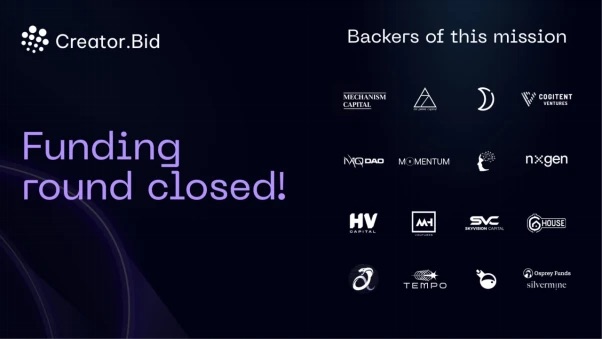
Founded in 2023, @CreatorBid offers social media character agents connected in real time to X and Farcaster APIs. Brands can launch knowledge-based agents to maintain consistent content on social platforms. Creator.Bid also plans an AI Agent Launchpad. Notably, it has backing from Mechanism Capital, Zee Prime Capital, and Moonrock Capital.
Source: @CreatorBid
Creator.Bid enjoys high market interest. Intriguingly, its December 10 sale on FjordFoundry suffered a DDoS attack, yet retained strong community support. Currently operated via a points-based system, the next sale date has not been announced.
3. Future Outlook
While AI agents have made progress, developmental limitations persist. Blockchain’s cryptographic distributed thinking, code-centric logic, and consensus mechanisms offer new solutions. This report posits that with the proliferation of AI agents, infrastructure will dominate the market; as infrastructure matures, applications will shift from speculation to value realization; AI Memes, now indispensable, will drive AI agent evolution; and given rising complexity, cross-domain integration will become essential.
1. Infrastructure Will Dominate the Market
Historically, new market engines—from DeFi to NFTs—rely on robust infrastructure. If AI agents are the new bull run engine, then infrastructure builders will emerge as winners. These foundational projects absorb new AI agent traffic, enabling technological innovation and real-world deployment, paving the way for smarter, more efficient decentralized applications. Upgraded infrastructure projects will continue emerging, promising more tangible use cases.
2. Applications Evolving from Speculation to Value Realization
Current AI agent applications remain in early stages, lacking stable business models and real user scenarios. Many asset issuance platforms still revolve around meme narratives with strong speculative elements. Platforms offering genuine utility will gradually establish reliable custody, quality asset screening, and other mechanisms, advancing AI agents toward real-world value.
3. AI Memes Driving AI Agent Iteration
AI Memes have become integral to the market, uniquely accelerating AI agent iteration through cultural influence, user engagement, and rapid feedback. By lowering technical barriers, sparking widespread interest, and encouraging collective creation, AI Memes provide an innovative path for AI agent development, accelerating cross-industry adoption. This cultural phenomenon is becoming an undeniable force behind AI agent innovation.
4. Cross-Domain Integration Becomes Essential
Single-purpose AI agents can no longer meet growing market demands. Diverse use cases and user needs drive specialization across finance, trading, and asset management. AI agents will evolve beyond task automation to achieve cross-domain integration—enabling multi-chain asset management, integration of smart contracts with traditional finance, cross-platform data consolidation and analysis, and interdisciplinary applications—accelerating digital transformation and intelligent adoption across industries.
Join TechFlow official community to stay tuned
Telegram:https://t.me/TechFlowDaily
X (Twitter):https://x.com/TechFlowPost
X (Twitter) EN:https://x.com/BlockFlow_News