








PolyFlow Insights: How PayFi Turns "Buy Now, Pay Later" into "Buy Now, Pay Never"
TechFlow Selected TechFlow Selected
PolyFlow Insights: How PayFi Turns "Buy Now, Pay Later" into "Buy Now, Pay Never"
PolyFlow provides the essential infrastructure for building PayFi scenarios, ensuring compliance, security, and seamless integration of real-world assets to drive the establishment of a new financial paradigm and industry standards.
 Navigating Web3 tides with focused insights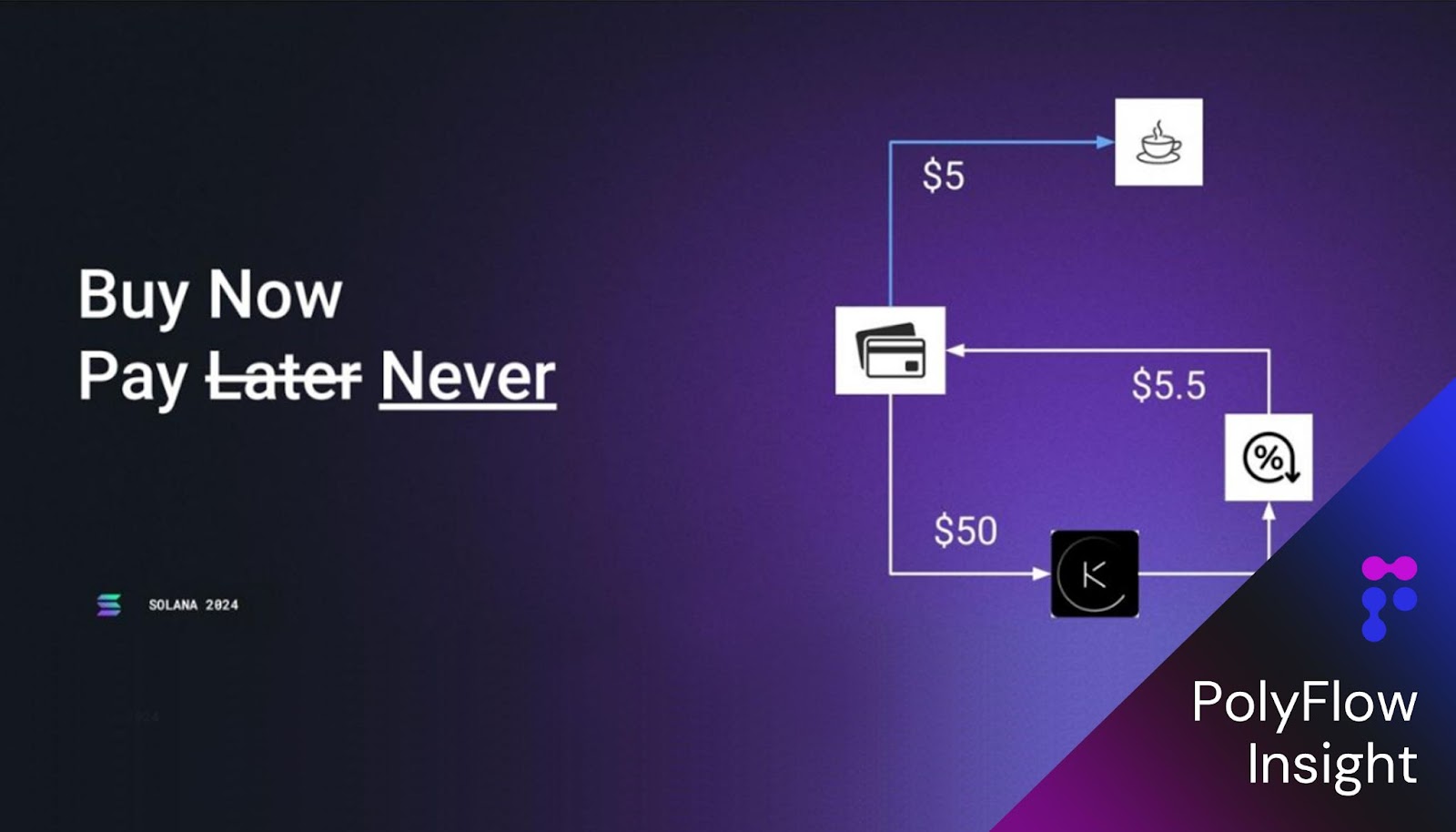
In the past decade, "Buy Now Pay Later" (BNPL) has become widely adopted in global e-commerce payments and is particularly popular among younger consumers. BNPL services are projected to account for 12% of global e-commerce spending on physical goods by 2025. As the wave of crypto adoption grows, PayFi—an innovative application combining smart contracts, blockchain technology, and decentralized finance (DeFi)—is offering consumers a payment experience approaching "Buy Now Pay Never."
In the evolution from "Buy Now Pay Later" to "Buy Now Pay Never," PolyFlow, as the foundational infrastructure for PayFi, enables compliant implementation and scalable application of Buy Now Pay Never through its core products: (1) PID (Payment ID), serving as the gateway for regulatory compliance, and (2) PLP (PolyFlow Liquidity Pool), acting as the custodial entry point for funds.
1. What Is Buy Now Pay Later?
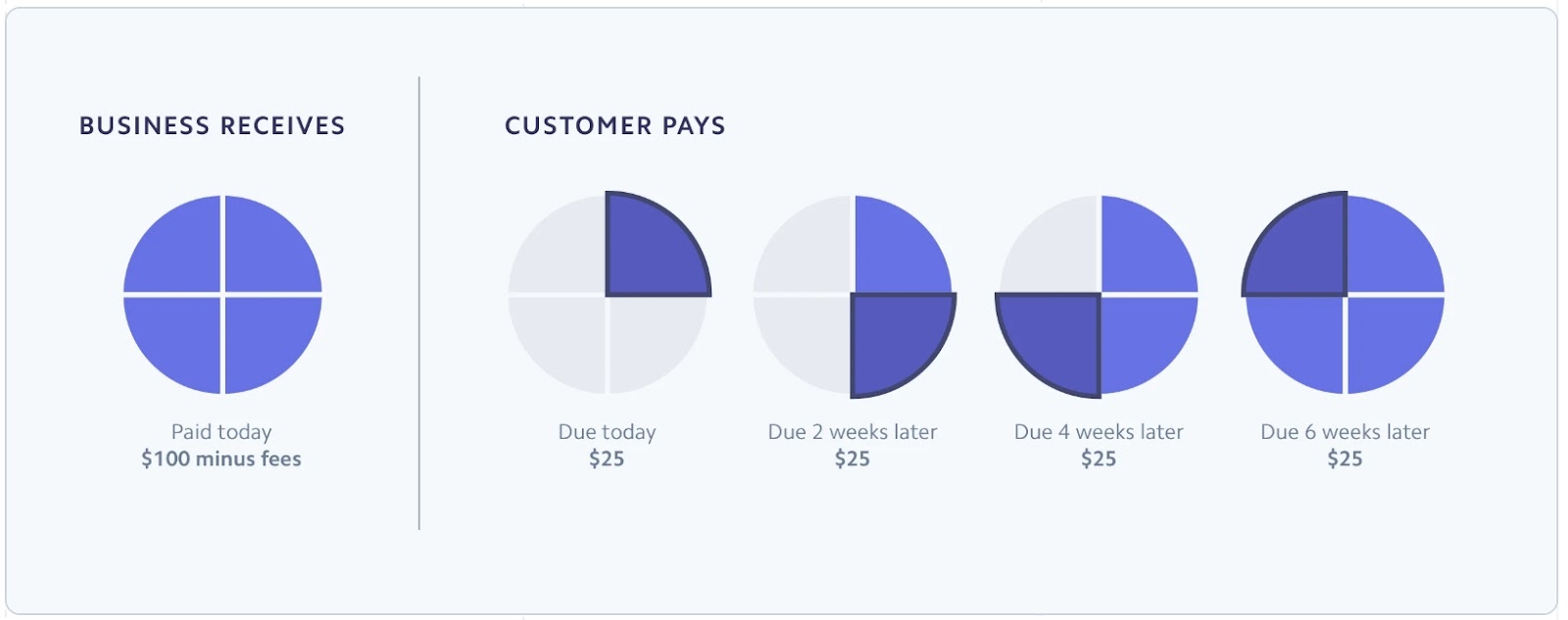
Buy Now Pay Later (BNPL) is an emerging online payment method that allows consumers to purchase products or services without paying the full amount upfront, enabling them to spread today’s consumption into installments paid over a defined future period. For example, a $100 purchase can be split into four payments of $25 each, typically interest-free.
This alternative payment method often appears alongside credit cards and other payment options and has become one of the most popular choices, especially among younger customers.
(What is buy now, pay later? BNPL platforms for businesses | Stripe)
According to data from Global Payments, it was estimated that in 2022, 44% of Gen Z and 37% of Millennials used BNPL services for purchases. More than half of U.S. consumers have used this service, while nearly 10% of e-commerce transactions in Australia utilized BNPL. In 2020, BNPL became the fastest-growing payment method in India and the UK. Analysts predict that by 2025, BNPL will represent 12% of global e-commerce spending on physical goods.
For consumers, the biggest appeal of BNPL lies in its ability to spread out relatively small purchase costs without incurring interest. Widely used in e-commerce retail, this more flexible payment option reduces payment barriers and meets consumer demand for installment and deferred payments. For merchants, BNPL can also increase conversion rates and average order value. According to Stripe, merchants using BNPL services can see revenue increases of up to 14%.
2. What Is Buy Now Pay Never in PayFi?
With the explosive growth of stablecoins and the rise of the PayFi narrative, Buy Now Pay Later is clearly becoming outdated. A new PayFi use case—Buy Now Pay Never—is emerging.
PayFi, or Payment Finance, refers to an innovative application model that integrates payment functions with financial services based on blockchain and smart contract technologies. At its core, PayFi leverages blockchain as a settlement layer, combining the advantages of Web3 payments and decentralized finance (DeFi) to enable efficient and free movement of value.
The concept of PayFi was first introduced as a new narrative by Lily Liu, President of the Solana Foundation, at the 2024 Hong Kong Web3 Festival. In her view, PayFi builds a completely new financial market centered around the time value of money (TVM)—something difficult or impossible to achieve in traditional finance.
The goal of PayFi is to realize the vision outlined in the Bitcoin whitepaper: building a peer-to-peer electronic cash payment network that does not rely on trusted third parties, while fully leveraging the benefits of DeFi to create a new financial market. This includes delivering novel financial experiences, constructing more complex financial products and applications, and ultimately forming an entirely new value chain.
(PayFi, How Solana Enables the Original Vision of Blockchain – Lily Liu, Solana Foundation)
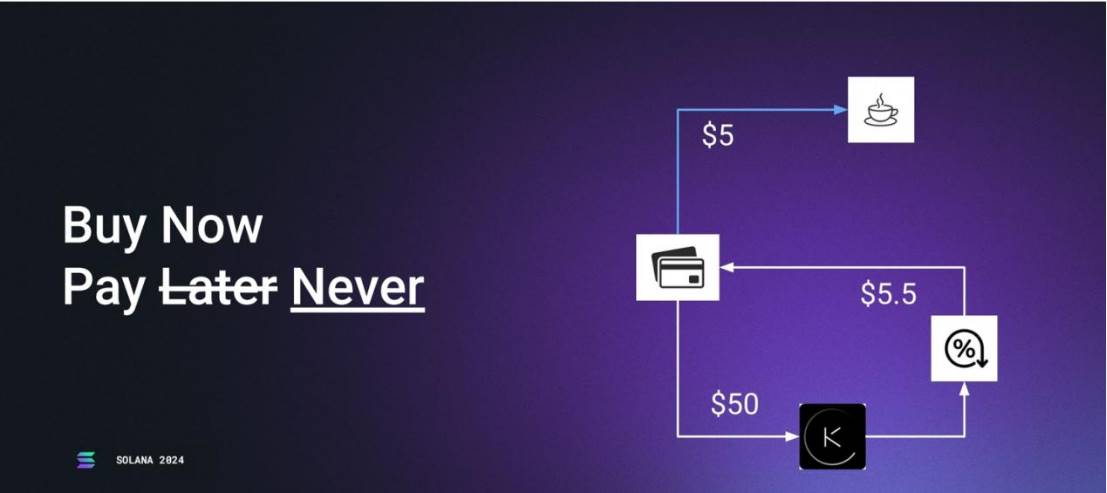
So how is Buy Now Pay Never achieved within PayFi? In her presentation, Lily mentioned the concept of Buy Now Pay Never—using blockchain and smart contract technology to lock in users’ future earnings generated in decentralized finance (DeFi) to pay for today’s consumption.
For example, if Sarah stakes $50 worth of assets in the PolyFlow protocol (expected to generate $5.50 in returns after one month), she could use that future $5.50 return to pay for her coffee purchase today via a PolyFlow-supported payment gateway.
This integration of real-world payment scenarios with DeFi exemplifies the core essence of PayFi.
3. From Buy Now Pay Later to Buy Now Pay Never
The convergence of blockchain-based payments and DeFi has given rise to PayFi. Lily eloquently articulated this: "PayFi creates a new financial market built around the time value of money. This on-chain financial market enables new financial paradigms and product experiences that are unattainable in traditional finance."
It is precisely this foundation that allows us to leverage blockchain technology to deliver a far more advanced experience—Buy Now Pay Never—surpassing existing BNPL services.
For consumers, Buy Now Pay Never offers a convenient and cost-effective purchasing method that doesn't interfere with their asset investments earning yield, while promoting real-world consumption.
For merchants, Buy Now Pay Never attracts a broader user base—including the crypto community—while boosting sales conversion rates and increasing average order values. Merchants no longer need to manage installment plans themselves and can instead focus solely on business growth.
For DeFi protocols, Buy Now Pay Never drives greater user participation in staking, fully unlocks the liquidity of yield-generating assets, and bridges the gap to real-world payment and consumption scenarios.
Within this new PayFi financial market, Web3 payments not only offer efficiency improvements over traditional finance—instant settlement, lower costs, transparency, and global reach—but also leverage decentralized finance (DeFi) to achieve decentralization across global networks, permissionless access, self-custody of assets, and individual sovereignty.
Beyond these lofty, cloud-high concepts, Buy Now Pay Never represents a practical PayFi scenario that genuinely benefits consumers—a true Consumer Application built for people.
4. How Does PolyFlow Enable Buy Now Pay Never?
PolyFlow is an innovative PayFi protocol designed to connect real-world assets (RWA) with decentralized finance (DeFi). As the infrastructure layer of the PayFi network, PolyFlow integrates traditional payments, crypto payments, and decentralized finance (DeFi), processing real-world payment scenarios in a decentralized manner. PolyFlow provides essential infrastructure for building PayFi use cases, ensuring compliance, security, and seamless integration of real-world assets, thereby driving the creation of new financial paradigms and industry standards.
It is precisely due to PolyFlow's decentralized infrastructure that composability and interoperability with numerous DeFi protocols are possible. Meanwhile, PolyFlow’s two powerful tools—PID (Payment ID) and PLP (PolyFlow Liquidity Pool)—serve as gateways for compliance onboarding and fund custody, respectively, ensuring the compliant deployment and scalable expansion of Buy Now Pay Never services.
Recently, PolyFlow launched the "Buy with Interests Program," actively collaborating with payment gateways, crypto payment card providers, and Web3 projects to build a new PayFi experience centered on Buy Now Pay Never—stay tuned!
PolyFlow is redefining how decentralized payment systems operate in the Web3 space and expanding innovative application scenarios for PayFi.

Join TechFlow official community to stay tuned
Telegram:https://t.me/TechFlowDaily
X (Twitter):https://x.com/TechFlowPost
X (Twitter) EN:https://x.com/BlockFlow_News
 @Polyflow_PayFi






