JD.com hires DeFi expert: Stablecoins are just the tip of the iceberg, PayFi is the deep-sea blueprint
TechFlow Selected TechFlow Selected
JD.com hires DeFi expert: Stablecoins are just the tip of the iceberg, PayFi is the deep-sea blueprint
A job posting can sometimes reveal a company's strategic intentions more clearly than an annual financial report.
 Navigating Web3 tides with focused insights
Author: Luke, Mars Finance
Sometimes, a job posting reveals more about a company's strategic intent than an annual financial report.
In August 2025, a recruitment notice from JD Technology was precisely such a case. It didn’t appear on the front page of mainstream job platforms, but quietly circulated within Web3 niche communities. What caught attention wasn't just the title “Stablecoin On-chain Activity Planner,” but its remarkably "crypto-native" requirements: “deep participation in the economic model design of at least one DeFi protocol” and “proficiency in DEX, lending, and derivatives protocols.”
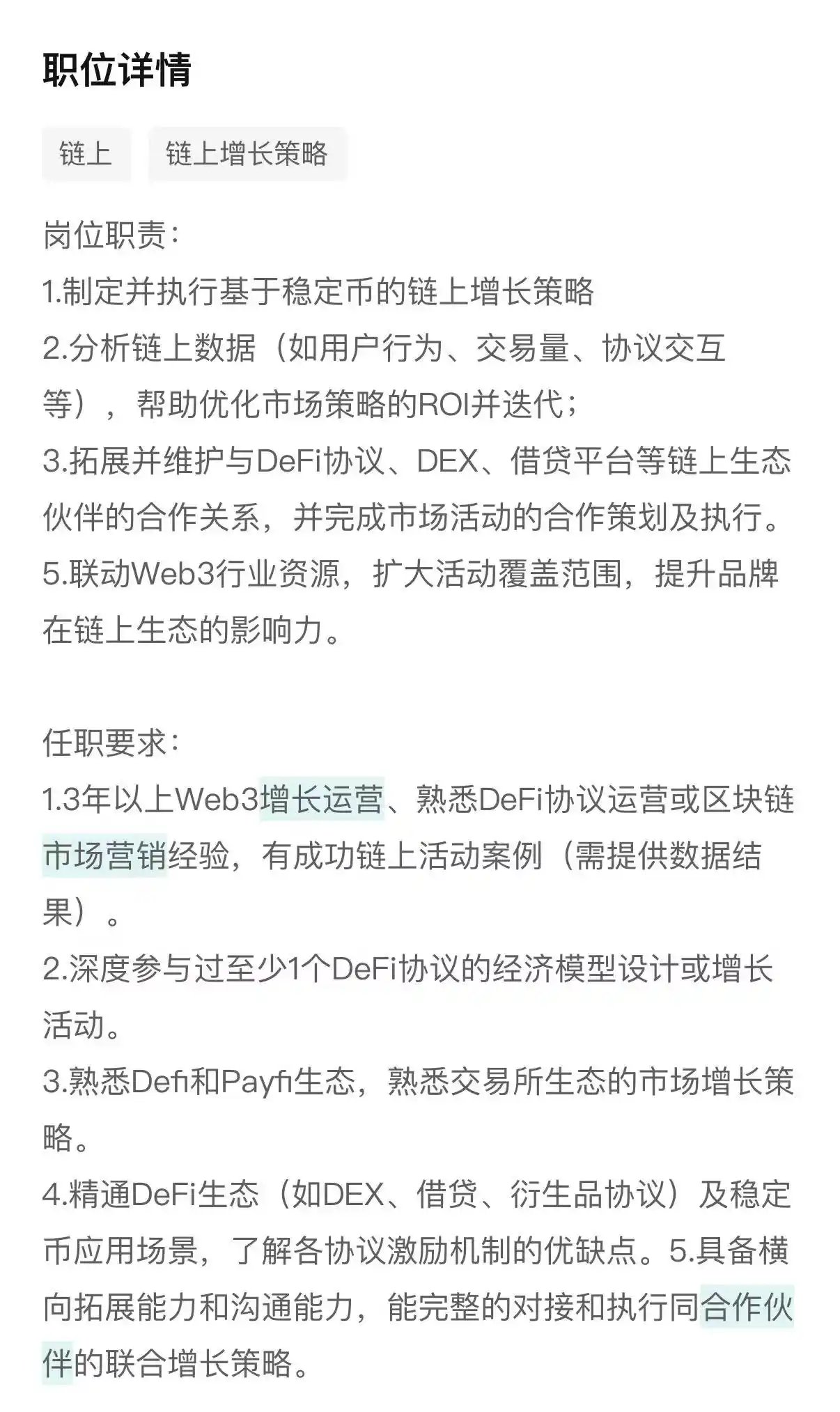
This wasn't about hiring a fintech expert to optimize internal payments—it was a hunt for a true on-chain strategist. When an internet giant with annual revenues exceeding one trillion yuan, rooted in physical retail and supply chains, begins openly seeking talent capable of operating in decentralized worlds, the message is unmistakably clear: JD is preparing to place its pieces on the global, permissionless Web3 chessboard.
Hong Kong’s Tailwind Arrives—JD Steps In
JD’s move didn’t happen in a vacuum. The timing of this recruitment perfectly aligns with a pivotal regulatory shift in Hong Kong.
Just days before the job posting surfaced—on August 1, 2025—Hong Kong’s long-anticipated Licensing Regime for Stablecoin Issuers officially took effect. This means that after multiple consultation rounds and sandbox testing, the Hong Kong Monetary Authority (HKMA) has rolled out a clear, compliant, and welcoming framework for stablecoin operators worldwide. Thus, JD’s talent search is less an exploration into uncharted territory and more a calculated move targeting a newly certified, strategically valuable frontier in global finance.
Xu Zhengyu, Hong Kong’s Financial Secretary, has repeatedly emphasized in public statements: “Provided regulation and risks are manageable, we support the steady and prudent development of the virtual asset market, viewing stablecoins as a key bridge connecting traditional finance and the virtual asset ecosystem.”
For a tech giant like JD—with deep roots in mainland China yet eager to connect globally—this tailwind arrives at the perfect moment. It offers an ideal “outlet”: a legally clear, geographically close, and culturally familiar strategic foothold. By establishing a compliant entity in Hong Kong, JD can legally issue fiat-pegged stablecoins (such as offshore RMB CNH or HKD), bypassing mainland China’s strict crypto regulations while directly participating in global on-chain economies.
The fact that JD released its recruitment ad immediately after the new regulation took effect is no coincidence—it’s a long-planned act of seizing the moment. The board is set, and JD clearly intends to be more than a spectator.
PayFi: Financial Lego Beyond Payments
If Hong Kong’s compliant environment represents the “right timing” for JD’s stablecoin initiative, then a seemingly minor term in the job description—PayFi—reveals its true strategic advantage and core ambition.
PayFi, short for Payment Finance, is a concept born in the crypto-native world. It goes far beyond simply “paying with cryptocurrency.” Its essence lies in using smart contracts to seamlessly integrate payment actions with complex financial services, making every fund flow programmable.
Imagine a scenario within JD’s operations: a small or medium-sized enterprise supplying goods to JD previously had to wait up to 90 days for payment, creating severe cash flow pressure. What happens under a PayFi model?
Once JD confirms receipt of goods, the system could generate an on-chain tokenized representation (an NFT or fungible token) of that accounts receivable and instantly send it to the supplier. Instead of waiting 90 days, the supplier could immediately use this “digital bill” as collateral in a DeFi lending protocol to access instant liquidity—or even split and trade it to pay upstream raw material suppliers. Entirely executed by code, the process becomes efficient, transparent, and extremely low-cost.
This is the power of combining Real World Assets (RWA) tokenization with PayFi—one of the most exciting narratives in the crypto industry in 2025. Jenny Johnson, CEO of asset management giant Franklin Templeton, once declared: “We believe tokenizing real-world assets will reshape the entire financial services industry. It’s one of blockchain’s most significant applications.”
For JD, with its vast network of merchants, complex supply chains, and billions of users, there lies trillions of yuan worth of “real-world assets”—accounts receivable, warehouse receipts, logistics orders, consumer credit. Activating these assets on-chain via stablecoins and PayFi would be like unblocking its entire circulatory system, unleashing exponential value. This isn’t merely about cutting costs and improving efficiency in existing supply chain finance; it’s about building an entirely new, programmable financial infrastructure.
“Amphibious Operations”: Divergent Web3 Paths Among Giants
JD’s explicit focus on stablecoins and DeFi also sets it apart in the landscape of Chinese tech giants exploring Web3. A horizontal comparison paints a fascinating picture:
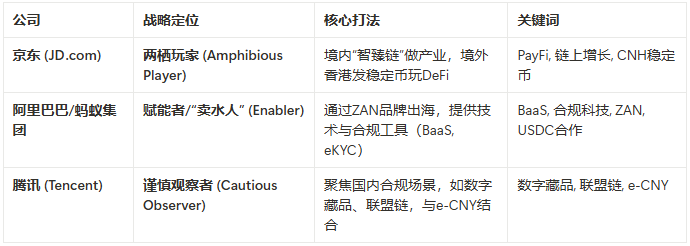
As shown in the table above, Ant Group, Alibaba’s affiliate, approaches Web3 more like a “water seller.” Its ZAN brand launched in Hong Kong focuses on providing compliance-focused technical components—e-KYC (electronic Know Your Customer), AML (anti-money laundering)—and BaaS (Blockchain-as-a-Service) for Web3 developers. Its strategy is one of “empowerment,” helping others mine gold rather than digging for it themselves. Recent reports suggesting its private chain plans to integrate the USD stablecoin USDC further confirm its preference for collaboration with established ecosystems over building from scratch.
Tencent, meanwhile, remains more cautious, focusing largely on consortium chains and digital collectibles—areas where domestic policy is clearer—while maintaining considerable distance from public blockchains.
Against this backdrop, JD’s strategy stands out as uniquely bold and forward-looking. Rather than settling for being a technology provider, JD has chosen an “amphibious operations” path:
-
Domestically (Inland): Its self-developed “Intelligent Chain” continues to deepen industrial blockchain applications in regulated environments—anti-counterfeiting traceability, digital evidence—embracing regulation, integrating with digital RMB (e-CNY), and strengthening its compliant “industrial digitization” foundation.
-
Internationally (Offshore): Leveraging Hong Kong as a gateway, JD is stepping in as a direct participant—issuing its own stablecoins, operating its own on-chain ecosystem, fishing in the vast ocean of DeFi, and exploring the boundless potential of “financial assetization.”
This dual-track strategy ensures stability and compliance for its domestic operations while opening infinite possibilities for the group’s future.
From E-commerce Empire to On-Chain Economy
JD’s move marks a significant turning point. It signals that the integration between top-tier Web2 giants and Web3 is shifting from theoretical discussion and peripheral experimentation to deep alignment with core business operations.
For years, people have debated how Web3 might “disrupt” Web2. But JD’s case may suggest another possibility: not disruption, but “elevation.” Web2 giants won’t be easily replaced. Instead, they’ll leverage their massive user bases, rich application scenarios, and strong capital to absorb Web3 technologies and philosophies, evolving into a new, more powerful hybrid form.
Of course, the road ahead is not smooth. From hiring one position to building a thriving on-chain ecosystem, JD must overcome numerous hurdles—technical integration, financial compliance, market education, and shifts in user behavior. It will face scrutiny not only from traditional financial institutions but also fierce competition from crypto-native players.
Nevertheless, when a commercial aircraft carrier the size of JD begins adjusting its course into the deep waters of DeFi, the entire industry should pay close attention. Because this isn’t just about one company’s future—it may be sketching a blueprint for how an e-commerce empire, via stablecoins as a bridge, could ultimately evolve into an efficient, transparent, and global on-chain economy. On that day, the end of a transaction won’t mark closure, but the beginning of new financial value creation.
Join TechFlow official community to stay tuned
Telegram:https://t.me/TechFlowDaily
X (Twitter):https://x.com/TechFlowPost
X (Twitter) EN:https://x.com/BlockFlow_News