








Decoding the Altcoin Season: 6 Position-Building Strategies to Help You Capitalize on Altcoin Momentum
TechFlow Selected TechFlow Selected
Decoding the Altcoin Season: 6 Position-Building Strategies to Help You Capitalize on Altcoin Momentum
The real knockoff season is still ahead.
 Navigating Web3 tides with focused insights
Author: CryptoAmsterdam
Translation: TechFlow
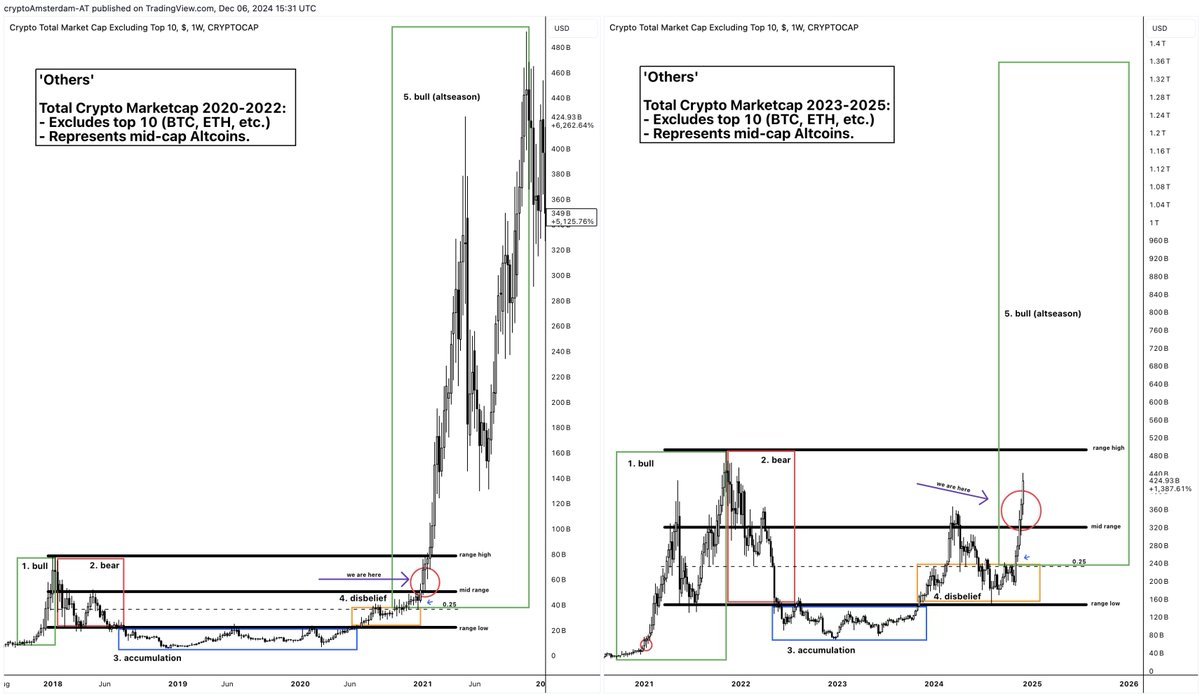
1. When Will the Altseason Arrive?
I believe altseason is coming soon, and here are some key analytical points:
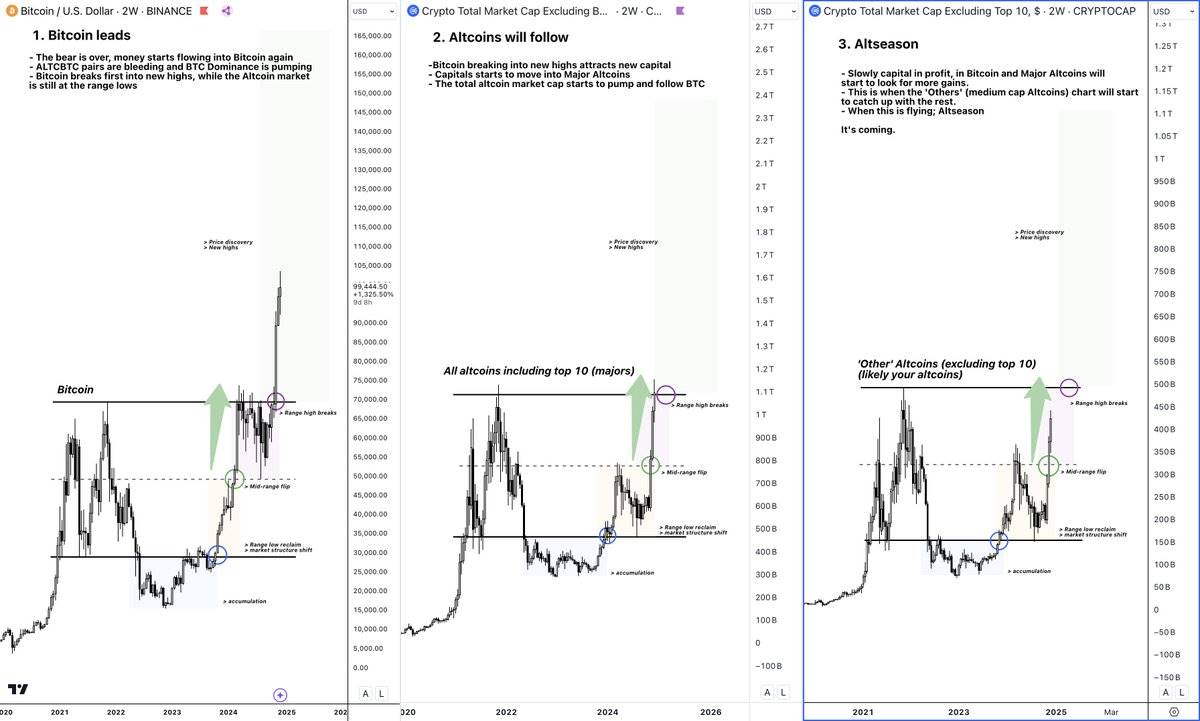
1.1 The Cycle Has Two Phases
-
Phase 1: Bitcoin price rises while altcoins fall (Bitcoin dominance increases).
-
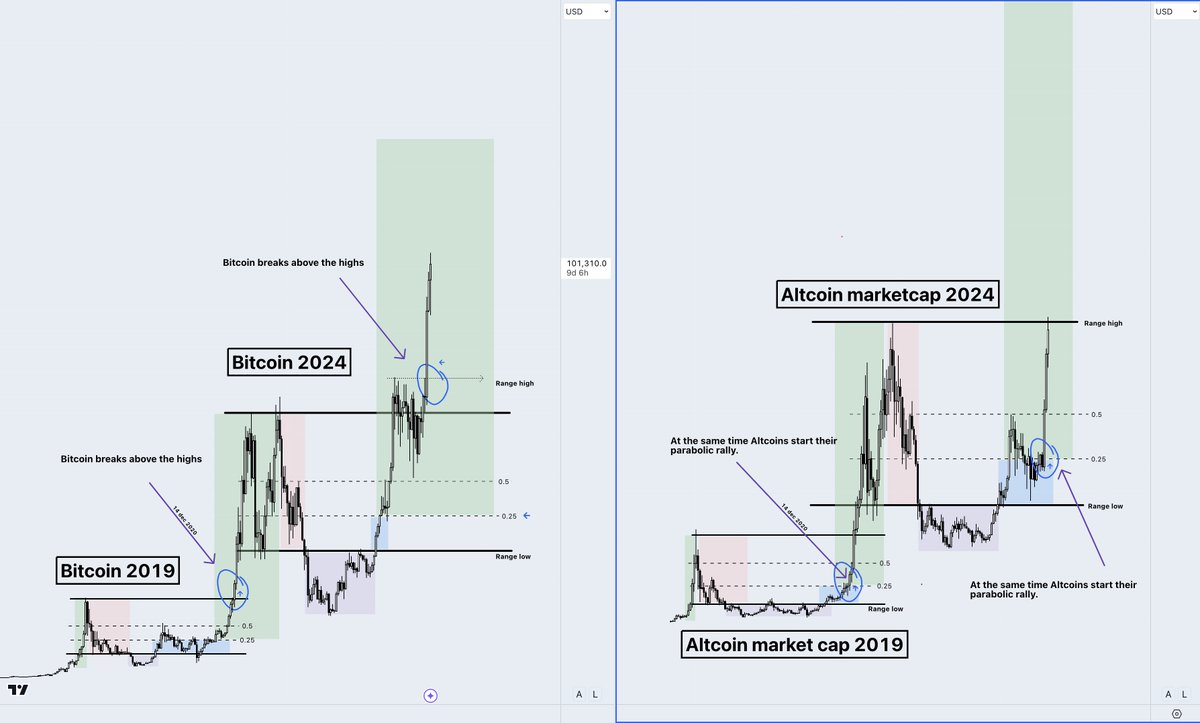
Phase 2: Bitcoin breaks its all-time high, and altcoins enter a rapid upward phase.
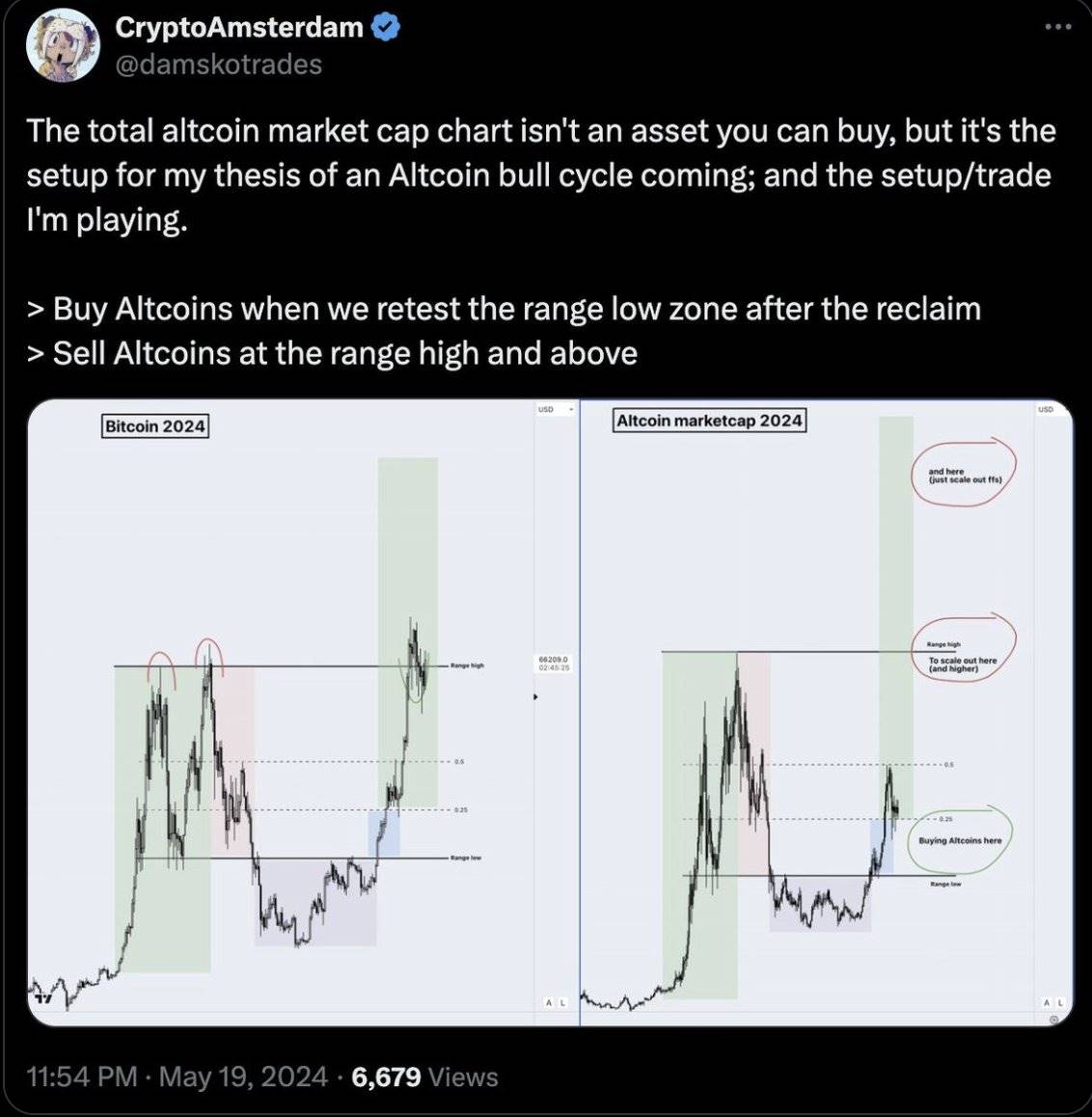
The pattern below illustrates this clearly:
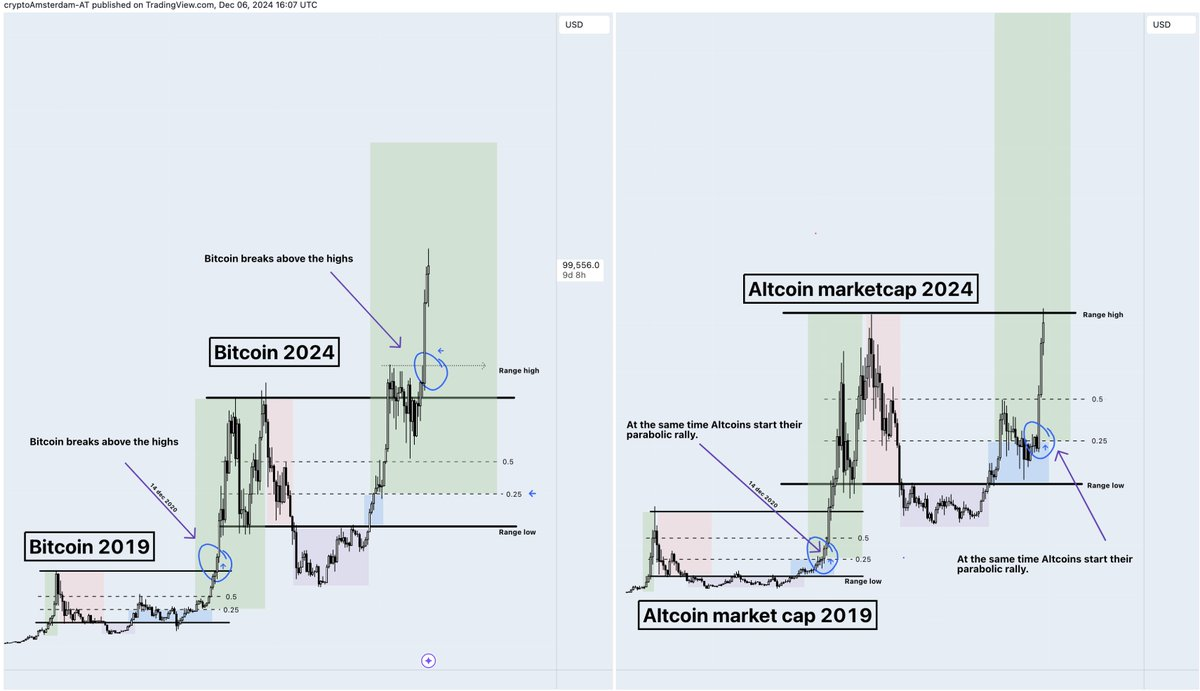
During this phase, we begin accumulating altcoins when their total market cap is at a range low. I believe altcoin prices will break new highs just like Bitcoin’s did.
Currently, Phase 2 has already started!
For more details, see: link.
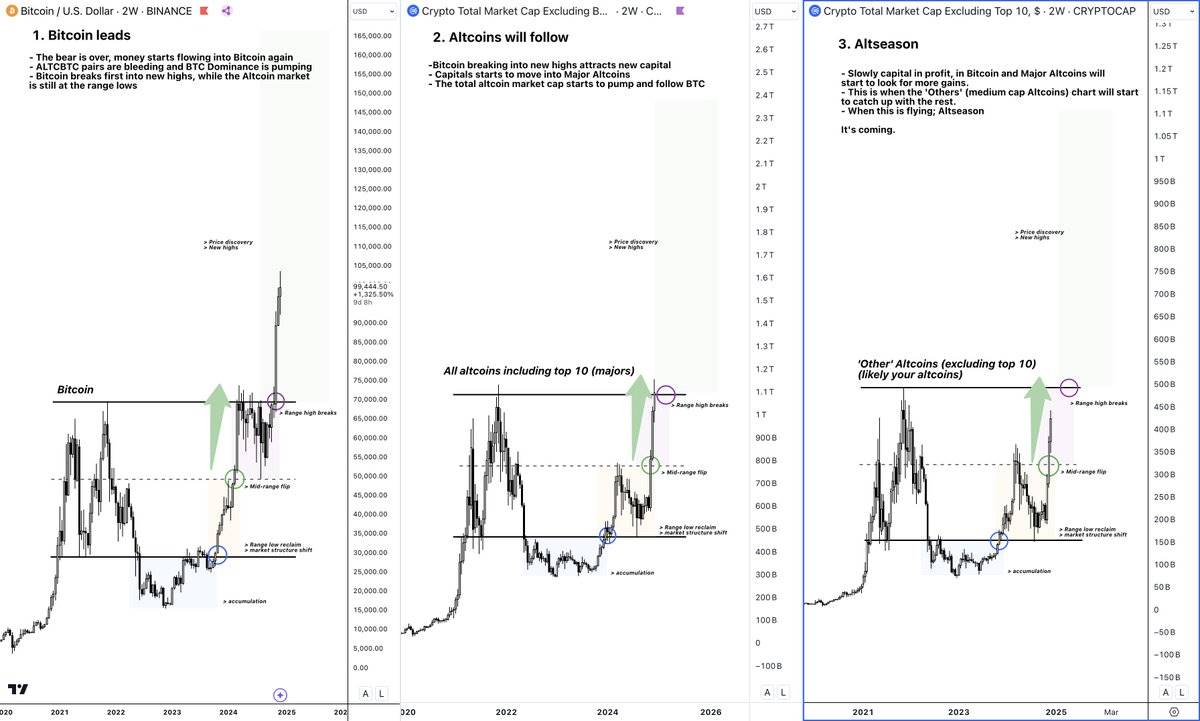
1.2 Capital Flow Patterns
The bull market began around the end of 2023, when Bitcoin bottomed out, rebounded back into range, and rose toward previous highs, while altcoins depreciated against Bitcoin and Bitcoin dominance increased.
Now that Bitcoin has broken its all-time high (our current phase), capital is beginning to flow into large-cap altcoins. Looking at the Total 3 chart (market cap of top 100 altcoins excluding BTC and ETH), although currently driven mainly by large-cap tokens like XRP, mid- and small-cap altcoins are catching up.
Eventually, funds from Bitcoin and large-cap coins will gradually shift into mid- and small-cap altcoins.
As market sentiment intensifies, investors become greedier and start chasing mid- and small-cap altcoins. I expect “Others” – mid-sized altcoins – to reach new highs. The real altseason is still ahead.
1.3 Bitcoin Dominance
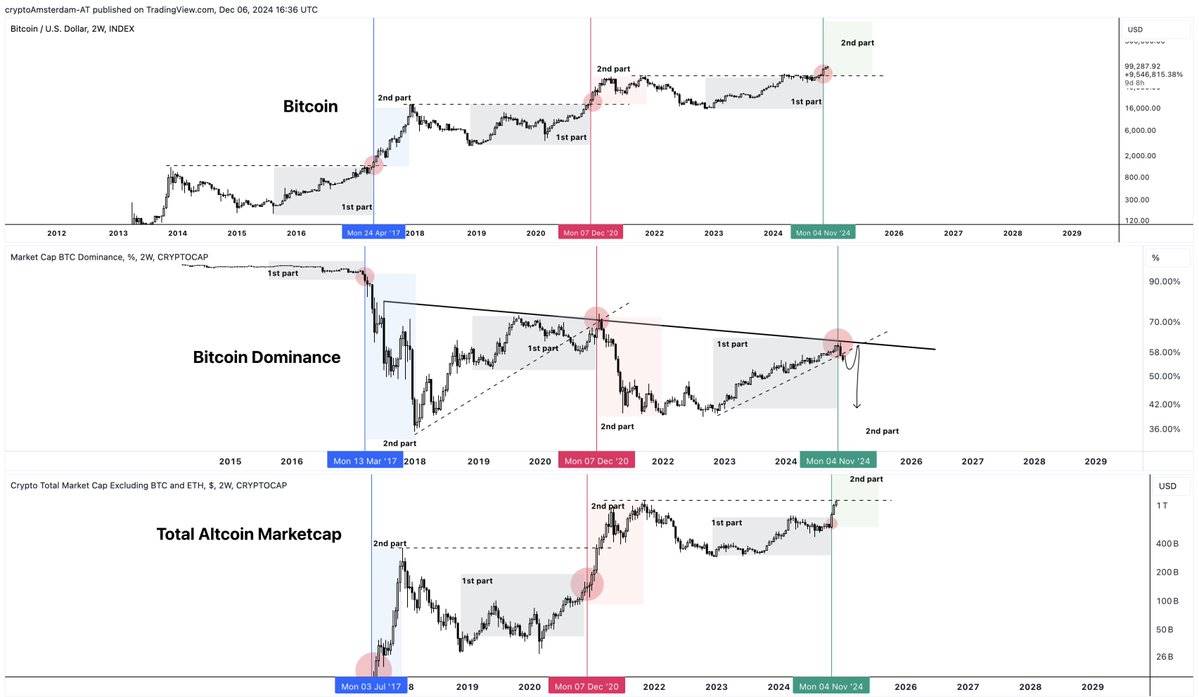
Each cycle follows a similar pattern: when Bitcoin breaks its previous all-time high and rallies for the first time, its market dominance begins to decline.
Currently, Bitcoin dominance has broken an uptrend that lasted over 800 days.
1.4 ETHBTC Analysis
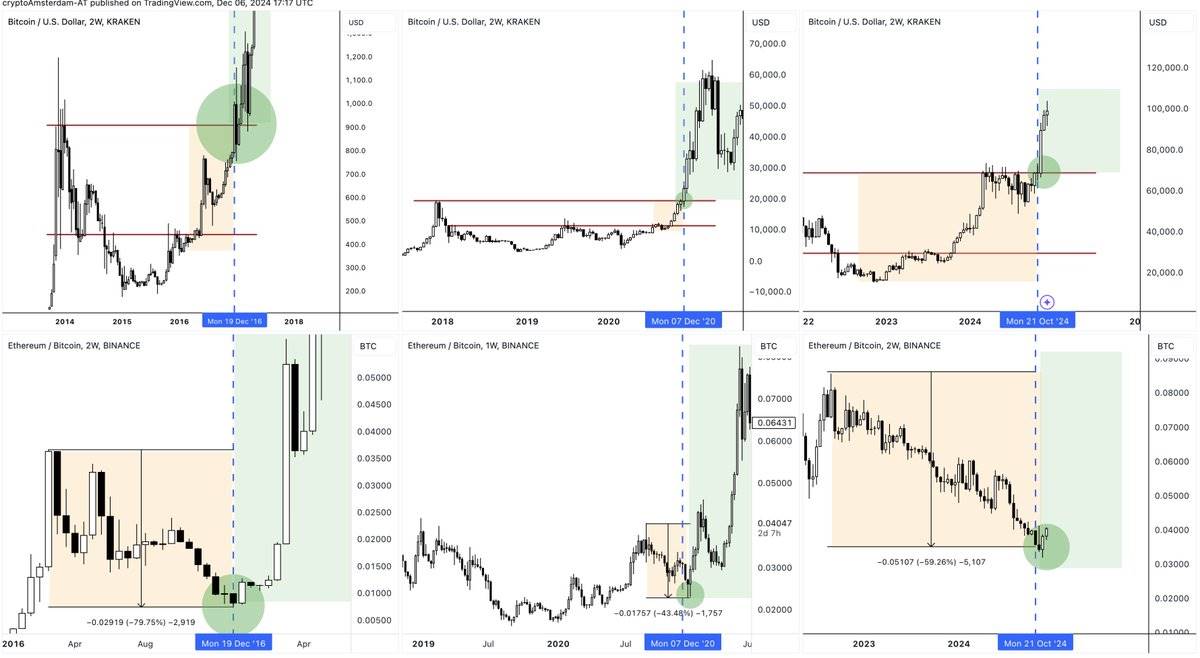
In every cycle, Ethereum tends to underperform early (while Bitcoin rises but remains below its prior peak), then rebounds once Bitcoin firmly establishes itself above previous highs.
This cycle is no different. More capital is expected to flow into Ethereum ecosystem tokens, on-chain utility tokens, and higher-risk assets. Once ETHBTC truly enters an uptrend, these tokens will perform even better.
ETHBTC Chart Analysis
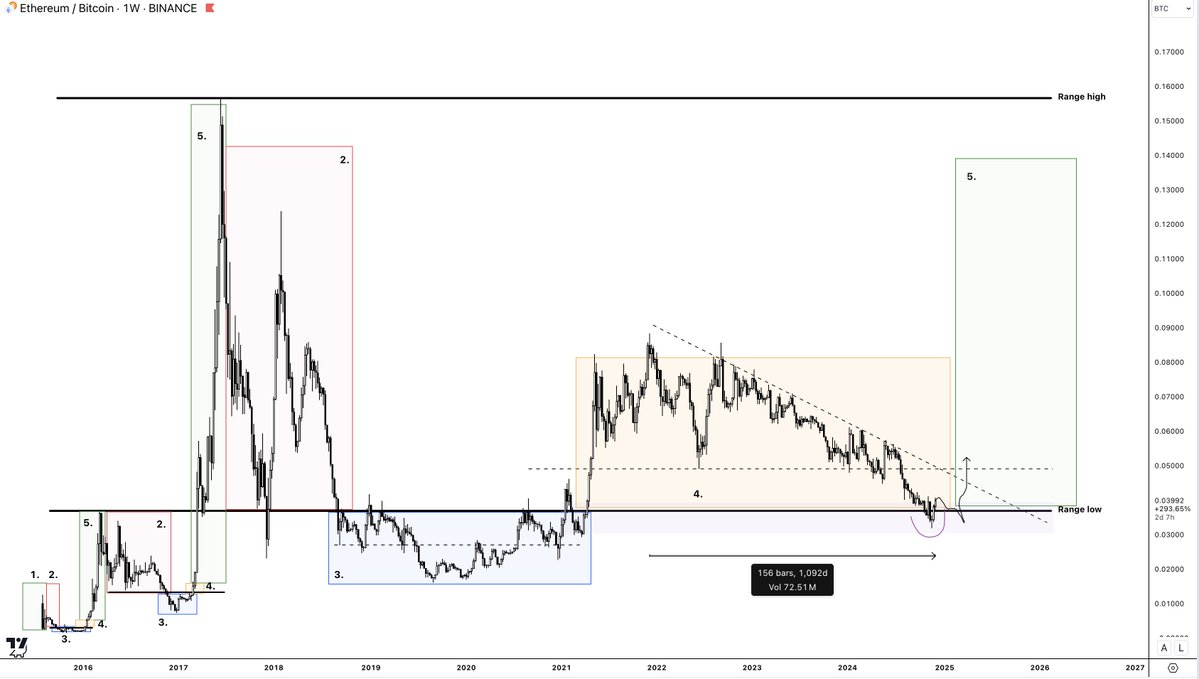
Currently, ETHBTC has retested and reclaimed its range low.
In 2021, it failed to break resistance at Stage 4. In this cycle, could we see a “super surge” at Stage 5?
A breakout above the current downtrend line would mark the end of a 1100-day bear market trend.
Additionally, 2024 is a pivotal year for the potential launch of Ethereum ETFs (exchange-traded funds). I believe the market still underestimates Ethereum's potential.
2. Have You Already Missed the Opportunity?
As mentioned earlier, the Amsterdam team has been accumulating altcoins over the past 5–6 months during the Total 3 market cap lows.
At range lows, consider the following:
-
Buy at key support levels;
-
Gradually build positions during slow consolidation periods instead of chasing price spikes;
-
Set clear stop-loss levels (e.g., below the range);
-
Lower volatility makes holding easier.
But if you choose to buy after a vertical price surge:
-
You may lack a clear stop-loss. This might not matter much for short-term traders, but for long-term investors, lacking a stop-loss increases risk.
-
The opportunity to profit from low to high within the range is gone; now your bet becomes whether altcoin market cap can reach new highs.
-
Buying during rapid price increases exposes you to higher volatility, where 20–30% pullbacks are not uncommon.
So I believe you’re not too late, because:
-
Bitcoin still has room to rise.
-
Capital rotation hasn’t fully reached mid- and small-cap altcoins yet (“Others” chart suggests potential new highs), so the most profitable phase hasn’t arrived.
-
Bitcoin dominance may continue to decline, while the ETHBTC ratio is likely to rise.
However, keep the following in mind:
-
Understand which phase of the market cycle we're in.
-
Clarify whether you’re entering a position for short-term trading or long-term investment.
-
Create a clear profit-taking plan.
-
Recognize this is a high-volatility phase where 10%–30% sharp corrections are possible.
-
Accept that such sharp pullbacks are hard to predict, and attempting to trade them may disrupt your longer-term investment strategy.
Risk analysis for entering at this stage (as opposed to 3–6 months ago):
Refer to this.
3. How to Enter – Recommendations:
If you missed the accumulation window over the past six months, first reflect on why.
It was likely due to emotional influence:
-
In bull markets, price surges are typically very fast, with few clear and sustained pullbacks.
-
Many miss the initial move, and when they finally FOMO-buy at higher prices, the market often enters consolidation or a sharp correction.
-
During consolidation, they grow pessimistic and end up missing the next rapid rally.
The correct strategy: Accumulate gradually during consolidations orpullbacks, stay patient, and focus on higher-timeframe market structure.
See more at here.
Now, specific recommendations!
Recommendation 1: Stick to Spot Trading, AvoidLeverage
Prioritize spot trading.
Many are accustomed to using leverage, but it's actually a trap. Every market swing feels like an “opportunity,” but most aren't. You don’t need to rush. Leverage trading ultimately leads most people to losses—or even complete wipeouts—don’t let it ruin your bull market gains.
Stick to spot trading so you won’t be forced to exit positions due to excessive leverage, or worse, get liquidated and miss market opportunities entirely.
Trust me, avoid leverage trading.
Recommendation 2: Don’t Chase Price, Focus on Pullbacks
Most people trade emotionally, buying only when prices rise (green candles) because it feels “safe.”
But markets never move straight up—even in bull runs, there are pullbacks:
-
Daily fluctuations: minor pullbacks of a few percent.
-
Every few weeks: 10%–30% panic-driven drops.
If you buy during price surges, you’re likely to panic-sell during pullbacks.
-
Buying during rallies feels comfortable.
-
Selling during declines feels relieving.
But the right approach is:
-
Buying may feel scary—but it’s the right timing.
-
Selling may feel painful—but it’s the rational choice.
If you can go against the crowd—accumulating during pullbacks and boldly buying during panic drops—you’ll gain a significant edge over most.
Recommendation 3: Scale In Gradually, Be Patient
So far:
-
Stick to spot trading.
-
Don’t chase rallies—accumulate during pullbacks.
Also, you don’t need to deploy all your capital at once.
You can scale in gradually. If you invest your entire fund when prices drop 5%, you might panic-sell if the market sees larger corrections (e.g., 10%, 20%, or even 30%).
The correct strategy: When price drops 5%, commit only 10% of your funds. That way, if deeper corrections follow (10%, 20%, 30%), you can keep averaging down instead of being shaken out by volatility.
What if the pullback doesn’t deepen? That’s fine. Don’t deploy all funds out of FOMO—doing so risks getting forced out during deeper corrections.
More pullback and entry opportunities will come.
In highly volatile markets, you can’t perfectly time every move. You don’t need to buy the absolute bottom or sell the top—just focus on long-term gains.
Recommendation 4: Manage Risk, Avoid Overexposure
You may have heard legendary stories of people turning full positions into millions, but overexposure severely tests your psychological resilience. If your position is too large, you may panic-sell during corrections and miss bigger opportunities.
Recommendation 5: Create a Plan That Fits You
Don’t blindly copy others’ plans. Instead, create a clear investment plan based on your goals and risk tolerance. This plan should include risk management and multiple contingency scenarios in case the market moves differently than expected.
A solid plan helps you stay calm during volatility, avoid wrong decisions driven by fear or euphoria, and enables gradual profit-taking.
Here’s what your plan should clarify:
-
Keep It Simple: Don’t make the plan overly complex.
-
Focus on Higher Timeframes (HTF): Pay attention to major trends, not short-term noise.
-
Define Clear Goals:
-
What market signals am I watching for?
-
Which tokens do I want to invest in? Why these?
-
How much capital will I allocate?
-
At which price levels will I scale in?
-
When will I exit?
-
For guidance on creating cyclical profit-taking plans, refer to this tweet.
Recommendation 6: Focus on Higher Timeframes, Keep Strategy Simple
-
Only look at higher time frame (HTF) charts to avoid distraction from short-term noise.
-
You only need to watch key price zones and market structure—ignore excessive market chatter.
-
Keep your strategy simple and clear.
Even a simple strategy gives you an edge:
-
Most use leverage—yours doesn’t.
-
Most chase green candles—yours doesn’t.
-
Most lack a clear profit plan—yours exists.
-
Most buy/sell all at once—yours scales in and out gradually.
Before sharing my altcoin watchlist, one key insight:
Insight:
In the current market, altcoins (“Others” market cap) are poised to hit new highs, drawing capital inflows from Bitcoin and major cryptocurrencies.
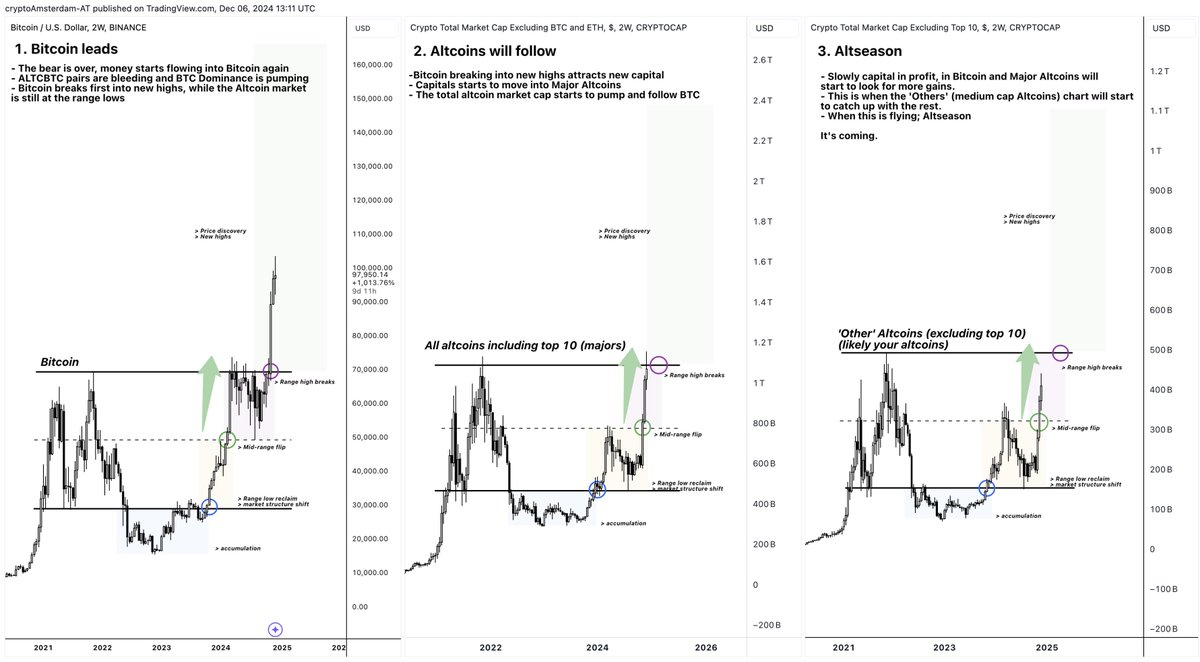
Currently, “Others” market cap is slightly above the range midpoint and gradually approaching the upper range.
Note that the upper range is typically a strong resistance zone, and multiple retests and pullbacks may occur before a breakout. This is often overlooked during strong market moves (like today’s sea of green).
Recall how Bitcoin behaved before breaking its upper range—it underwent several pullbacks and consolidations before succeeding.
Even in the last bull cycle, at the beginning of altseason, the “Others” market cap chart saw a 30% sharp correction before breaking the upper range.
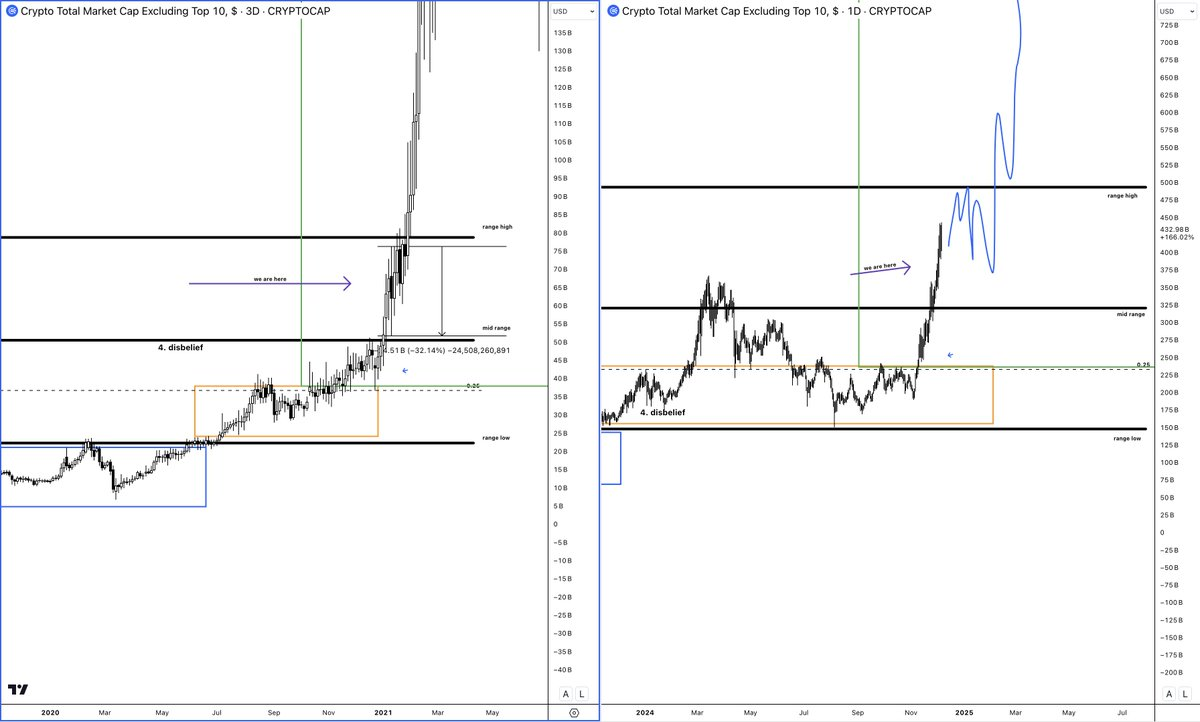
So remember:
-
Before full-blown altseason arrives, the market may experience significant corrections—even multi-week downturns.
-
Instead of trying to time these pullbacks, adopt the following strategy:
-
Scale in slowly: Gradually increase exposure—don’t deploy all capital at once.
-
Avoidleverage: High leverage carries extreme risk and could lead to liquidation.
-
Buy duringpullbacks: Focus on building positions during red candles (price drops), not green ones (rallies).
-
Stay patient, stick to a long-term strategy, and you’ll be better positioned to profit through market volatility.
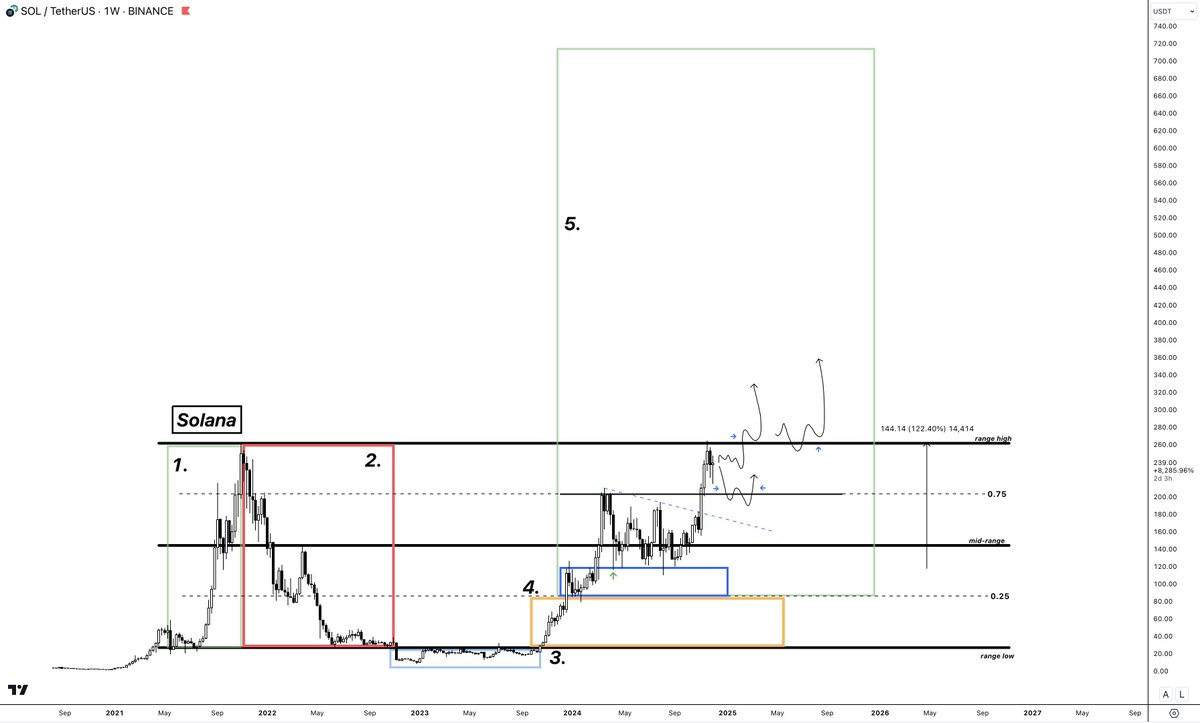
SOL is a strong large-cap performer in this market cycle, showing clear momentum—a noteworthy candidate.
From a cyclical perspective, I expect SOL to break its current upper range and exhibit significant upside potential as price enters the “discovery phase” (when new all-time highs prompt the market to reassess its true value).
Consider scaling in gradually at this stage. However, note that current prices are near strong resistance at the upper range. A full-position entry now may be difficult to hold through potential 10%–30% pullbacks. Therefore, strictly follow a scaled-in accumulation plan.
Also, recommend spot-only trading—avoid leverage. Here’s my approach:
-
Wait for a breakout above the upper range, then initiate a small position.
-
If price continues rising and stabilizes above the range, scale in further.
-
If price pulls back below the range and then breaks out again, that’s another entry opportunity.
-
If price retraces to the prior consolidation zone, that also offers a chance to scale in.
-
Consider adding more when price rebounds after a pullback and breaks a short-term downtrend line.
In short, prepare clear response plans for various market scenarios and accumulate gradually via spot trading.
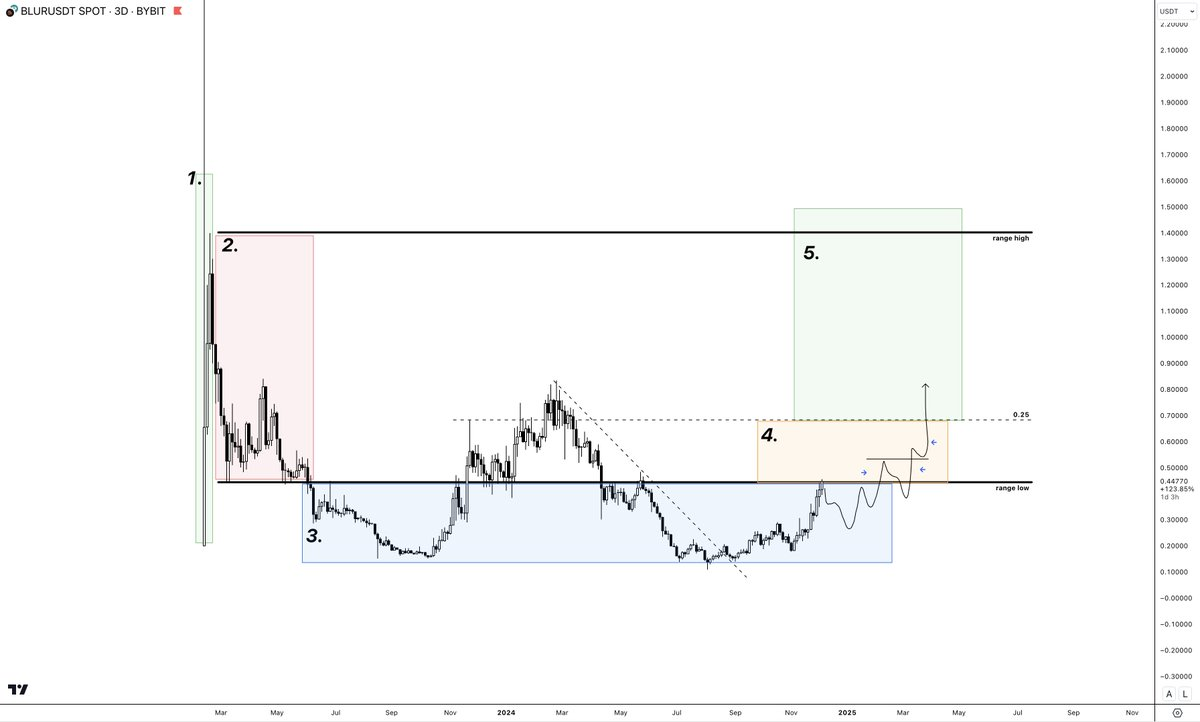
2. $BLUR
BLUR is a unique token. Earlier this year, it failed to defend the Stage 4 range low (support broke at lower price levels), likely due to the overall NFT market slump.
Now, the NFT market is recovering. Opensea may launch its own token, and Magic Eden’s token is set to go live next week.
With these catalysts, combined with current market and chart performance, BLUR may regain market attention.
My key watch level: whether a buying opportunity emerges when price reclaims the range low (marked by the arrow on the chart).
If the market drops again, you could also try accumulating at the Stage 3 range low.
For me, however, this token is better suited for short-term trading rather than long-term holding.
3. $MEME
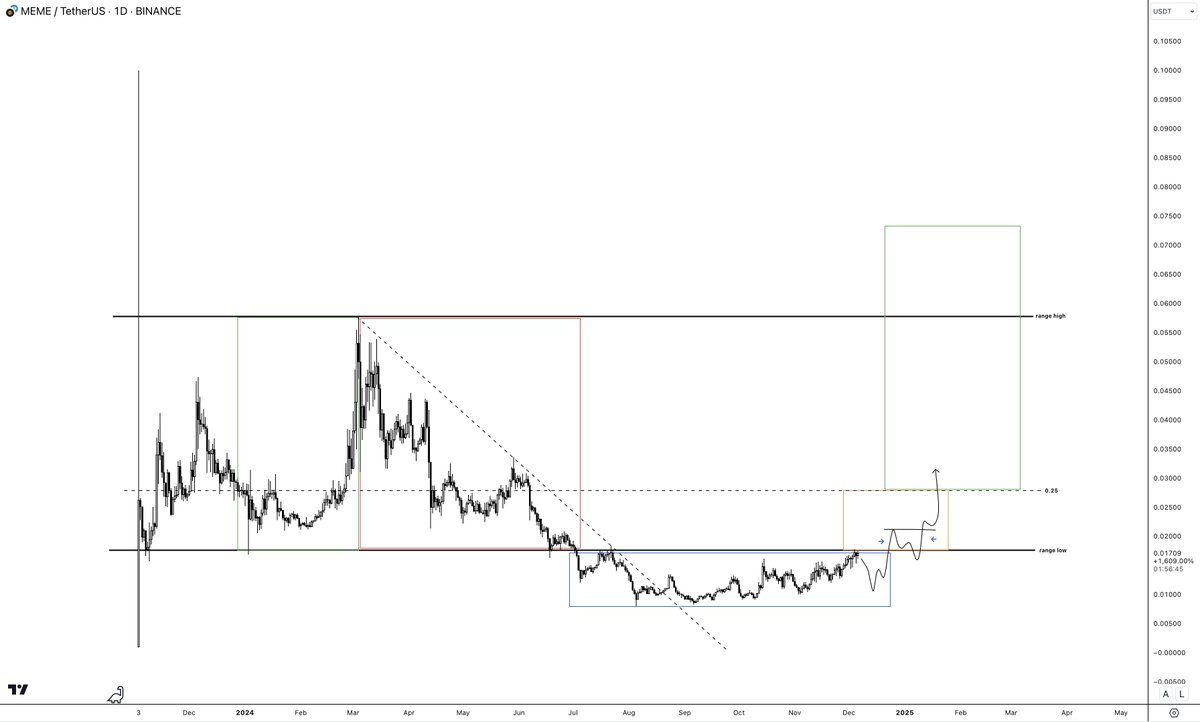
Meme-themed investments are well-known even among casual investors. It's hard to imagine a token named “MEME,” now listed on all top exchanges, wouldn’t attract significant market attention.
This token has a nearly perfect price structure and is currently in Stage 3. I’ll wait for a clear breakout and reclaim of key levels before entering.
Besides, this token is linked to a major NFT collection. With the NFT market recovery, the $ME incentive program rollout, and the potential launch of an Opensea token, additional upward momentum is possible.
4. $ORAI
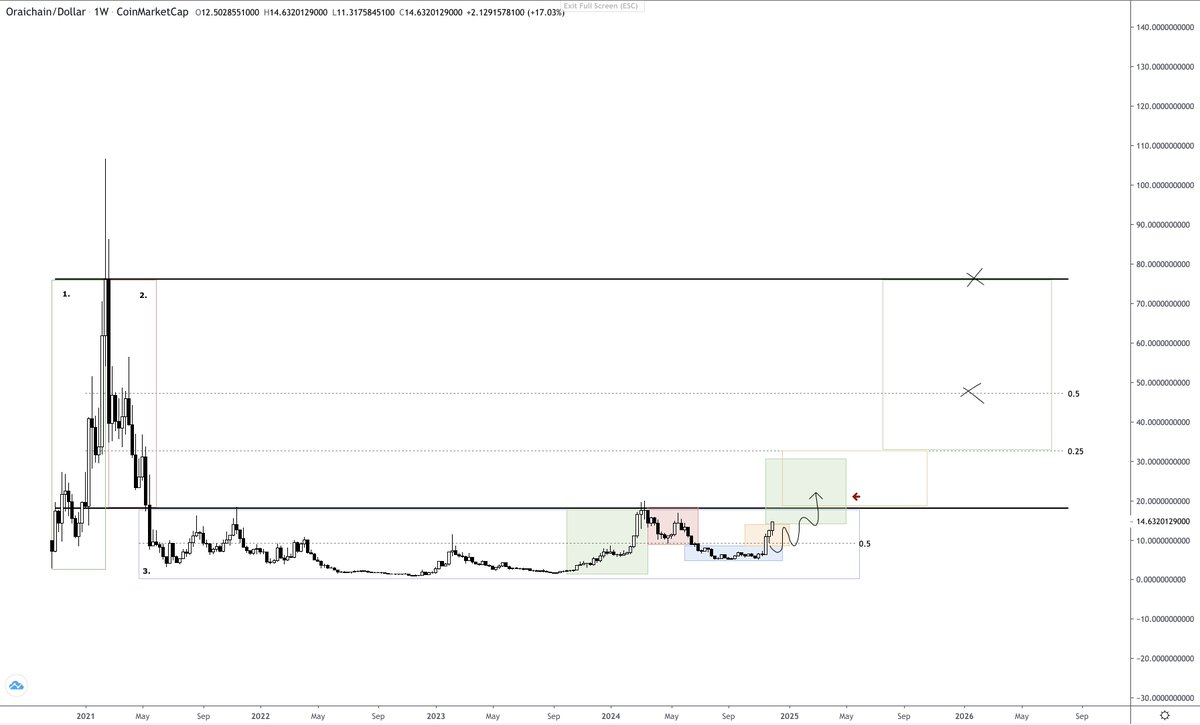
$ORAI is a veteran AI token. Last week, it successfully reclaimed Stage 4 (orange zone) on the short-cycle market structure, so I added a position.
If price pulls back to this zone again, I’ll add more.
I’ve also set price alerts—when it breaks out above the macro-level range low, that will signal a new entry opportunity.
5. $TIA
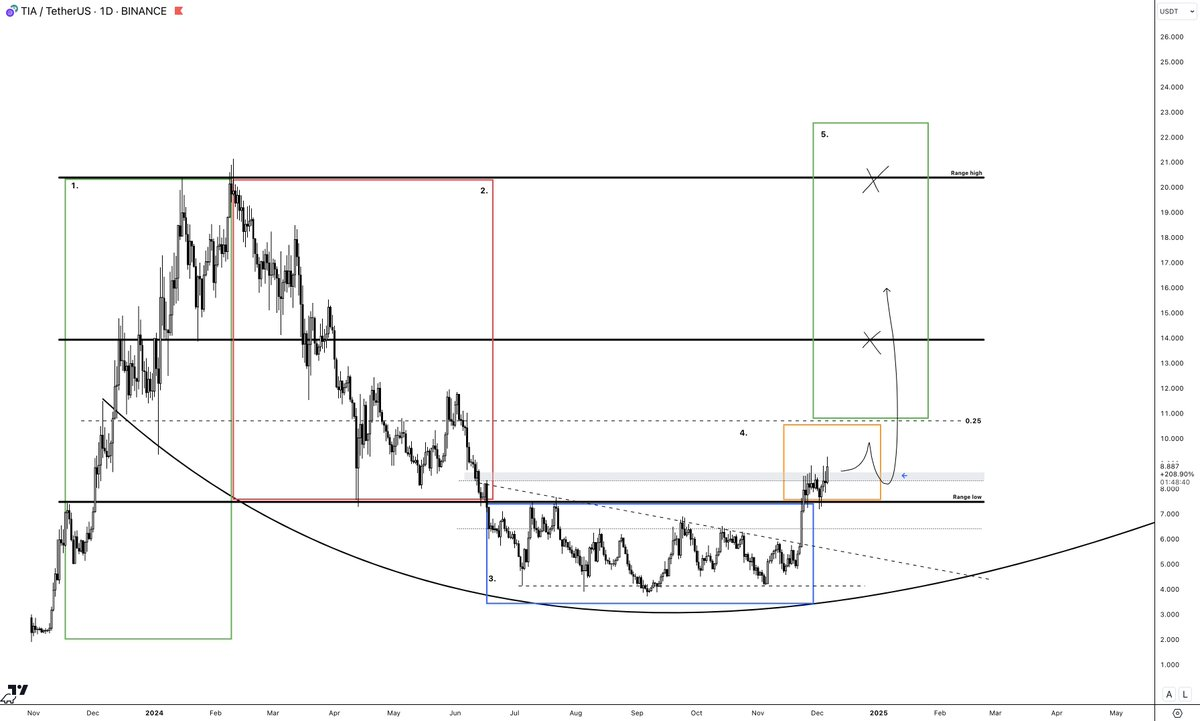
I’ve held $TIA since it reclaimed and retested its range low.
Currently, it’s attempting to break its current price structure. I believe if price makes a clear breakout above the gray zone, any subsequent pullback would present a great opportunity to add more.
Join TechFlow official community to stay tuned
Telegram:https://t.me/TechFlowDaily
X (Twitter):https://x.com/TechFlowPost
X (Twitter) EN:https://x.com/BlockFlow_News
 @damskotrades


