Hotcoin Research | Bitcoin breaks $100,000: Is the altcoin season really here?
TechFlow Selected TechFlow Selected
Hotcoin Research | Bitcoin breaks $100,000: Is the altcoin season really here?
This article provides an in-depth analysis of the current market cycle's characteristics and driving factors from multiple dimensions, including the macroeconomic environment, market structure, on-chain indices, features of this altcoin rally, and trends in promising sectors.
 Navigating Web3 tides with focused insights
Author: Hotcoin Research
1. Introduction
As Bitcoin's price regains the $100,000 mark and Ethereum rebounds sharply, the overall crypto market is rising. On-chain activity and trading volume across multiple public chains have significantly increased, reflecting renewed enthusiasm for capital inflows and a sustained recovery in risk appetite. Under the dual influence of macro tailwinds and internal market momentum, the cryptocurrency market is currently in a high-energy accumulation phase.
Against this backdrop, there is widespread market speculation about whether the altseason has already begun. This article conducts an in-depth analysis of the current market cycle from multiple dimensions—macroeconomic environment, market structure, on-chain indices, characteristics of the current altcoin rally, and performance of promising sectors—and offers forward-looking insights into future trends and risks, providing readers with valuable reference for understanding the current landscape and future trajectory of the crypto market.
2. Macro Background and Market Structure Analysis
With easing U.S.-China tariff tensions, global liquidity expansion, Trump’s repeated calls for rate cuts, and continued improvement in crypto regulation, the structure of the crypto market has undergone profound adjustments: Bitcoin dominance has declined, the altseason index has strengthened, and stablecoin supply has surged—laying a solid foundation for the development of the upcoming altseason.
2.1 Macro Environment and Policy Context
Recently, the global macro environment has produced several signals favorable to risk assets. U.S. inflation has dropped notably, with April CPI rising only 2.3% year-on-year—the lowest level in four years—allowing the Federal Reserve to hold steady in May and maintain the federal funds rate within the 4.25%-4.50% range. Meanwhile, the U.S.-China trade war has seen significant de-escalation: both sides reached a 90-day tariff truce, reducing U.S. tariffs on Chinese goods from 125%-145% down to 10%-30%, while China lowered its tariffs from 125% to 10%. This "ceasefire" has reduced fears of economic recession, prompting Wall Street institutions to lower their recession probability forecasts. U.S. President Trump has repeatedly pressured the Fed to cut rates sooner. Although Fed officials remain cautious about early rate cuts, markets expect two modest cuts in the second half of the year.
These macro developments have boosted global risk appetite, driving capital back into equities, cryptocurrencies, and other risk assets. The improved macro backdrop has laid the groundwork for a structural bull market in crypto in 2025: rising expectations of monetary easing, returning liquidity, and investors holding cash ready to buy dips in various crypto assets. As of May 15, the total market cap of cryptocurrencies has climbed to $3.5 trillion.
2.2 Changes in Crypto Market Structure
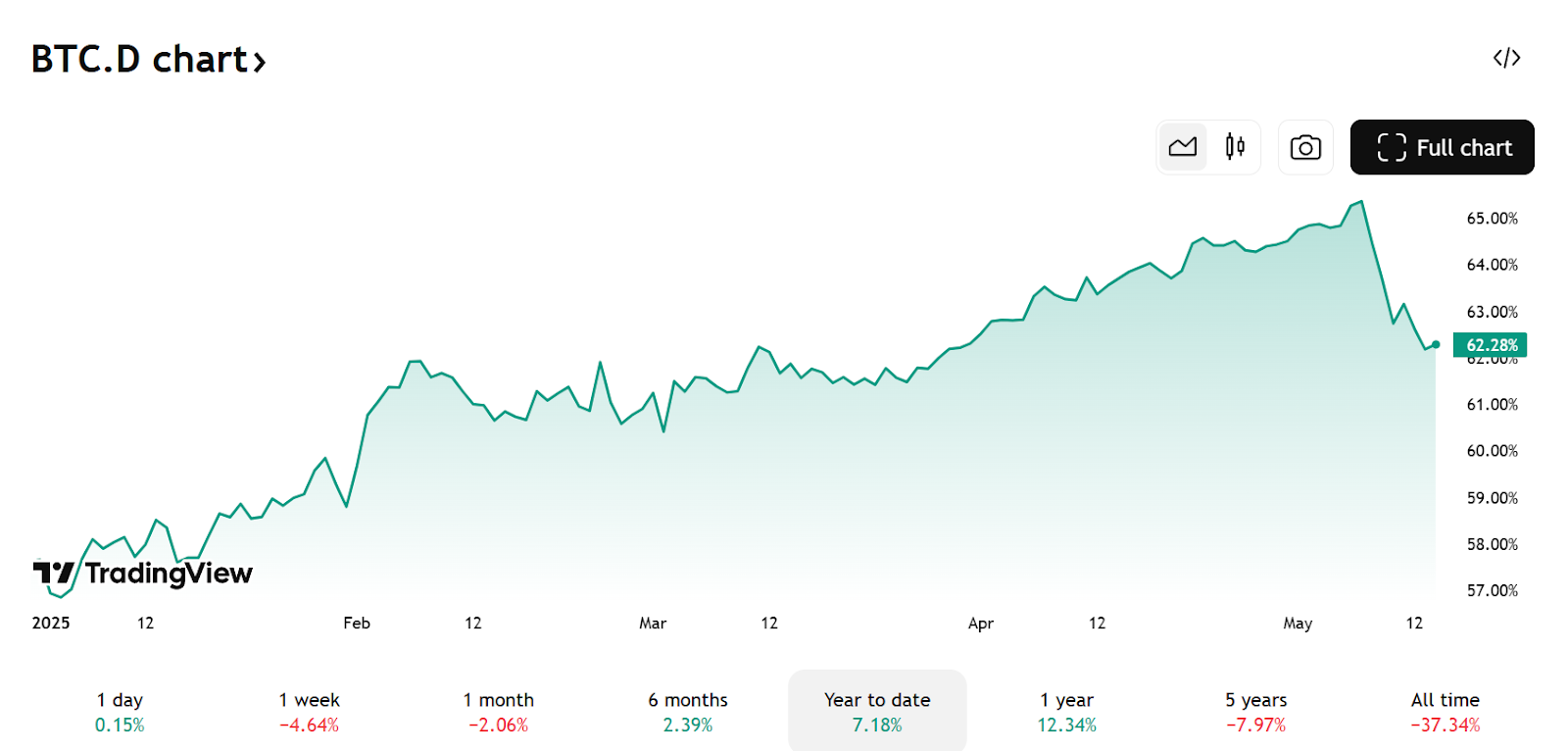
The crypto market structure has shown clear shifts during this rally. First, Bitcoin dominance peaked and began to decline. At the beginning of the year, institutional inflows drove Bitcoin’s market share (BTC Dominance) upward, reaching nearly 64-65% in early May—a sign that the market was still in a “Bitcoin season.” However, after Bitcoin reclaimed the $100,000 threshold on May 9 and continued climbing, capital started rotating out of Bitcoin and into broader altcoins. According to TradingView data, Bitcoin dominance plunged approximately 4.6 percentage points in just one week—the largest weekly drop of the year. A peak and subsequent decline in Bitcoin’s share of the crypto market is historically one of the classic signals marking the start of an “altseason.”
Source:https://www.tradingview.com/symbols/BTC.D/?timeframe=YTD
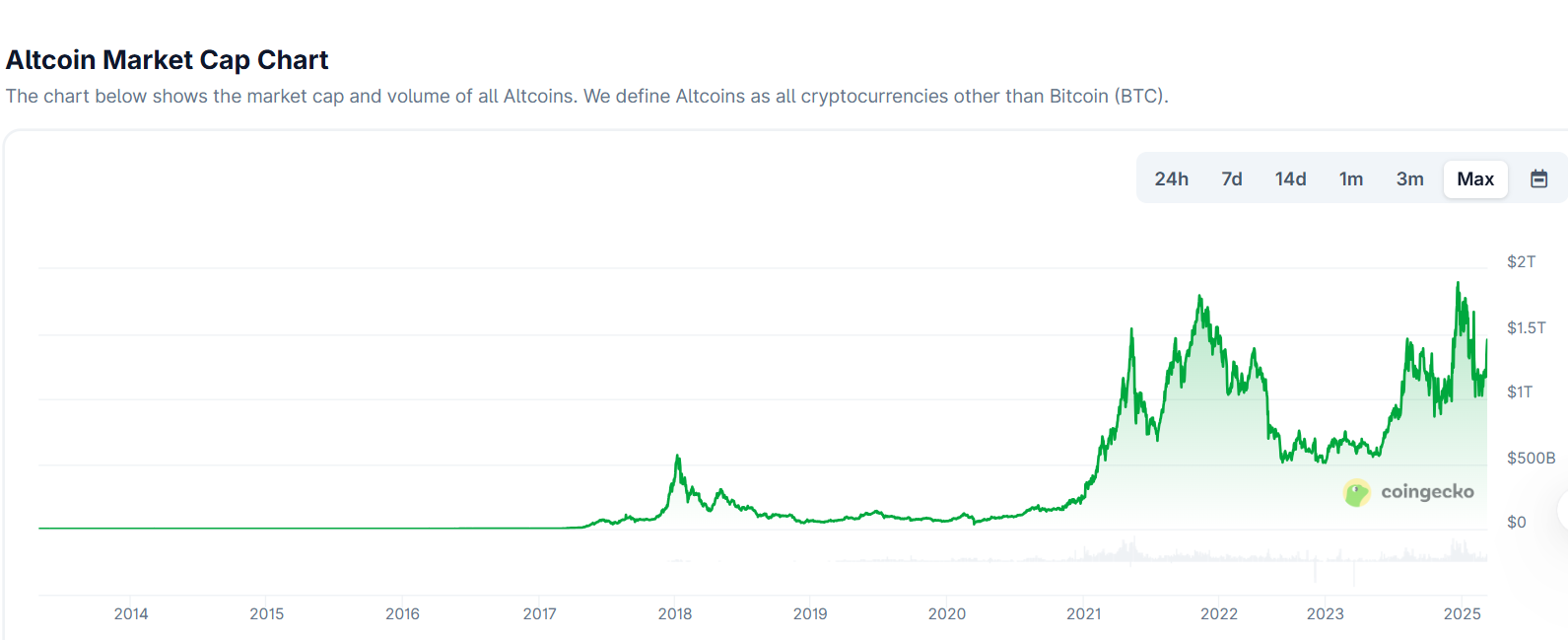
At the same time, the total market cap of altcoins has rebounded sharply. After falling to around $0.93 trillion in April—a阶段性 low—the total altcoin market cap (excluding BTC) surged in May and has now exceeded $1.45 trillion, successfully breaking out of a descending wedge pattern that had persisted since the end of 2024 and entering a new upward wave. This breakout coincides precisely with the notable decline in Bitcoin dominance and reflects capital reallocating away from Bitcoin toward other cryptocurrencies.
Source:https://www.coingecko.com/en/global-charts
2.3 Altcoin Season Index Analysis
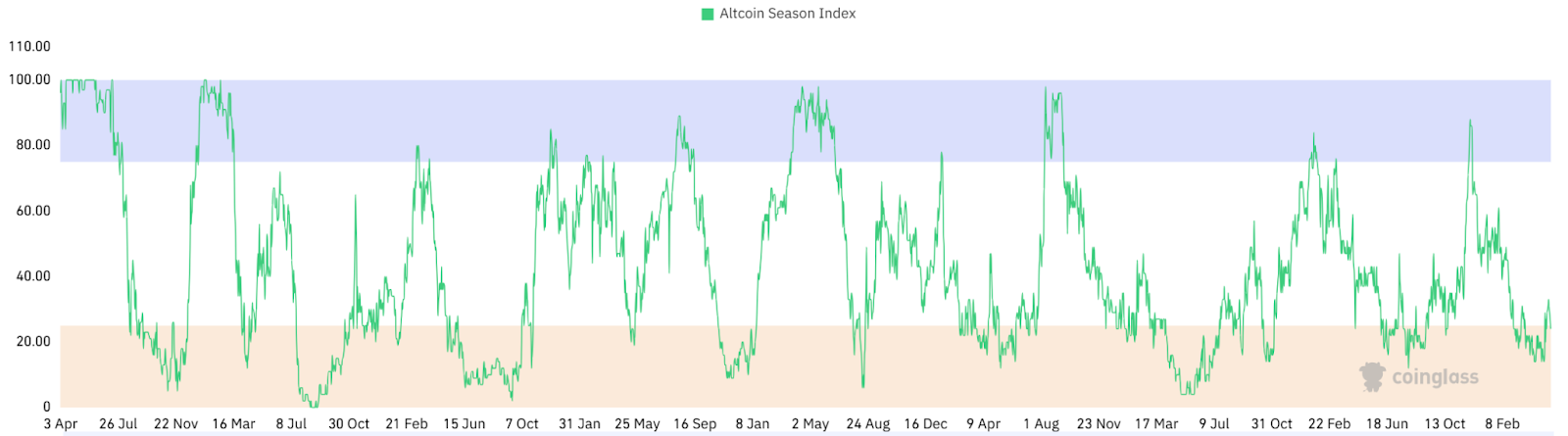
A more intuitive sentiment indicator is the "Altcoin Season Index." According to Coinglass data, this index fell as low as 14 on April 26 but has since rapidly risen to 31. While it has not yet reached the 75+ threshold typically associated with a full-fledged altseason, it has clearly moved beyond Bitcoin’s solo run and entered a neutral-to-strong zone. This confirms a shift in market sentiment from caution to risk-taking: investors are beginning to increase exposure to altcoins. This shift is also reflected in on-chain metrics—active addresses and transaction volumes—where multiple public chains saw significant growth in early May, indicating rising investor participation. DEXs also recorded a 30% weekly increase in total trading volume, reaching $84 billion. Dormant on-chain activity has reawakened, signaling a revival in market momentum.
Source:https://www.coinglass.com/pro/i/alt-coin-season
In addition, the total market cap of stablecoins hit a record high of approximately $245 billion in early May. Among them, the dominant stablecoin USDT experienced explosive growth, surpassing $150 billion in market cap. By comparison, USDT stood at around $83 billion at the peak of the 2021 bull market. As a bridge between fiat and crypto, the surge in stablecoin supply indicates massive amounts of capital are entering the market via stablecoins and waiting for entry opportunities. This provides “fuel” for further altcoin gains, as funds may continue converting from stablecoins into BTC and various alt assets, fueling the next leg of the rally.
3. Characteristics of the Current Altcoin Rally
Historical experience shows that altseasons usually follow periods of strong Bitcoin rallies or temporary tops, when capital seeks higher returns by flowing into mid- and small-cap coins. Bitcoin’s breakthrough above $100,000 served as the catalyst for the current altseason, and the rotation pattern aligns with previous cycles. However, compared to past altseasons, this rally differs significantly in duration, price movement structure, and participant composition.
-
Duration and pace: Past altcoin frenzies often lasted months, occurring during Bitcoin consolidation or pullback phases. In contrast, the current rally has only just begun as of mid-May, with many altcoins showing relatively modest gains. As one analyst joked: “Many alts dropped 90% from their December highs; now they’ve rebounded 10%, and people are already shouting ‘The long-awaited altseason is here!’” The full-blown altcoin mania hasn’t reached the level of universal euphoria seen in prior cycles. The altseason index has only recently recovered from its lows and remains far below the typical 75 “mania” threshold. Social media buzz and retail FOMO sentiment are still brewing. Therefore, this altseason may unfold more gradually and last longer, rather than spiking sharply like in previous cycles.
-
Growth structure and rotation order: This altcoin rally exhibits a “large-cap-led, gradual diffusion” pattern. In early May, large-cap coins such as ETH, Solana, and BNB led the charge, posting daily gains between 5% and 15%. This was followed by catch-up rallies in mid-cap mainstream coins (e.g., MKR, CRV, AAVE). In contrast, small-cap and long-tail assets did not immediately surge. This suggests current capital favors projects with fundamental support, and the speculative frenzy has not yet fully ignited. That said, as the market evolves, smaller-cap coins could still see catch-up rallies or even speculative blow-offs.
-
Narratives and nature of capital: The 2017 alt boom was driven by ICO hype—new tokens could skyrocket based solely on whitepapers. In 2021, narratives like DeFi, Dogecoin mania, NFTs, and metaverse took turns in the spotlight, fueled by massive retail sentiment. This cycle’s narrative themes are more diverse and “professional.” Leading themes such as AI and RWA attract not just speculators but also a significant portion of institutional and industrial capital.
-
Investor structure and profile: A defining feature of this market cycle is significantly lower retail participation compared to the last cycle, with institutional capital playing a larger role. Institutional investors are acting as the primary source of incremental funding. This means much of the current market action involves institutional players trading among themselves. Today’s participants are largely “veterans” who have lived through multiple cycles. Capital rotates quickly between sectors, and trends have shorter lifespans—lacking the one-way rocket launches seen during mass retail buying. This underscores how retail absence leads to short-term speculation without sustained long-term trends. Additionally, the growing share of derivatives trading indicates more sophisticated players are using futures and options for leveraged strategies—a stark contrast to past cycles dominated by retail spot buyers. All these factors make the current market’s volatility patterns and structure more complex.
-
Regulatory environment and market ecosystem: Past altcoin manias occurred during periods of regulatory neglect and “wild west” growth. Now, global regulation is accelerating. In this cycle, regulation has actually become a tailwind: more lenient U.S. stances, ETF approvals, Hong Kong opening up trading, and national Bitcoin reserves have created positive market expectations. This allows institutional capital to participate more aggressively in crypto investments. These ecosystem changes suggest this altseason may be more orderly and grounded in value.
4. Analysis of Promising Sectors and Trending Narratives
4.1 Meme Coin Mania Continues
Undoubtedly, meme coins have become the most active sector in the crypto market. The launch of Pump.fun eliminated barriers to creating meme coins, enabling “anyone to mint a coin,” sparking a gold rush in meme coin creation. Despite overall market volatility and weakness at the beginning of the year, BNB Chain emerged as the second-largest meme coin network after Solana, driven by CZ’s endorsements, the launch of Four.me (a meme coin launchpad on BNB Chain), Binance Alpha, Binance Wallet TGE, and the Alpha points system. Recently, meme launch platforms have started to break Pump.fun’s monopoly. With Raydium launching LaunchLab, and platforms like Letsbonk.fun and Believe built upon it, along with Eliza Labs releasing auto.fun—which replicates pump.fun’s “no-code issuance” model and adds AI agent deployment capabilities—meme tokens are set for explosive growth, further amplifying speculation and volatility.
Moreover, established meme coins like DOGE and SHIB, after prolonged dormancy, finally found new catalysts in 2025. Alongside catch-up rallies in legacy meme coins, newer ones such as BONK, WIF, PEPE, MOODENG, POPCAT, and FARTCOIN have taken turns surging. TRUMP, the meme coin tied to Trump’s IP, has experienced volatility since its January launch and saw a significant rebound on May 22 following the “TRUMP dinner” event. This indicates that meme coins with active communities and lasting influence are gradually transcending short-term speculation and building more durable consensus value.
The capital behind meme coins mainly comes from speculative retail traders and short-term funds. On-chain data reveals frequent transactions with relatively small individual sizes, showing clear signs of quick in-and-out behavior. Meanwhile, discussions about meme coins are increasing on social media platforms like Twitter and Reddit, and some KOLs have resumed daily recommendations of “10x potential coins,” signaling that speculative sentiment is brewing again.
4.2 AI Sector Remains Hot
After ChatGPT ignited the AI wave last year, AI-themed tokens like FET, AGIX, and OCEAN briefly soared. However, they underwent deep corrections as the market cooled. Entering 2025, global interest in artificial intelligence continues to grow, and with the crypto market turning bullish, the AI sector is heating up again. Since April, several AI-related tokens have rallied rapidly, outperforming the broader market. Fetch.ai (FET) has consistently announced technical progress and partnered with Google Cloud, strengthening its fundamentals. Technically, FET formed a rounded bottom in February and developed a classic cup-and-handle pattern by mid-April, signaling strong market confidence in its return to a bull trend.
Virtuals Protocol (VIRTUAL) and ai16z (AI16Z), two AI agent projects, delivered impressive gains at the end of 2024 but lost about 90% of their value during the early 2025 market correction. In April, as market conditions improved, both staged dramatic comebacks, refocusing attention on the “AI agent” narrative. If global AI applications continue to explode in the second half of 2025, AI narrative tokens could benefit from a dual boost of improving fundamentals and rising market sentiment.
4.3 Layer2 Poised for Catch-Up Gains
Ethereum’s Layer2 scaling has been one of the most important technological trends in crypto over the past two years. In 2025, this sector continues to evolve with new developments. The L2 landscape is becoming multi-polar: Arbitrum leads in user numbers and dApp ecosystem, Optimism maintains influence through OP Stack, while Base leverages Coinbase’s resources to rapidly expand its user base. However, compared to their ecosystem progress, L2 project tokens have underperformed in this rally. Since April, ARB and OP have only seen mild rebounds, lagging behind the broader market. Arbitrum, in particular, faces cautious market sentiment due to governance controversies after its airdrop and an 80% price crash afterward. Despite lackluster short-term token performance, industry experts still view the long-term potential and strategic importance of the L2 sector positively.
It’s worth noting that the strong recovery of high-performance L1s like Solana, BNB, and Sui poses some competitive pressure on L2s. However, considering compatibility and security, L2s remain the preferred path for Ethereum’s ecosystem expansion. If the bull market continues, capital may rotate back from overheated small-cap tokens to these high-market-cap platform coins, leading to catch-up gains.
4.4 RWA Gains Institutional Favor
RWA has become another major institutional narrative in this market cycle. Amid rising interest rates from the Fed, which boosted traditional asset yields, DeFi’s embrace of RWA is seen as a “win-win” strategy: DeFi users gain access to stable on-chain yields, while traditional institutions can use it to expand financing channels. MakerDAO and Ondo Finance stand as the twin leaders in the RWA space. MakerDAO’s “Endgame Plan,” which allocates U.S. Treasuries, gives its stablecoin DAI reliable yield, allowing MKR holders to share protocol profits and enhancing token value. Ondo directly offers tokenized U.S. Treasury funds to institutions and high-net-worth individuals, innovatively enabling on-chain users to easily hold traditional financial products. Other notable projects include Maple Finance (providing on-chain credit for institutions) and Centrifuge (a tokenization platform for asset securitization). Each has its focus, but all contribute to bridging on-chain and off-chain finance.
While the RWA concept is hot, retail participation remains limited. Many RWA products involve compliance requirements (KYC, accredited investor thresholds) and specialized knowledge, leaving small investors mostly at the conceptual awareness stage. This means RWA-driven rallies are primarily propelled by large capital flows.
5. Conclusion and Outlook
All signs indicate the crypto market has warmed significantly, but the true peak of frenzy may not have arrived yet—the “altseason” is imminent. Declining Bitcoin dominance, broad-based altcoin rallies, emerging new narratives, and shifting sentiment from caution to greed collectively suggest the market is transitioning from a “Bitcoin-centric” to an “altcoin-centric” phase. The altseason is already beginning to take shape, though it has not yet reached its final, most manic stage.
In summary, the current crypto market sits at a delicate inflection point: Bitcoin leads the charge, alts prepare to rise, and institutional rationality intertwines with retail sentiment. The altseason is brewing but not yet fully unleashed. We expect that with continued macro tailwinds and further capital inflows, the altcoin segment could see a stronger climax in the second half of the year. But this time, the rally may not simply replicate past frenzies; instead, it could evolve new characteristics under more mature market conditions.
Macro liquidity will be the decisive factor shaping the length and height of this cycle. There is growing consensus that the Fed may begin cutting rates in the second half of 2025. Once actual rate cuts commence, global liquidity will loosen further, potentially giving risk assets a “second-half acceleration.” Thus, this crypto bull market might feature a “double peak”—rising in the first half on expectations, then surging again in the second half when actual easing materializes. This implies the altcoin rally may not end abruptly, but instead could enjoy a second wind. If liquidity improves further and narratives continue to develop, the peak of altseason could arrive in late 2025 or even early 2026. Until then, this party is likely to continue for some time.
About Us
TechFlow, as the core research hub within the Hotcoin ecosystem, is dedicated to providing professional, in-depth analysis and forward-looking insights for global crypto investors. We have built a three-in-one service framework of “trend assessment + value discovery + real-time tracking,” delivering precise market interpretation and practical investment strategies through deep dives into industry trends, multidimensional evaluation of promising projects, and round-the-clock market monitoring. Supported by our weekly “Top Pick” strategy livestreams and daily “Blockchain Headlines” briefings, we empower investors at all levels. Leveraging advanced data analytics models and extensive industry networks, we help novice investors build cognitive frameworks and enable institutional clients to capture alpha, jointly seizing value growth opportunities in the Web3 era.
Risk Warning
The cryptocurrency market is highly volatile and inherently risky. We strongly advise investors to fully understand these risks and operate within a strict risk management framework to ensure capital safety.
Join TechFlow official community to stay tuned
Telegram:https://t.me/TechFlowDaily
X (Twitter):https://x.com/TechFlowPost
X (Twitter) EN:https://x.com/BlockFlow_News
 @HotcoinAcademy