
Y Combinator’s Favored Gold Rush: 10 AI Frontiers Worth Exploring
TechFlow Selected TechFlow Selected
Y Combinator’s Favored Gold Rush: 10 AI Frontiers Worth Exploring
Artificial intelligence (AI) is transforming the way we work at an unprecedented pace, and we are entering a golden age of creation.
 Navigating Web3 tides with focused insights
Author: Y Combinator
Translation: TechFlow
The Golden Age of Building
Right now is the best time in history to be a builder. We’ve just witnessed an astonishing scene: a giant robot "chopstick" precisely catching a falling skyscraper mid-air. This is not only a technological marvel but also symbolizes a massive leap forward in our ability to build. Artificial intelligence (AI) is transforming how we work at an unprecedented pace, and for builders, AI is creating profound impacts. We are entering a golden age of building—one that presents a rare opportunity to create things that can truly make the country better. Below are some innovation areas we believe are especially worth exploring during this golden era.
Government Software

Author: Harj Taggar
Selling software to governments has long been known for its high barriers, and most entrepreneurs don’t even consider entering this space. But if you can crack it, the rewards are enormous. For example, Palantir is one of the few startups that successfully broke into this market and now has a market cap of $125 billion.
This may be a particularly good moment to try. With persistent budget deficits, governments urgently need to reduce spending and improve efficiency. At the same time, rapid advances in artificial intelligence now make it possible to automate administrative tasks that currently cost governments billions of dollars annually.
Combining these two trends, developing AI-powered software to automate government operations can both cut costs and boost efficiency. In particular, large language models (LLMs) excel at handling repetitive administrative tasks such as form-filling, application reviews, or document summarization. As users of government services, we would all benefit from faster service—no more waiting in line at the DMV.
While government might sound like an unglamorous area for startups, if you’re willing to dig deep, we’d love to hear your ideas.
Public Safety Technology

Author: Garry Tan
Everyone should feel safe in their homes and while walking down the street. This is a fundamental promise that a civilized society should offer its citizens. Startups have already begun making progress in this area. For instance, Flock Safety (YC S17), with its license plate cameras, has helped solve 10% of reported crimes in the U.S., aiming to increase that to 25% next year. Meanwhile, Abel Police (YC S24) reduces police paperwork time from hours to minutes, saving up to 25% of officers’ daily time for actual policing duties.
Public safety technology is already delivering real change—and will continue to do so. If you're working on innovations in the following areas, we'd especially love to hear from you:
-
Advanced Computer Vision: Technologies using computer vision to detect suspicious activities or people in need of help from video streams, while preserving personal privacy.
-
Emergency Response Technology: Tools that enhance the speed and coordination of emergency responses. If you have ideas for getting help to where it’s needed faster, we want to help you bring them to life.
-
Community Safety Tools: Solutions that improve interactions between communities and law enforcement—for example, tools enabling neighbors to look out for each other and stay informed about local safety conditions.
-
Efficient Law Enforcement Tools: Technologies that help law enforcement operate more efficiently and fairly, such as workload management systems or tools that improve operational precision.
If your startup is ready to join this wave of innovation, we’d love to connect.
Made in America
Author: Jared Friedman
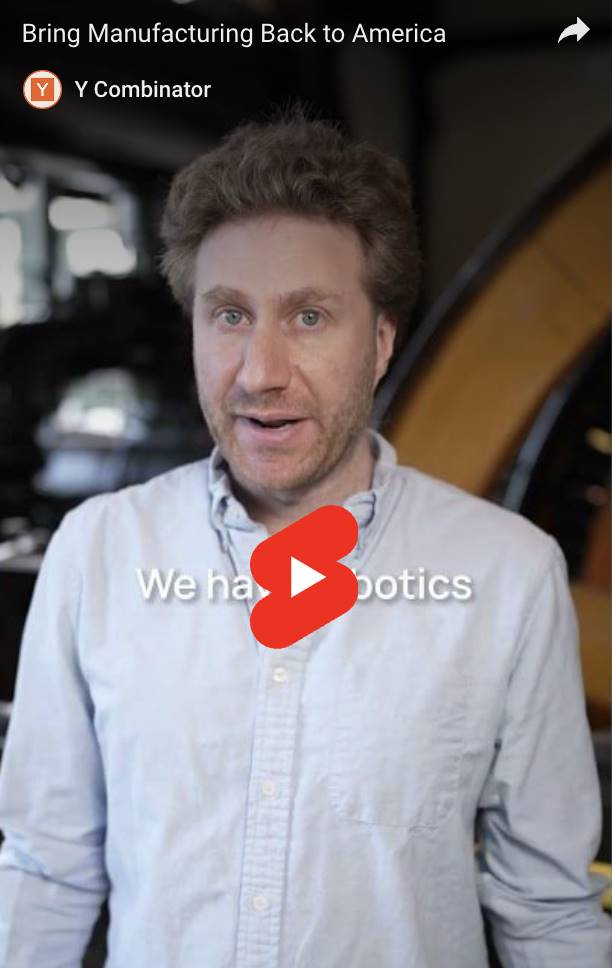
In the 19th century, Britain became the world’s richest nation by becoming the “workshop of the world.” The United States replicated this success in the 20th century. However, over the past few decades, America has gradually abandoned this role. The hollowing out of manufacturing has not only intensified social and political divisions but also left the U.S. in a geopolitically unstable position.
Bringing manufacturing back to America is now one of the few areas of strong bipartisan consensus. Elon Musk has already shown us this is achievable by building Tesla Gigafactories in Austin and Nevada. We believe today’s technological advances give a new generation of builders even more opportunities to follow his path.
New machine learning (ML)-based robotic systems are automating more parts of production, reducing the labor cost advantage that once made offshoring attractive. Moreover, companies like SpaceX and Tesla have trained a whole generation of engineers in how to build American companies that produce physical goods but operate with a startup mindset.
We’ve already seen successful examples of this model. For instance, Astranis (W16) builds telecommunications satellites in the heart of San Francisco—a site once used to build warships for the U.S. Navy. Gecko Robotics (W16), headquartered in Pittsburgh, the old industrial core of America, manufactures robots for industrial inspection. Solugen (W17) produces industrial chemicals in a large factory in Houston.
Stablecoin 2.0

Authors: Brad Flora and Harj Taggar
Earlier this year, we put out a call for more stablecoin startups. Since then, the stablecoin space has only improved. Historically, the main challenge for stablecoins has been regulation—U.S. attempts to regulate stablecoins have repeatedly failed. But now, the regulatory outlook in the U.S. looks more promising, and we expect sensible legislation to emerge soon.
This year, transaction volumes for stablecoin payments have surged, now accounting for over a fifth of Mastercard’s payment volume. Nearly 30% of global remittances are now conducted via stablecoins, and traditional financial institutions (like Visa) are offering platforms for banks to issue their own stablecoins. Additionally, Stripe recently acquired Bridge, a stablecoin startup, for $1 billion—an event that will undoubtedly attract more investors and capital into the space.
Now is one of the best times to start a stablecoin company. We’re especially interested in ideas around:
-
Business-facing services that make it easier for companies to hold and manage stablecoins.
-
Developer-friendly tools that simplify integration of stablecoin functionality.
If you're exploring innovations in stablecoins, we’d love to talk.
Large Language Models for Chip Design (LLMs for chip design)

Author: Garry Tan
Every breakthrough in AI increases demand for more powerful chips capable of training larger models. In this technological race, no nation wants to fall behind. Chip design and manufacturing are no longer just economic issues—they are now essential to survival in the post-AI era. OpenAI’s O1 model demonstrated that reasoning-capable large language models (LLMs) can drive major breakthroughs in science and engineering. We’re highly interested in teams using LLMs to improve chip design.
We’re especially excited about teams focused on designing ASICs (application-specific integrated circuits) and FPGAs (field-programmable gate arrays). Traditionally, developing custom digital systems required significant investment in development, design, and testing, making FPGA and ASIC development high-cost and high-barrier fields. But with the emergence of large language models, these costs are dropping significantly, opening the door to many new types of specialized computing.
Most computers today use the von Neumann architecture—processing programs and data through a single shared memory and operating via serial fetch-and-execute cycles. This architecture offers great flexibility and ease of reprogramming. However, for specific tasks like cryptocurrency mining, data compression, or dedicated encryption, optimizing both algorithm and hardware design can yield 5x to 100x improvements in computation speed and 10x to 100x reductions in energy consumption.
Below is a chart provided by Taner Sadikoglu, illustrating the difference in data flow between optimized FPGA systems and traditional CPUs.
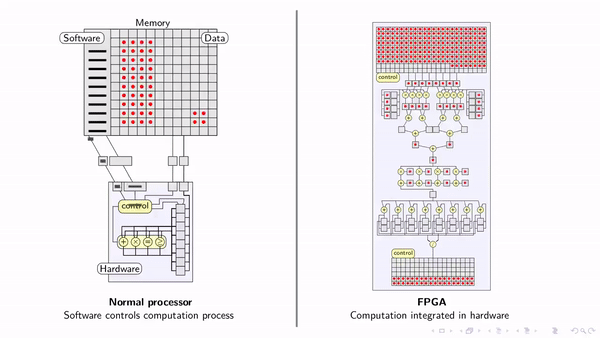
Given the order-of-magnitude performance gains possible with FPGAs and ASICs, using LLMs to optimize this process could yield highly valuable outcomes and open up substantial business opportunities for startups.
Fintech 2.0
Author: Dalton Caldwell
The past two years have been challenging for fintech startups. The collapse of Silicon Valley Bank led regulators to tighten restrictions on new startups, and investors pulled back from the sector. Yet we believe this is about to change—and now is the best time to start a fintech company.
In the past, the hardest part of launching a financial startup was securing agreements with banks or other regulated partners. Today, thanks to providers like Stripe and the rise of new technologies such as stablecoins, this process is becoming much simpler.
The rapid advancement of AI tools will inevitably transform finance. For small startups without legacy systems, this shift brings structural advantages, enabling them to quickly build the next generation of global financial products.
We believe now is the ideal time to build a new wave of fintech companies on top of existing infrastructure. We’re looking for innovative ideas in insurance, investment banking, wealth management, international payments, and related areas.
New Space Companies
Authors: Jared Friedman and Dalton Caldwell
The cost of accessing space is falling rapidly. Since SpaceX’s first launch in 2006, costs have dropped by more than 10x. Today, a startup can build and launch a satellite with just a seed round.
As access to space becomes as routine and low-cost as commercial aviation, shipping, or freight, entirely new business opportunities will emerge. How many kilograms of payload do you think will be launched into space today? A year from now? Five years? Ten?
While starting a space company may seem ambitious, it’s not necessarily harder than starting a software company. YC has funded multiple space startups—including Astranis, Relativity Space, and Stoke among others—and their success rate may even exceed that of startups in other sectors.
AI-Aided Engineering Tools
Author: Diana Hu
Engineering tools for the physical world have seen little meaningful progress in decades. CAD/CAM software used by mechanical engineers, EDA tools used by electrical engineers, and CFD tools used by aerospace engineers—all still rely on complex numerical solvers and physics simulations. These tools are not only computationally expensive but require deep expertise, sometimes even PhD-level knowledge, to use effectively.
We believe a new generation of AI-powered tools will completely transform this landscape.
By integrating AI models with reasoning capabilities for solving mathematical and physical problems, we can help engineers design and build physical systems—such as airplanes, buildings, circuits, chips, and satellites—faster and with higher quality.
We’re eager to support founders building AI-aided engineering tools that drive this transformation and become the next generation of computer-aided engineering (CAE).
One Million Jobs 2.0

Author: Dalton Caldwell
We want to fund startups that can create one million jobs—jobs that must be done by humans and cannot be replaced by AI.
Historically, every major technological shift has changed the nature of human work. For example, farming once employed most people, but mechanization drastically reduced agricultural labor. Similarly, elevator operators and typists have largely disappeared.
Yet technological change usually creates better new jobs and greater value for humanity. In this AI-driven world, such jobs might involve empowering more people to run their own local businesses or earn a living by providing services online or offline.
Many AI futurists remain uncertain about what future jobs will look like. We want to fund founders who can answer that question.
Join TechFlow official community to stay tuned
Telegram:https://t.me/TechFlowDaily
X (Twitter):https://x.com/TechFlowPost
X (Twitter) EN:https://x.com/BlockFlow_News
 Y Combinator