








Messari XRP Deep Dive Report: Q3 Native Smart Contract Proposals Hit New High, Daily Trading Volume Up 94% Quarter-on-Quarter
TechFlow Selected TechFlow Selected
Messari XRP Deep Dive Report: Q3 Native Smart Contract Proposals Hit New High, Daily Trading Volume Up 94% Quarter-on-Quarter
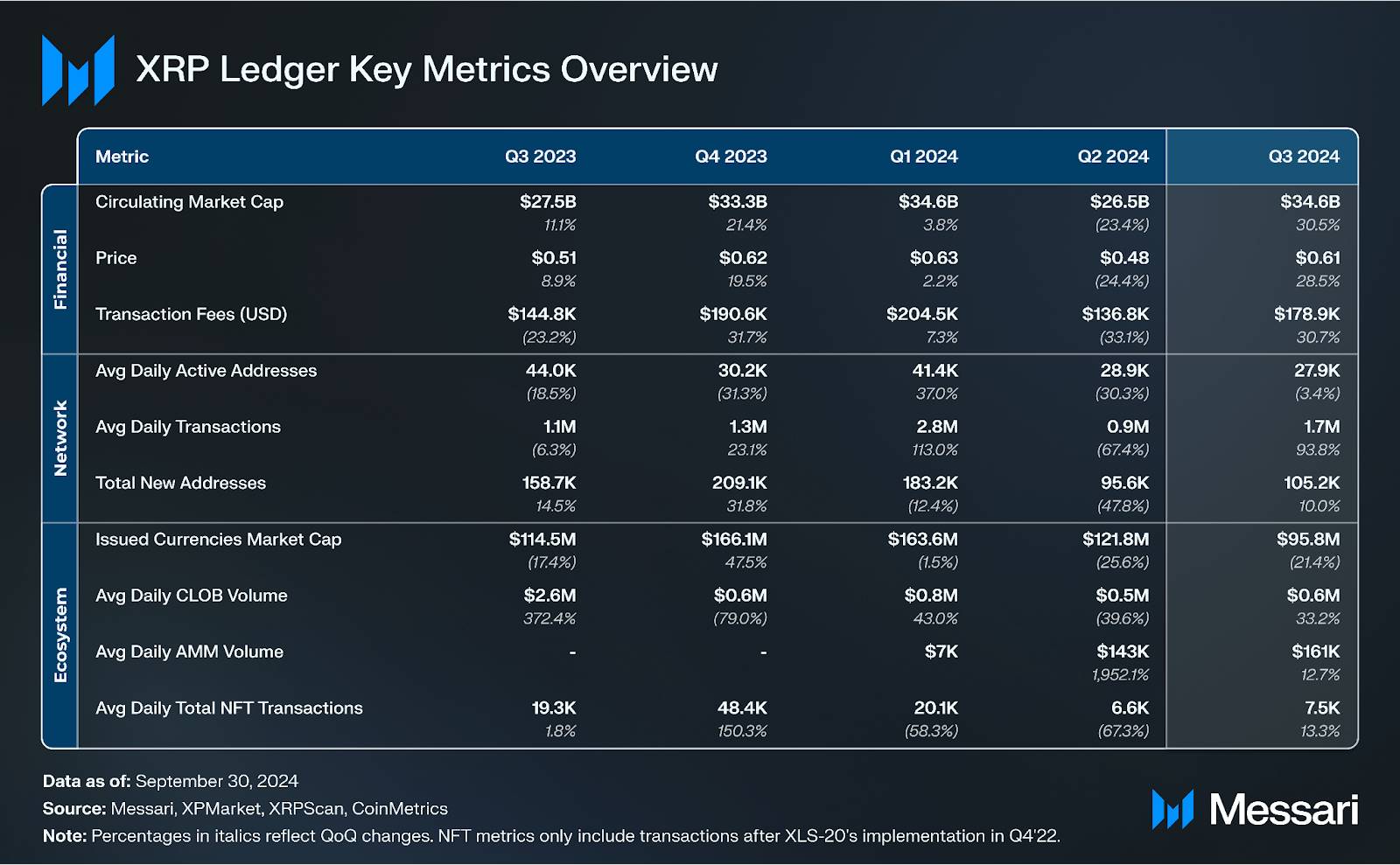
The number of new addresses on XRPL increased by 10%, reaching a cumulative total of 105,000.
 Navigating Web3 tides with focused insights
Author: Matt Kreiser
Translation: TechFlow
Key Insights
-
In September this year, Ripple partnered with the XRP community to announce plans to introduce native smart contract functionality on the XRP Ledger (XRPL) via an upcoming XLS proposal, bringing greater flexibility to the ecosystem.
-
XRPL's daily transaction volume increased 94% quarter-over-quarter to 1.7 million; new addresses also rose by 10%, reaching a cumulative total of 105,000.
-
In August, Ripple announced its USD-pegged stablecoin RLUSD entered private testing on both XRPL and Ethereum networks, currently awaiting regulatory approval.
-
Built upon proposals from the previous quarter, XRPL is developing a native lending protocol that will allow users to lend and borrow assets—including XRP, stablecoins, wBTC, and wETH—via single-asset vaults.
-
The community passed several revised proposals introducing decentralized identity (DID) features to XRPL, enabling verifiable digital identities, and adding price oracles to provide pricing references for wrapped and bridged assets.
Overview
Having operated for over a decade, the XRP Ledger (XRP) is a blockchain network offering cross-currency, cross-border payments, and asset tokenization. XRPL’s core strengths lie in its fast, low-cost transactions (relative to other money-centric blockchains) and rich native functionalities such as tokens, NFTs, a decentralized exchange (DEX), escrow services, built-in compliance, and token management tools.
With these capabilities, XRPL can perform many functions found on other programmable blockchains, supporting markets for NFTs, stablecoins, synthetic assets, and more. These are enabled through integrated mechanisms like a central limit order book (CLOB) and automated market makers (AMMs), achieving high composability. Notably, XRPL’s base layer does not currently support complex smart contracts—a deliberate design choice aimed at ensuring network security and stability. However, the XRPL community is actively exploring advanced scripting capabilities, such as Hooks technology. Additionally, sidechains offer extended functionality, broadening the ecosystem’s use cases.
XRPL’s development is supported by multiple teams and individuals, including Ripple, InFTF (formerly the XRPL Foundation), XRPL Labs (and its subsidiary Xaman), and XRPL Commons. Beyond individual users, XRPL provides digital payment infrastructure for traditional financial institutions such as commercial banks and fintech companies. The community shows strong interest in developing B2B and B2C financial solutions. For a full introduction to XRP Ledger, refer to our coverage launch report.
Key Metrics
Financial Analysis
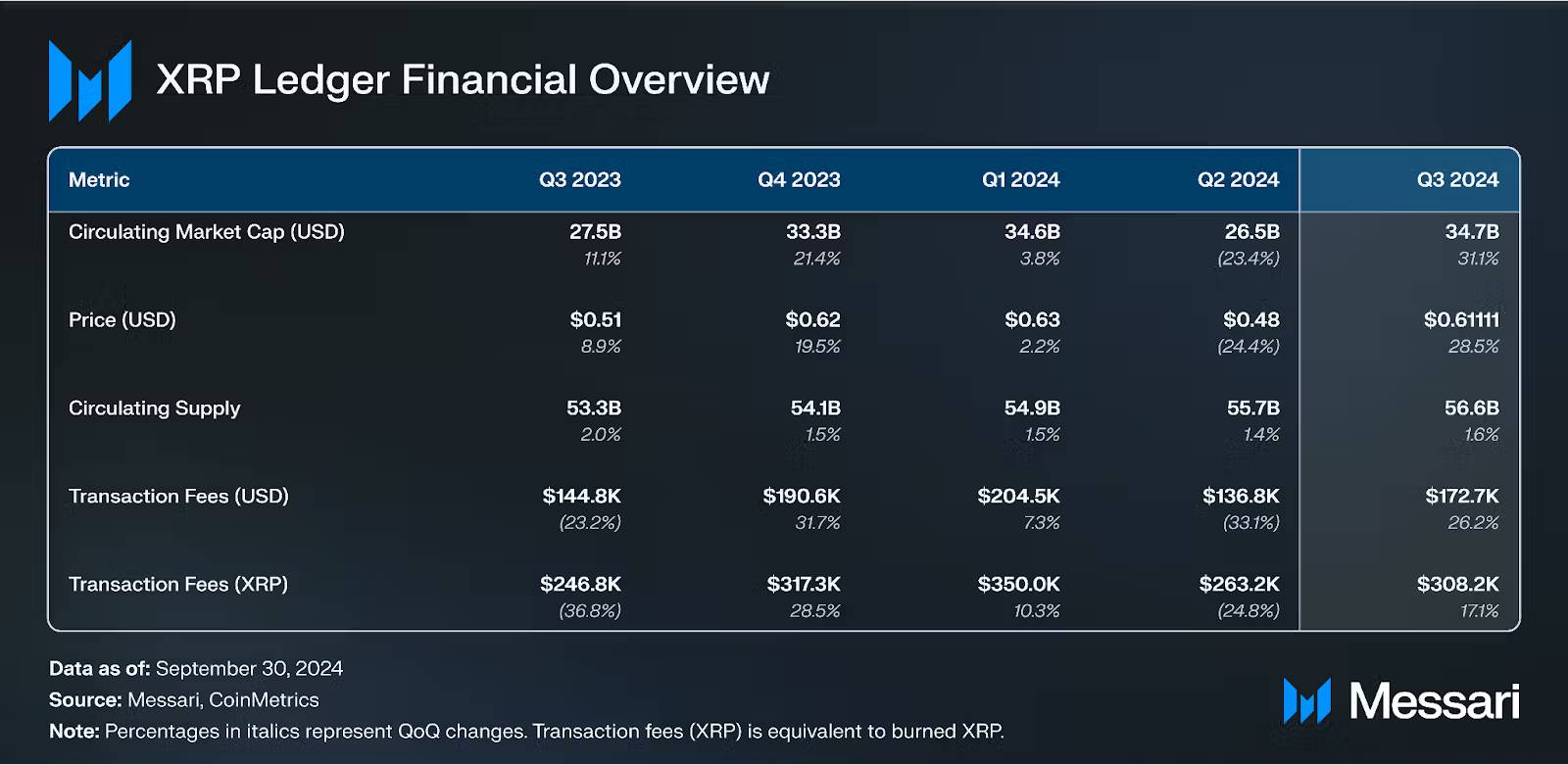
As of the end of Q3 2024, XRPL’s native token XRP ranked seventh globally by market capitalization at $34.7 billion, according to historical data. Its circulating market cap grew 31.1% quarter-over-quarter, while the price increased 28.5%. The faster growth in market cap compared to price was due to a 1.6% increase in circulating supply. In September, asset manager Grayscale launched an XRP Trust, offering qualified investors a new investment vehicle. Furthermore, in October and November, ETF issuers including Bitwise, Canary, and 21Shares filed S-1 forms to launch XRP-based exchange-traded funds (ETFs).
On XRPL, transaction fees are systematically burned, creating a deflationary effect on the total supply (10 billion XRP). Since inception, nearly 13 million XRP have been burned (worth approximately $7.9 million as of Q3 2024). The burn rate remains low primarily because transaction fees on XRPL are extremely cheap (less than $0.002 per transaction). Meanwhile, 1 billion XRP (worth about $610 million as of Q3 2024) are released monthly from escrow accounts to Ripple. Any XRP not used or distributed by Ripple during the month is returned to a new escrow contract. This mechanism will continue until the remaining ~39 billion XRP enter circulation. At that point, fee burning will become the only factor affecting XRP supply.
Unlike many other cryptocurrency networks, XRPL does not distribute rewards or transaction fees to validators. Under its Proof-of-Association (PoA) consensus mechanism, validator incentives center on supporting network decentralization—similar to full nodes on Ethereum or Bitcoin rather than traditional staking validators or miners. PoA relies on trust relationships between nodes, managed through Unique Node Lists (UNLs).
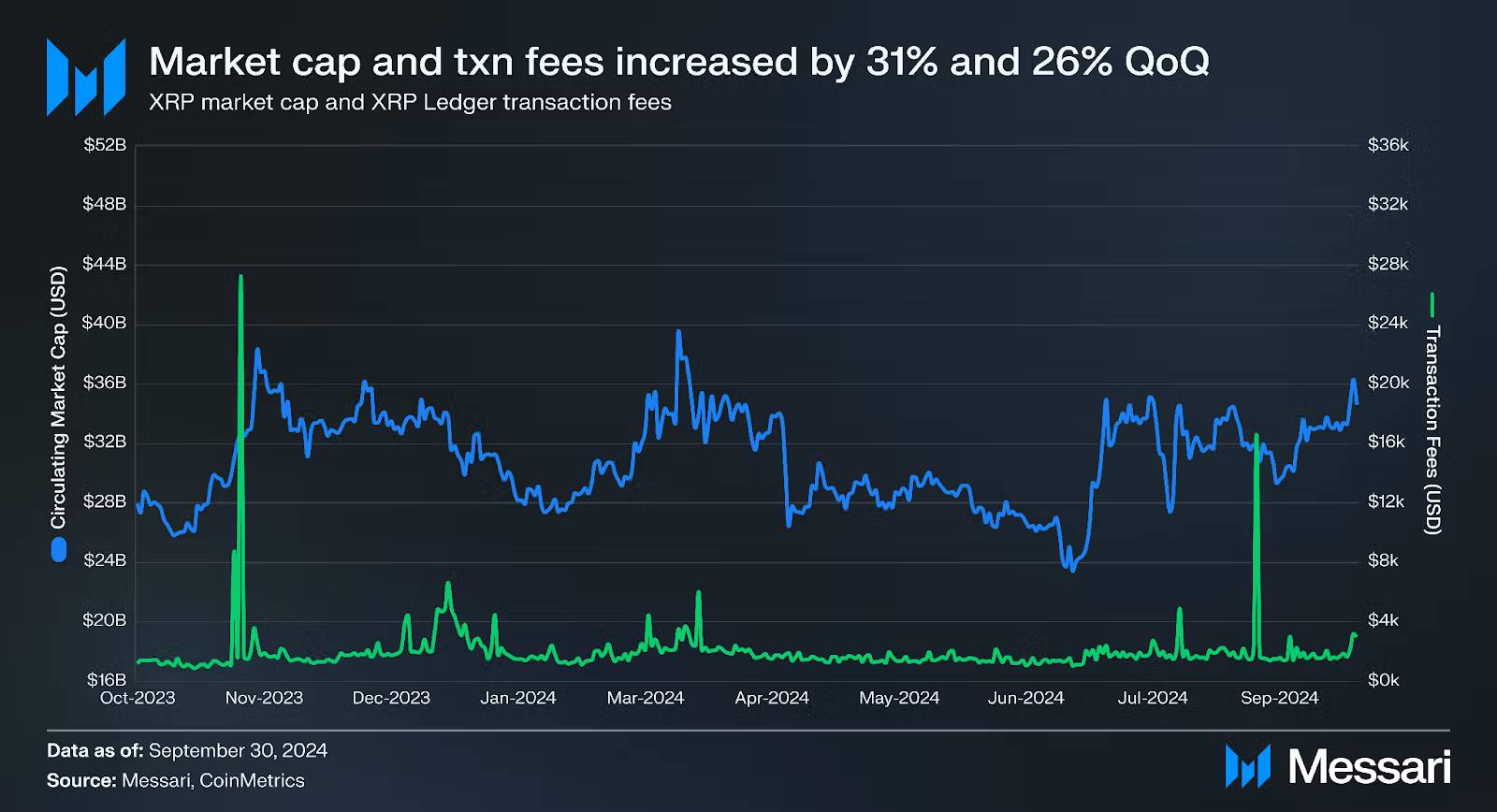
Notably, XRP’s market cap grew 31% quarter-over-quarter, significantly outperforming the overall crypto market, which declined by about 3%. On an annual basis, XRP’s circulating market cap increased 26%. On XRPL, transaction fees are burned instead of being distributed to stakers. Nevertheless, fee burning reduces the total XRP supply, thereby increasing the value of remaining XRP holdings. In effect, this mechanism transfers wealth from users paying transaction fees to XRP holders.
Network Analysis
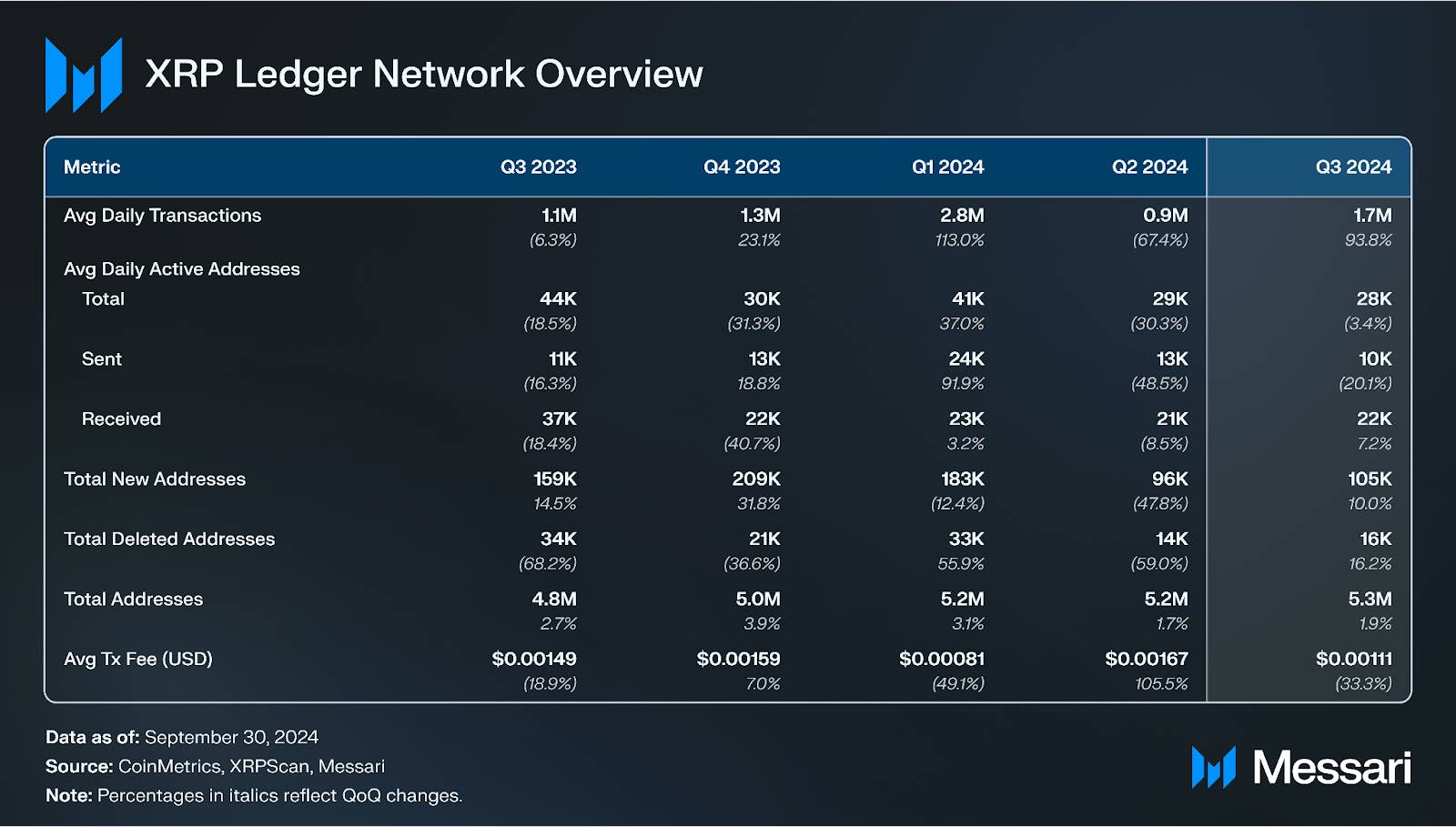
Following a general decline in network metrics last quarter (except for total addresses), multiple indicators rebounded in Q3 2024. Daily transaction volume surged 94% quarter-over-quarter to 1.7 million, and new addresses increased 10% to 105,000. However, according to Ripple’s Q3 report, this growth was driven largely by microtransactions (under 1 XRP), which appeared linked to spam messaging campaigns. Year-on-year, quarterly new address creation fell 34% from Q3 2023 to Q2 2024.
Account creation and deletion on XRPL carry significance, as each account requires a 10 XRP reserve deposit, which is refundable upon deletion. This makes XRPL’s account metrics more reliable than networks allowing zero-cost account creation, reducing susceptibility to Sybil attacks.
Despite rising transaction volume, total active addresses on XRPL declined 3% quarter-over-quarter. This overall drop stemmed mainly from a 20% decrease in active sending addresses (unique senders), while active receiving addresses (unique receivers) increased only 7%.
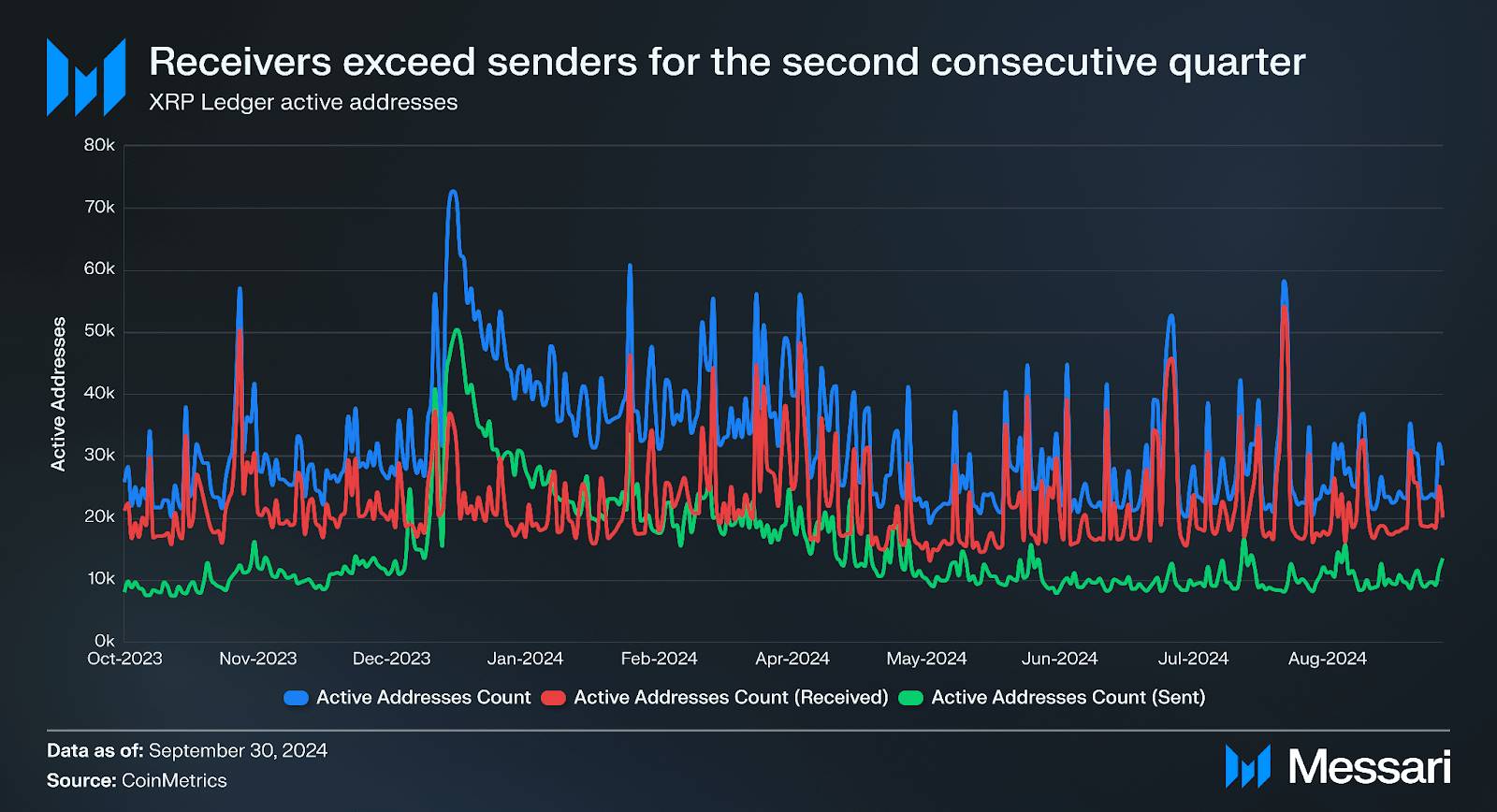
It’s important to note that XRPL supports destination tags, allowing one address to receive and track deposits for multiple users. This design may cause underestimation of daily active addresses. For example, a centralized exchange’s single account may represent thousands of users, whereas on networks like Ethereum or Bitcoin, each user typically needs a separate address to receive tokens.
This quarter marked the second consecutive quarter where active receiving addresses outnumbered active sending addresses. Active receiving addresses reflect the number of addresses receiving transfers or other transactions. When receiving addresses exceed sending ones, it often indicates previously inactive wallets are receiving tokens—common during airdrops, a strategy using token distribution to reward and attract community members. Given XRPL’s low transaction fees and batch transaction support, airdrops are particularly practical on this network.
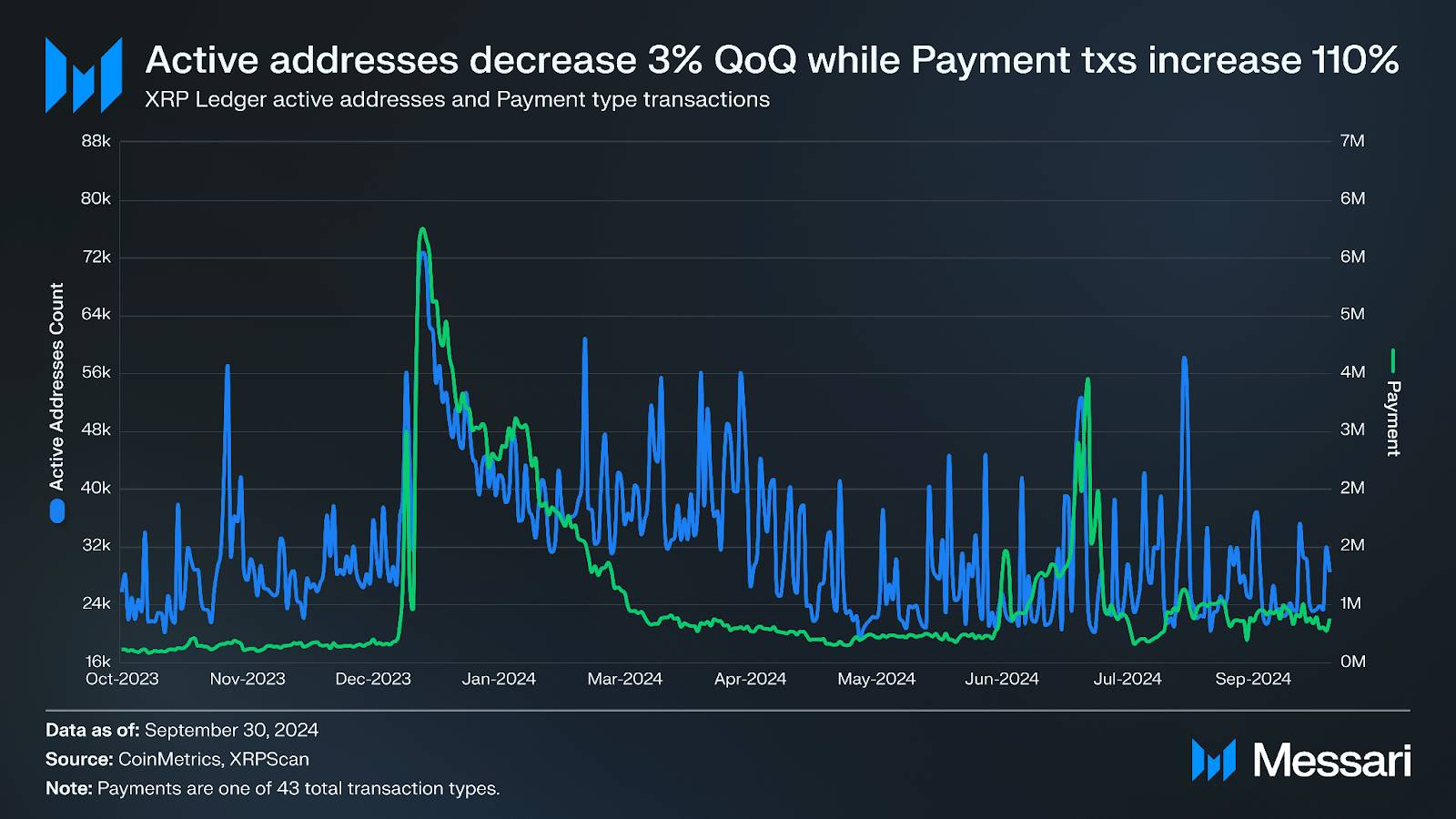
Payment transaction volume, after two consecutive quarters of decline, rose 110% quarter-over-quarter this quarter, driven by a surge in inscriptions activity beginning late 2023. In contrast, total active addresses decreased 3%, as noted earlier. Historical data suggests that when network activity sees minor spikes, the gap between active receiving and sending addresses is typically caused by centralized exchanges and custodial platforms. These platforms often use destination tags to identify transaction endpoints and conduct deposits/withdrawals primarily via payment transactions. As a result, payment transaction receiving addresses consistently outnumber sending ones.
Additionally, users commonly create wallets on centralized exchanges or custodial platforms to quickly obtain the initial XRP needed for self-custody wallets. After acquiring XRP, many users withdraw it to self-custodied wallets, leading to fewer active sending addresses but more receiving ones.
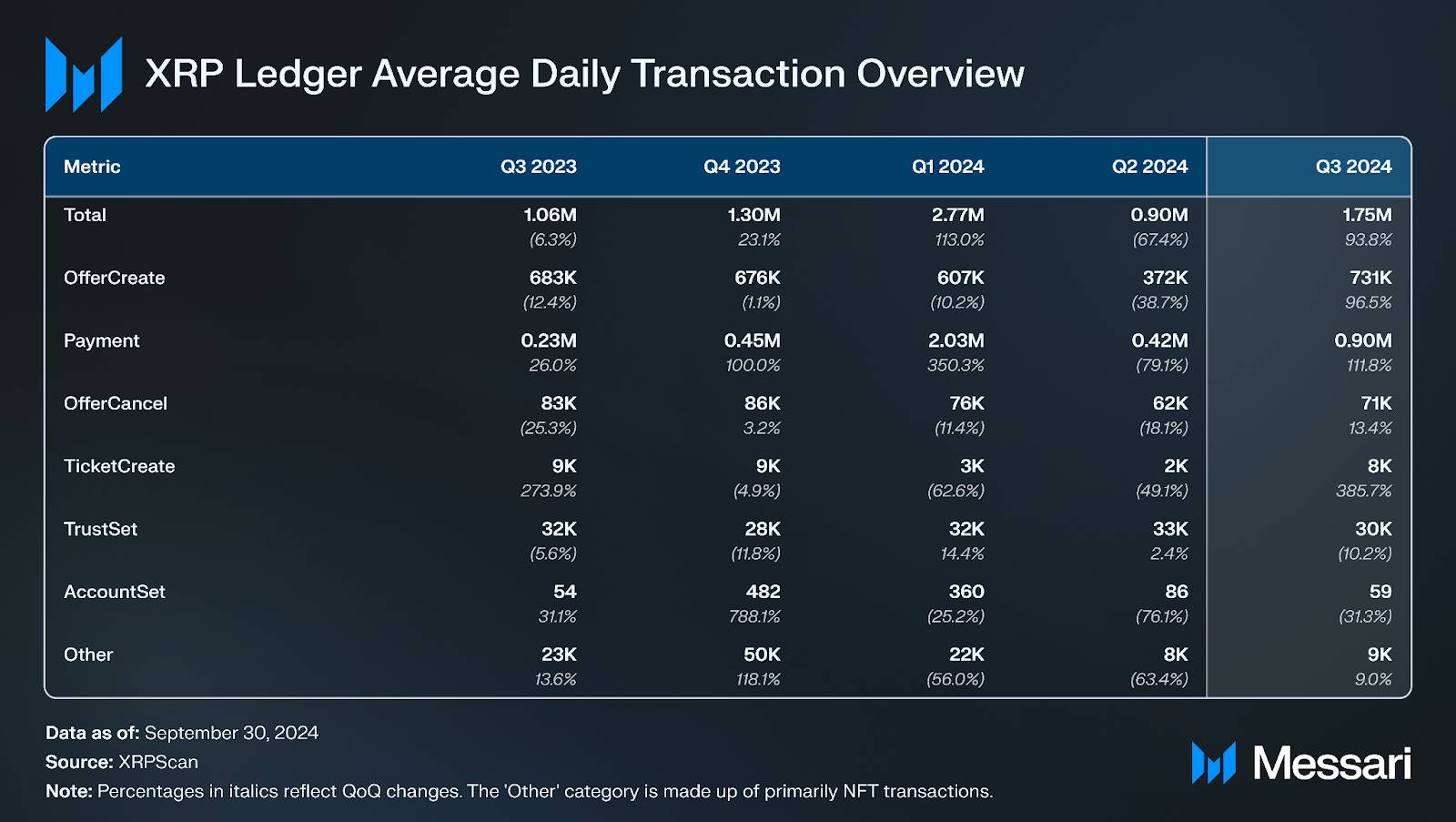
Total daily transactions on XRPL include 43 different types, such as payments, escrow creations, NFT destructions, and account deletions. This quarter, average daily transaction volume increased 94%, rising from 900,000 to 1.75 million per day.
Prior to Q1 2024, OfferCreate was the most common transaction type. OfferCreate submits orders to the order book but doesn’t immediately execute trades unless matching open orders exist. It’s primarily used to initiate DEX limit orders, represented by Offer objects on the order book. Some unfilled orders generate new ones, similar to the UTXO model. Users can cancel pending orders via OfferCancel. Trust Lines (Trust Lines) are structures for holding tokens, protecting accounts from unwanted tokens, and TrustSet transactions are used to enable or disable these lines.
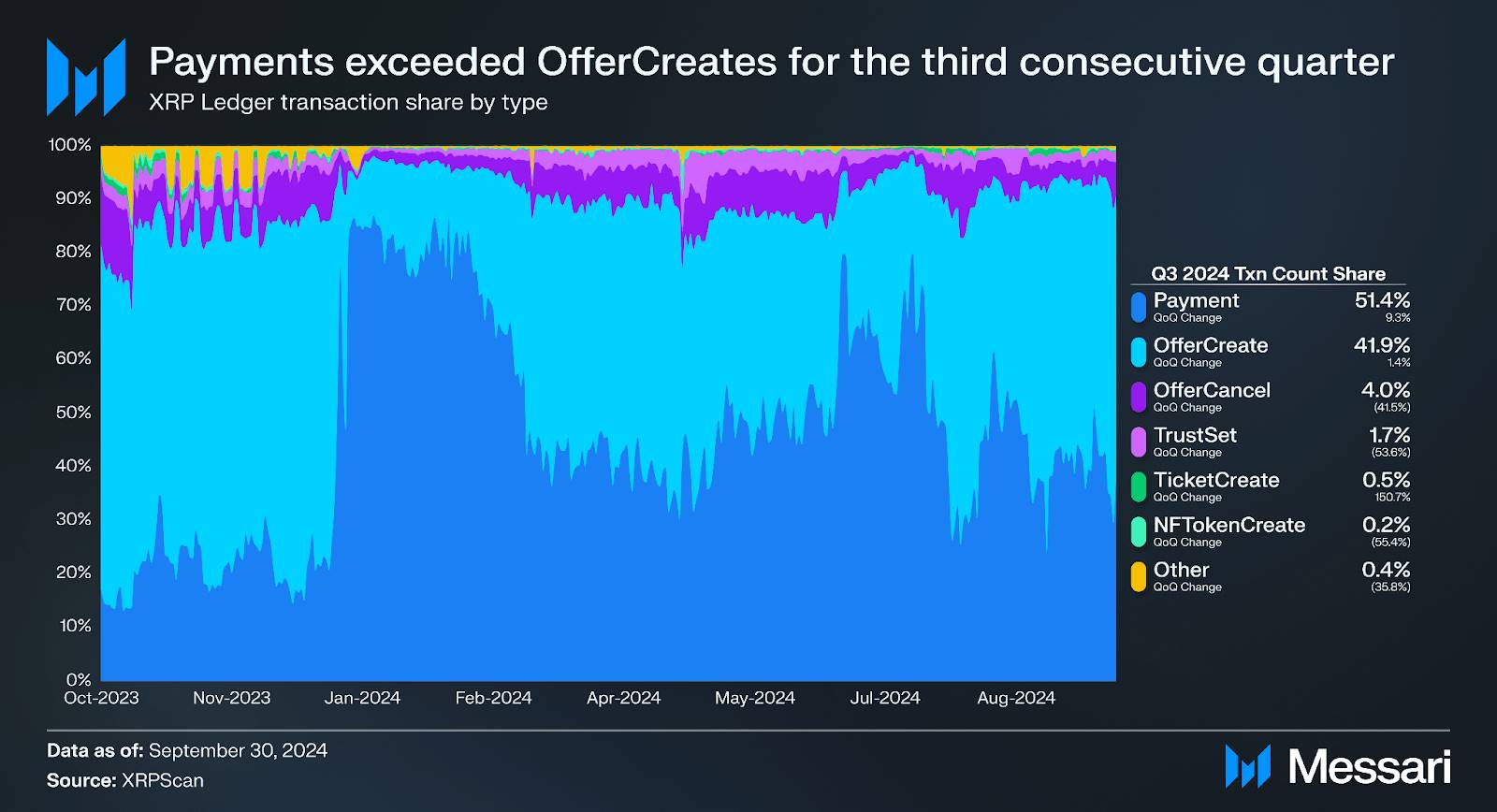
Payment and OfferCreate transaction shares increased 9% and 1% quarter-over-quarter, respectively. Before Q1 2024, OfferCreate was the most frequent transaction type on XRPL.
Overall, average daily total transactions rose 94%, from 900,000 to 1.75 million per day. The “Other” category includes transactions related to NFTs, escrows, multisigs, signature key setups, and more. Detailed information on these can be found in the Ecosystem Overview section.
Decentralized Exchange (DEX)
CLOB (Central Limit Order Book)
XRPL’s Central Limit Order Book (CLOB) primarily handles trading of fungible tokens (also known as issued currencies or simply tokens). A core component since XRPL’s inception, the CLOB reduces reliance on third parties and avoids inherent smart contract risks by consolidating liquidity. Currently, most trading on XRPL occurs via the native CLOB. Although XRPL has only one CLOB, multiple gateways provide user interfaces. These gateways share liquidity and offer a seamless experience for regular users.
AMM (Automated Market Maker)
Building on the existing CLOB, XRPL introduced Automated Market Makers (AMM) in March via the XLS-30 standard. AMMs operate via liquidity pools, using algorithms to price assets instead of pre-defined order specifications. Liquidity pools allow token holders to earn trading fees by providing liquidity. Notably, trades can route through both AMM and CLOB, as they work together as core components of the DEX.
In September, XRPL activated a revision to better match trade sizes, optimizing AMM swap rates. Also in September, Hummingbot released its XRPL connector (as part of Hummingbot 2.0), supporting automated market making and arbitrage strategies on XRPL.
Servers
Nodes and validators (called servers) run the same client software: rippled. Since its release in September, over 55% of nodes have upgraded to V2.2.3. As of Q3 end, XRPL had 621 nodes and 109 validators. Node count increased from 602 in Q2, while validator count decreased from 119.
XRPL servers participate in federated consensus, part of XRPL’s Proof-of-Association (PoA) mechanism. Validators do not stake tokens or receive economic rewards. Instead, the system relies on node trust. Each node maintains a list of trusted nodes called a Unique Node List (UNL). Additionally, Negative UNL dynamically adjusts a server’s “effective UNL” based on validator uptime. UNLModify transactions were invoked an average of 4.3 times daily in Q3, indicating changes in Negative UNL—marking validators going offline or coming back online.
Ecosystem Analysis
Although XRPL’s ecosystem offers many features comparable to programmable settlement layers (e.g., Ethereum, Solana, Cardano), it does not natively support smart contracts. However, in September, Ripple and the broader XRP community announced plans to introduce native smart contracts on XRPL via an upcoming XLS proposal. These smart contracts will be permissionless, allowing users to deploy them without prior approval, and will interact with built-in XRPL features such as escrow, NFTs, authorized trust lines, payment channels, DEX, and AMM.
XRPL intentionally omits arbitrary smart contracts at the base layer to maximize security, performance, and stability. Instead, core functionalities like the DEX and issued currencies are embedded directly into the protocol. XRPL supports various asset forms represented on-chain via Tokens (also called issued currencies or IOUs), representing any currency, commodity, or unit.
Decentralized Finance (DeFi)
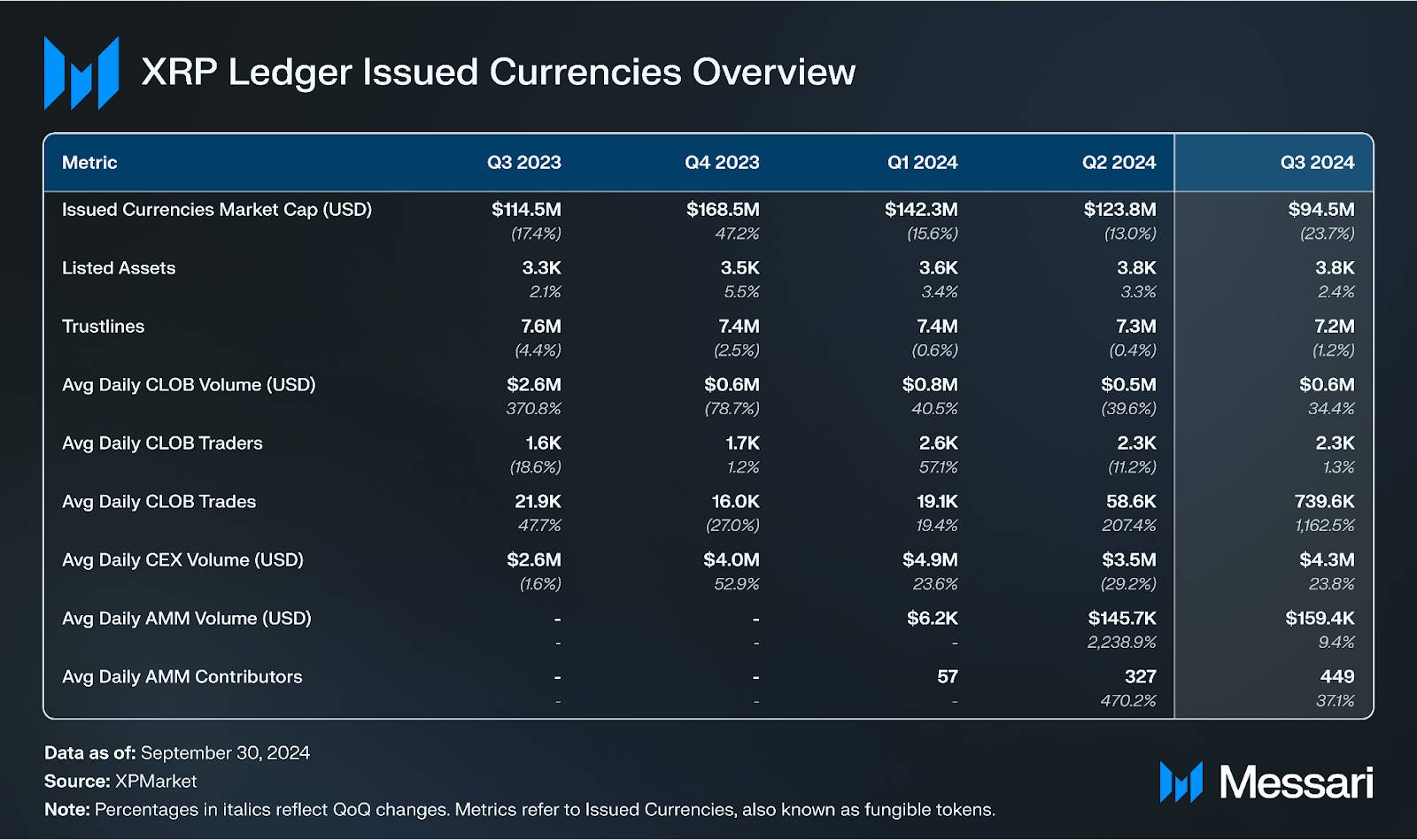
The total market cap of fungible tokens (issued currencies) declined 24% quarter-over-quarter to $95 million. There are over 3,800 listed assets on XRPL, but the top token SOLO accounts for 34% of total market cap. The top four tokens collectively hold 71%.
Top tokens by market cap on XRPL as of Q3 end:
-
Sologenic (SOLO): $34.3M market cap, 228,000 holders. SOLO is used to pay transaction fees on the Sologenic gateway.
-
Bitstamp BTC (BTC): $12.5M market cap, 4,500 holders. Bitstamp BTC is a wrapped version of Bitcoin offered by Bitstamp.
-
Gatehub Fifth ETH (ETH): $11.3M market cap, 26,000 holders. Gatehub Fifth is a wrapped version of Ether provided by GateHub.
-
Coreum (CORE): $8.9M market cap, 71,000 holders. CORE is the native token of the Coreum sidechain, developed by the Sologenic team.
Trust Lines are a mechanism on XRPL for holding fungible tokens while preventing forced receipt of unwanted tokens. Thus, Trust Lines make token behavioral metrics on XRPL more reliable. The first two Trust Lines are free, but each additional token object (e.g., issued currency) requires locking 2 XRP (called owner reserve). Creating a new address also requires a 10 XRP base reserve. These requirements significantly raise the cost of Sybil attacks (i.e., manipulating network metrics via fake identities). Therefore, holder count is a reliable indicator of token adoption on XRPL, especially given fungible tokens vastly outnumber NFTs.
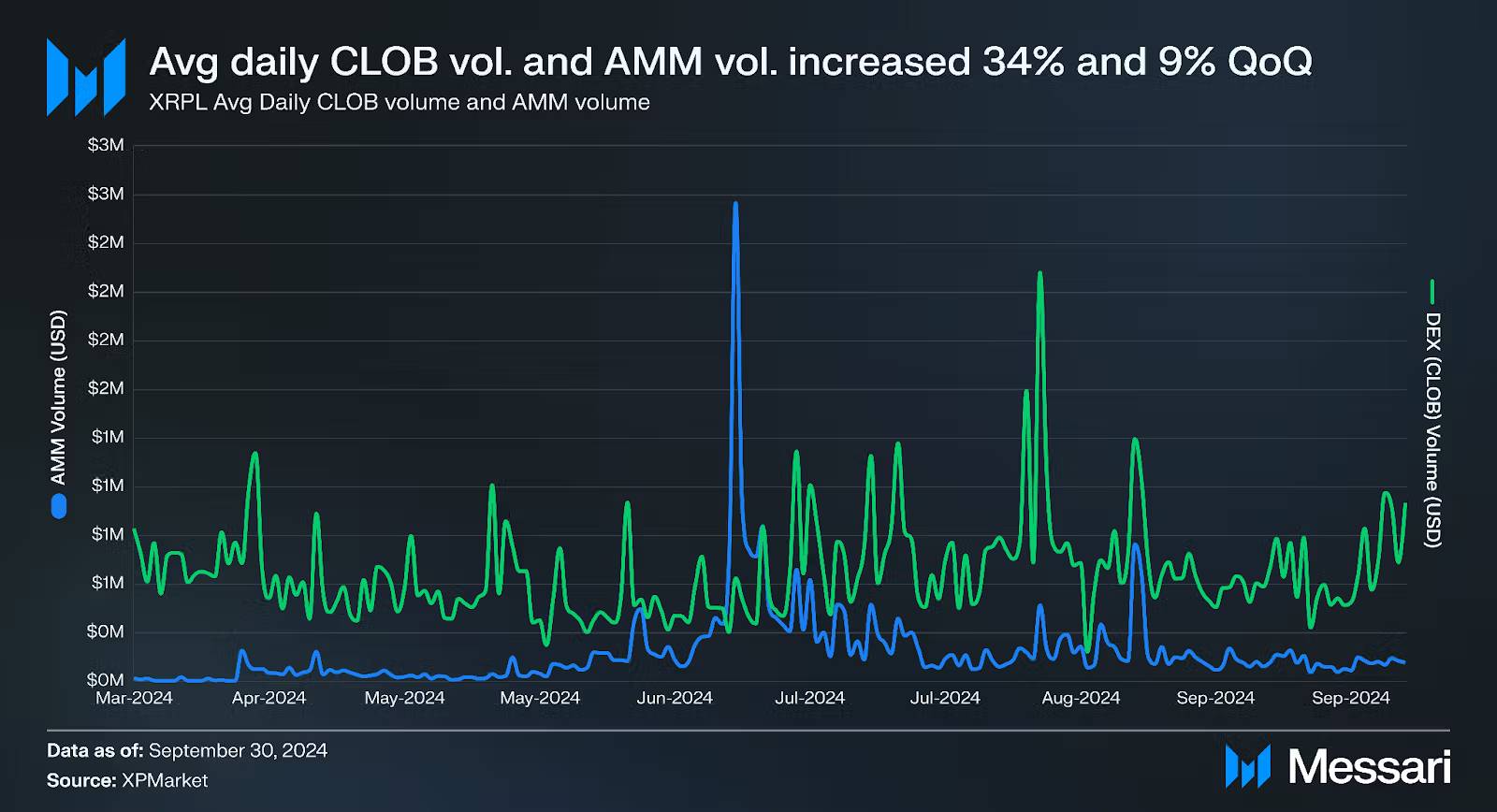
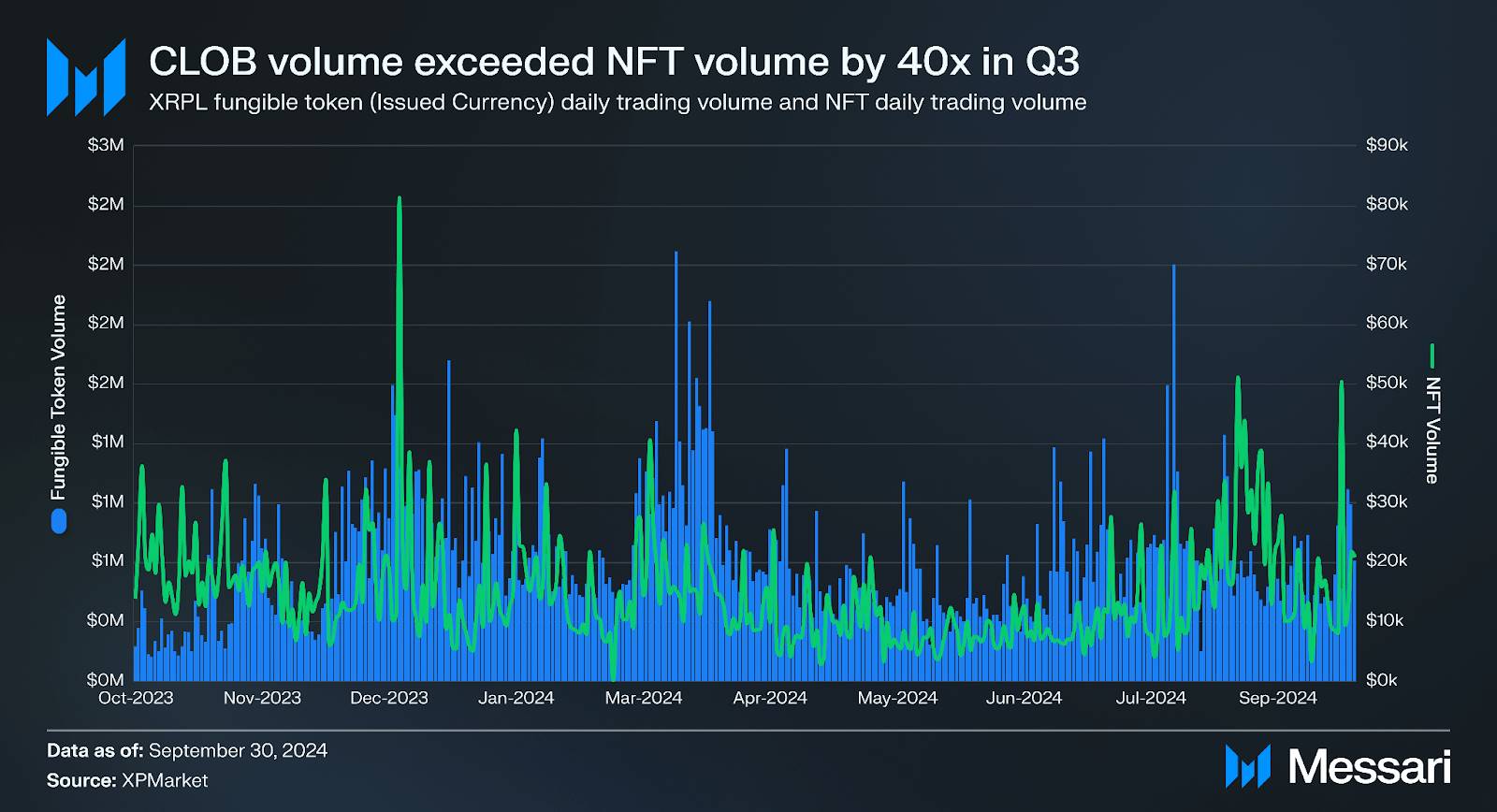
XRPL’s Central Limit Order Book (CLOB) saw daily trading volume rise 34% quarter-over-quarter to $640K, while daily transaction counts surged over 1,110% to 740K. Daily CLOB traders increased 1% to 2,300. Sologenic is the leading DEX (primary native DEX gateway) on XRPL by issued currency trading volume. Other notable DEXes (gateways) include XPMarket and xrp.cafe.
Since launching in March, AMM volume surpassed CLOB volume for six consecutive days in June, peaking at $2.5M. While not reaching Q3 daily highs, AMM average daily volume still grew 9% to ~$160K, reflecting sustained usage growth. Existing platforms like Sologenic and xrp.cafe, along with new entrants like Orchestra Finance and Moai Finance, have all integrated. Notable features include Orchestra Finance’s continuous auction mechanism to reduce fees and xrp.cafe’s Telegram trading bot (First Ledger). Liquidity on AMMs is shared across all DEXes (gateways), just like on CLOB.
Stablecoins and wrapped tokens stand out on XRPL by holder count. Gatehub and Xaman (formerly Xumm) collaborated to bring 14 digital assets to XRPL. Top stablecoins and wrapped tokens (IOUs) on XRPL as of Q3 end:
-
Bitstamp BTC: $12.5M market cap, 4,500 holders
-
Gatehub Fifth (ETH): $11.3M market cap, 26,000 holders
-
Gatehub USD: $3.4M market cap, 20,000 holders
-
Bitstamp USD: $2M market cap, 7,000 holders
In April, Ripple first announced plans to launch a USD-pegged stablecoin on XRPL and Ethereum. The stablecoin will leverage XRPL’s native features and follow ERC-20 standards on Ethereum. It will be fully backed by USD deposits, short-term U.S. Treasuries, and “other cash equivalents,” undergoing monthly third-party audits. Introducing a trusted stablecoin in a new environment often significantly boosts liquidity (e.g., 2023 Cardano’s iUSD), especially as ideal trading pairs in AMMs.
Since then, Ripple has provided further updates on RLUSD. In August, Ripple announced RLUSD entered private testing on XRPL and Ethereum, pending regulatory approval. In October, Ripple President Monica Long stated RLUSD was “operationally ready,” and Ripple announced exchange partners and an RLUSD advisory board. Notably, RLUSD is issued under a New York trust charter to ensure strict oversight and regulation.
Nevertheless, stablecoins on XRPL have yet to reach the adoption levels of major stablecoins like USDT and USDC on other networks, with market caps of $125B and $37B, respectively.
Also in April, a proposal emerged to introduce a native lending protocol (XLS-66) on XRPL, enabling users to lend and borrow supported assets like XRP, wBTC, and wETH via single-asset vaults (XLS-65). Unlike overcollateralized lending protocols like Aave, this protocol aims to offer on-chain fixed-term and interest-bearing loans via pooled funds with preset terms, relying on off-chain underwriting, risk management, and a First-Loss Capital protection scheme—similar to TrueFi’s model on Ethereum.
In September, both proposals received multiple updates, including direct asset-holding single-asset vaults and vault and loan protocols supporting issuer-initiated recovery and freezing for compliant and regulated assets.
Axelar, a full-stack interoperability protocol (a crypto overlay network), integrated XRPL in Q1. It connects the XRPL ecosystem to over 60 networks, including Ethereum and Cosmos ecosystems. With AMM development, Axelar enables easier access to liquidity from many top TVL networks.
Real World Assets (RWAs)
Real World Assets (RWAs) can be utilized on XRPL in multiple ways. In August, OpenEden launched tokenized U.S. Treasury bills (T-bills) on XRPL, with Ripple pledging $10M to OpenEden’s TBILL token. Additionally, Archax and Ripple are developing a mechanism for financial institutions to tokenize RWAs onto XRPL, aiming to bring hundreds of millions of dollars in RWAs to XRPL next year. Zoniqx and Ripple are also working to bring Zoniqx’s tokenization services to XRPL. Specifically, clawback functionality will allow asset issuers to move RWAs on-chain while maintaining compliance.
Last quarter, Meld Gold announced a partnership with Ripple to bring fungible gold and silver assets to XRPL. Additionally, Tiamonds, a tokenized diamond project, allows users to hold NFTs representing real-world diamonds on the xrp.cafe marketplace.
Beyond RWAs, XRPL is seen as a tool for other institutional products. Ripple is one of the main companies driving XRPL technology adoption in institutional and government contexts. The company focuses on leveraging XRP and XRPL for on-demand liquidity, asset custody, and tokenization solutions.
NFTs
On XRPL, NFT creation and transfer are built into the core protocol, eliminating the need for smart contracts—similar to XRPL’s issued currencies (native tokens). In October 2022, NFTs were standardized via the XLS-20 standard, offering users benefits like royalties and anti-spam features. These help users avoid receiving unwanted tokens and maintain legal compliance by avoiding certain prohibited tokens and smart contracts within specific jurisdictions.
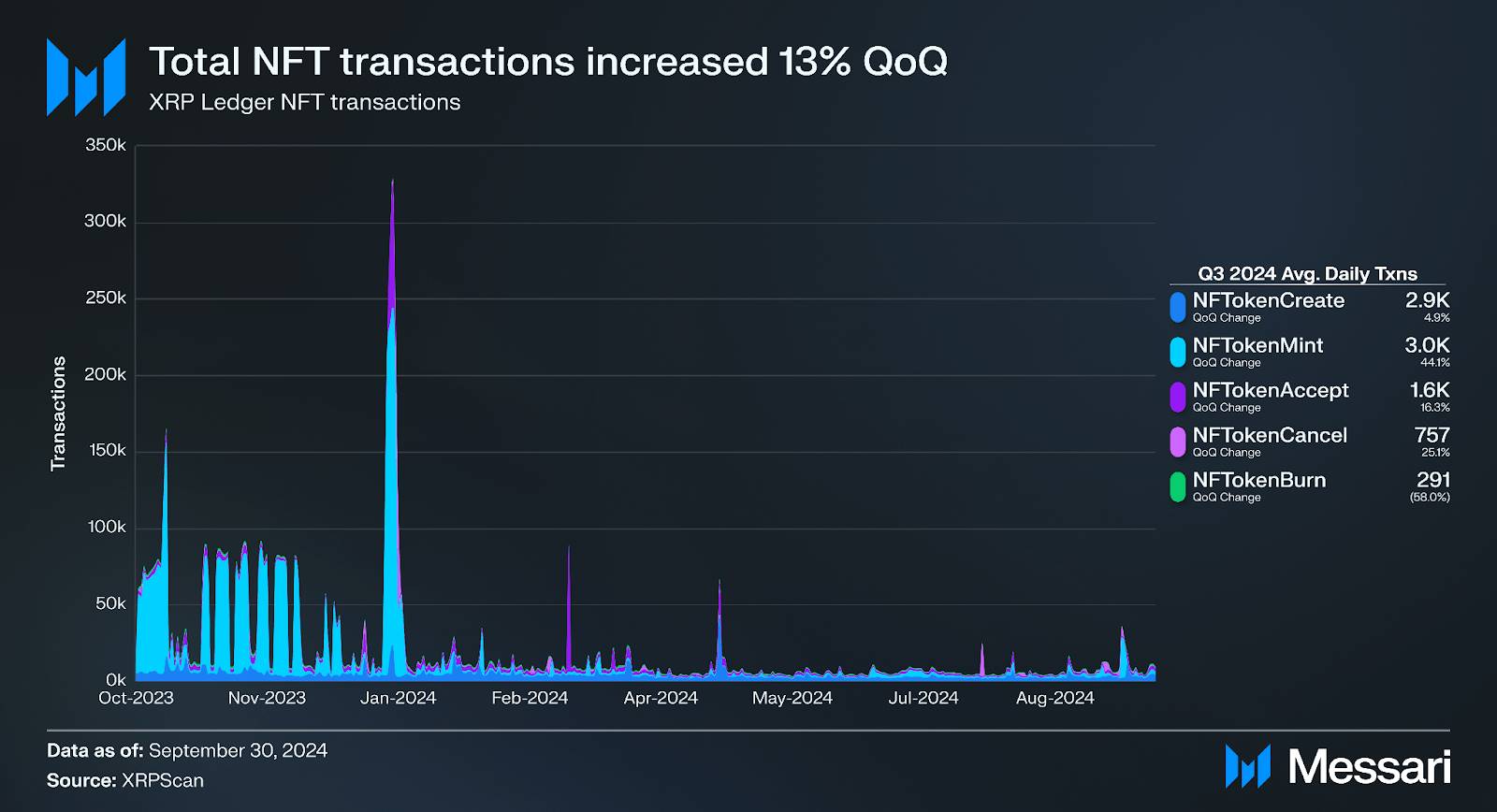
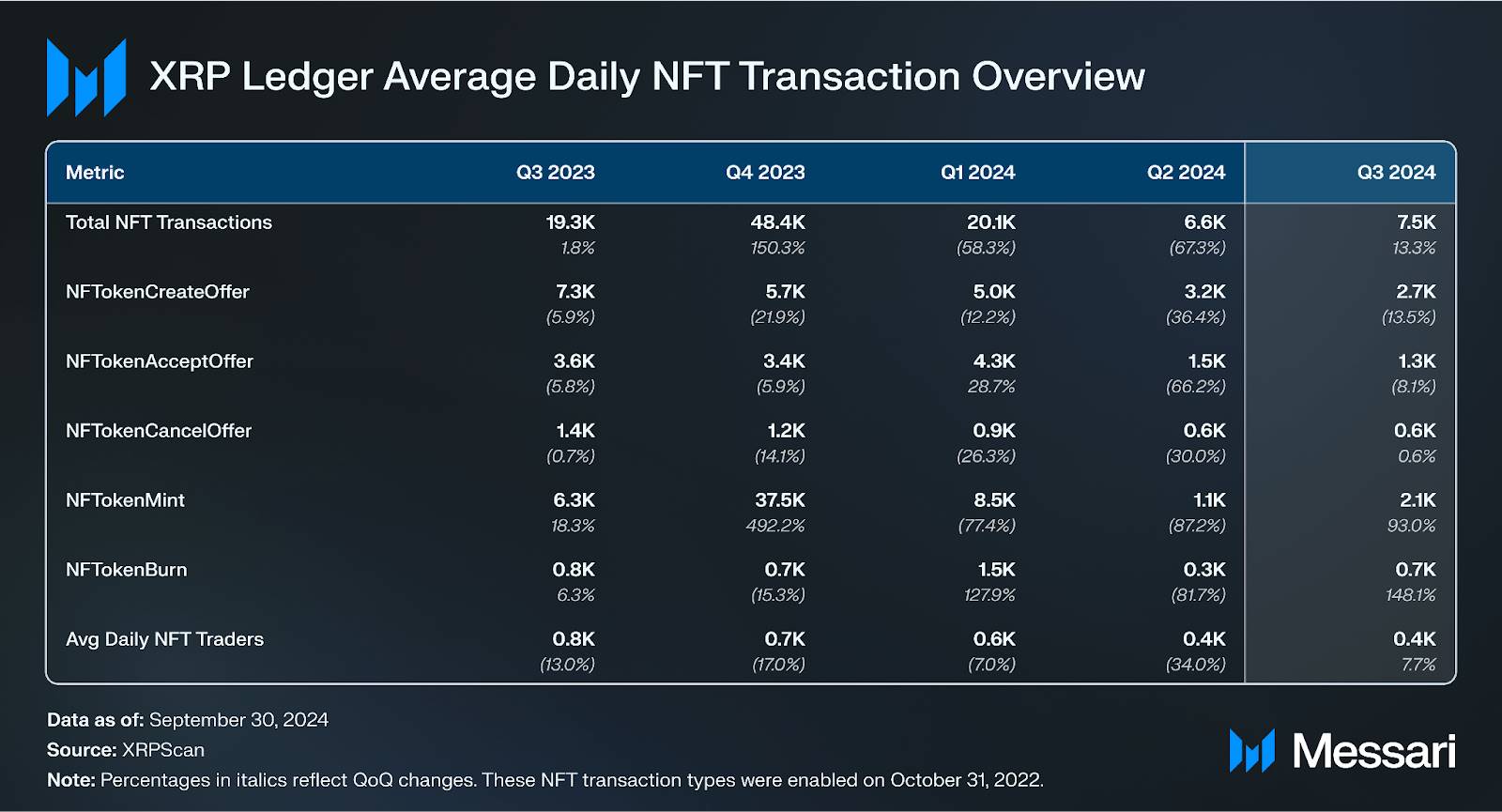
In Q3, NFT mint and burn transaction volumes grew 93% and 148%, respectively, indicating active market engagement. However, NFT creation and accept-offer transaction volumes declined 13% and 8%, while cancel-offer volume remained flat quarter-over-quarter. These figures reflect dynamic shifts in XRPL’s NFT market.
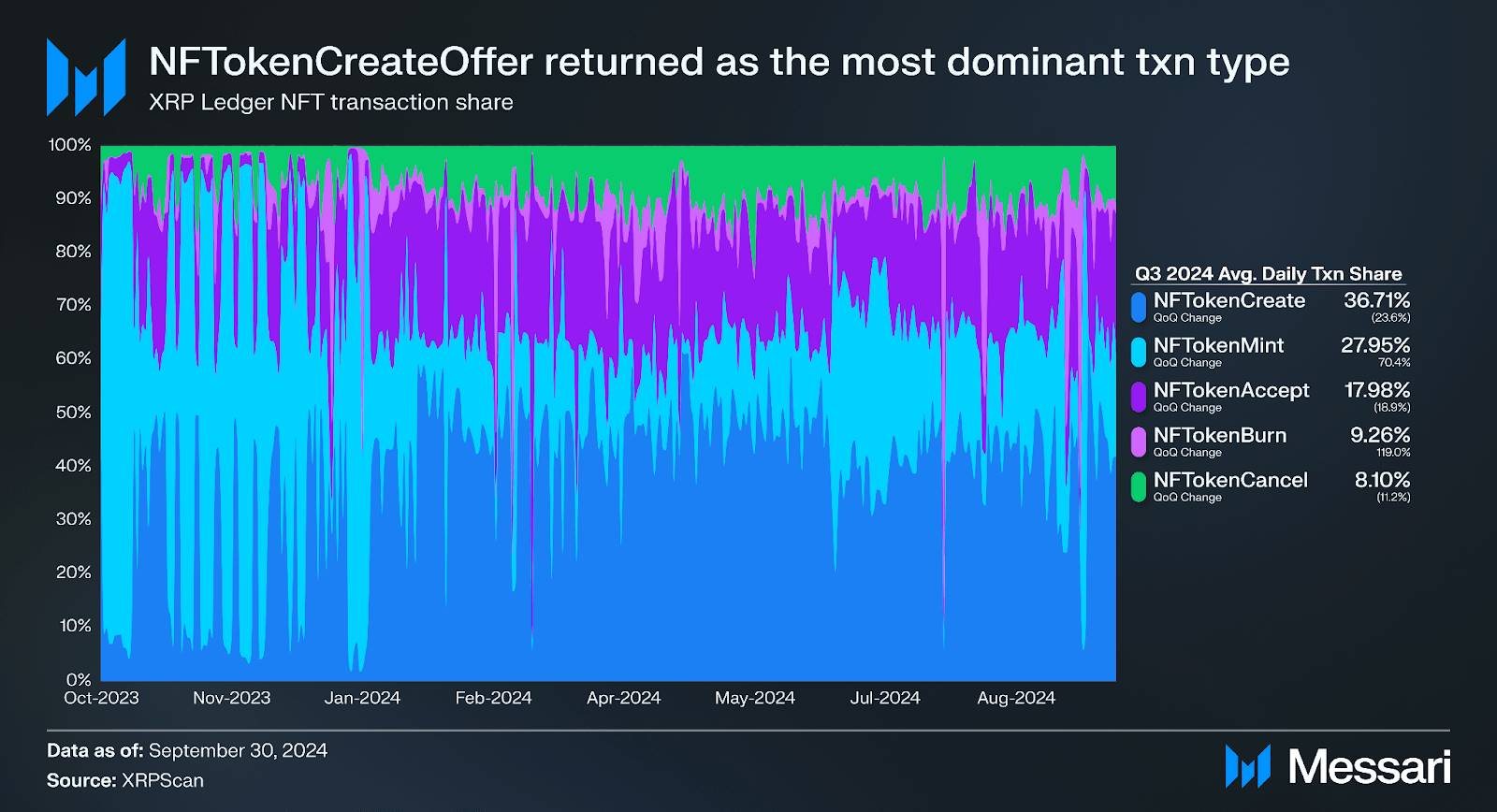
In Q4 2023 and Q1 2024, NFTokenMint became the most common NFT transaction type on XRPL due to a surge in minting activity, surpassing NFTokenCreateOffer. However, in Q2 and Q3 2024, NFTokenCreateOffer regained dominance. This shift aligns with the broader trend on XRPL where OfferCreate (used to place buy/sell orders) dominates transaction types. As of Q3 2024, total NFTs minted via XLS-20 reached 6.7 million, with over 3.4 million minted in Q4 2023 alone.
Prominent NFT projects on XRPL include:
-
Gaming NFTs, such as Zerpmon, a Pokémon-like blockchain game;
-
Digital collectibles from traditional Web2 companies, such as branded collections from Ducati Motorcycles and FIFA World Cup league digital assets;
-
Tokenized RWA solutions, such as Tiamonds’ tokenized diamonds and Xange’s carbon credit program.
Additionally, last quarter xrp.cafe launched its automated NFT launch platform, enabling any user to easily publish NFT series on XRPL.
Sidechains
Several sidechains developed for XRPL are underway, some already live. XRPL maintains simplicity on the main chain (L1), using sidechains to deliver higher programmability for general and specific use cases. This design allows XRPL to scale functionality while preserving efficiency.
Coreum
Coreum (CORE) is an enterprise-grade L1 blockchain focused on interoperability and scalability. The network runs a WASM virtual machine and uses Bonded Proof-of-Stake (BPoS) consensus, securing the network via token staking. Coreum’s native token CORE pays for transaction fees, stakes, and rewards validators.
Developed by the Sologenic team, Coreum aims to meet user needs unmet by XRPL. Its initial goal is to support security tokenization, such as NYSE-listed tokenized stocks and synthetic assets. In March 2024, Coreum completed integration of the Inter-Blockchain Communication (IBC) protocol, connecting to all IBC-supported networks including Cosmos Hub, Ethereum, and BSC. Subsequently, Coreum implemented key updates:
-
June 2024: Integrated with Picasso Network to achieve IBC interoperability with Solana;
-
Integrated Band Protocol’s Band Oracle to bridge RWAs to IBC-enabled chains;
-
Launched Coreum V4 upgrade in July 2024, introducing smart contract extensions, asset recovery, and dynamic NFT data.
Users can now transfer assets between Coreum and XRPL via a non-custodial Sologenic bridge. This interoperability enhances flexibility and scalability for the XRPL ecosystem.
XRPL EVM Sidechain
Last quarter, the Ripple team announced XRPL EVM Sidechain as the official name for the Peersyst EVM sidechain proposal, aiming to bring smart contracts to the XRPL ecosystem. The sidechain grants EVM developers and applications access to XRPL with broad applicability. Built on Cosmos SDK (specifically evmOS), it connects to XRPL via the XRPL-EVM Bridge. The devnet is live, using Comet BFT PoS consensus (a Tendermint variant) to produce blocks roughly every 3.9 seconds.
The latest version of Peersyst’s EVM sidechain was deployed on devnet V2 in Q2 2023. Dapps like identity protocol XRPDomains are live on testnet. Key additions in this version include:
-
Support for transferring XRP, IOUs, and ERC-20 tokens via bridging;
-
Introduction of Proof-of-Authority consensus, where a set of trusted nodes validate transactions;
-
Smart contract verification on the block explorer.
Cosmos IBC interoperability was enabled in May, allowing tokens to bridge from IBC-enabled chains to XRPL. Additionally, in June, the Ripple team announced that Axelar would replace the bridge design proposed in the cross-chain bridge specification (XLS-38d), becoming the exclusive bridge for XRPL EVM Sidechain. This includes sourcing the sidechain’s native gas token (eXRP) from XRPL. In a later announcement, Peersyst stated the XRPL EVM Sidechain would launch “later this year” following Axelar integration.
Root Network
Root Network is a blockchain-based NFT system focused on UX and Metaverse, operated by Futureverse. Root Network and its bridges to XRPL and Ethereum are in alpha stage. The bridge was upgraded in September to enable bidirectional bridging of any token between XRPL and Root Network.
Based on a Substrate fork, Root Network uses XRP as its default gas token and supports EVM smart contracts. It employs Delegated Proof-of-Stake (dPoS) consensus (via ROOT token). Root Network’s roadmap aligns with XRPL, planning to integrate XLS-20 NFT standards and draw liquidity from XRPL’s DEX. Additionally, via FuturePass’s account abstraction features, Root Network will offer social recovery, asset management, flexible wallet options, and a Web2-like user experience.
Hooks
Hooks is an innovative feature developed by XRPL Labs to provide smart contract-like programming capabilities on XRPL. While not Turing-complete or capable of complex arbitrary logic, Hooks allow attaching conditions and triggers to transactions, similar to scripts on UTXO chains like Bitcoin or Cardano (pre-Alonzo). Developers can implement features like time-locked payments, royalty distributions to creators, transaction volume limits, or counterparty restrictions. In July, the XRPL Labs team launched the latest Hooks testnet written in JavaScript (JS), one of the most widely used programming languages.
Governance
XRP Ledger (XRPL) uses an off-chain governance process, allowing community members and organizations to propose network changes. Users can submit proposals (also called amendments) to the project’s GitHub “XRPL-Standards” repository. Block-producing validators on the network can then run XRPL source code versions implementing the proposed amendments. If 80.00% or more of block-producing validators support the modified code for two weeks, it becomes the network’s new standard. Validators not supporting the updated code are blocked from contributing to consensus until they upgrade.
Recently passed key proposals include:
-
Decentralized Identity (XLS-40): Decentralized Identity (DID) was enabled at the end of October, enabling verifiable, self-sovereign digital identities on XRPL for compliance, access control, digital signatures, and secure transactions.
-
Price Oracles (XLS-47): This amendment was enabled in November, bringing price oracles to XRPL for pricing wrapped/bridged assets. Anyone can now call OracleSet to create or update price oracles, or call OracleDelete to remove them. Oracle providers Band Protocol and DIA integrated with XRPL in July. Post-enabling, the get_aggregate_price API aggregates prices from all live oracles, discarding outliers.
Additionally, significant governance proposals were submitted in Q3 2024:
-
Multi-Purpose Tokens (XLS-33): Proposal to introduce the Multi-Purpose Token (MPT) standard. MPT supports metadata to store parameters for issued RWAs, such as maturity dates for tokenized bonds. Combined with the clawback feature enabled in Q1 2024, XRPL continues adding features to give compliant token issuers greater control.
-
AMM Clawback (XLS-74): Proposal to support clawback functionality on AMMs. Regulated tokens like RLUSD require clawback capability to maintain fully compliant AMM liquidity pools.
-
Simulate Transaction Execution (XLS-69): Proposes a new simulate API method for developers to safely test and refine transactions.
-
Permissioned Domains (XLS-80): Introduces permissioned domains accessible only by users based on their decentralized identity (DID). Notably, this amendment builds on last quarter’s proposed on-chain credential support (XLS-70), which adds support for creating, accepting, and deleting credentials on XRPL as part of identity management, first introduced with Decentralized Identity (XLS-40), implemented at end of October.
In September, entities supporting XRPL—including Ripple, InFTF (formerly XRPL Foundation), XRPL Labs (and Xaman), XRPL Commons, and other XRP community members—announced discussions to establish a new XRP Ledger Foundation. Additionally, XRPL Foundation assets agreed to transfer to a new independent foundation governed by developers, users, academics, validators, and infrastructure providers. As part of the transition, the former XRPL Foundation team established a new Inclusive Financial Technology Foundation (InFTF), intended to merge into a single foundation entity.
Other Key Updates
In Q3, the XRPL ecosystem enhanced overall utility through new integrations, partnerships, and feature upgrades:
-
Peersyst launched XRPL Snap, integrating MetaMask wallets with XRPL.
-
Immersive announced collaboration with Xahau Network to bring self-custodied on-chain Mastercards to XRPL.
-
Futureverse, an AI and metaverse technology and content company, announced plans to integrate Ripple Custody for secure digital asset storage.
-
Ripple announced the launch of Ripple Payments in Brazil, with Latin America’s largest crypto exchange Mercado Bitcoin as its first customer. Additionally, Ripple announced a partnership with Brazil’s Fenasbac via the Next accelerator program to support fintech innovation on XRPL.
-
Ripple introduced a “Try it” feature for the Ripple Payments API, allowing developers to test API requests in real-time without logging in or using real funds.
-
XRPScan announced the beta launch of XRPL Advanced Search Engine, enabling users to search and filter by over 100 transaction fields.
-
XRPL infrastructure developer Girin Labs announced funding from Ripple’s XRP Ledger Japan and Korea Fund. Girin Labs is building the Girin Wallet for XRPL and Lotus Protocol, a liquid staking and lending protocol on the Root Network XRPL sidechain.
XRPL Community Support Programs
In September, the XRPL Grants Program introduced artificial intelligence (AI) as a new grant focus area. Earlier in May, Ripple announced changes to the XRPL Grants Program, including revised applicant screening criteria, rolling applications, involving other XRPL-based project developers in reviews, office hours for feedback to applicants and rejected candidates, and a feedback survey for applicants. Additionally, the XRPL Accelerator Program offers two tracks in 2024: the Launch Program for early-stage projects and the Scale Program for later-stage ones. In July, the first Launch cohort was announced, while the second Scale cohort began in September.
Also in July, Ripple announced a partnership with Dubai International Financial Centre (DIFC) to connect developers with DIFC’s Innovation Hub, and in August announced a partnership with APAC DAO to support Southeast Asian developers building on XRP Ledger. Other community initiatives include XRPL hackathons and XRPL Commons’ Aquarium Residency for developers. The RippleX Bug Bounty Program also rewards individuals or groups who identify and report bugs in repositories like ripple, xrpl.js, xrpl-py, and xrpl4j.
Summary
XRPL’s native order book (CLOB) and automated market maker (AMM) saw trading volumes grow 34% and 9% quarter-over-quarter, respectively, in their second full quarter. Additionally, XRPL’s daily transaction volume increased 94% to 1.7 million, and new addresses rose 10% to 105,000. However, this growth was primarily driven by microtransactions (<1 XRP), which, according to Ripple’s Q3 2024 report, may be linked to spam messaging campaigns.
Several key proposals were activated in Q3, including Decentralized Identity (DID) for verifiable digital identities and price oracles for pricing wrapped or bridged assets. Additionally, Ripple’s USD stablecoin RLUSD has been in private testing on XRPL and Ethereum since August, pending regulatory approval. Meanwhile, Ripple and the XRP community are developing native smart contract functionality for XRPL, along with a lending protocol enabling users to lend and borrow assets (e.g., XRP, wBTC, wETH) via single-asset vaults. As these upgrades roll out, XRPL is poised to attract more users and boost network activity in the future.
Join TechFlow official community to stay tuned
Telegram:https://t.me/TechFlowDaily
X (Twitter):https://x.com/TechFlowPost
X (Twitter) EN:https://x.com/BlockFlow_News
 Messari






