Tax-Free Wealth: How Hong Kong Attracts Hedge Funds and Family Offices
TechFlow Selected TechFlow Selected
Tax-Free Wealth: How Hong Kong Attracts Hedge Funds and Family Offices
Hong Kong's introduction of a profits tax exemption policy for virtual assets will have a profound impact on the entire crypto industry.
 Navigating Web3 tides with focused insights
By Man Qun Blockchain Legal Services
When considering where to establish investment vehicles for investing in virtual assets—whether funds or single-family office investment tools—tax considerations should be a primary factor. Hong Kong is known for its favorable tax policies, such as its territorial taxation principle, which means companies are taxed only on profits generated within Hong Kong. This creates a favorable environment for international businesses, as offshore income remains untaxed.
 ▲ Sina News screenshot
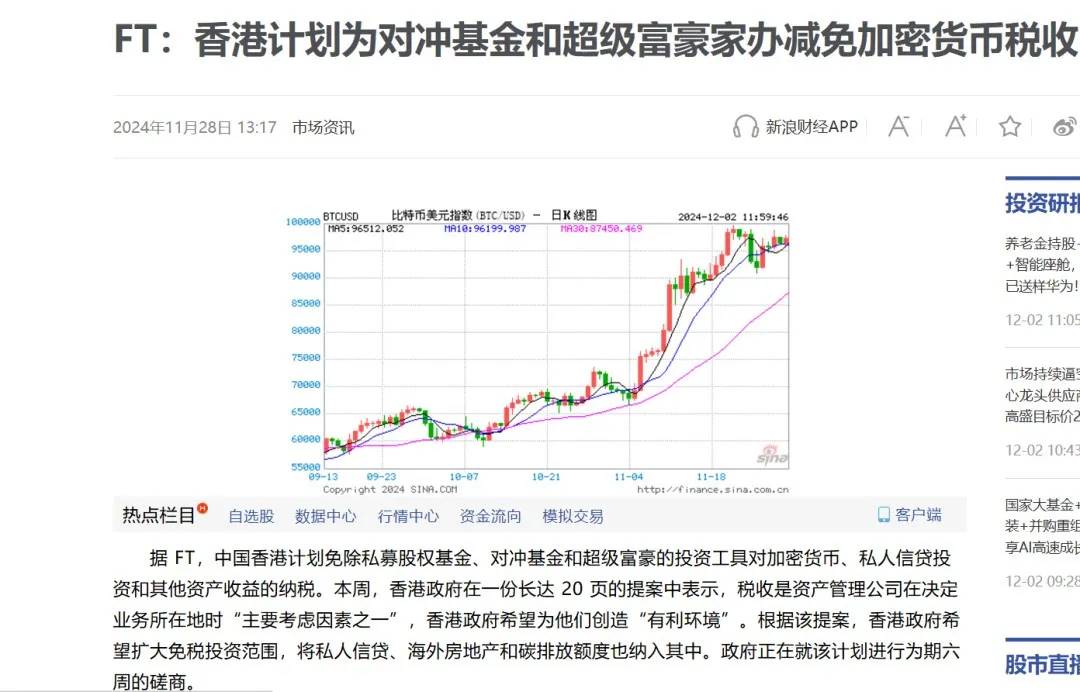
Now, when discussing Hong Kong's "profits tax," there are several important tax exemptions to note. However, until recently, virtual assets were not included in Hong Kong’s list of tax-exempt assets.
That may soon change...
Proposed changes to the tax treatment of virtual assets in (i) private placement funds and (ii) single-family office investment vehicles
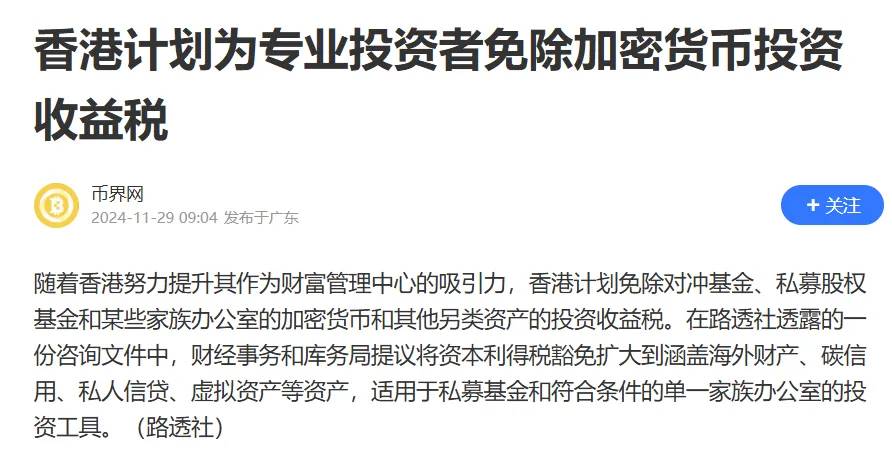
Currently, Hong Kong is conducting a public consultation proposing new profits tax exemptions for virtual assets. The Financial Services and the Treasury Bureau has suggested expanding the existing scope of profits tax exemption to cover investment instruments used by (i) private placement funds and (ii) single-family offices, including but not limited to:
-
Overseas real estate
-
Carbon credits, emissions derivatives, or allowances
-
Private credit investments and loans
-
Virtual assets
(i) Private Placement Funds
In Hong Kong, there is a unified tax exemption regime that provides profits tax exemption for qualifying private funds, including those structured as Limited Partnership Funds (LPFs) and Open-ended Fund Companies (OFCs). Under this regime, private funds can enjoy tax exemption on income derived from investments—such as capital gains, interest, and dividends—provided they meet certain criteria. These include being managed by an investment manager licensed under the Securities and Futures Ordinance, and that the fund’s activities are primarily investment-related rather than commercial or trading in nature.
However, until now, there has been uncertainty regarding whether virtual assets could be included within Hong Kong private funds and whether doing so would affect eligibility under the unified tax exemption regime. Therefore, the new proposal brings much-needed clarity, confirming that virtual assets can indeed qualify as “qualifying investments” and thus be eligible for profits tax exemption.
It is worth noting whether the government will further clarify the tax treatment of other crypto-related income or derivatives in the consultation paper. For instance, it remains unclear how staking rewards and other forms of crypto-related income are classified and taxed in Hong Kong.
(ii) Single-Family Office Investment Tools
Currently, Hong Kong law provides preferential profits tax treatment for qualifying single-family office investment tools, offering a 0% preferential tax rate on assessable profits arising from qualifying and incidental transactions. However, virtual assets are currently excluded from this scope. If the proposed changes in the consultation paper take effect, the definition of designated assets will be expanded to include virtual assets. Such assets would encompass common crypto assets like Bitcoin and Ethereum, as well as certain utility tokens, security tokens, and stablecoins.
Potential Impacts of Hong Kong as a Virtual Asset Hub
Introducing a profits tax exemption for virtual assets in Hong Kong will have far-reaching implications for the entire cryptocurrency industry. Below are some specific potential impacts:
▲ News screenshot
1. Attracting Global Investors
The new tax policy will attract investment managers and high-net-worth individuals globally, positioning Hong Kong as their preferred hub for virtual asset investments. Hedge funds and family offices seeking to maximize after-tax returns may increasingly favor establishing investment vehicles in Hong Kong. Moreover, the policy could also draw international virtual asset exchanges, custodians, and other ecosystem players to expand operations in Hong Kong, further solidifying its position in the global crypto landscape.
2. Boosting Local Economic Growth
As more investment managers and family offices set up in Hong Kong, local professional service sectors—including legal, accounting, tax, and banking—will benefit from increased demand. This will not only drive growth in these industries but also create new employment opportunities. Additionally, through such policy initiatives, the Hong Kong government demonstrates its support for blockchain technology and virtual assets, boosting confidence among technology-driven enterprises looking to establish a presence in the region.
3. Encouraging Innovation and Ecosystem Development
Hong Kong’s inclusive approach toward virtual assets and clear tax guidelines will encourage more startups, developers, and investors to enter the space. This could accelerate innovation in areas such as decentralized finance (DeFi), blockchain infrastructure, and tokenized assets. As these emerging fields develop rapidly, Hong Kong could become not only a center for capital aggregation but also a global laboratory for crypto innovation.
4. Enhancing International Competitiveness
Currently, Hong Kong is in fierce competition with Singapore for the title of Asia’s leading virtual asset hub. By offering competitive tax policies, Hong Kong could gain an edge—particularly in attracting virtual asset funds and family offices. Singapore’s imposition of Goods and Services Tax (GST) on virtual asset transactions may make Hong Kong more attractive in comparison. Furthermore, Hong Kong’s close ties with mainland China offer international investors unique strategic advantages for accessing the vast Chinese market.
What to Watch Next
The consultation period for the discussion paper will end on January 3, 2025. We will closely monitor developments and conclusions from the consultation to further share insights on how these proposed changes may impact the industry.
Join TechFlow official community to stay tuned
Telegram:https://t.me/TechFlowDaily
X (Twitter):https://x.com/TechFlowPost
X (Twitter) EN:https://x.com/BlockFlow_News