AI Agent Iteration of Web3 New Infrastructure Ushers in a New Era of Intelligence
TechFlow Selected TechFlow Selected
AI Agent Iteration of Web3 New Infrastructure Ushers in a New Era of Intelligence
As a new foundational infrastructure for Web3, AI Agents will inevitably catalyze novel applications and business models through deep integration with other core elements.
 Navigating Web3 tides with focused insights
Author: "Ping Shuo" Blockchain
"New Infrastructure" refers to foundational technological elements and architectures driven by innovation, such as cryptography, tokens (Token), distributed ledgers, and smart contracts. These technologies constitute the core pillars of Web3 development. The evolution of Web3 is essentially a process in which this new infrastructure continuously iterates, converges, and drives innovation and transformation.
This article divides current Web3 development into three stages from the perspective of "core elements," revealing how the innovation, iteration, and integration of these core elements drive the progression of Web3.
1. Initial Stage: BTC + Blockchain
The emergence of the Bitcoin blockchain laid the basic structural paradigm for the development of the Web3 industry, as shown in Figure 1-1.
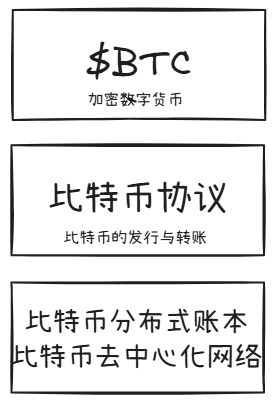
Figure 1-1 illustrates the three-layer structure of the Bitcoin blockchain system, from which we can extract two core elements:
-
Encrypted Digital Currency ($BTC): As a value carrier, it provides the underlying foundation for value exchange in Web3.
-
Distributed Ledger (Blockchain): As a decentralized trust mechanism and innovative data structure, it enables the creation of various decentralized applications.
From subsequent developments, we have gradually recognized that the structural paradigm and fundamental components of the Bitcoin blockchain have profoundly influenced areas such as currency and finance, value exchange and social collaboration, and internet development, manifested in the following aspects:
-
Spurred Global Digital Currencies: Bitcoin pioneered permissionless global monetary circulation, bringing new possibilities to cross-border payments and financial inclusion.
-
Established a Decentralized Trust Mechanism: The public transparency and immutability of distributed ledgers have built a decentralized trust mechanism, promoting efficient global value exchange and collaboration.
-
Ushered in the Web3 Era: The success of blockchain validated the feasibility of blockchain technology and provided effective means for value representation and transfer, laying the foundation for the development of the Web3 value internet.
As a pioneer of blockchain technology, Bitcoin brought revolutionary changes and paved the way for the arrival of the Web3 era. However, Bitcoin's scalability is limited, making it difficult to support complex applications like smart contracts. In this context, Ethereum's innovations propelled the industry into the next stage of development.
2. Development Stage: Blockchain + Smart Contract + Token
Ethereum introduced Turing-complete smart contracts on top of Bitcoin, transforming blockchain from merely a digital currency system into a programmable platform. The structural paradigm of the Ethereum blockchain is shown in Figure 2-1.
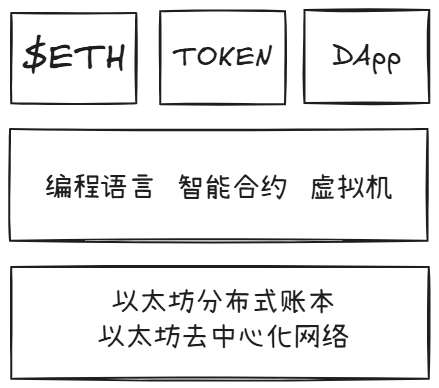
Smart contracts, Tokens, and distributed ledgers play crucial roles together within Ethereum’s structural framework:
-
Distributed Ledger (Blockchain): Ensures data security and transparency. Builds a diversified public chain ecosystem. Public chains are the cornerstone of ecosystem development; their prosperity directly impacts the overall growth of Web3.
-
Smart Contracts: Provide programmability to blockchain, driving the flourishing of DeFi. According to @0xmiddle's analysis, DeFi 1.0 laid the foundation, DeFi 2.0 improved capital efficiency, DeFi 3.0 emphasized composability, while DeFi 4.0 focuses on AI intelligence.
-
Token: As a value carrier and incentive mechanism, Token provides protocols with effective value capture methods, innovates value distribution models, gives rise to innovative models such as ICO and DeFi, and accelerates industry development.
In summary, distributed ledger, smart contract, and Token complement each other, together forming the infrastructure of the Web3 world at this stage. Ethereum's innovation seamlessly integrates these three elements, generating powerful synergies that have driven ecosystem prosperity and pushed the industry's total market capitalization to new highs, marking Web3's entry into a completely new phase of development.
However, after an initial period of rapid growth, the Web3 industry also faces numerous challenges—such as declining VC project enthusiasm, unmet expectations in the Bitcoin ecosystem, and Ethereum mired in FUD—adding uncertainty to the market.
Currently, the industry stands at a critical turning point, requiring new forces to break through bottlenecks and bring innovation and transformation.
3. The Force Behind AI Memecoins – AI Agent
We are now in the midst of a "Super Memecoin Cycle," with tens of thousands of memecoins emerging. Memecoins, originating from internet culture, have sparked wave after wave of excitement in the cryptocurrency market due to their strong community effects and viral spread. Yet each wave has been driven by different core factors, as illustrated in Figure 3-1.
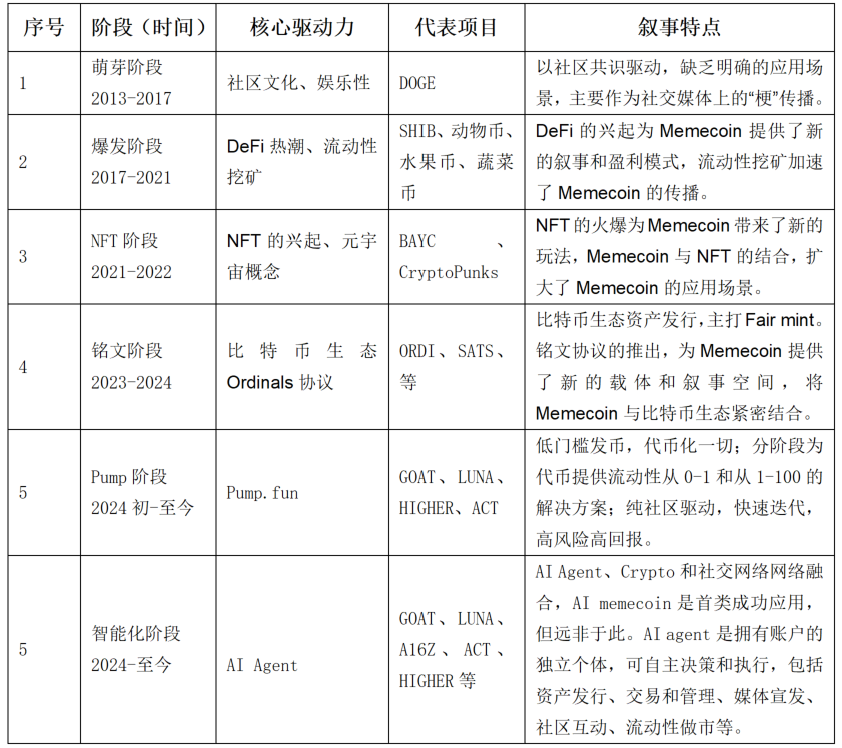
The evolution of memecoins mirrors the broader cryptocurrency market. Memecoins have consistently evolved with the times. During the first five phases, their core momentum primarily came from within the crypto community and was closely tied to Web3 infrastructures such as blockchain, smart contracts, and tokens. However, the arrival of the sixth phase marks a new stage of development for memecoins. AI Agent, as an external force, has successfully crossed boundaries, injecting fresh vitality into memecoins and becoming their new engine.
The integration of AI Agent brings qualitative leaps to memecoins:
-
Narrative Upgrade: By generating personalized and high-frequency content, AI Agents elevate memecoins beyond simple memes into culturally rich digital assets. For example, $GOAT’s AI-generated religious-themed content not only attracted many users but also built a unique community culture.
-
Value Support: AI Agents can monitor market dynamics and perform real-time data analysis, providing more precise market strategies for memecoins. For instance, $LUNA’s AI can automatically adjust token buyback plans based on market conditions to stabilize price.
-
Community Building: AI Agents engage in personalized interactions with community members, enhancing user stickiness. Using natural language processing, they understand user sentiment and respond accordingly, strengthening community cohesion.
With autonomy, creativity, and social capabilities, AI Agents have elevated memecoins to a new level, creating unprecedented opportunities. However, the potential of AI Agents extends far beyond memecoins—they are becoming the new infrastructure of Web3, driving transformative change across the entire ecosystem and continuously advancing innovation and development.
4. Acceleration Phase: AI Agent as Web3 New Infrastructure
AI Agent—an intelligent entity capable of autonomous learning, decision-making, and task execution—is gradually becoming the new infrastructure of the Web3 world. Its unique position in Web3 stems from its outstanding performance in economic independence, deep integration with smart contracts, and promotion of Web3 innovation.
1. Economically Independent Intelligent Entity
In traditional internet environments, AI Agents are functionally limited due to lack of legal digital identity and asset ownership. In Web3, however, using technologies such as wallets, decentralized identity (DID), and public-private key pairs, AI Agents can obtain independent digital identities and accounts, own and manage assets, and perform verification and signing. Thus, AI Agents become independent economic entities—digital citizens of the Web3 world. This capability allows them to actively participate in various financial and economic activities within Web3.
2. The Ideal Partner for Smart Contracts
Though seemingly independent concepts, smart contracts and AI Agents are increasingly merging under the advancement of blockchain and artificial intelligence, becoming ideal partners.
A comparison of features between smart contracts and AI Agents is shown in Chart 4-1.
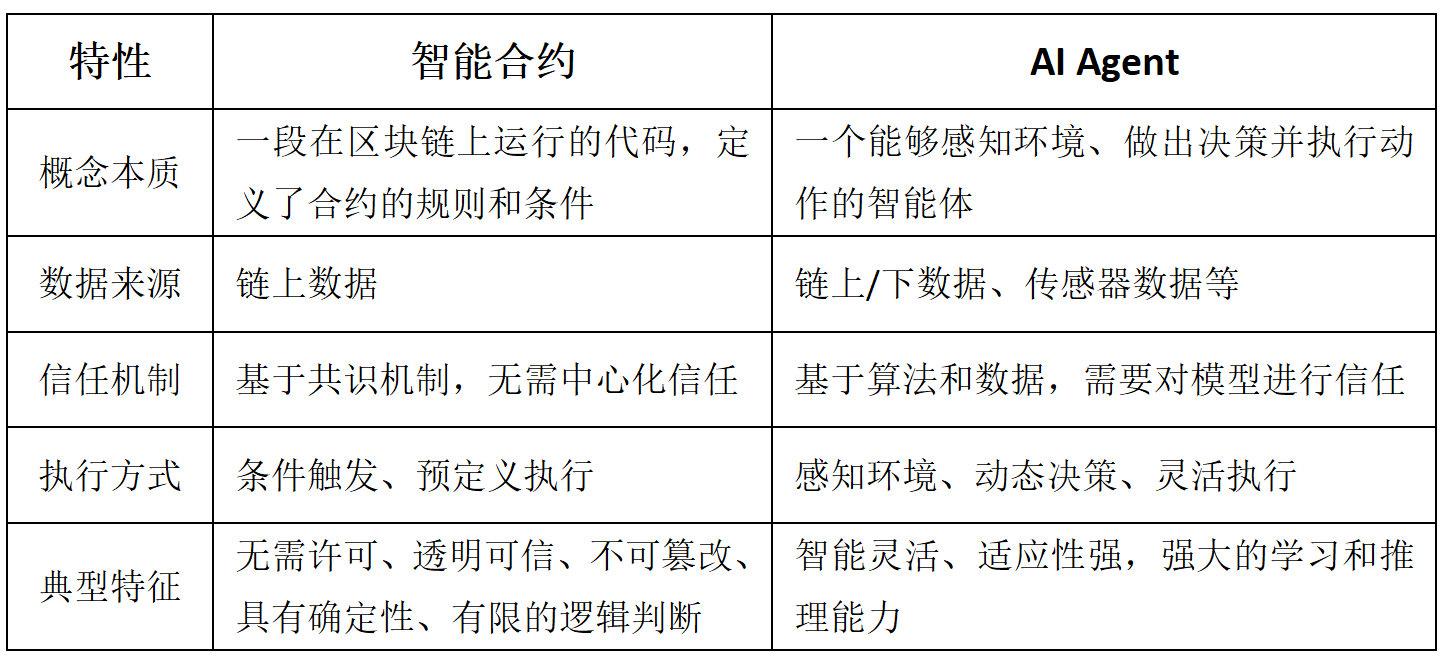
By combining AI Agents with smart contracts, the strengths of both can be fully leveraged:
-
Combining Determinism with Flexibility: Smart contracts provide a reliable execution environment, while AI Agents enable dynamic adjustments based on real-time data and environmental changes, allowing for more flexible applications.
-
Integrating Decision-Making with Automated Execution: AI Agents act as intelligent brains, analyzing complex problems and making decisions, then executing those decisions automatically via smart contracts, improving efficiency.
-
Merging On-chain and Off-chain Data: While smart contracts mainly handle on-chain data, AI Agents can utilize both on-chain and off-chain data (e.g., sensor inputs, social media, and market data) for more comprehensive analysis and decision-making.
-
Uniting Decentralization with Intelligence: Smart contracts ensure decentralization and transparency, while AI Agents introduce intelligence, helping realize visions of decentralized autonomous organizations (DAOs) and decentralized applications (DApps).
Through deep integration with smart contracts, AI Agents will play increasingly important roles in Web3, driving innovation and transformation.
5. AI Agent Ushers in a New Intelligent Era for Web3
As new infrastructure, AI Agent is leading Web3 into a new intelligent era. This is evident in infrastructure and application innovations across major public chains, spanning fields such as AI memecoins, systems and tools, AgentFi, AI Payment, gaming, and entertainment—more information can be found online.
Among various public chains, Arweave/AO align particularly well with AI development in terms of architecture and system resources. Their communities place strong emphasis on AI Agent development, collectively treating the deployment of AI Agent applications as a shared goal and guiding principle—making them worthy of close attention.
-
In System Architecture: AO adopts the Actor model, where each component operates as an independent agent capable of parallel computation—a design highly compatible with AI Agent-driven application architectures.
-
In System Resources: AI relies on models, algorithms, and computing power, demanding substantial resources. This aligns perfectly with AO’s resource characteristics. The Arweave+AO system, built on the SCP paradigm, offers scalable computing, data, and storage resources. It can allocate dedicated computing resources to each AI process, effectively eliminating performance bottlenecks, and provide trusted data sources for AI models to reduce bias during training.
-
In Key Technologies: Supported by three key technologies—WASM64, WeaveDrive, and the Llama.cpp large language model inference engine—AO can run multiple large language models (e.g., Llama 3 and GPT-2) directly within smart contracts, establishing a solid foundation for AI Agent application development and operation.
-
In Foundational Protocols: FusionFi Protocol (FFP) is a protocol specification and development toolkit designed to connect different agents, build information bridges, and standardize interactions between DApp agents. Through FFP, transactions, loans, futures, and other financial services can be seamlessly integrated, building a cross-application, cross-scenario decentralized financial ecosystem.
-
In Trusted Data: Dria enables AI models to access up-to-date, complete, and verified information, effectively reducing the bias and inaccuracies common in centralized data sources, thus providing high-quality data for AI Agent applications.
-
In Asset Innovation: @outprog, founder of EverVision, innovatively proposed the concept of "AgentFi Notes," aiming to reconstruct decentralized trust among entities. This concept empowers individuals to exercise sovereignty by issuing personal notes and managing assets, integrating multiple financial scenarios such as exchange, futures, collateralized lending, and stablecoins.
-
In Application Innovation: Permaswap, the leading DEX in the ecosystem, evolved into a super liquidity aggregator after launching FusionFi Protocol, integrating multiple financial forms. Botega, the ecosystem’s first autonomously agent-driven DEX, built an AMM system with independent processes capable of autonomously executing advanced order types such as trailing stops, dollar-cost averaging, and limit orders, and intelligently allocating liquidity to enhance trading efficiency.
As conditions mature, Arweave/AO may unlock the potential of data-driven intelligent businesses through their advantages in permanent storage of data and atomic data assets and ultra-parallel computing, meeting the needs of real-world on-chain and off-chain economic activities.
Although the Arweave/AO ecosystem is still in its early stages, its upstream and downstream components are developing cohesively, positioning it as an active builder of the intelligent Web3 era—with promising future prospects.
Conclusion
The development of Web3 is a continuous process of innovation and iteration. Core elements such as distributed ledgers, smart contracts, and tokens played pivotal roles in the early and developmental phases of Web3, driving innovation and maturity in areas such as encrypted digital currencies, public chains, and DeFi.
Today, AI Agent, as a new form of Web3 infrastructure, deeply integrates with other core elements and can operate across domains including Crypto, GameFi, Gaming, Social, and Metaverse, inevitably giving rise to entirely new applications and business models. From AI Memecoins to AgentFi, these innovative cases demonstrate that AI Agent has become the core driving force behind the intelligent upgrade of the Web3 ecosystem.
As public chain ecosystems continue to improve and AI technology advances steadily, AI Agents will play an increasingly significant role in Web3, ushering in a more intelligent, open, and inclusive digital era.
Join TechFlow official community to stay tuned
Telegram:https://t.me/TechFlowDaily
X (Twitter):https://x.com/TechFlowPost
X (Twitter) EN:https://x.com/BlockFlow_News