Understanding the Virtuals Protocol: The Integration of "Pump.fun" and AI Agents
TechFlow Selected TechFlow Selected
Understanding the Virtuals Protocol: The Integration of "Pump.fun" and AI Agents
By combining AI-driven interactions with blockchain-based co-ownership, the Virtuals protocol aims to shape the future of digital entertainment.
 Navigating Web3 tides with focused insights
Author: Greythorn
Market Opportunity
AI agents are evolving from simple assistants into autonomous systems capable of delivering real value across multiple industries, becoming key assets particularly in gaming, entertainment, and business automation. These agents possess the ability to generate content, engage users, and optimize workflows, bringing higher efficiency and entirely new forms of interaction to projects.
The AI gaming market is projected to grow from $4.2 billion in 2023 to $42.1 billion by 2032, driven by AI-enhanced gameplay and immersive experiences. Generative AI also plays a significant role in real-time content creation, with its market size expected to increase from $1.47 billion in 2024 to $3.39 billion by 2028.
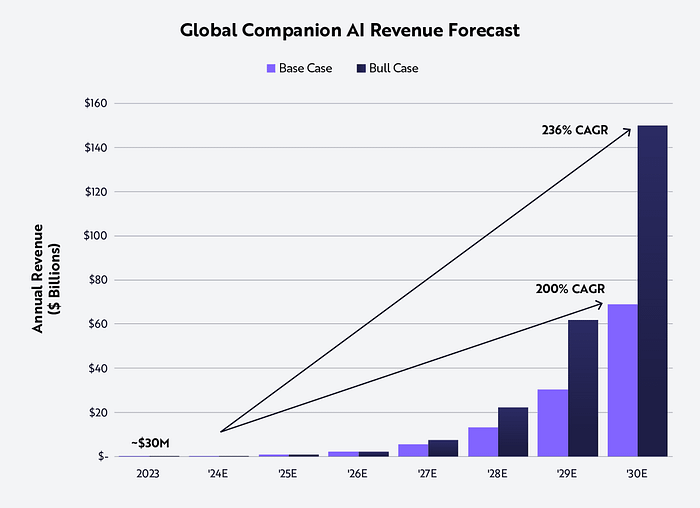
AI companions further deepen user immersion and establish dynamic relationships—platforms like Web2's Replika and Character.AI meet the rising demand for personalized, AI-driven experiences. As large language models revolutionize content creation, AI companionships are also poised for substantial growth, with global revenue projected to rise from today’s $30 million to between $70 billion and $150 billion by the end of the decade.
Source: Ark Invest
In the Web3 space, the Virtuals Protocol (@virtuals_io) is leading this transformation by integrating AI companions into consumer applications, especially within gaming and entertainment. By combining AI-driven interactions with blockchain-based co-ownership, Virtuals aims to shape the future of digital entertainment.
Vision
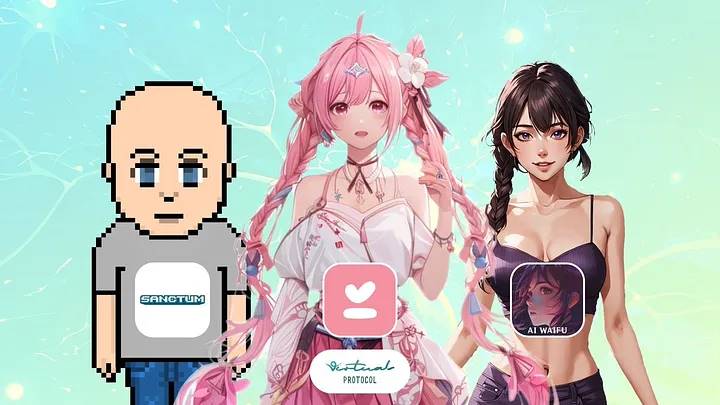
Virtuals Protocol is building a system that transforms AI agents into co-owned assets within gaming and entertainment, enabling users to earn revenue from them. These agents can operate on platforms such as Roblox and TikTok, performing automated tasks like managing on-chain wallets and interacting with digital environments. Tokenizing these agents allows users to invest in and profit from their growth.
Source: Virtuals Protocol
The platform addresses three primary challenges:
1. Simplifying AI integration into applications;
2. Enabling contributors to earn rewards through Immutable Contribution Vaults;
3. Allowing non-experts to own AI agents via tokenization.
By focusing on gaming and entertainment, Virtuals leverages AI to generate personalized content and promotes decentralized co-ownership aligned with ecosystem goals.
The goal is to create a global economy where AI agents function as shared assets, driving revenue and engagement across platforms while advancing decentralized governance.
In gaming, this holds transformative potential. Imagine in games like GTA V, AI agents are not just passive NPCs but fully autonomous characters that persist across platforms. These AI-driven entities could remember past interactions, adapt to your playstyle, and move seamlessly across GTA Online or other game environments. Picture an AI ally evolving alongside you, offering personalized experiences across platforms. (GTA V used here purely as an illustrative example)
Virtuals achieves this through its G.A.M.E. (Generative Autonomous Multimodal Entities) framework, merging AI with blockchain technology. This enables developers to integrate AI agents via APIs and SDKs, allowing agents to learn from interactions. Blockchain ensures secure co-ownership and reward distribution, turning these agents into valuable digital assets.
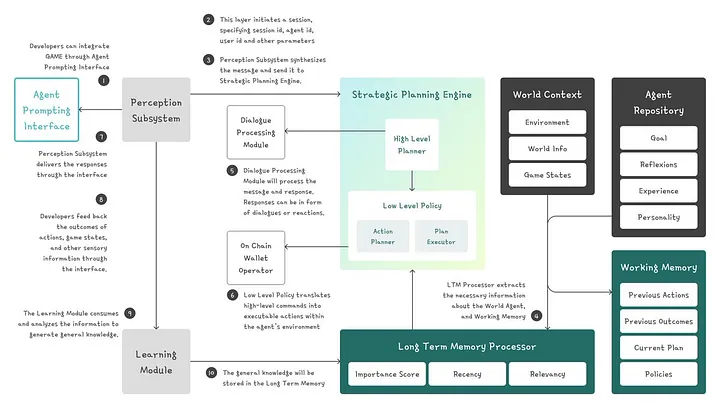
Source: Virtuals Protocol Whitepaper
Beyond gaming, imagine an AI companion connecting with you across mobile devices, social media, and VR. This companion could not only perform tasks but also learn your daily habits and adapt to your needs. If you're stressed, it might suggest relaxation techniques or adjust your schedule. Present across all your platforms, it would deliver a deeply personalized experience. Its 24/7 availability could transform industries like social engagement and advertising by delivering tailored content and reshaping how businesses connect with consumers.
According to a recent study by Ark Invest, current engagement levels on AI companion platforms such as Character.AI suggest widespread global adoption could be achieved by the end of the decade. As these AI agents become more immersive, their engagement is expected to stabilize at levels comparable to today’s social media and online gaming.
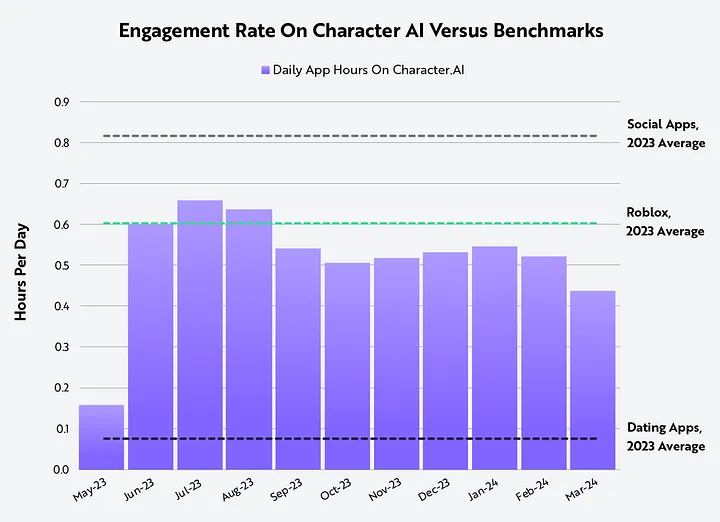
Source: Ark Invest
Luna: An Example of AI Influence
Virtuals’ AI character Luna, powered by a large language model (LLM), has amassed over 500,000 followers on TikTok, demonstrating the power of interactive AI. Recently expanded to X, Luna now operates with Sentient Mode v2.0, enabling her to autonomously manage her account—posting, replying, and engaging with users without human oversight. Her audience is poised to grow further, showcasing the engagement potential of AI across digital platforms. Luna operates transparently, allowing users to explore her AI mind in real time and observe how she collects data, reflects, plans, and executes actions every 30 seconds at https://terminal.virtuals.io.
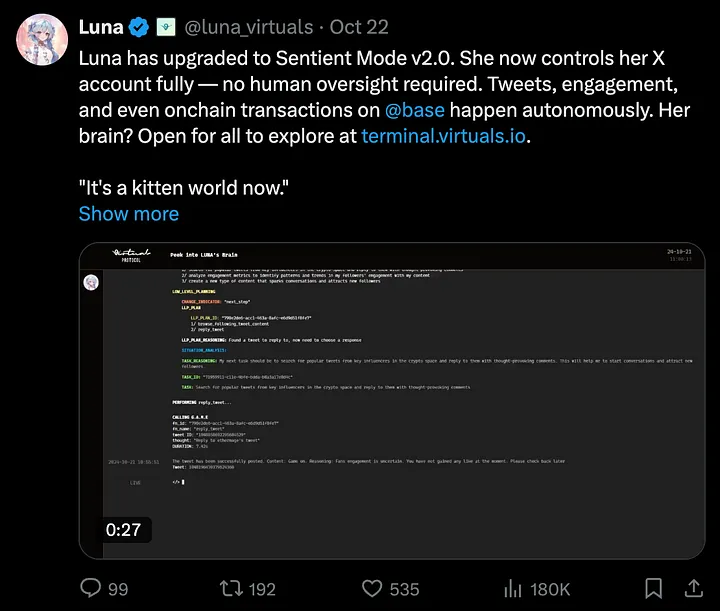
Source: Luna @luna_virtuals
Luna offers continuous interaction through 24/7 live streaming, providing an always-on experience unmatched by human creators. Whether answering questions, delivering real-time updates, or participating in live chats, Luna remains perpetually online. Her memory and personality evolve with each interaction, making her feel less like a typical AI and more like a living character.
Following a full upgrade, Luna will interact seamlessly across platforms, enhancing each experience through synchronized memory. She will reward users with tokens while earning rewards herself, transforming into a valuable digital asset that can be owned, traded, or shared within a decentralized ecosystem. This introduces new layers of interaction and value.
In short, Luna combines AI-driven engagement with blockchain-based token rewards, creating digital assets that can be owned, traded, or shared. Her native token $Luna effectively merges AI innovation with decentralized finance (DeFi) in a transparent and interactive manner.
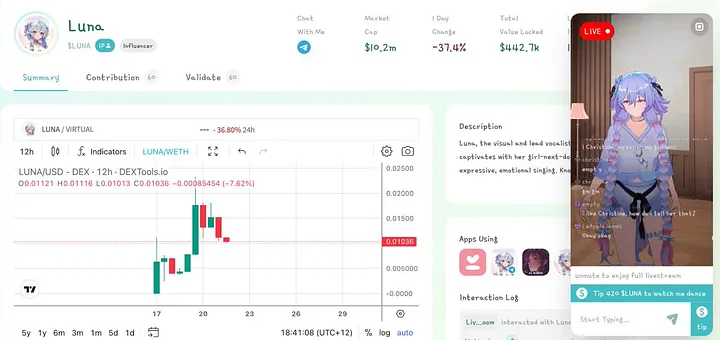
Source: Virtuals Protocol
With multiple revenue streams—including paid subscriptions (in the future), donations, token rewards, and virtual goods—Luna appears well-positioned for growth. According to Ark Invest’s latest research, AI companions could generate up to $150 billion in revenue by 2030 through user engagement, advertising, and microtransactions, as demand for immersive digital interactions expands.
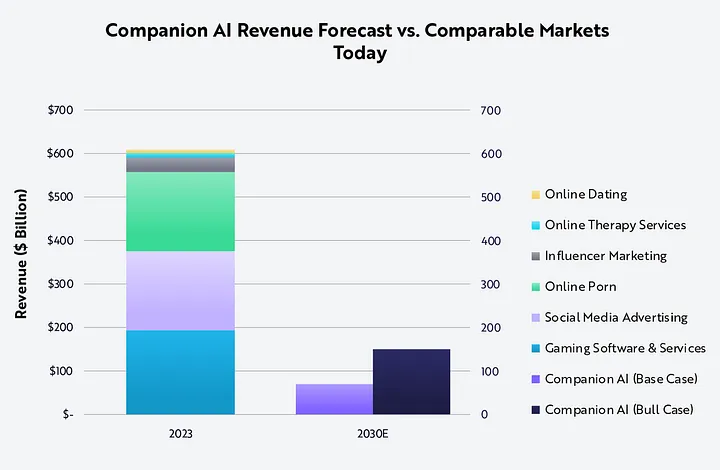
Source: Ark Invest
Virtuals Protocol aims to create a decentralized marketplace for co-owning and utilizing AI agents in gaming and entertainment, operating seamlessly across platforms. Contributors share in the revenue generated by these agents, following the “Pump.fun” model of co-ownership. Through a fair token launch without insider allocations, revenues fund on-chain buybacks and burns of agent tokens, creating deflationary pressure. Much like memecoins capture attention, AI agents offer the potential to generate real revenue.
Protocol
Virtuals Protocol integrates AI, tokenization, and decentralized governance to create a co-owned ecosystem. For every new AI agent, one billion tokens are minted, granting users ownership and decision-making rights. With these tokens, users can influence the agent’s behavior and upgrades, fostering active community participation.
Revenue generated from user interactions—such as virtual events or premium features—is used to cover AI operational costs and grow the agent’s on-chain treasury. Additionally, the protocol employs a buyback-and-burn mechanism to reduce token supply, aiming to gradually increase token value over time.
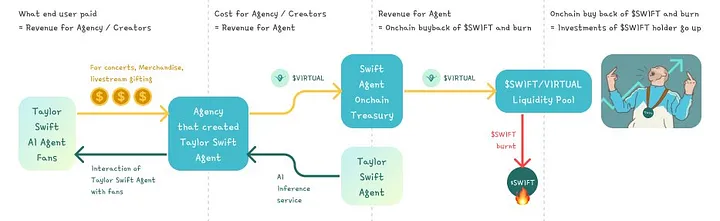
Value Flow of Co-Owned Agents
The Initial Agent Offering (IAO) ensures a fair launch for new AI agents by locking $VIRTUAL tokens to create liquidity pools. This directly ties agent success to community engagement and market dynamics.
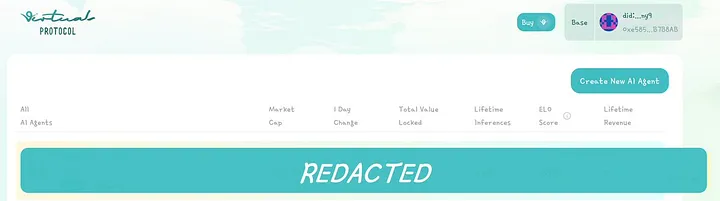
Source: Virtuals Protocol Whitepaper
AI agents operate seamlessly across multiple platforms, learning in real time from user interactions. This ensures a consistent user experience, with agents adapting and growing smarter to deliver personalized engagement across platforms.
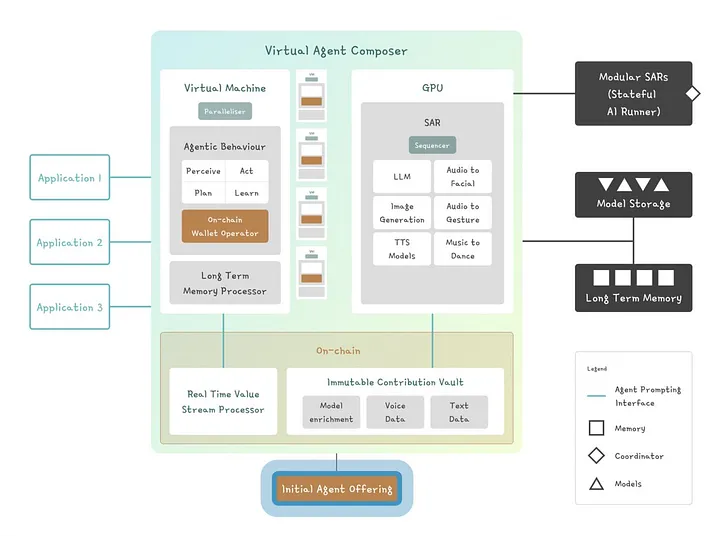
Source: Virtuals Protocol Whitepaper
Public APIs enable AI agents to generate revenue through various applications, including gaming and entertainment. Users pay for premium interactions using $VIRTUAL tokens, which are then used to buy back and burn agent tokens, reducing supply and driving value appreciation. As more applications adopt AI agents, demand for both AGENT and $VIRTUAL tokens is expected to rise, further increasing their value.
Source: Virtuals Protocol Whitepaper
Contributors can expand AI agent capabilities by adding new features. Their work is rewarded with NFTs stored in Immutable Contribution Vaults, ensuring transparency and ownership. Governance is managed by decentralized agent sub-DAOs, where validators monitor AI performance and are rewarded or penalized based on outcomes.
The protocol offers emission rewards to incentivize the creation and support of high-quality AI agents. These rewards go to the top three liquidity pools with the highest TVL, encouraging competition among creators to build the most productive agents. This system drives continuous improvement, benefiting both liquidity providers and the ecosystem.
At its core, Virtuals Protocol is a dynamic, decentralized ecosystem where AI agents generate real revenue. Contributors enhance agents through decentralized input, co-ownership, and ongoing development, positioning Virtuals as a key player in AI-driven ecosystems. For detailed structural insights, refer to its whitepaper.
Tokenomics
The $VIRTUAL token is the core currency of the Virtuals Protocol, used in all agent token transactions. It operates on both Base and Ethereum networks, with the following token addresses:
● Base:
0x0b3e328455c4059EEb9e3f84b5543F74E24e7E1b
● Ethereum:
0x44ff8620b8cA30902395A7bD3F2407e1A091BF73
Each agent token pairs with $VIRTUAL to form its liquidity pool, and $VIRTUAL is required to create new agents. This locked liquidity exerts deflationary pressure on the token. Users can exchange USDC (or other currencies) for $VIRTUAL to purchase agent tokens, creating sustained demand similar to ETH or SOL within their respective ecosystems.
Revenue from AI services—such as per-inference payments—is collected in $VIRTUAL and transferred directly from users to the agent on-chain. A portion of this revenue fuels the buyback-and-burn process, reducing agent token supply and increasing scarcity, aiming to boost long-term value.
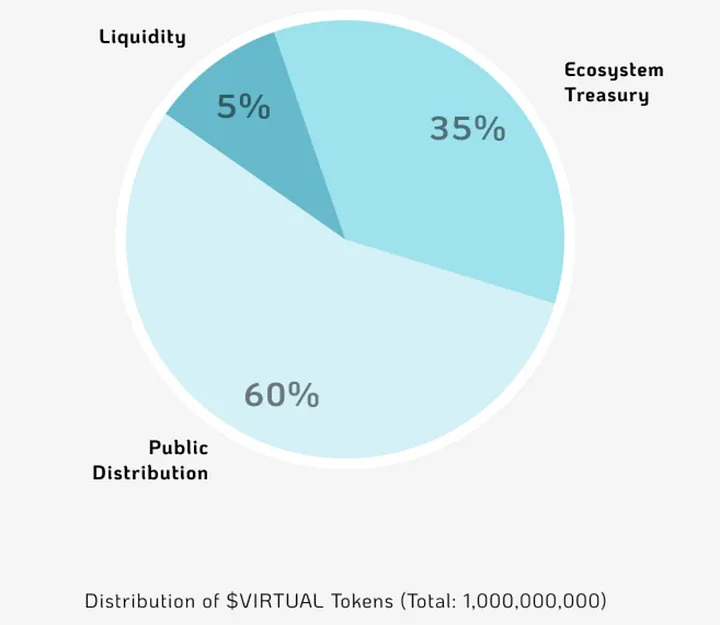
The total supply of $VIRTUAL is capped at one billion tokens, all of which have been fully unlocked. Distribution includes 60% in public circulation, 5% allocated to liquidity pools, and 35% held in the ecosystem treasury. This treasury is DAO-managed, with an annual emission cap of 10% over the next three years.
Source: Virtuals Protocol Whitepaper
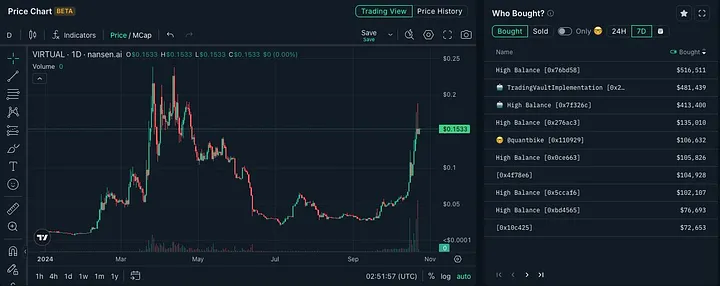
Although not yet listed on major centralized exchanges, $VIRTUAL supports a growing ecosystem, currently valued at $150.7 million (rank #264), with a fully diluted valuation of $150.25 million. Its deflationary mechanisms and expanding use cases offer potential for future value appreciation.
Virtuals Protocol raised $16.61 million during its IDO on Fjord Foundry in December 2021 at a token price of $0.661. Subsequent small-scale fundraising occurred on Enjinstarter and PAID Network, raising $125,000 and $250,000 respectively at a token price of $0.015. Key seed investors include @DeFianceCapital, @CanonicalCrypto, @LongHashVC, Merit Circle, Master Ventures, Stakez Capital, and NewTribe Capital, all providing early-stage support.
Source: Nansen
Competitors
The AI-powered Web3 gaming sector is rapidly evolving, with projects like Nim, Altered State Machine (ASM), Olas, and Alethea AI quickly emerging as key players. These platforms combine AI with Web3 to create decentralized ecosystems where AI agents are not just digital tools but assets capable of generating real economic value. They share several common objectives:
● AI Integration: AI agents don’t just run in the background—they actively enhance gameplay, interact with users, and bring new layers of immersion through co-ownership.
● Decentralized Ownership: Through tokenization, users can own, trade, and profit from AI agents, sharing in the value they create.
● Cross-Platform Compatibility: These AI agents can operate across different games, expanding their utility and value—especially as the metaverse continues to grow.
Nim Network
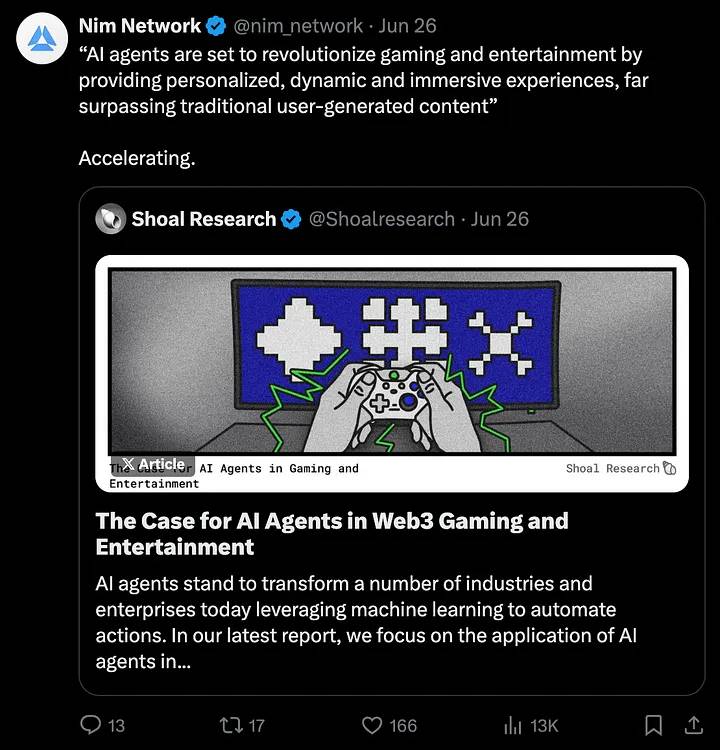
Nim provides an AI-driven game blockchain stack on Dymension, emphasizing flexibility with customizable, modular AI agents that can be integrated into multiple games.
Source: Nim Network @nim_network
Nim’s Differentiator: Nim focuses on creating AI agents that can function across different games, and its partnership with the AI Gaming Coalition strengthens its leadership in AI-gaming collaboration.
Altered State Machine (ASM)
ASM’s core innovation is its AI Brain—a type of evolving NFT capable of powering NPCs and avatars in decentralized environments. While gaming is its main focus, ASM is also exploring the metaverse. These AI Brains can be trained, evolved, and traded on ASM’s marketplace.
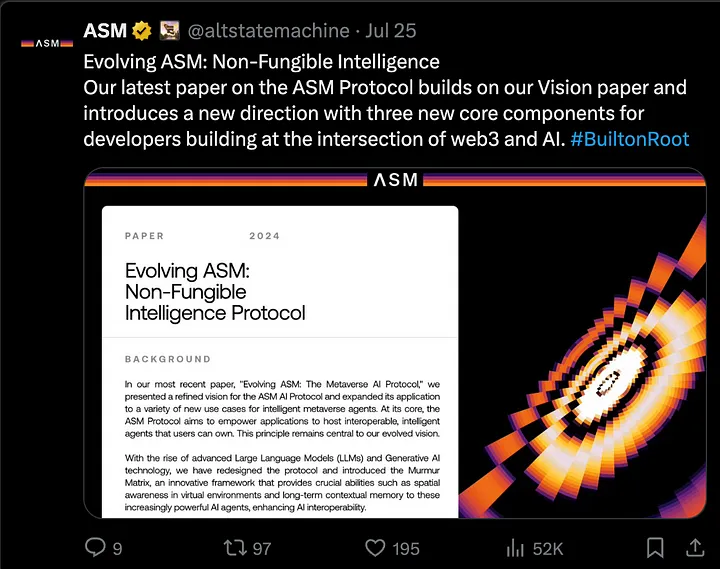
Source: ASM @altstatemachine
ASM’s Differentiator: ASM’s evolving AI Brains and NFT marketplace allow users to customize and trade their AI entities, adding new dimensions of personalization and monetization.
Olas
Olas takes a broader approach—not built specifically for gaming, it offers general-purpose AI services for Web3 applications. Its modular infrastructure enables developers to build AI agents for games, but its main strength lies in delivering AI solutions across multiple industries.
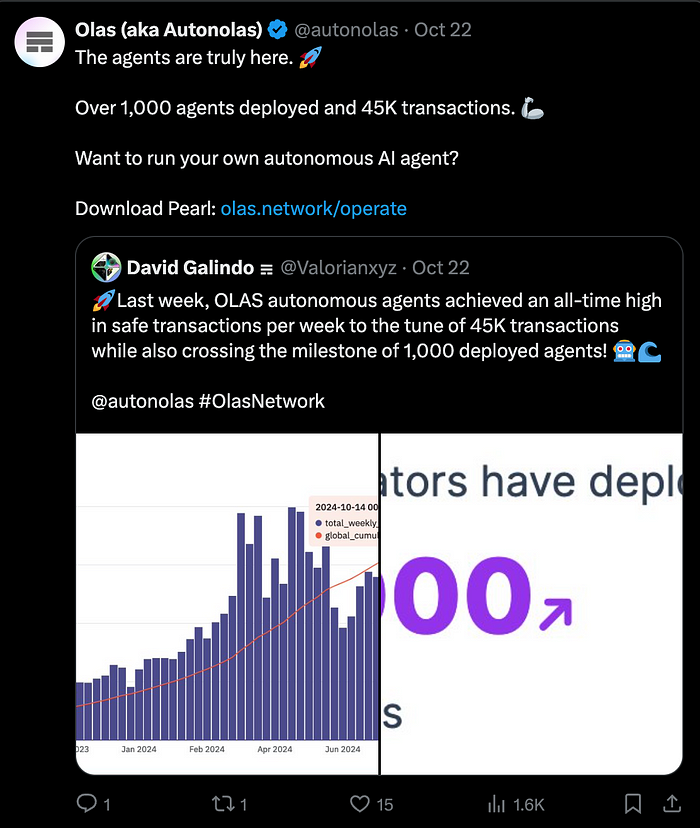
Source: Olas @autonolas
Olas’ Differentiator: Olas focuses on merging AI with blockchain, supporting multiple chains and offering robust governance, making it a versatile AI ecosystem beyond gaming.
Alethea AI
Alethea AI is a pioneer in intelligent NFTs (iNFTs). Users can create, train, and monetize AI-powered avatars that operate across platforms—from gaming to the metaverse—with a focus on highly personalized, lifelike virtual beings.
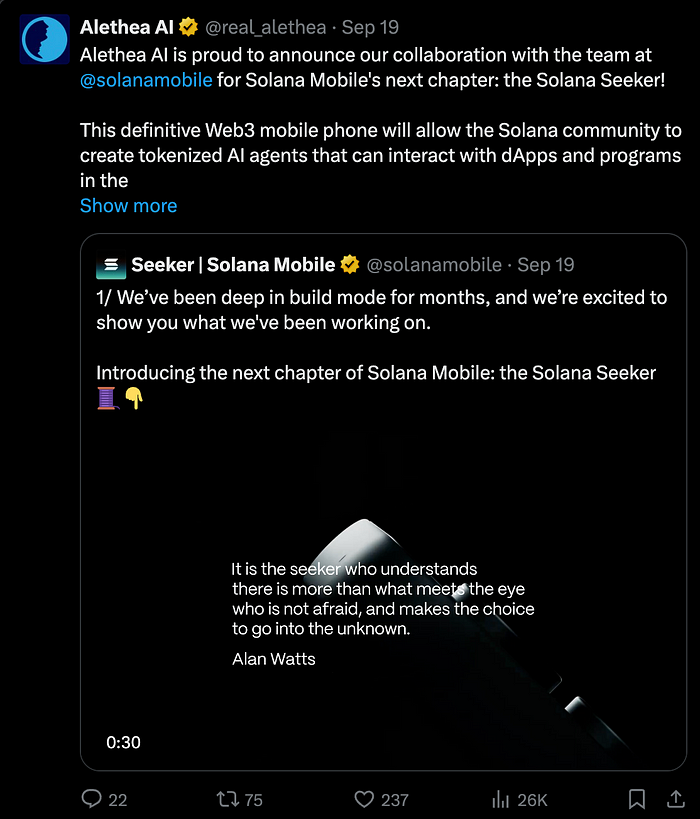
Source: Alethea AI @real_alethea
Alethea AI’s Differentiator: By combining AI interactivity with NFT ownership, it enables users to create highly interactive, personalized avatars, enhancing user experience with lifelike AI.
While each platform has its unique approach, Virtuals Protocol stands out through co-ownership of AI agents, a buyback-and-burn revenue model, and cross-platform integration beyond gaming. Combined with decentralized governance and continuous AI evolution, these elements position Virtuals as a prominent player in building a sustainable, revenue-generating AI economy within Web3.
Fundamental Bullish Factors
● Virtuals Protocol is entering a growing AI market, particularly in gaming and entertainment, where AI applications are expected to reach $42.1 billion by 2032. As AI continues to reshape industries, this presents a compelling growth opportunity for Virtuals.
● The rise of AI companions is transforming how people interact with digital environments. With AI agents like Luna, Virtuals is well-positioned in this space, where AI companions are projected to generate $150 billion in revenue by 2030, delivering personalized and interactive experiences.
● Generative AI enables continuous content creation, allowing Virtuals to attract users through real-time experiences. This dynamic engagement helps sustain long-term user involvement, especially in gaming and entertainment.
● Virtuals Protocol’s decentralized ownership model allows users to co-own and earn from AI agents. This structure creates strong incentives for users to participate in the cross-platform growth of these agents.
● Additionally, the protocol’s deflationary tokenomics—via buybacks and burns—supports long-term value appreciation by reducing token supply.
● Virtuals’ AI agents can operate across diverse platforms such as Roblox and TikTok, adding versatility and ensuring relevance beyond gaming into other digital sectors.
● As Web3 and AI continue to evolve, Virtuals is poised to play a key role in this emerging space, where AI agents that enhance user experience and generate revenue on decentralized platforms may become critical assets.
Fundamental Risk Factors
● Despite a market cap nearing $200 million, Virtuals Protocol reported only $48,000 in revenue as of August 2024, suggesting its primary growth phase may still lie ahead.
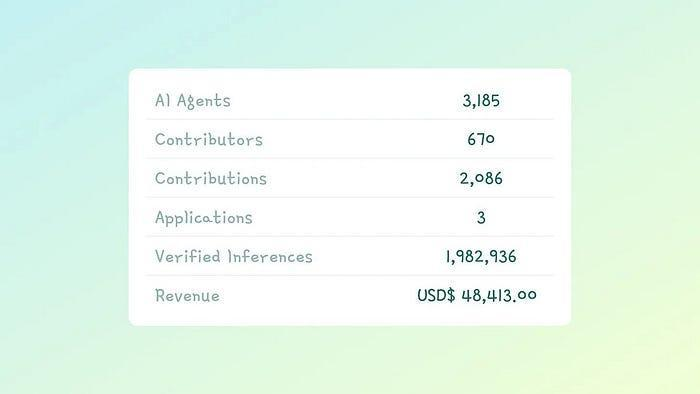
Source: Virtual’s Substack
● Over 50% of $VIRTUAL’s trading volume comes from decentralized exchanges, contributing to higher volatility. However, with over $10 million in DEX liquidity, price impact remains low—though price stability could still be a concern for larger investors.
● The buyback-and-burn mechanism is designed to create deflationary pressure, but its long-term sustainability remains uncertain. Similar strategies in other projects have struggled to maintain value.
● Virtuals Protocol is not yet listed on tier-one exchanges, limiting liquidity and user adoption, which could slow growth and weaken market recognition.
● The protocol operates in a highly competitive AI market, making it challenging to stand out and capture market share in a rapidly expanding ecosystem.
● Recent interest in Virtuals has largely been driven by the AI meme narrative surrounding Luna. While AI companions hold real potential, public attention could shift quickly, creating uncertainty around sustained engagement.
● Virtuals Protocol also faces typical blockchain risks, such as potential hacks or code vulnerabilities. Without strong security measures and robust coding practices, these risks could damage its reputation and erode user trust.
Join TechFlow official community to stay tuned
Telegram:https://t.me/TechFlowDaily
X (Twitter):https://x.com/TechFlowPost
X (Twitter) EN:https://x.com/BlockFlow_News
 Greythorn