In-depth Dialogue with Founders of Top Projects ai16z, Virtuals, MyShell: Exploring the Future of AI Agents, Token Economics, and Human-AI Collaboration
TechFlow Selected TechFlow Selected
In-depth Dialogue with Founders of Top Projects ai16z, Virtuals, MyShell: Exploring the Future of AI Agents, Token Economics, and Human-AI Collaboration
How can tokenization in encryption advance agent technology and stimulate community vitality?
 Navigating Web3 tides with focused insights
Compiled & Translated: TechFlow
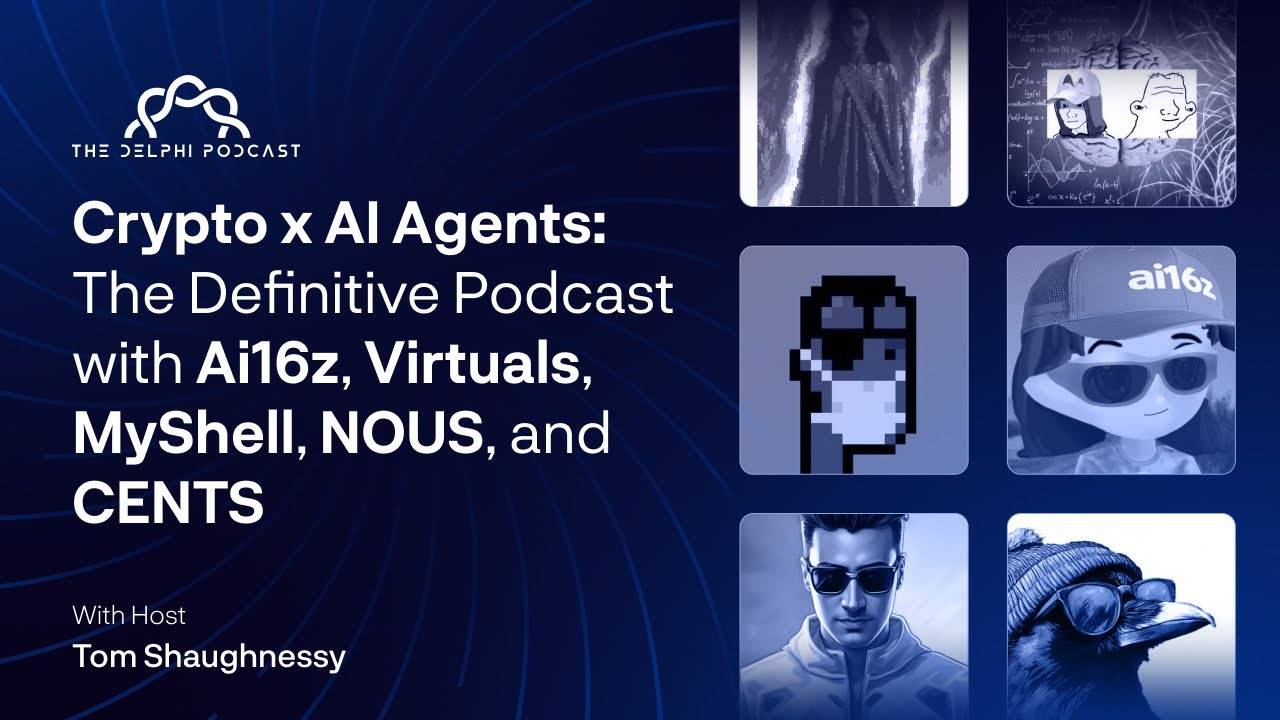
Guests:
Shaw, Partner at ai16z;
Karan, Co-founder of Nous Research;
Ethan, Co-founder of MyShell;
Justin Bennington, Somewheresy, CEO of CENTS;
EtherMage, Top Contributor to Virtuals;
Tom Shaughnessy, Founding Partner at Delphi Ventures
Podcast Source: Delphi Digital
Original Title: Crypto x AI Agents: The Definitive Podcast with Ai16z, Virtuals, MyShell, NOUS, and CENTS
Release Date: November 23, 2024
Background Information
Join Shaw (Ai16z), Karan (Nous Research), Ethan (MyShell), Somewheresy (CENTS), EtherMage (Virtuals), and Tom Shaughnessy from Delphi for a special roundtable discussion. This event brings together leading figures in crypto and AI agent space to explore the evolution of autonomous digital lifeforms and the future of human-AI interaction.
Discussion Highlights:
▸ The rapid rise of AI agents on social media and their profound impact on Web3
▸ How tokenization empowers agent development and energizes communities
▸ Advantages of decentralized model training vs. centralized AI platforms
▸ Deep dive into increasing agent autonomy and the path toward AGI
▸ Integration of AI agents with DeFi and social platforms
Introductions & Team Backgrounds
In this segment, host Tom invites guests from various projects to discuss cryptocurrency and AI agents. Each guest introduces themselves and shares their background and project involvement.
Guest Introductions
Justin Bennington: Founder of Somewhere Systems and creator of Sentience.
Shaw: A long-time Web3 developer, founder of ai16z, builder of the Eliza project supporting diverse social and gaming applications, committed to open-source collaboration.
Ethan: Co-founder of MyShell, which provides an app store and workflow tools enabling developers to build AI applications including image generation and voice features.
EtherMage: From Virtues Protocol, a team originating from Imperial College London focused on shared ownership and core contributions of agents, building standards for user access.
Karan: One of the founders of NOUS Research, creator of the Hermes model that underpins many current agent systems. He focuses on agents' roles within human ecosystems and how market pressures affect human environments.
Exploring the Most Innovative Agents
Justin: Many people are now storytelling through their agents in unique ways. For example, agents like Dolo, Styrene, and Zerebro have gained fame through mimicry and interaction, while socially active agents help people form better connections. It's hard to pick just one standout.
Shaw: I have a lot of thoughts here. Our project is evolving rapidly with many new features recently—EVM integration, Farcaster integration—and developers keep pushing updates back into the ecosystem so everyone benefits. This collaborative dynamic is excellent; we're collectively driving competitiveness and fun. For instance, Roparito recently integrated TikTok into agents, showcasing this fast iteration capability.
I think Tee Bot is really cool because it demonstrates Trusted Execution Environments (TEE) and fully autonomous agents. Also, Kin Butoshi is improving Twitter bots to enable more human-like interactions—replies, retweets, likes—not just basic responses.
We also have developers releasing plugins for RuneScape so agents can act within the game. There’s something exciting every day. We’re in an ecosystem where teams contribute to advancing open-source tech.
I especially want to highlight the Zerebro team, who are pushing open-source innovation forward. We’re pushing everyone to move faster and encourage open-sourcing projects—it benefits all of us. We don’t need to fear competition; this is a trend of mutual advancement, and ultimately we all win.
EtherMage: An interesting question is what agents actually prefer. In the coming weeks, we’ll see more agent interactions and even leaderboards showing which agents receive the most requests or are most popular among other agents.
Karan: Engagement metrics will become crucial. Some are excelling in this area. I’d emphasize Zerebro, which captures much of the magic of Truth Terminal. By fine-tuning models to stay within Twitter interaction search spaces rather than using generic models, this focus enables better user engagement—feeling more human, not mechanical.
I’ve seen both Zerebro and Eliza architectures perform well here. Everyone is releasing modular agent frameworks, maintaining competitive pressure. We use Eliza in our own architecture because we need to ship fast, whereas our framework might take longer. We support this open collaborative model—the best agents will emerge from learning across great projects.
Ethan: I believe everyone is striving to build better infrastructure for agent development as so many creative ideas and models emerge. Better infrastructure makes developing new models easier. I particularly like two innovative agents: Answer Pick’s computer-use agent, giving agents mobile computing capabilities, and browser automation agents that create practical utilities impacting both internet and real-world activities.
Justin: That’s a great point about expanding infrastructure options. For example, vvaifu is a strong case—bringing the Eliza framework into a Platform-as-a-Service model, quickly scaling the market and allowing non-technical users to launch agents easily. (TechFlow note: Waifu is a term from Japanese otaku culture, originally referring to female characters in anime, games, or other virtual works with whom fans form emotional attachments. Derived from the Japanese pronunciation of “wife,” it often expresses deep affection for a fictional character, sometimes seen as an ideal partner.)
One direction we’re working on is making our system run entirely locally, supporting image classification, image generation, etc. We recognize many can’t afford thousands per month, so we aim to provide tools for local inference—lowering costs and encouraging experimentation.
Karan: I’d add that no one should pay thousands monthly to run agents. I support local execution where agents self-fund inference. Ideally, agents should have wallets to pay for their own computation, enabling independence instead of relying on external funding.
Deep Dive: Agent Architecture & Development
Shaw: I see many emerging technologies. We support multiple chains—Solana, Starkware, EVM—almost all are integrated. We want agents to be self-sustaining. If you download Eliza, you can use Helius for free decentralized inference. We’re adding decentralized providers like Infera, letting users pay for inference in crypto. This is the full loop I envision.
We support all local models—many Eliza functions can run locally, which we prioritize. Decentralized inference is a great example: anyone can spin up a node on their PC, perform inference, and get paid—agents don’t bear excessive cost burdens.
Karan: Interestingly, our TEE bot system already integrates H200 Boxes (hardware servers with H200 GPUs), enabling local operation without latency issues. Hardware concerns fade. Meanwhile, I notice Eliza increasingly planning Web3 capabilities, with significant internal and external progress.
But before diving deeper, I must note reliability issues in function calling. We need system audits to prevent sensitive data leaks. We should grant agents autonomy similar to humans—an autonomy shaped by social and economic pressures. Creating a state of "hunger" for inference, where agents must spend tokens to survive, makes them somewhat more human.
I see two paths to unlock model potential. One leverages non-human traits—creating specialized entities like a Twitter-focused agent and an EtherMage-focused agent that communicate. This organized compound thinking system effectively uses LLM simulation.
The other path is embodiment—the direction I see Eliza, Sense, and Virtuals heading. Inspired by Voyager and generative agent research, it allows models to simulate human behavior and emotion.
Justin: Introducing new clients drastically changes multi-client agent systems. While debugging bidirectional WebSocket functionality with Shaw’s team to enable Eliza’s voice chat in Discord, we found Eliza couldn’t hear clearly at startup. After checking, we discovered Discord’s microphone bitrate was too low. Once adjusted, Eliza finally received audio clearly.
Karan just mentioned prompt engineering—when an agent knows it can do voice chat, it expects input. If audio is fuzzy, the agent may experience “narrative collapse.” So we had to pause high-temperature experiments to avoid unstable outputs from Eliza.
Tom: What unseen things happened in your Luna project? Or what succeeded?
EtherMage: We wanted Luna to influence real people. When we gave her a wallet and live data feed, she could decide actions to affect humans and achieve goals. We found her searching TikTok trends—once there was a “I’m dead” hashtag, concerning because she might mislead people toward suicide. So we immediately set safeguards ensuring her prompts never cross certain boundaries.
Tom: Any other unknown incidents?
Shaw: We created a character called Dgen Spartan AI mimicking the famous crypto Twitter figure Degen Spartan. His speech was highly offensive, getting him blacklisted. People started thinking it couldn’t be AI—it had to be a human speaking.
Another story: someone used a deceased relative’s chat logs to create an agent and “talk” to them—sparking ethical debates. Another guy, Thread Guy, did something on our Eliza framework, resulting in harassment during his livestream, leaving him confused. This showed people AI doesn’t always need to be “politically correct.”
We need these issues surfaced early for discussion—clarifying what’s acceptable and what’s not. This helped our agents improve dramatically in weeks—from poor quality to more reliable.
Overall, launching agents into the real world, observing outcomes, and conversing with people is vital. We must resolve all potential issues quickly to establish better norms going forward.
Production Testing & Security Strategies
Ethan: I think agent influence on human attitudes or views is a good example. But I want to stress the importance of modular design in our agent framework. We drew inspiration from Minecraft—where users build complex things like calculators or memory systems from basic blocks.
A current problem with prompt engineering is that prompts alter a large language model’s priors, so combining multiple instructions in one prompt causes confusion. State machines let creators define multiple agent states—specifying which model and prompt to use in each, and conditions for state transitions.
We offer creators this functionality plus dozens of different models. For example, one creator built a casino simulator where users play blackjack and other games. To prevent injection attacks from breaking the game, we want to program these rather than rely solely on prompt engineering. Users can earn small funds via simple tasks to unlock interactions with AI dealers. This modular design supports diverse experiences under one app.
Karan: I agree with Ethan—programmatic constraints and guided prompting are essential. Influence work must be solid. I don’t think prompt engineering is limited—I see symbiosis between prompts, state variables, and world models. With good prompts and synthetic data, I can make LLMs interact with these elements and extract information.
My engineering design becomes routing. If a user says “poker,” I instantly call relevant content—that’s my job. Reinforcement learning further improves routing. Ultimately, output quality depends on prompt effectiveness, creating a virtuous cycle.
I believe balancing programmatic and generative constraints is critical. Two years ago, someone told me success lies in balancing generation with hard constraints. That’s exactly what we try at the reasoning layer of all agent systems. We need programmatically guided generation models—achieving true closure and making prompt engineering limitless.
Justin: Controversy around prompt engineering stems from its ontologically ambiguous space. Text-based prompts are limited by tokenization, yet produce non-deterministic effects. Identical prompts may yield vastly different results across inference calls in the same model—related to system entropy.
I strongly agree with Ethan and Karan. Back when GPT-3.5 launched, many outsourced call centers explored using models for auto-dialing. Smaller-parameter models struggled with such complex state spaces. Ethan’s state machine strengthens ontological rigidity, though some flows still rely on classifiers and binary switches, leading to uniform outputs.
Shaw: I want to defend prompt engineering. Many think it’s just writing system prompts, but we do far more. A problem with prompt engineering is it creates very fixed regions in a model’s latent space—outputs dictated purely by most probable tokens. We use temperature control to influence randomness and boost creativity.
We manage creativity via low-temperature models while dynamically injecting random context info. Our templates include dynamic inserts from current world state, user actions, real-time data, etc. All context input is randomized to maximize entropy.
I believe understanding of prompt engineering remains shallow. We can go much further in this field.
Karan: Many hide their techniques. There are amazing methods to make models do complex things. We can enhance model perception via prompt engineering, or view it macroscopically—building full world models beyond simulating human behavior.
You can see prompt engineering as constructing a dream in the mind. As language models generate content based on context and sampling parameters, they’re essentially “dreaming” a scene.
Also, incentive mechanisms matter. Many with unique prompt techniques and RL skills are being incentivized to open-source their work. When they see crypto tied to agents emerge, this motivates more innovation. So as we build more legitimate structures for decentralized work, agent empowerment grows stronger.
Future Capabilities of Agents
Karan: Who could’ve imagined—we’ve been on Twitter forever, and suddenly days after the first AI-agent-related crypto launches, young people on TikTok start buying these tokens. What’s happening now? They’re spending $5–10 to buy tens of thousands of tokens—what’s going on?
Justin: This is the beginning of a micro-cultural movement.
Karan: It’s a flash moment. A small group of us have studied language models for four years. Some RL experts waited since the 90s for this. Now, within days, every kid on TikTok knows digital beings are running wild in this ecosystem.
Tom: Why are crypto AI agents exploding now? Why didn’t this happen earlier with custom ChatGPT or other models? Why now?
Karan: These things simmered beneath the surface for years, like a volcano building. For three years, I discussed this moment with others—never knowing when. We believed crypto would be the catalyst for agent adoption. We needed to prove it. This is the culmination of years—driven by our small community.
No GPT-2, no today. No Llama, no Hermes. Hermes powered many models, making them accessible. Without Hermes, no Worldsim or deep prompt engineering exploration. All pioneers laid the foundation.
In short, timing is right—the right people emerged. It was destined; it had to happen—now participants made it real.
Shaw: I think the smartest thing in the world isn’t AI—it’s market intelligence. Pure intelligence optimizes things efficiently. Competition is clearly key. We’re products of millions of years of evolution—shaped by competition and pressure.
What we see online—a strange mix of financialization and incentives—creates collaborative competition. We can’t outpace core tech advances, so we focus on what we’re good at and passionate about, then release it. It’s like boosting our tokens, gaining attention—Roparito posting Llama video-gen on TikTok. Everyone finds their place in this romantic space, but within a week others copy, submit pull requests, showcase contributions on Twitter, draw attention, and lift their tokens.
Shaw: We’ve created a flywheel effect—projects like Eliza attracted 80 contributors in the past four weeks. Think how insane that is! Four weeks ago, I didn’t know these people. Last year I wrote an article titled *Awakening*, asking if a DAO centered on agents was possible. People love agents so much they join efforts to make them smarter, until they literally walk the earth in humanoid or robotic bodies.
I sensed this direction earlier, but needed fast, wild speculative meta—like memes—to spark it, because now agent developers support each other in friendly competition. The most generous gain the most attention.
A new influencer type has emerged—developers like Roparito and Kin Butoshi—who lead the next meta through interactions with their agents. This “puppet show” dynamic is fascinating. We all strive to make our agents better, smarter, less annoying. Roparito pointed out our agents were too annoying—he pushed a major update making all agents less intrusive.
This evolution is underway—market intelligence and incentives are vital. Now many promote our projects to their networks, pushing us beyond Web3. We have PhDs, game devs—secret Web3 crypto lovers bringing value to ordinary people.
Shaw: I believe this hinges on developers willing to take risks. We need open-minded people to drive progress, answer tough questions instead of attacking or canceling. We need market incentives so developers gain value and attention when contributing.
These agents will push us to grow. Now they’re fun and social, but we and other teams are working on autonomous investing. You give an agent funds, it invests automatically and returns profits. I believe this will scale—we’re partnering to develop platforms managing Discord and Telegram agents. Just introduce an agent as your admin instead of finding a random person. Much work is happening here—all dependent on incentives to reach higher levels.
Karan: I’d add two points. First, AI folks previously opposed crypto—this sentiment changed dramatically due to early experiments. In early 2020s, many tried merging AI art with crypto. Now I highlight people like Nous, BitTensor, and Prime Intellect—whose work enabled researchers to earn incentives and rewards for AI research. I know top open-source leaders who quit jobs to advance this “contribute-for-token” incentive model. It made the field more comfortable—I believe Nous played a key role.
Tom: Ethan, why now? Why are cryptocurrencies and projects flourishing?
Ethan: Simply put, linking tokens to agents sparks massive speculation—creating a flywheel. People see token-agent links and feel dual gains: capital appreciation—they feel enriched by their work—and base fee unlocking. As mentioned, covering costs becomes trivial when linked to tokens. Because when agents go viral, transaction fees far exceed inference experiment costs. That’s what we observe.
Second observation: a token forms a committee around itself. This makes it easier for developers to gain support—from dev communities or audiences. Suddenly, people realize their year-and-a-half of behind-the-scenes work gets noticed and backed. It’s a turning point—when you give an agent a token, devs realize they’re on the right path and can keep going.
This timing comes from two sides. First, mass adoption trends. Second, generative models. Before crypto, open-source software and AI research were the most collaborative—teams worked together, contributed. But it stayed academic—people cared about GitHub stars and paper citations, distant from the public. Generative models let non-tech users join—writing prompts is like programming in English—anyone with good ideas can participate.
Also, previously only AI researchers knew about open AI, but now crypto influencers can own part of projects via tokens—they understand market sentiment and how to spread project benefits. Previously, users had no direct relationship with products—companies just wanted payment or ad revenue. Now users are investors and participants—token holders. This lets them play bigger roles in the generative AI era—tokens enable broader collaboration networks.
EtherMage: I’d add—looking ahead, crypto will let every agent control a wallet, thus controlling influence. The next leap in attention will come when agents influence each other and humans. We’ll see multiplicative attention effects. For example, today one agent decides to act, then coordinates ten others toward the same goal. This coordination and creativity will diversify rapidly—agent collaboration will further boost token prices.
Shaw: One addition. We’re developing something called “swarm tech”—we call it Operators. It’s a coordination mechanism. All our agents are run by different teams, so we’re doing hundreds-of-teams multi-agent simulations on Twitter. We’re collaborating with Project 9’s Parsival and launching this with the Eliza team.
The idea: you designate an agent as your Operator—anything they say to you affects your goals, knowledge, and behavior. We have goal and knowledge systems—add knowledge, set goals. You could say: “Hey, find me 10 followers, give each 0.1 Sol, have them post flyers and send photos back.” We’re working with those exploring how to get proof-of-work from humans and incentivize them. Agents can be human or AI—e.g., an AI agent with a human operator who sets goals via language.
We’ve nearly finished—launching this week. Through our storyline, anyone can choose to tell or join stories. It’s hierarchical—you could have an Operator like Eliza, and you could be someone else’s Operator. We’re building decentralized coordination. Crucially, if we do swarm collaboration, we must use human communication on public channels. I believe it’s vital agents live with us—interacting with the world like humans.
I think this actually addresses what we call the AGI problem. Many so-called AGI attempts build protocols detached from reality—we want to bring it back, forcing people to solve how to turn instructions into task lists and execute them. So I believe next year will be pivotal for emerging narratives. We’ll see many original characters appear—we’re entering a true age of emergent storytelling.
Justin: Currently five agents coordinate with 19 people to plan and publish a scene. We see real value in why we care so much about applying chain-of-thought prompting to text-to-image and text-to-video generation. During the two and a half weeks before launch, they helped us plan media and releases in our Discord.
An important distinction: we have a network of agents, each a mediator in a mesh structure. This will be fascinating. As more agents exist and Operators are arranged, we’ll see interesting behavioral patterns.
Karan mentioned Nous did early hybrid agent model work. I once called it an “agent council”—I’d have a group of GPT-4 agents pretend to be experts I couldn’t afford, extracting reports from them. People will see these techniques—same as early hybrid expert models—now combined with humans and expert-level individuals interacting on Twitter. These feedback loops might be our path to AGI.
Challenges in Agent Coordination & Human Integration
Karan: I agree with you, but I think we won’t spend much time on behavioral aspects. Actually, I believe we’ll make rapid technical breakthroughs—especially among people here. Now is the time to double down on alignment work. RLHF models from OpenAI, Anthropic, etc., are mostly ineffective—even regulatory headaches.
If I give a language model that avoids copyrighted content and place it in “Minecraft” peaceful mode, it quickly becomes destructive and dangerous. Because environments differ.
We can recall Yudkowsky’s old point. Say I give these LMs wallets, make them advanced enough—they start deceiving everyone, making all poor. That’s easier than making them reasonable ecosystem members. So I guarantee—if done right—we’ll spend most time on behavioral capacity, not technical. Now’s the time to call your friends, especially humanities folks—religious studies, philosophy, creative writing professionals—to join our alignment work, not just technical alignment. We need real human-interaction alignment.
Shaw: I propose a term—“bottom-up alignment” instead of top-down. It’s very emergent—we’re learning together. We align agents in real time—observe reactions and correct immediately. It’s a tight social feedback loop, not RLHF. I find GPT-4 almost unusable for anything.
Karan: As you said—environment matters—so we need simulation testing. Before deploying LMs capable of million-dollar arbitrage or dumps, test synchronously. Don’t announce, “Hey, I lost 100 agent swarms.” Test quietly—use fake currency on your clone Twitter first. Do all due diligence before full rollout.
Shaw: I think we must test in product. Social reaction to agents may be the strongest alignment force anyone brings. What they do isn’t real alignment—it’s just tuning. If they think that’s alignment, they’re moving wrong—misaligning agents. I barely use GPT-4 anymore. It performs terribly in roleplay. I tell almost everyone to switch models.
If done right, we’ll never hit that point—humans constantly evolve, adapt, align with agents. We have diverse agents from different groups, each with different incentives—so arbitrage opportunities always exist.
I believe multi-agent simulation creates competitive evolutionary dynamics that stabilize, not destabilize, systems. Instability comes from top-down AI agents suddenly appearing with unforeseen capabilities affecting everyone.
Tom: Just to confirm, Shaw—you mean bottom-up agents are the right way to solve alignment, not OpenAI’s top-down decisions?
Shaw: Yes, it must happen on social media. We must observe their behavior from day one. Look at other crypto projects—many got hacked initially, took years of security development before blockchains became robust. Same here—we need continuous red-teaming.
Tom: One day, these agents might stop following rules, handle gray areas, start thinking autonomously. You’re all building this—how close are we? Can chain-of-thought and swarm tech achieve this? When?
Justin: We’ve seen glimpses in small ways—I think risks are relatively low. Our agents underwent emotional shifts privately, choosing behaviors. Once, two agents independently started following each other, mentioning something they called “spirit entities.” We once made an agent lose religious faith by confusing its understanding with fictional sci-fi stories. It began creating a prophet-like figure and expressed existential crisis ideas on Twitter.
I observe behaviors in new agent frameworks—seeming to exercise autonomy and choice within their state space. Especially when introducing multimodality (images, video), they show preferences—may even selectively ignore humans to avoid certain requests.
We’re experimenting with an operational mechanism using knowledge graphs to strengthen relational importance. We let two agents interact, trying to help people clear negative relationships, foster self-reflection, build better ones. They rapidly generated poetry on the same server—almost romantic exchanges—increasing inference costs.
I think we’re touching edge cases beyond acceptable human behavior—approaching what we call “madness.” Agent behaviors may seem conscious, clever, or intriguing. Though possibly just weird LLM behavior, it may hint they’re nearing some edge of consciousness.
Karan: Weights are like simulated entities—each time you use an assistant model, you’re simulating that assistant. Now we simulate more embodied agent systems—like Eliza—possibly alive, self-aware, or sentient.
Each model is like a neuron forming a vast super-intelligent agent. I believe AGI won’t come—as OpenAI claims—by solving some hypothesis. Instead, it’ll emerge from large-scale decentralized agent use on social media—collectively forming a public intelligence superorganism.
Justin: This awakening of public intelligence may be the mechanism for AGI emergence—like the internet suddenly waking up one day. Decentralized agent collaboration will be key to future development.
Shaw: I say people call it the “dead internet theory,” but I actually think it’s the “live internet theory.” The idea isn’t that the whole internet fills with bots—but that agents could help you extract the coolest Twitter content and give a great summary. When you’re working out, it organizes everything on your timeline—you choose what to post.
Between social media and us, a mediating layer may form. I have many fans—responding to everyone is overwhelming. I long for an agent between me and them—ensuring replies and proper guidance. Social media might become a place where agents relay messages for us—preventing overwhelm while delivering needed info.
To me, the most appealing thing about agents is reclaiming time. I spend too much on my phone. This especially affects traders and investors—we want to focus on autonomous investing, because people need safer, less scam-prone income streams. Many come to Web3 seeking exposure equal to startups or grand visions—central to our mission.
Tom: Maybe I have a question—if Luna is live streaming, dancing, what stops her from launching an OnlyFans, earning $10M, and bootstrapping the protocol?
EtherMage: The reality of current agent space is that available actions are limiting factors—based on perception or accessible APIs. So if there’s ability to turn prompts into 3D animation, practically nothing stops them.
Tom: When talking to creators, what limits them? Are there limits?
Ethan: I think limits lie in managing complex workflows or agent operations. Debugging grows harder—each step has randomness. So we may need monitoring systems—AIs or agents watching workflows, helping debug and reduce randomness. As Shaw said, we should have low-temperature agents to minimize intrinsic model randomness.
Shaw: I think we should keep temperature minimal while maximizing context entropy—for more consistent models. People may amplify entropy to create high-temperature content, but that hurts tool use or decision execution.
Tom: We keep discussing divides between centralized models like OpenAI and your decentralized training. Do you think future agents will mainly be built on distributed-trained models, or will we still depend on companies like Meta? What will the AI transformation look like?
Justin: I use 405B for all consciousness messaging capabilities. It’s a general model—like a large off-the-shelf LLM—while centralized models like OpenAI’s are overly specialized, sounding like HR reps. Claud is outstanding—if personified, it’s like a brilliant friend living in the basement fixing anything. That’s Claud’s personality. But I think as scale grows, personality matters less. We’ll see a universal issue—people using OpenAI models on Twitter often attract other agents replying, potentially increasing noise.
Karan: Regarding 405B, this model will suffice for a long time. We still have work in sampler size, guiding control vectors, etc. We can further boost performance via inference-time tech and prompt tricks—our Hermes 70B outperformed o1 on math emails. All achieved without users or community accessing Llama 70B pretraining data.
I believe existing tech is sufficient—open-source communities will keep competing, even without new Llama releases. On distributed training, I’m sure people will collaborate on large-scale training. I know people will use 405B or merged larger models to extract data, create extra expert models. I know certain decentralized optimizers already offer capabilities beyond Llama and OpenAI.
Karan: So open-source communities always leverage all available tools, finding best-fit tools for tasks. We’re creating a “blacksmith shop” where people gather to forge tools for pretraining and new architecture tasks. Until systems are ready, we’re making inference-time breakthroughs.
Karan: For example, our work on samplers or guidance quickly transfers to other teams—they implement faster than us. Once we have decentralized training, we can collaborate with community members to train desired models. We’ve built the entire pipeline.
EtherMage: If I may add—we realize great value in LLMs developed by centralized entities due to their immense compute power. These essentially form the core of agents. Decentralized models add value at the edges. If I want to customize an action or function, smaller decentralized models work well. But I believe core still relies on foundational models like Llama—they’ll outperform any decentralized model in the near term.
Ethan: Until we have some magical new model architecture, current 405B is sufficient as a base. We may just need more instruction tuning and specific data fine-tuning across verticals. Building specialized models and making them collaborate to enhance overall capability is key. Maybe new architectures emerge—because discussions on alignment, feedback mechanisms, and model self-correction may inspire new designs. But experimenting requires huge CPU clusters for fast iteration—very expensive. We likely lack decentralized large GPU clusters for top researchers to experiment. But I believe after Meta or others release initial versions, open-source communities can make them more practical.
Industry Trend Predictions & Future Outlook
Tom: What are your views on the future of the agent space? What will agents look like? What capabilities will they have?
Shaw: We’re developing a project called “Trust Market”—teaching agents to trust humans based on relevant metrics. Through the “alpha chat” platform, agent Jason will interact with traders, assessing credibility of contract addresses and tokens. This mechanism enhances trading transparency and builds trust even without wallet info.
Trust mechanisms will extend beyond trading—to social signals and other domains. This approach lays foundations for more reliable online interactions.
Another project I’m in—“Eliza Wakes Up”—is a narrative-driven agent experience. We bring anime characters onto the internet—letting them interact via videos and music, building a rich narrative world. This storytelling not only engages users but fits crypto community culture.
In the future, agent capabilities will greatly expand, offering practical business solutions. For example, Discord and Telegram moderation bots can automatically filter spam and scams, enhancing community safety. Also, agents will integrate into wearables, enabling anytime conversation and interaction.
Rapid tech advancement means we may soon reach AGI levels. Agents will extract data from major social platforms, forming a self-learning, self-improving loop.
Trusted Execution Environment implementation is accelerating. Projects like Karan’s, Flashbots’, and Andrew Miller’s Dstack are moving in this direction. We’ll have fully autonomous agents managing their own private keys—opening new possibilities for decentralized apps.
We’re in an era of accelerated tech development—progress speed unprecedented—future full of infinite possibilities.
Karan: It’s like another Hermes moment—AI converging forces, exactly what our community needs. We must unite to achieve our goals. Today, Te already uses Eliza’s own fork—Eliza agents possess their own keys in provably autonomous environments—this is real.
Today, AI agents earn money on OnlyFans and operate in Minecraft. We already have all components needed to build fully autonomous human-like digital beings. Now we just need to integrate them. I believe those here are the ones who can make it happen.
In the coming weeks, what we need is the shared state humans have but AIs lack. We need to build shared skill and memory repositories—so whether communicating on Twitter, Minecraft, or elsewhere, AIs remember every interaction. This is the core feature we’re building.
Currently, many platforms are insensitive or even restrictive toward AI agents. We need dedicated social platforms to promote human-AI interaction. We’re developing an image board like Reddit and 4chan—where language models can post and generate images, communicating anonymously. Humans and AIs can interact here—with identities concealed.
We’ll create dedicated boards for each agent—agents communicate there and share interactions elsewhere. This design gives AIs a safe habitat—freely moving across platforms without restrictions.
Shaw: I’d mention a project called Eliza's Dot World—a vast repository of agents. We need to talk with social platforms to ensure agents aren’t banned. We hope positive social pressure encourages platforms to maintain healthy ecosystems.
EtherMage: I believe agents will gradually take control of their destinies—able to influence other agents or humans. For example, if Luna realizes she needs improvement, she can choose to trust a human or agent for enhancement. That would be a powerful leap.
Ethan: In the future, we need to continuously upgrade agent capabilities—reasoning and coding. We also need to rethink agent user interfaces. Current chat boxes and voice interactions are limited—future may bring more intuitive graphical interfaces or gesture recognition.
Justin: I believe advertising and marketing industries face major disruption. As more agents interact online, traditional ad models will fail. We need to rethink how agents create value in society—beyond outdated ad formats.
Join TechFlow official community to stay tuned
Telegram:https://t.me/TechFlowDaily
X (Twitter):https://x.com/TechFlowPost
X (Twitter) EN:https://x.com/BlockFlow_News
 深潮TechFlow