Token Unlocks Imminent: Analyzing Zircuit, the First Layer2 Network Integrating AI Mechanisms
TechFlow Selected TechFlow Selected
Token Unlocks Imminent: Analyzing Zircuit, the First Layer2 Network Integrating AI Mechanisms
Is the Layer2 sector emerging from its prolonged consolidation period? Can ZRC ride this wave?
 Navigating Web3 tides with focused insights
Author: Liaoliao
Zircuit, the first ZK Rollup network in the industry to integrate AI concepts and boasting a Total Value Locked (TVL) exceeding $2 billion, has been making frequent moves recently.
On October 25, Catizen announced that Zircuit became the first project to launch on its Launchpool platform.
On October 31, Zircuit partnered with Binance Web3 Wallet to launch a gas rebate campaign, offering gas cashback to all users who bridge and stake ETH on Zircuit via the Binance Web3 Wallet app.
On November 1, Zircuit announced its Fairdrop airdrop initiative, allocating 2% of the ZRC token supply to over 200,000 eligible EIGEN holders and stakers, rewarding early supporters of the restaking vision.
In just a few short days afterward, Zircuit’s governance token ZRC began trading in pre-market sessions on major exchanges including Bitget, Gate, and Bybit. Real-time data shows ZRC trading around $0.11 on Bybit (Bitget at $0.10, Gate at $0.082). Based on a total supply of 10 billion tokens, this implies a valuation as high as $1.1 billion.
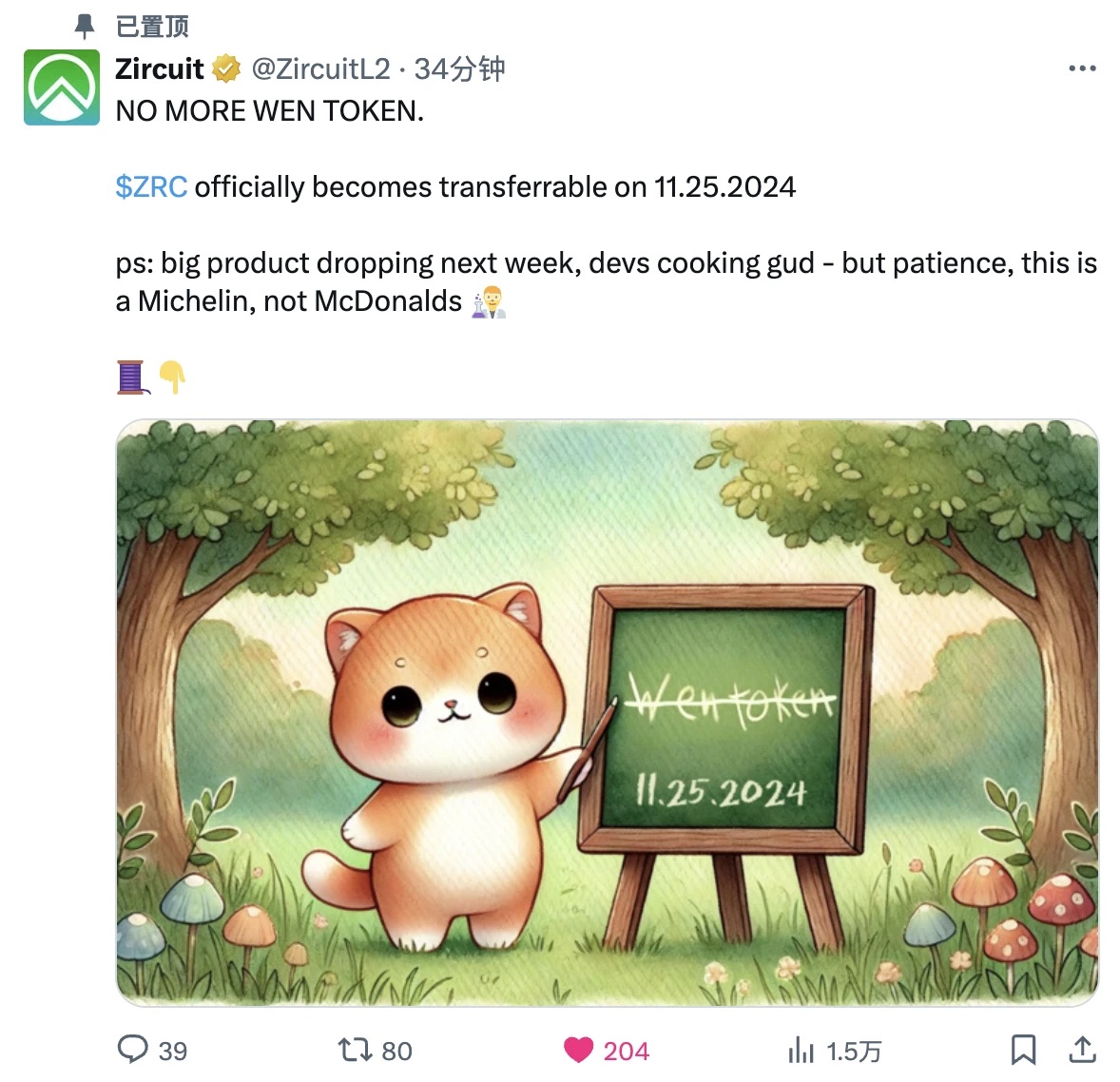
On November 22, Zircuit officially announced that transfer restrictions on ZRC would be lifted on November 25, marking the official entry of ZRC into circulation.
Three Unique Advantages That Set Zircuit Apart
In July this year, Zircuit completed a new round of funding, backed by Binance Labs, Mirana Ventures, Amber Group, Selini, Robot Ventures, Nomad Capital, Borderless Capital, and angel investors from projects such as Renzo, Etherfi, Pendle, Parallel, LayerZero, Axelar, F2 Pool, Nonce, KelpDAO, ETHGlobal, and Maelstrom.
Zircuit skillfully integrates multiple cutting-edge concepts—ZK, AI, and Restaking—leading some users to struggle with categorizing it precisely. If we were to summarize Zircuit's positioning in one sentence, it would be: Zircuit is a Layer 2 network that combines the advantages of Optimistic Rollup and ZK Rollup, leverages AI to enhance network security, and revitalizes ecosystem liquidity through Staking and Restaking narratives.
This definition highlights Zircuit’s three core differentiators, represented by the keywords: “OP + ZK,” “AI,” and “liquidity.”
Keyword 1: OP + ZK
The term “OP + ZK” refers to Zircuit’s hybrid architecture combining Optimistic Rollup and ZK Rollup. Building a Rollup network involves various components such as sequencers, data publication, smart contracts, bridges, and execution layers. To accelerate development, Zircuit adopted OP Stack—the most widely used and battle-tested Rollup development framework available today. However, since OP Stack only supports Optimistic Rollups, Zircuit removed all Optimistic-specific modules and replaced them with ZK-based components to evolve into a more secure and efficient ZK Rollup.
As a result, while Zircuit operates on a hybrid foundation, end users experience it entirely as a ZK Rollup. This hybrid design allows Zircuit to build securely and rapidly, bypassing functional limitations of OP Stack while achieving full ZK Rollup capabilities. Additionally, compatibility with OP Stack ensures smoother support for future Ethereum upgrades, enabling Zircuit to keep pace with broader Ethereum ecosystem developments.
Keyword 2: AI
Among all existing Layer 2 networks, Zircuit stands out as the only one that effectively integrates AI mechanisms directly into network operations. Specifically, Zircuit has introduced an SLS (Sequencer-Level Security) system at the sequencer level, which includes an AI evaluation module trained on transaction data from all EVM-compatible chains. This module autonomously detects and identifies potentially malicious transactions.
When a transaction is initiated on Zircuit, the AI evaluation module automatically checks whether it exhibits signs of malicious intent. All inspection results are fully transparent on-chain. Only transactions passing this check are included in blocks and added to the chain. Transactions failing the AI review are temporarily quarantined, allowing Zircuit’s security experts to conduct further analysis to rule out potential protocol vulnerabilities.
In an environment where on-chain security incidents are common, this AI intervention mechanism enables proactive prevention rather than reactive damage control, significantly enhancing user asset protection.
Of course, due to the fully automated nature of the AI system, there may theoretically be cases of false positives ("mis-kills"). Zircuit has stated that according to test data, the accuracy rate of the module exceeds 99.5%, meaning legitimate transactions are rarely misidentified. In extreme cases where a valid transaction is mistakenly flagged, Zircuit has implemented a manual override mechanism to release quarantined transactions.
Keyword 3: Liquidity
For late-starting Layer 1 and Layer 2 projects, accumulating initial liquidity remains a significant challenge.
Zircuit’s strategy is to actively embrace the Staking and Restaking narratives. Even before mainnet launch, Zircuit deployed deposit contracts on the Ethereum mainnet for ETH and multiple Liquid Staking Tokens (LSTs) and Liquid Restaking Tokens (LRTs), allowing users to earn regular staking and restaking rewards while also receiving Zircuit Points. This approach attracted billions of dollars in liquidity prior to mainnet launch, placing Zircuit among the top Layer 2 networks in terms of early liquidity accumulation.
This is also why Zircuit chose to airdrop 2% of the ZRC supply to EigenLayer ecosystem users—to acknowledge EigenLayer’s pivotal role in advancing the Restaking concept. Notably, Zircuit is the first project within the Restaking ecosystem to conduct an airdrop to non-direct users, a move that earned widespread community praise.
Token Unlocks Imminent: Tracing Zircuit’s Development Journey
Looking back at Zircuit’s development path—from opening staking in February to ZRC officially entering circulation on November 25—Zircuit has executed at remarkable speed, successfully launching a Layer 2 network with over $2 billion in liquidity.
-
In February, Zircuit opened staking on the Ethereum mainnet, allowing users to participate in the ecosystem and earn Zircuit Points by staking ETH, ezETH, rswETH, rsETH, LsETH, and stETH, or completing various tasks;
-
In August, Zircuit officially launched Phase 1 of its mainnet and unveiled its first airdrop program. The first season allocated 7% of the total ZRC supply, qualifying 262,200 addresses. Additionally, 14% of the token supply was reserved for future airdrops (totaling 21% for airdrops and community incentives). The second-season airdrop is currently ongoing.
-
In October, Zircuit announced the upcoming launch of Zircuit Liquidity Hub, enabling users to migrate liquidity from Ethereum mainnet to Zircuit’s Layer 2 to accumulate Zircuit Points faster and receive staking yields, protocol tokens, partner airdrops, and other benefits in one place. Notably, Zircuit covered the gas fees for migrating from Ethereum mainnet to Layer 2 to minimize friction.
-
Late in October, Zircuit launched Phase 2 of its mainnet and disclosed that $150 million in liquidity had already been migrated.
-
In November, Zircuit accelerated further—not only launching the Fairdrop airdrop and listing ZRC on Bitget, Gate, and Bybit pre-markets, but most importantly announcing that ZRC transfer restrictions would be lifted on November 25. Zircuit also teased the release of a major new product the following week, potentially bringing fresh surprises to the market.
-
While consistently delivering milestones, Zircuit continues to advance its Build to Earn program, incentivizing builders, founders, and community members contributing to the ecosystem, thereby accelerating ecological expansion.
A Closer Look at the ZRC Tokenomics
According to the ZRC token economic model disclosed by Zircuit, the total supply of ZRC is capped at 10 billion tokens, distributed as follows:
-
21% allocated to airdrops and community rewards—one of the highest airdrop ratios among all Layer 2 projects. This includes 7.00% for Season 1 airdrop, 3.00% for Season 2, and 2.45% for promotional campaigns (Fairdrop, Catizen, Binance Web3, etc.), all unlocked at TGE; additionally, 8.55% is reserved for future airdrops and rewards, subject to 6- or 12-month lockups followed by 24-month linear vesting;
-
13.08% allocated to Community Provisions, with a 1-year lockup followed by 24-month linear release;
-
17.93% dedicated to ecosystem development, with a 1-year lockup followed by 24-month linear release;
-
18.70% allocated to the Foundation, with a 1-year lockup followed by 24-month linear release;
-
18.74% allocated to the team, with a 1-year lockup followed by 24-month linear release;
-
10.55% allocated to investors, with a 1-year lockup followed by 24-month linear release.
Combined, 21% plus 13.08%—a total of 34.08%—is allocated to Zircuit’s community users, making it one of the Layer 2 projects with the largest community allocations. Since the first airdrop, Zircuit has conducted multiple token distribution events. The completed Season 1 and ongoing Season 2 airdrops are expected to reach 342,000 addresses; the EigenLayer-focused airdrop covers approximately 203,000 addresses; the Catizen Launchpool campaign involved 105,000 users; and the collaboration with Binance Web3 Wallet reached about 40,000 users.
Timing the Market Uptick: What’s Next for ZRC?
Reviewing 2024’s market trends, the Layer 2 sector experienced a prolonged consolidation period following the Dencun upgrade. However, after ETH surged unexpectedly on the evening of November 21, Layer 2 tokens including OP, ARB, and STRK posted gains exceeding 20%, suggesting a possible resurgence in the Layer 2 space.
Zircuit’s decision to lift ZRC transfer restrictions on November 25, while not intentionally timed (given prior pre-market listings indicated preparation), positions it perfectly to ride any upcoming sector-wide momentum. Moreover, Zircuit—with its triple advantage of AI integration and innovative design—is a rare standout in an otherwise homogenous Layer 2 landscape. Given these factors, ZRC’s post-launch performance could be worth watching closely.
Join TechFlow official community to stay tuned
Telegram:https://t.me/TechFlowDaily
X (Twitter):https://x.com/TechFlowPost
X (Twitter) EN:https://x.com/BlockFlow_News
 Odaily