Exclusive Interview with Jason Huang, Founder of NDV: A Traditional Investor Who's All In on Bitcoin
TechFlow Selected TechFlow Selected
Exclusive Interview with Jason Huang, Founder of NDV: A Traditional Investor Who's All In on Bitcoin
Ethereum is Alibaba, Solana is Pinduoduo?
 Navigating Web3 tides with focused insights
Interview & Article: Anderson Sima, Executive Editor, Foresight News
Interviewee: Jason Huang (@Jhy256), Founder of NextGen Digital Venture
British science fiction writer Douglas Adams once commented on technological progress: "Anything invented between the ages of 15 and 35 is a revolutionary technology that will change the world. Anything invented after age 35 is unnatural and deserves divine punishment." Jason is now 36 years old, and he believes he has found that revolutionary technology.
During the Christmas holiday in 2023, Jason was in Osaka with his family. On his way back, he made a prediction about the crypto market at the airport (when Bitcoin was trading around $43,000), stating that Bitcoin could surpass $50,000 by May 2024 and reach $100,000 by year-end.
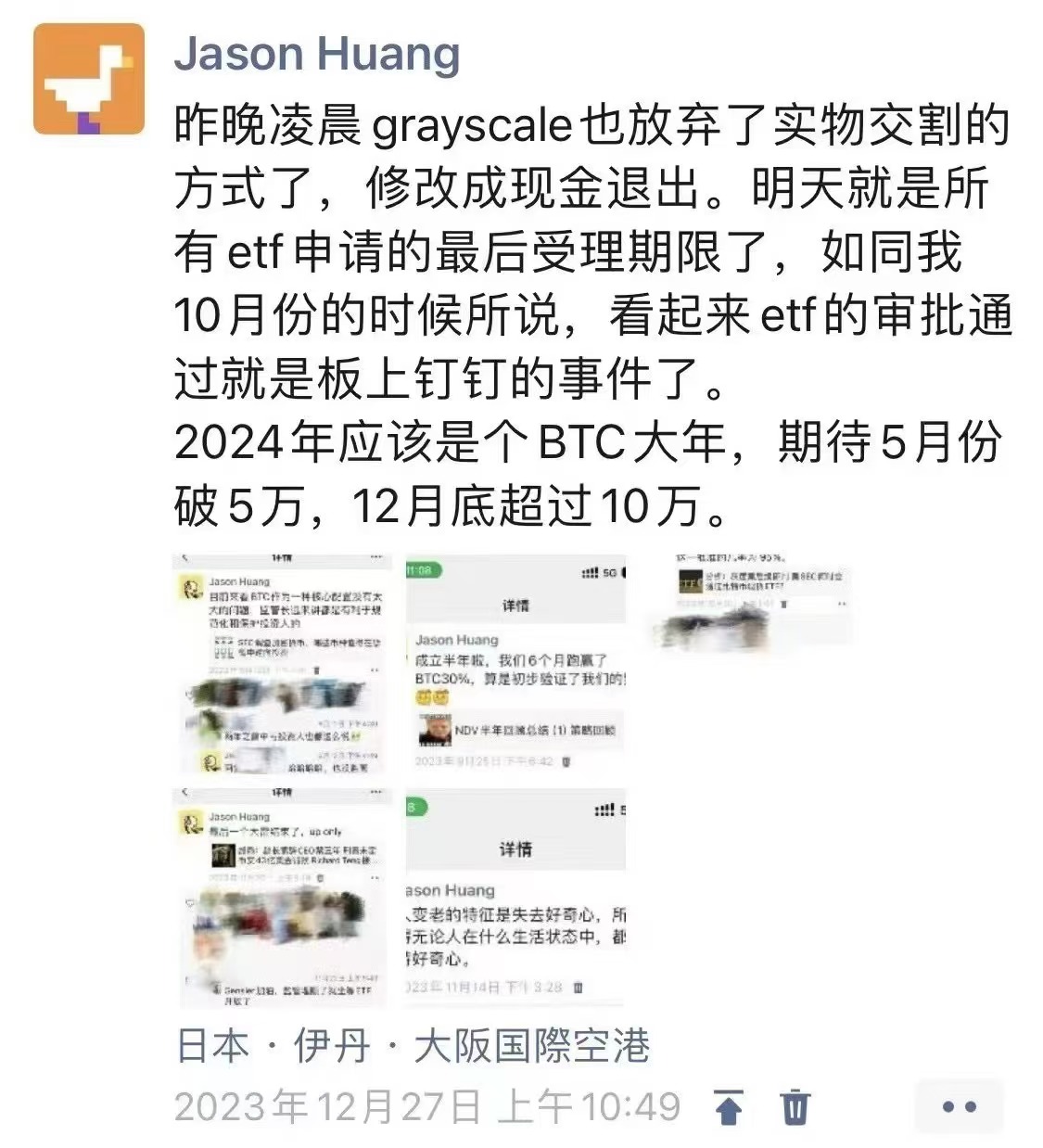
Reality turned out to be even more dramatic—before December 2024 even arrived, Bitcoin had already broken through $99,000, putting Jason’s forecast just one step away from fulfillment. According to his estimates, LPs in the first fund of NextGen Digital Venture (NDV) are set to achieve over 300% returns.
NDV’s first fund focuses on cryptocurrency-related equities and was launched in partnership with Metalpha (Nasdaq: MATH), a digital asset wealth management firm. At the time of its founding, U.S. spot Bitcoin ETFs had not yet been approved, and traditional finance had not yet turned its attention to digital assets. NDV successfully captured the growth of digital assets throughout the ETF approval process.
Jason Huang has extensive experience in venture capital, having worked at institutions such as Huaxing Capital and Qiming Venture Partners. In 2022, at the age of 34, he chose to leave Blue Pool Capital—the family office co-founded by Jack Ma and Joe Tsai—amidst puzzled glances from some peers, and dove into the world of cryptocurrency, founding NextGen Digital Venture. That same year, the Golden State Warriors, led by Stephen Curry—who happens to be the same age as Jason—won the NBA championship, Jason’s favorite team and player. “Steph Curry’s championship in 2022 gave me tremendous courage to start my own venture,” said Jason Huang.
Shortly after NDV’s founding in 2023, I interviewed Jason regarding the state of the crypto market at that time—an interview whose content partially resonates with today’s developments. One year later, I invited Jason Huang, founder of NDV, once again to discuss how the cryptocurrency industry has evolved over the past year and future investment trends. Below is the edited transcript of our conversation.
Over 3x Return in 20 Months
Foresight News: When we spoke last year, NDV’s first fund had just launched. Spot Bitcoin ETFs were not yet approved, but you were firmly holding Grayscale’s trust product. Could you briefly summarize NDV’s journey over the past year?
Jason: One of our key moves in the first year was allocating a major portion of the fund into GBTC. At the time, it traded at a discount to Bitcoin, which gradually narrowed and eventually disappeared after the ETF approval. By the end of last year, we realized that post-approval, the ETF would become a pure Bitcoin index fund, so we shifted our strategy toward crypto-related equities. This year, for example, we’ve increased exposure to companies like Coinbase and MicroStrategy.
From the beginning, we believed the best way to invest was through securities tied to crypto, because traditional finance rarely jumps directly into buying digital assets. Stocks offer a more familiar vehicle for institutional investors. Our mission is to help traditional finance gain exposure to the crypto space and generate returns. We entered the market on March 29 last year at $29,000, and since then, the fund’s unrealized gains have exceeded 3x, significantly outperforming Bitcoin itself.
Foresight News: Looking back, moving from traditional VC into crypto must have attracted skepticism?
Jason: Absolutely—many people didn’t understand, and even now, friends still ask me why I made that decision. But I see finance as fundamentally about innovation on either the capital side or the asset side—you have to focus on one. Early-stage firms like Sequoia China and Hillhouse rode the waves of China’s internet and healthcare booms. If crypto takes off, we’re positioned for a similar generational opportunity—it just takes time. Our fund hasn’t even turned two yet. Everything is just getting started.
Foresight News: What is NDV’s positioning in the market?
Jason: As I mentioned, finance is about innovation on the capital and asset fronts. NDV is essentially focused on two things:
1) Bringing traditional financial capital into Crypto
2) Bringing high-quality assets into Crypto
We’ve accomplished the first through our equity fund. Going forward, as the U.S. regulatory environment evolves, we can also focus on the second. Changes in SEC leadership may open new opportunities for crypto—such as tokens that can distribute dividends or be issued compliantly at lower cost. These could bring transformative changes to the token economy. I’m actively researching which types of assets might drive such shifts. This will likely be a major theme over the next few years.
Bitcoin’s Future: A National Reserve Asset?
Foresight News: What changes might the Trump administration bring to the crypto market?
Jason: The most significant factor is likely a change in SEC leadership—Gary’s resignation is highly probable (Editor’s note: Gary announced his resignation shortly after this interview). This could shift Bitcoin regulatory policy. As for market reaction: under a Democratic administration, any rally might have been more gradual. But with Trump’s pro-crypto stance, the market is front-running aggressively, making it harder to predict.
This election gave Republicans control of both houses of Congress and a majority in the Supreme Court—a feat only achieved twice before in U.S. history, by Lincoln and FDR. Now, Trump is the third. Many close to him hold substantial Bitcoin positions, including Vice President JD Vance, Elon Musk, and Peter Thiel, who backs Vance.
If Congress begins discussing using federal reserve funds to buy Bitcoin—even just discussing it—Bitcoin’s price could surge dramatically. Prices reaching $200,000–$300,000 per BTC become plausible, though it’s uncertain whether this will be a top priority for the Trump administration.
Foresight News: There’s a trend of Bitcoin evolving from “digital gold” to a strategic national reserve asset. How do you view this?
Jason: I can’t name specific institutions, but yes, sovereign funds are indeed discussing it. After speaking with several mid-sized sovereign wealth funds, I found they aren’t yet ready to treat Bitcoin as a strategic reserve. In fact, I suspect the U.S. might move faster. Some sovereign funds remain cautious due to past losses from failed exchanges or related companies, so they’re waiting to see what the U.S. does first.
But once momentum starts, this shift could happen much faster than expected. I originally thought this story might take six years—but it might unfold in just two.
Foresight News: Will these traditional funds invest directly in Bitcoin?
Jason: Very rarely. Most university endowments and pension fund committees I’ve spoken with consist of members aged 60 to 70. For them, Bitcoin is a hard-to-grasp novelty. But if you frame it as a new tech sector, acceptance improves. They’re more willing to invest in crypto-related companies than in Bitcoin directly. However, the approval of ETFs now allows institutions to allocate to BTC in a compliant manner—that’s why this bull market is truly a “Bitcoin bull.”
Ethereum Is Alibaba, Solana Is Pinduoduo?
Foresight News: Your strategy seems to avoid Ethereum ETFs. In the last cycle, Ethereum vastly outperformed Bitcoin, but now there’s widespread dissatisfaction. What’s behind your decision not to engage with Ethereum?
Jason: When introducing crypto to traditional investors, I find they struggle enough to understand Bitcoin—understanding Ethereum is even harder. My investment philosophy leans toward backing disruptive forces—X factors that can reorder market rankings. Think of Pinduoduo: it came from behind and reshaped China’s e-commerce landscape. Right now, Ethereum lacks meaningful innovation or mass adoption—this is evident from market sentiment and capital flows. In contrast, Solana has a bit of that Pinduoduo vibe. I don’t hold Solana myself, but I appreciate narratives where disruption is possible.
Foresight News: What’s your personal asset allocation look like?
Jason: When I founded NDV, I put nearly all my liquid assets into crypto—except for property and private market holdings. I allocated most of my personal liquidity into my own fund, which I believe is the best commitment to my LPs. Currently, my portfolio is roughly 4:1 or 5:1 in favor of Bitcoin versus other cryptos.
The non-Bitcoin allocations are projects led by founders I know personally and deeply respect, or recommendations from trusted friends. For example, in early October, I posted on X that I bought a meme coin recommended by my partner Christian—it’s up about 20x from the bottom. The core here is trust transfer: I back things done by reliable people or endorsed by those I fully trust. But when I buy these, I treat them as venture bets—positions I’m prepared to lose money on.
Foresight News: What are your plans for the next year?
Jason: I’ve committed to my first fund’s investors that I’ll wind down the fund at the peak of this four-year crypto cycle. I personally believe that peak will occur within the next 12 months, depending on macro and policy developments. After that, I plan to seriously explore the idea I mentioned earlier: bringing Web2 talent and assets into Web3.
Join TechFlow official community to stay tuned
Telegram:https://t.me/TechFlowDaily
X (Twitter):https://x.com/TechFlowPost
X (Twitter) EN:https://x.com/BlockFlow_News
 Foresight News