Reviving Dormant NFTs: From Forgotten to Gamified Co-Creation for Value Renewal
TechFlow Selected TechFlow Selected
Reviving Dormant NFTs: From Forgotten to Gamified Co-Creation for Value Renewal
NFT gaming could be a breakthrough.
 Navigating Web3 tides with focused insights
Author: DawnXue
NFTs were undoubtedly the highlight of the last cycle. From crypto art and sports collectibles to in-game assets, NFTs left a trail of success across various domains. However, after the glory days of PFP projects like CryptoPunks and Bored Ape Yacht Club (BAYC), the narrative culminated in the hype around virtual land in the metaverse. Today, these once-popular assets are gradually being forgotten.
The Price Bubble and Limited Utility of the NFT Market
According to historical data from OpenSea, blue-chip NFTs such as BAYC and Doodles have fallen more than 90% from their peak prices. This phenomenon is not only disheartening but also prompts us to reflect on the core issues within the NFT market:
-
Bursting price bubbles. During the previous market boom, NFT prices were heavily inflated. As market enthusiasm cooled, excessively high prices led to a sharp decline in buyers, causing trading volumes to plummet. Similar to other speculative markets, NFTs experienced rapid price surges followed by swift corrections, lacking subsequent narratives or fundamental value support, ultimately eroding investor confidence.
-
Limited utility. Many NFTs serve overly simplistic functions, existing primarily as speculative instruments. Very few possess genuine long-term utility. For example, PFP (profile picture) NFTs offer little beyond representing a user's social identity, while collectible NFTs may have aesthetic value but struggle with sustained appeal and liquidity.
Co-Creation and Revenue Sharing in NFTs
The core of Web3 lies in co-creation and shared revenue. Looking back, most NFT issuance and profits have been concentrated in the hands of individual creators or platforms:
-
PFP NFTs: Projects like CryptoPunks and BAYC retain all earnings for the founding team.
-
Sports collectibles: NFTs representing specific sports moments are issued and controlled by centralized platforms.
-
Virtual land: Platforms like Decentraland and The Sandbox maintain dominant control over land issuance.
Although some metaverse platforms allow users to create custom assets, overall, true deep collaboration between players and platforms has yet to be realized.
Exclusive vs. Non-Exclusive Usage: A New Perspective on NFT Utility
Currently, most NFT usage models are exclusive—only the holder can use or grant sole usage rights to others. This model limits NFT accessibility and reduces its earning potential. The exclusivity of NFT usage resembles the early days of computing, which revolved around hardware like chips—you could buy or lease them (NFTs already support such technical capabilities), but mass adoption remained impractical.
In contrast, non-exclusive usage is far more open. The same NFT asset can be licensed to multiple parties simultaneously, generating broader value. For instance, the "Little Ghost" NFT authorized collaborations with brands, allowing multiple consumers to purchase co-branded products and pay a premium, thereby expanding the NFT’s market value.
What other high-utility assets can this NFT container hold? When such useful NFTs are licensed to multiple users at once, can holders earn income during ownership rather than only upon sale? Can Web3-style co-creation be applied to NFTs? Can the dormant, illiquid NFTs sitting in wallets be awakened?
NFT gaming might be the breakthrough. NFT is a powerful container—not just for in-game assets, but for entire games themselves.
NFT Games
Why start with games? The gaming industry often leads technological innovation—be it the emergence of computers (text adventures, graphical interface games), PC development (mouse-and-keyboard games, multiplayer online games), or the rise of keypad phones (Snake) and smartphones (touch-based gameplay in *Angry Birds*, motion controls in *Temple Run*). Games have consistently driven advancements in user experience and interaction design.
And we should start with simple games. Small games have low development costs and allow rapid iteration. They’re easy to pick up, feature straightforward mechanics, appeal to broad audiences, and are highly shareable.
The High Barrier to Game Development
While small games are inexpensive to develop, most players lack coding skills. It's nearly impossible for non-developers to independently build even seemingly simple games, let alone incorporate creative elements. However, platforms can collaborate with players to co-create games and share revenue—platforms provide technical development capabilities, while players contribute resources such as NFTs.
Game Co-Creation
Not all games are suitable for co-creation, but certain types are ideal—for example, puzzle games. Since each image creates a different game, variety emerges naturally.
Co-creation model using a puzzle game as an example:
-
The platform develops the core game logic and opens an NFT image upload feature.
-
Players can upload NFT images from their wallets, and the platform generates a customized puzzle game.
-
Each puzzle game can be minted as an NFT. Players enter via a ticket system, and revenues are distributed proportionally between the image provider and the platform.
This model enables clear division of labor between developers and users while avoiding redundant development. By using their own NFTs, players prevent piracy and enhance the combinability and utility of their NFTs.
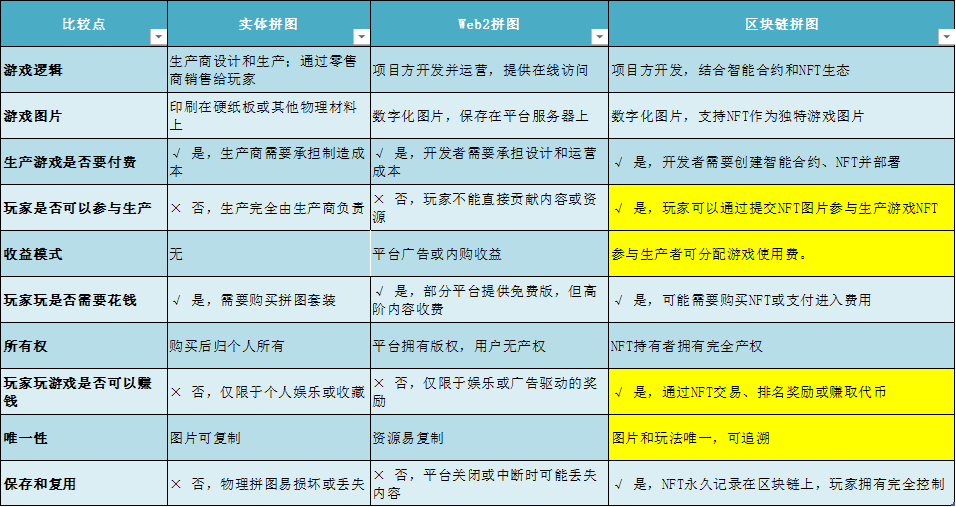
Below is a comparison of physical puzzles, Web2 digital puzzles, and blockchain-based puzzles, highlighting the advantages of the blockchain approach.
Reviving Dormant NFTs
Long-forgotten NFTs may regain relevance through a successful game, while new NFTs created via co-creation can spread widely among users. Through this model, NFTs evolve beyond mere collectibles or speculative tools into assets with real utility.
The Financial Nature and Revenue Models of NFT Games
Financialization is one of the core features of blockchain gaming. NFT games offer not only entertainment value but also sustainable revenue distribution mechanisms:
-
Initial funding and reward mechanisms
Users pay initial funds when creating a game to attract participants. Players join by paying entry fees, and rewards are distributed based on leaderboard rankings.
-
Revenue distribution
Post-issuance revenues from game NFTs can be split between the platform and content contributors. Holders can earn dynamic income through usage rights during gameplay, rather than relying solely on capital gains from resale.
-
Beyond this, project teams with capacity can add points systems, airdrops, and other mechanisms to further enhance financialization.
The Broad Applicability of Game NFT Co-Creation Models
Beyond puzzle games, this co-creation model applies to other game types that share the following characteristics:
-
Diversity through simple modifications: Core rules remain unchanged, but user-uploaded images or map edits generate unique experiences.
-
Low development cost: No complex logic required; most content can be completed via image swaps or parameter adjustments.
-
Easy to share and spread: Each player-created version can attract niche interest communities.
Beyond games, this model could even extend to other types of assets.
Of course, NFTs and games complement each other—games may also advance with the momentum of NFTs. In short, NFTs have not been disproven. We may have only seen the tip of the iceberg of this new frontier. The rest awaits builders to explore.
Join TechFlow official community to stay tuned
Telegram:https://t.me/TechFlowDaily
X (Twitter):https://x.com/TechFlowPost
X (Twitter) EN:https://x.com/BlockFlow_News