How to Play Meme Coins with GMGN? (Beginner's Guide)
TechFlow Selected TechFlow Selected
How to Play Meme Coins with GMGN? (Beginner's Guide)
Beginner's Guide to Meme Operations
 Navigating Web3 tides with focused insights
Author: Viee, Core Contributor of Biteye
Editor: Crush, Core Contributor of Biteye
Recently, on-chain traffic has exploded—meme coins tied to lucky mascot narratives surged by 60,000%, and the DeSci narrative is gaining momentum. Meme coins have become the biggest dark horse of this bull market!
On-chain trading can be challenging for beginners. In this guide, Biteye will walk you through step-by-step how to get started with meme coins using GMGN.
An advanced guide will follow—stay tuned.

This article focuses on initial participation in new launches (IPO-style), teaching you how to find, analyze, and trade newly listed meme coins.
01 Quick Beginner's Guide
1. What is GMGN?
A website combining a meme coin data dashboard with trading tools.
2. What is on-chain trading?
Activities and transactions conducted directly on the blockchain, without relying on centralized exchanges like Binance or OKX.
3. Which wallet should I use?
Mainstream wallets such as Phantom or OKX. Installation and usage tutorials are available via YouTube searches—we won't cover them here.
4. What is a token address (CA)?
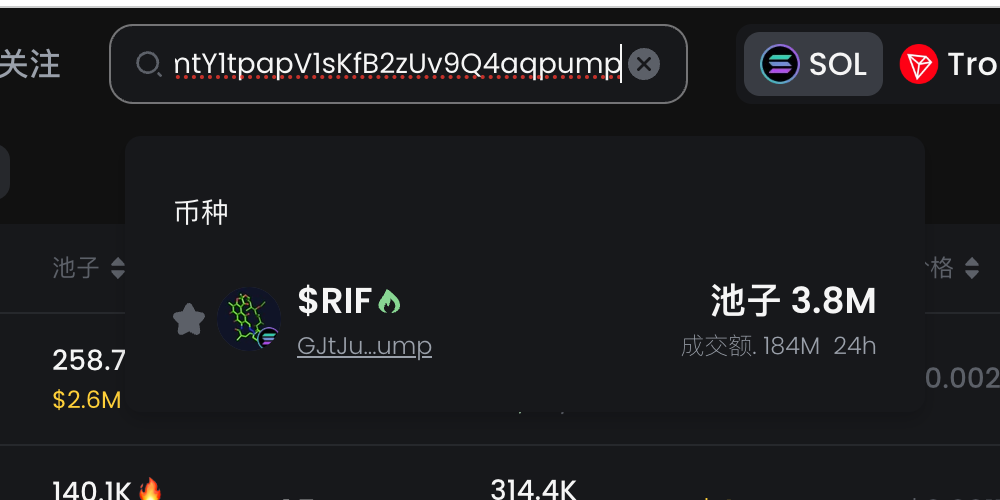
A string of characters like "GJtJuWD9q*****wMBmtY1tpapV1sKfB2zUv9Q4aqpump". Paste it into the search bar on GMGN to locate the token.
As shown below:
02 Discovering New Projects
1. Follow the Smart Money
Tracking “smart money” means monitoring user wallet addresses that have achieved high returns on-chain, observing their investment choices. Below are three links to GMGN’s smart money lists across different chains, along with icon explanations:
Ethereum Chain: https://gmgn.ai/discover?chain=eth
Solana Chain: https://gmgn.ai/discover/?chain=sol
Blast Chain: https://gmgn.ai/discover?chain=blast
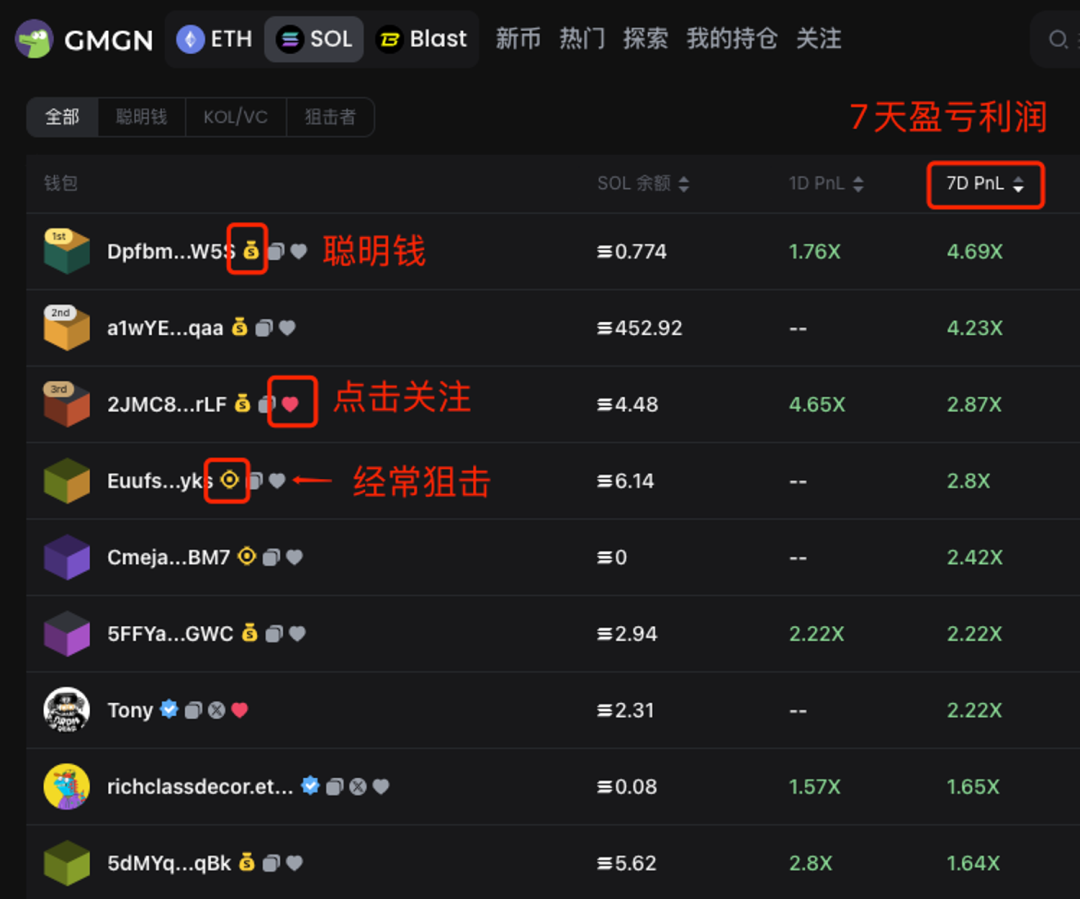
Once you follow smart money wallets, new activity will show a red bubble and sound notification (configurable) at the bottom-left corner under "Followed".
GMGN also supports Telegram notifications, so you’ll receive instant alerts whenever a followed wallet makes a move.
Click “Followed” to view real-time trading activities of smart money, including buy/sell actions, opening positions, adding to positions, full exits, etc.
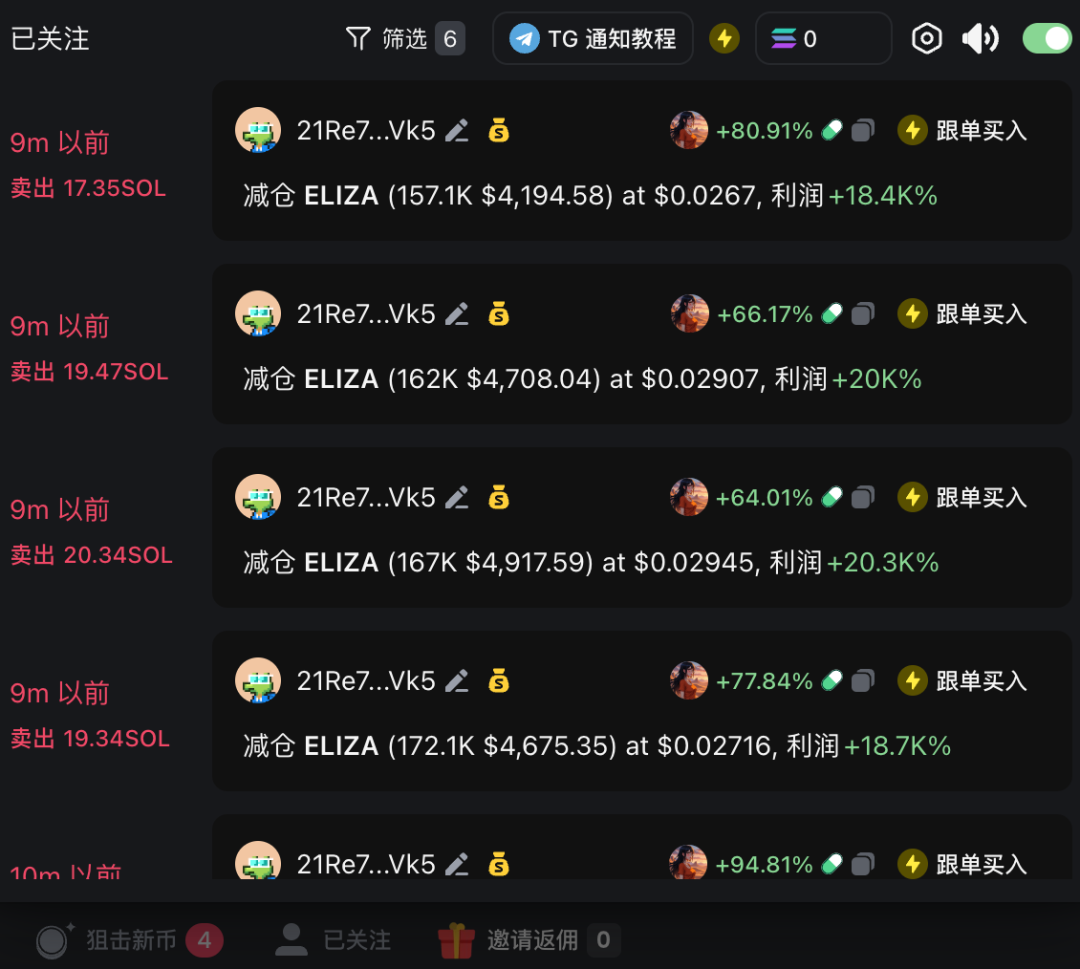
You can click into any smart money address for more detailed insights, including portfolio analysis, profit/loss distribution, and transaction history.
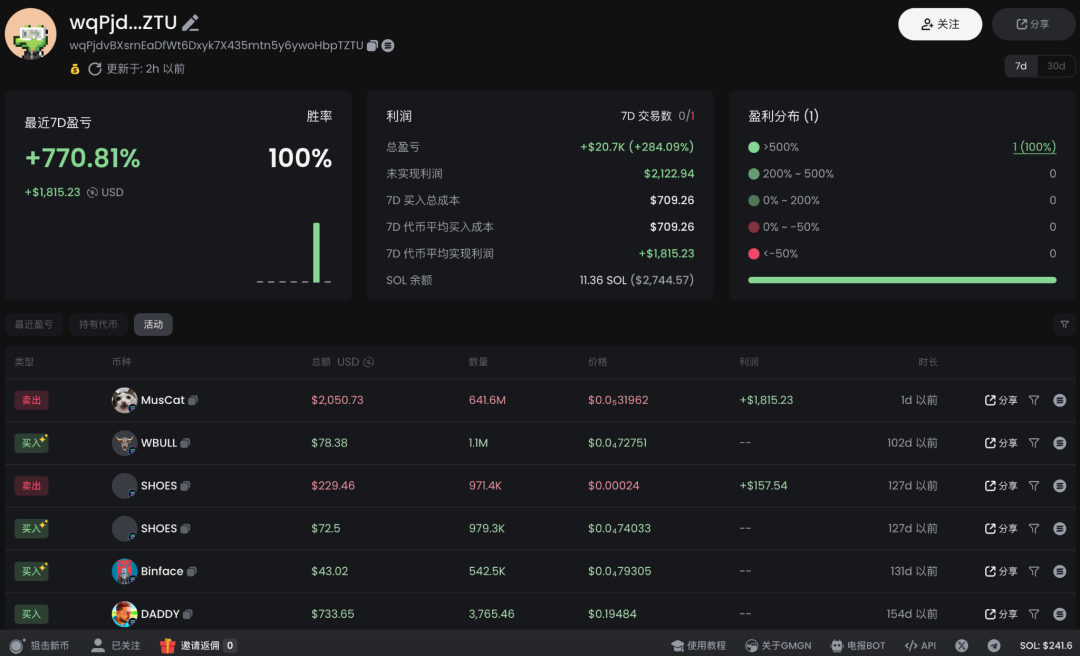
Every day, thousands of new meme coins launch on-chain. There may be instances where multiple smart money wallets converge on a single token. When selecting whom to follow, consider your own trading style to avoid information overload. It’s best to track wallets whose strategies align with yours for efficient signal filtering.
Note: Always verify contract security—even smart money investors sometimes buy risky contracts without due diligence.
2. Scan Twitter & Scan Chains
-
Scan Twitter: Follow numerous Chinese and English KOL accounts related to meme coins on Twitter and join discussion groups to stay updated with the latest news and trends.
-
Scan Chains: Closely monitor tokens moving from inner markets (smaller pools) to outer markets (larger exchanges), quickly assessing their investment potential.
On GMGN, you can monitor these three types of tokens:
-
Type 1: Newly created inner-market tokens (highest risk)
-
Type 2: Inner-market tokens nearing capacity
-
Type 3: Tokens already in the outer market (lowest risk)
Explanation of Inner Market vs Outer Market:
When a new project successfully deploys via the automated token minting tool pump.fun, users can purchase its tokens using SOL. Once the market cap reaches $69,000, liquidity is automatically migrated from pump.fun to Raydium.
-
Before reaching $69,000, it’s considered an inner-market token. At this stage, the project is extremely early and highly risky.
-
After hitting $69,000 and successfully listing on Raydium, it becomes an outer-market token. The project then enters a more developed phase, reducing some risk.
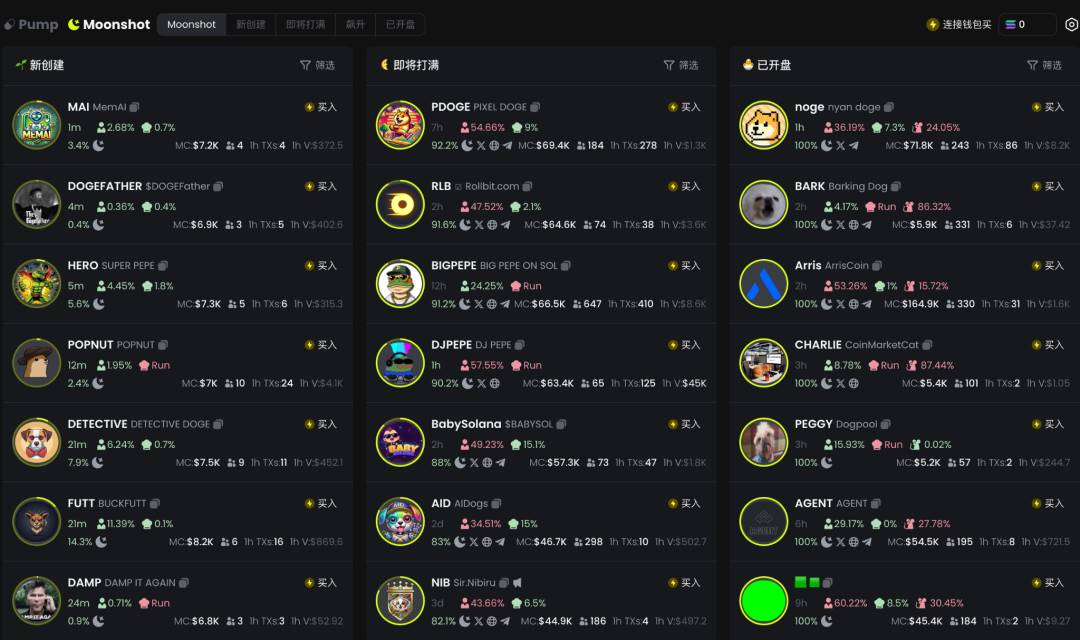
We recommend focusing primarily on tokens that have entered the outer market. While still risky, outer-market tokens are significantly safer than inner-market ones and are more beginner-friendly.
Moreover, only a small number of outer-market tokens reach multi-million dollar valuations, meaning there remains substantial profit potential.
Note: A token entering the outer market does not guarantee price appreciation. Many tokens drop to zero shortly after launching on Raydium. Always remain cautious when investing!
By patiently monitoring and analyzing these tokens’ performance, we can assess their potential and investment value to ultimately generate profits. But how exactly should we conduct this analysis? Read on.
03 Token Analysis
Now that you’ve learned how to use GMGN to discover new on-chain tokens, the next step is analyzing and selecting promising meme coins from the crowd.
Decisions should be based on factors such as current trends, narratives, market cap, community strength, and market dynamics. Different types of meme coins require different strategies:
1. Trend-Based Tokens
These tokens often gain rapid popularity due to short-term events or viral trends. They typically start with low market caps and can surge over 10x, potentially growing from hundreds of thousands to tens of millions in valuation.
However, if the trend fades, lacks price support, receives no celebrity endorsement, fails to establish a strong narrative, doesn’t build a vibrant community, or misses out on rare catalytic events, liquidity may dry up and prices could steadily decline.
Examples of rare catalytic events include:
-
$SLERF founder accidentally burned the LP tokens, reserved airdrop tokens, and mint authority, triggering massive bullish sentiment on-chain and leading to $SLERF’s quick listing on major exchanges.
-
Recent example: $BITCAT. As on-chain sentiment around the “mascot” concept intensified, Bitcoin’s official Twitter suddenly posted an image of a black cat. Some interpreted this as hinting at an official Bitcoin mascot. As consensus spread rapidly, $BITCAT surged—its market cap skyrocketed from hundreds of thousands to $100 million within just three hours, stabilizing around $50 million later that night.
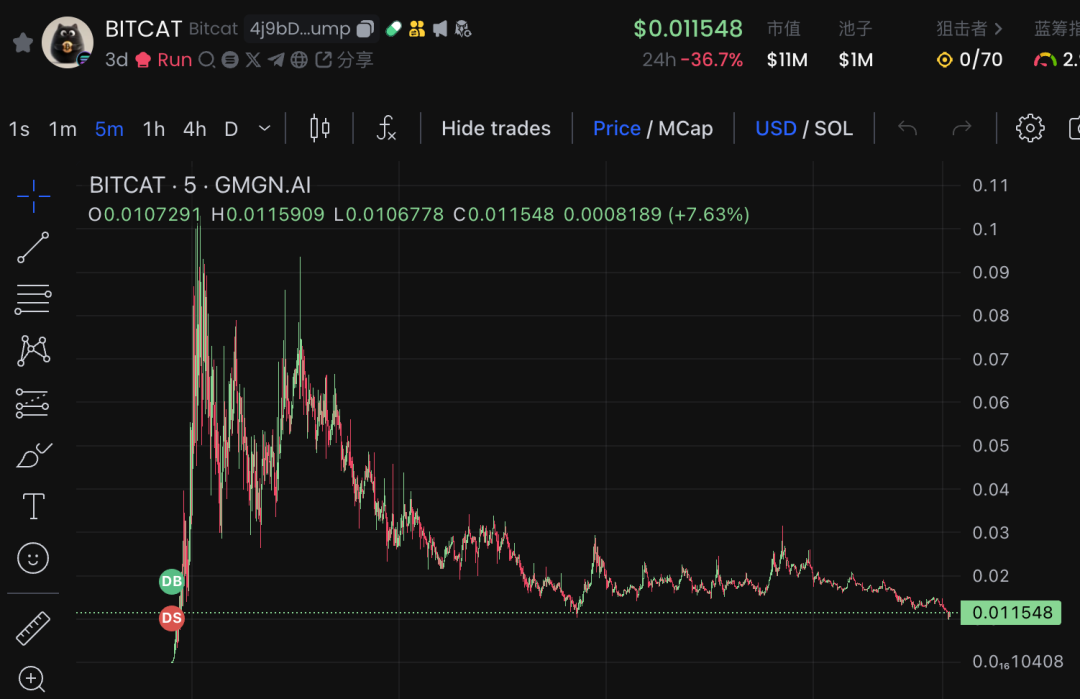
For such tokens, our recommendations are:
-
Buy early—ideally when market cap is below $1M. Avoid chasing entries above $10M, which increases the risk of getting trapped.
-
If you believe the trend has staying power, wait for an 80% price pullback before entering to reduce risk.
2. Narrative-Driven Tokens
These tokens don’t rely solely on fleeting hype but grow steadily around a compelling story or strong community, gradually increasing from small to large market caps.
Unlike flash-in-the-pan trend tokens, they often experience multiple phases of stable growth, usually ranging from several million to tens of millions in market cap, sometimes exceeding $100M.
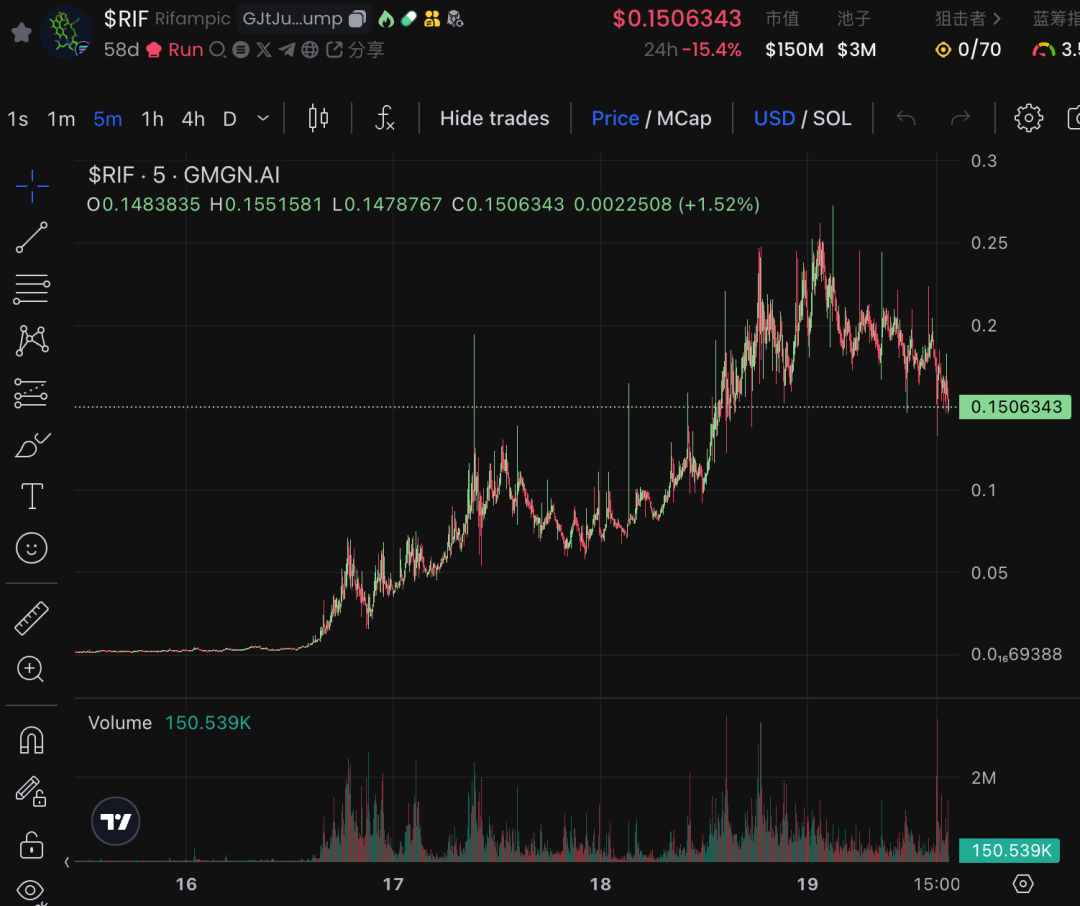
For example, $RIF—linked to antibiotics used in treating tuberculosis—is currently the leading DeSci + Meme coin. Its rise was fueled by rising interest in the DeSci (decentralized science) narrative. As the first token launched under Pump Science, increasing attention boosted buying pressure, solidifying its position as the top player in the sector.
Our suggestions for these tokens:
-
Focus on emerging yet meaningful narratives—like DeSci—and consider gradual accumulation at low market caps (from hundreds of thousands to low millions).
-
Monitor social media presence, community engagement, and capital inflows over the medium to long term to evaluate sustainability and upside potential.
04 How to Trade
The image below shows an overview of GMGN’s trading interface:
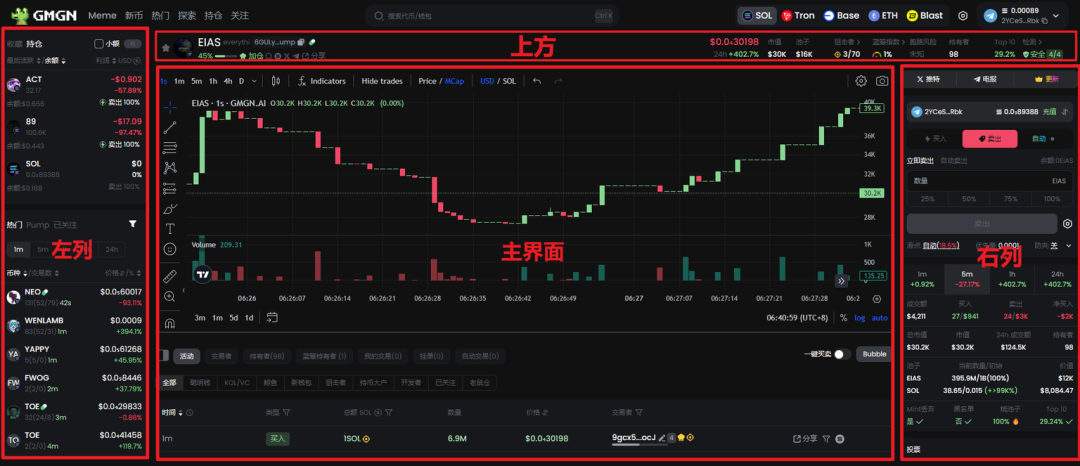
1. Left Panel
Favorites & Holdings List
Quickly check price movements and profit changes for your favorite and held tokens. You can also sell instantly while monitoring the market.
Trending, Pump, and Followed Lists
Filter trending and pumping tokens by time, number of trades, price, or price change percentage to match your strategy. The “Followed” list allows one-click copying of trades even during active monitoring.
2. Central Main Interface
Beneath the price chart lies extensive information about the token, including trading activity, traders, holders, blue-chip holders, categorized into smart money, KOLs/VCs, whales, new wallets, snipers, large holders, developers, followed addresses, and suspected insider wallets.
Use this data when evaluating a token—especially analyzing large holders and smart money behavior. For instance:
-
Flag suspected insider wallets to determine whether insiders are distributing tokens via secondary wallets to dump and exit.
-
Identify potential phishing wallets—non-purchase transfers will be flagged accordingly.
3. Right-Side Trading Panel
View Metrics
Check key metrics such as trading volume, buy/sell orders, net inflow, liquidity, mint status, blacklist status, burn ratio, and rug-pull probability—all crucial indicators.
Set Slippage and Enable Anti-MEV Protection
Slippage refers to the maximum acceptable deviation in token amount per trade. Higher slippage increases execution speed. Generally, set slippage around 0.5%. During volatile periods, increase to 10%.
(Note: MEV sandwich attacks occur when bots detect incoming trades and front-run them, inflating the purchase price. Enabling Anti-MEV mode effectively prevents such attacks.)
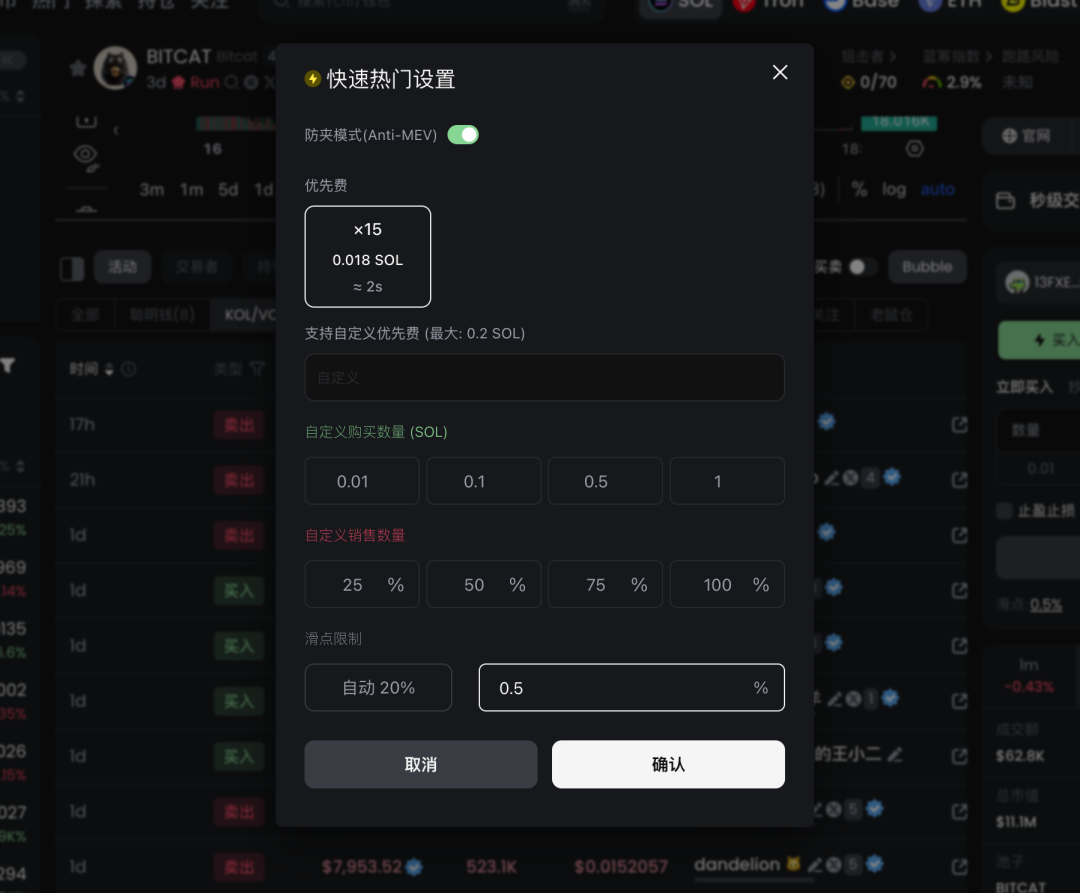
Enter Amount and Manually Buy/Sell
We’ll cover advanced features like limit orders and automated buys in a future guide—stay tuned.
05 Risk Warning
Thousands of meme coins appear on-chain every day. Most go to zero. The chance of a token becoming a “golden dog” (reaching $10M–$100M+ market cap) is extremely low—not to mention getting listed on major exchanges.
In short: higher returns come with higher risks. Please invest responsibly!
Join TechFlow official community to stay tuned
Telegram:https://t.me/TechFlowDaily
X (Twitter):https://x.com/TechFlowPost
X (Twitter) EN:https://x.com/BlockFlow_News
 @BiteyeCN