Quick Look: OpenLayer, a New Player in the AI Data Layer
TechFlow Selected TechFlow Selected
Quick Look: OpenLayer, a New Player in the AI Data Layer
From restaking to AI data layers, OpenLayer provides trusted data for on-chain and off-chain apps.
 Navigating Web3 tides with focused insights
By 1912212.eth, Foresight News
Crypto VCs are still investing in the AI sector. On November 20, OpenLayer, a crypto-AI startup founded by three former Robinhood employees, closed a $5 million seed round. The funding was backed by institutions including a16z CSX (the crypto startup accelerator), Geometry, IOSG Ventures, Spartan Group, and LongHash Ventures, as well as angel investors from projects such as EigenLayer and AltLayer. OpenLayer was also selected for a16z crypto’s spring startup accelerator program announced in March this year.
AI Data Layer
Initially launched as an AVS (Actively Validated Service) on EigenLayer, OpenLayer has now attracted over 48,000 stakers with more than $1 billion worth of assets staked. However, OpenLayer is not limiting itself to AVS offerings. According to its latest website description, OpenLayer is a modular, trusted data layer that combines optimistic execution, cryptographic verification, and decentralized physical infrastructure to deliver trustworthy data to both on-chain and off-chain applications.
The platform enables users to contribute and validate data via a Chrome extension and earn points. Developers can access this data—with user authorization—for use cases such as AI model training.
Prior to this, the project received grants from the Ethereum Foundation, Optimism, and Arbitrum.
Architecture Design
OpenLayer acts as an AI data layer, allowing users to contribute and verify data—and earn points—through a Chrome extension. According to the project’s website, application developers can access this user data with explicit user consent, preserving privacy. Use cases include AI model training, user targeting, and feature enhancement.
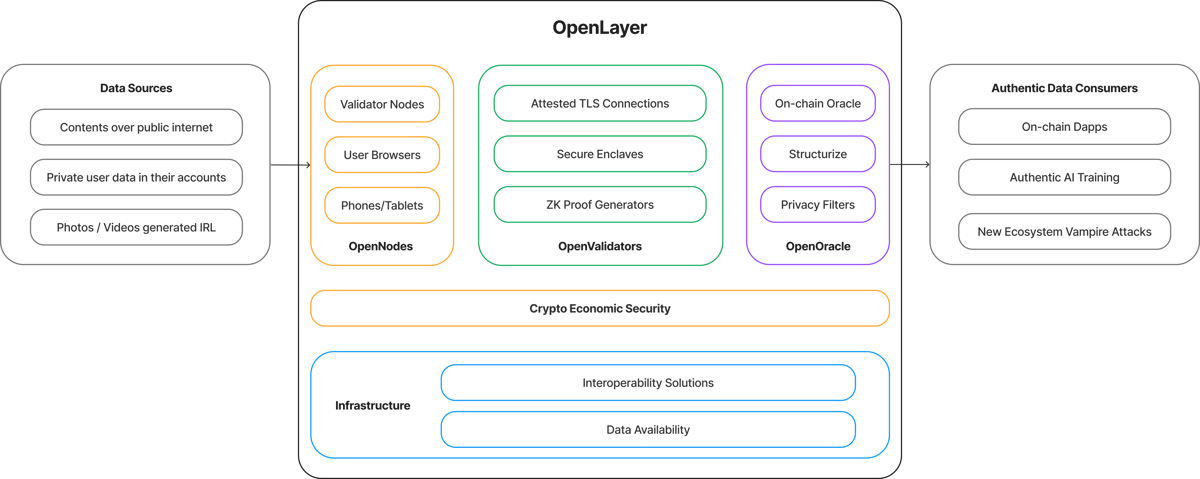
OpenLayer’s service use cases span multiple categories:
-
Applications requiring accurate and authentic data inputs
-
AI model training that sources legally compliant data from online and offline origins
-
Companies aiming to bootstrap their platforms by leveraging user identities and reputations from existing platforms
OpenLayer connects data supply and demand by providing modular solutions that coordinate data collection, validation, and transformation, enabling flexible combinations between data sources, consumers, and specific validation methods.
In terms of interoperability, OpenLayer integrates multiple interoperability solutions such as Avail, NodeKit, and LayerZero, ensuring its data solutions automatically reach as broad a customer base as possible.
The OpenLayer ecosystem will include roles such as data users, requesters, node operators, and validators—all operating in coordination with OpenLayer and restaking via EigenLayer.
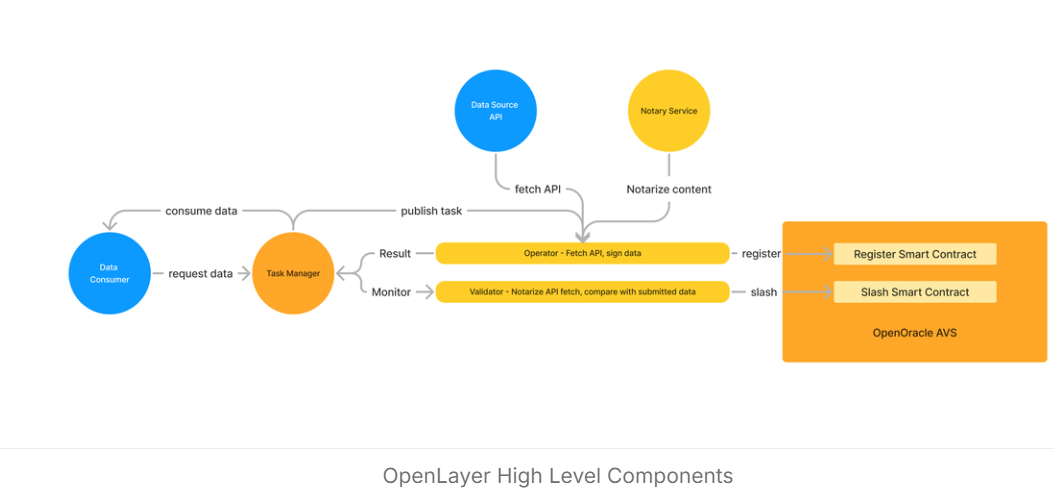
A requester specifies a symbol and posts a request as a task to OpenLayer’s smart contract. Once the task is completed, they can read the result from the smart contract. Node operators perform the following actions to begin supplying data to OpenLayer.
For certain task types, each operator may return different results. An operator type known as an aggregator standardizes and consolidates these results into a consistent output. The attestation service acts as a witness on one end, verifying that operators actually made the API calls and did not report random or fabricated data to the oracle. Validators serve as guardians of the ecosystem, monitoring new tasks and responses from node operators.
Earning Points
Jiang, co-founder of OpenLayer and former tech lead at Robinhood, revealed that the protocol plans to issue a token in the future, and current points earned through the incentive program may be redeemable for tokens later. Users can install the OpenLayer Chrome extension, log in, and connect their wallet to earn points in three ways.
The first method involves clicking on an egg to collect points, with up to four feedings allowed per day. The second requires connecting a Coinbase wallet and a Twitter account to complete registration and earn points. The third is a common referral mechanism.
Currently, several social networks, gaming platforms, and AI companies are using OpenLayer to query and leverage verified user data, and OpenLayer charges for such access to ensure revenue.
Join TechFlow official community to stay tuned
Telegram:https://t.me/TechFlowDaily
X (Twitter):https://x.com/TechFlowPost
X (Twitter) EN:https://x.com/BlockFlow_News
 Foresight News