DEXX Revelation: On-Chain Survival Rules for Navigating the Trading Bot Security Dilemma
TechFlow Selected TechFlow Selected
DEXX Revelation: On-Chain Survival Rules for Navigating the Trading Bot Security Dilemma
There is always a trade-off between high returns and absolute safety.
 Navigating Web3 tides with focused insights
Author: SafePal
"Dark Forest," a concept derived from the science fiction novel *The Three-Body Problem*, serves as a stark metaphor for today's Web3 security landscape: While blockchain offers vast possibilities and innovative applications, it also resembles a "dark forest" filled with brutal, zero-sum games—where ordinary investors are often the hunted, disadvantaged by information asymmetry.
On November 16, multiple community users reported that the on-chain trading terminal DEXX had been compromised. Post-incident analysis revealed critical flaws in DEXX’s private key management—keys were reportedly transmitted and stored in plain text. The total loss, according to incomplete estimates, exceeds $20 million.
Against this backdrop, how can average users strengthen their self-protection mechanisms on-chain? This has become a pressing concern. Veronica, co-founder and CEO of SafePal, participated in an 𝕏 Space hosted by 137Labs titled “Security Reflections After the DEXX Incident: How to Avoid Pitfalls in Crypto Investing,” alongside Andy, founder of BlockSec; veteran trader Huisuo Ge; and OneOne, researcher at 137Labs. They discussed the DEXX security breach and offered practical safety advice for crypto investors.
This article summarizes the key insights shared during the Twitter Space discussion, compiled for readers.
The Heavy Cost of Front-Running Bot Tools
In crypto investing, high returns and absolute security are often mutually exclusive. Trading bots like DEXX and Unibot have gained popularity due to features such as one-click copy trading and rapid fund transfers. However, this convenience is built on centralized architectures that require users to grant fund access or wallet permissions—significantly increasing asset risk.
Users tend to underestimate the security implications of these tools. While they may trust major exchanges, they often overlook the risks posed by smaller platforms. The DEXX incident exposed fatal weaknesses in some trading tools’ private key management—a truly non-custodial wallet should store private keys exclusively on the user’s device, not rely on centralized servers. Even if encrypted, without memory-level security protections (such as TEE or enclave), private keys remain vulnerable to theft.
Moreover, the attack was highly sophisticated, with hackers dispersing stolen funds to complicate tracking. This makes recovery extremely difficult and suggests future attacks could be even more complex and harder to defend against. Two scenarios emerge: either the platform was breached due to technical vulnerabilities, or there was insider collusion or deep infiltration. If the latter, the potential risks are far graver.
Data from Dune shows that the top five trading bots by volume are Trojan, BonkBot, Maestro, Banana Gun, and Sol Trading Bot—all recording over $100 million in 7-day trading volume and each serving more than 300,000 users. This fuels a mindset of “get rich quickly or go broke,” causing most users to ignore significant underlying risks.

Image source: Dune
Veronica pointed out that nearly all such front-running trading tools face similar security risks. These bots achieve ultra-fast on-chain transactions—avoiding repeated manual signing—by sacrificing some degree of security and non-custodial design:
Whether using hardware wallets, app wallets, or browser extension wallets, users normally spend several seconds manually confirming each transaction. But to enhance speed and user experience, these bots often compromise, reducing private key security to the minimum to enable faster execution.
This trade-off isn’t inherently wrong, nor does it mean every project is unsafe. However, it places immense demands on the development team’s security capabilities. If teams lack robust defenses, pursuing seamless UX can lead to catastrophic consequences—users and projects alike may suffer massive losses.
Beyond this, most current trading bots have a clear security flaw: To enable automation, they typically generate and store private keys for each user. While convenient for automated copy trading, this creates high risk—if attackers breach the platform, all stored user private keys could be exposed, resulting in asset loss.
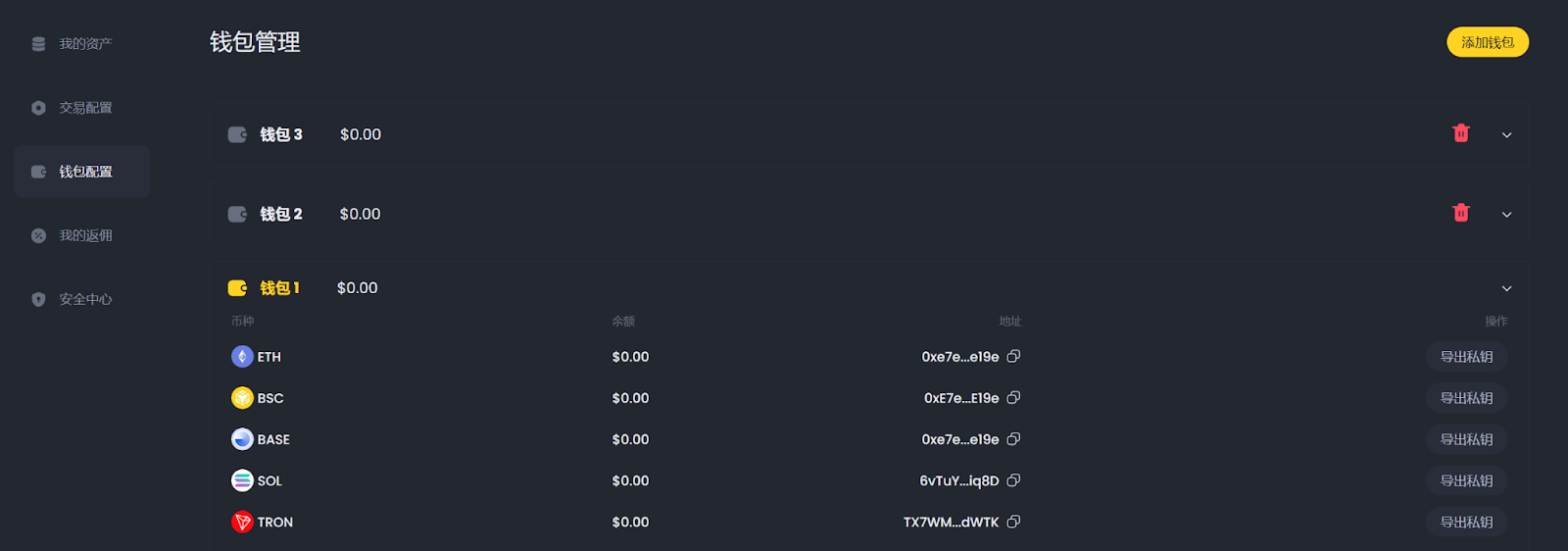
Image source: DEXX “Wallet Management” page
Yet there exists a safer alternative architecture that enables automated trading without accessing user private keys:
This approach relies on smart contracts, creating a "PDA account" linked to the user’s wallet, allowing transactions without requiring private key signatures. The platform can use a restricted "operator account" to execute trades, but its permissions are strictly limited—only able to perform trades, never freely transfer user assets.
Such smart contract-driven designs greatly enhance security, as private keys remain solely under user control and are never stored on centralized servers. Though more complex and demanding higher engineering and security expertise, this model is both feasible and significantly safer.
Currently, most users are unaware of the difference between these two models—or prioritize convenience over security. But as security incidents increase, both users and developers may increasingly favor secure architectures. This advanced design could gradually become standard, helping prevent future DEXX-like events.
The Web3 Security Chain: From Transaction Approvals to Private Key Protection
OneOne believes current on-chain security risks can be broadly categorized into two areas: transaction approvals and private key protection.
The first common attack vector is “Approve Phishing.” For example, attackers send small amounts of tokens or NFT airdrops (“dusting attacks”) to trick users into clicking and authorizing transactions. Once authorized, attackers gain partial wallet access and can steal assets—including cryptocurrencies and NFTs. Users should handle unknown tokens and airdrops cautiously and avoid unnecessary approvals.
Private key theft generally occurs through several methods:
-
Malware attacks: Attackers pose as project teams inviting users to test new products, luring them into downloading executable files containing trojans. Once installed, private keys and account passwords can be easily stolen.
-
Clipboard hijacking: Through phishing websites, attackers gain clipboard access. When users copy and paste private keys, sensitive data is intercepted and exploited.
-
Remote control attacks: Using malicious remote software, attackers take control of users’ computers—even stealing private keys while users sleep. Tools commonly used by airdrop farmers, such as “fingerprint browsers,” often involve cloud storage. If compromised, assets are easily stolen. Many users fail to set up two-factor authentication (2FA), further increasing risk.
-
Input method vulnerabilities: Many users prefer smart input methods, which may collect and upload keystroke data to the cloud, raising the risk of private key exposure. It’s recommended to use system-default input methods, which offer fewer features but greater security.
Overall, when conducting on-chain transactions—especially when interacting with DeFi apps or trading tools—users must take extra precautions. Authorization management is particularly critical: Ethereum’s mechanism requires users to approve token spending for smart contracts, which attackers can exploit. Therefore, users should regularly review their wallet’s approval list and revoke unused permissions—especially forgotten early authorizations—to reduce risk.
When choosing DeFi platforms, users should assess their security measures, including whether comprehensive audit reports exist, continuous automated monitoring is in place, and whether the platform regularly updates and patches vulnerabilities. When using trading bots, it’s advisable to diversify asset management—do not keep large sums in accounts controlled by trading robots. Withdraw profits promptly to more secure wallets to minimize potential losses.
Huisuo Ge emphasized that as a trader, understanding the mechanics of trading tools and platforms is crucial. In today’s speculative trading environment, many focus only on price volatility and excitement, ignoring the hidden dangers in trading tools. Traders should set up security alerts—for instance, pool drain or liquidation warnings—to maintain constant risk awareness.
Veronica stressed a simple yet vital principle: There is always a trade-off between efficiency in profit-seeking and full security. The most important advice is proper fund segregation—if you find yourself losing sleep or constantly checking your phone due to large investment positions, it likely means your capital allocation has exceeded your risk tolerance.
What Practical On-Chain Security Tools Are Available?
Veronica recommends using built-in security tools in non-custodial wallets like SafePal—for example, regular authorization checks. Users can scan all their cross-chain approval records and revoke unnecessary ones with one click, reducing the chance of exploitation by hackers.
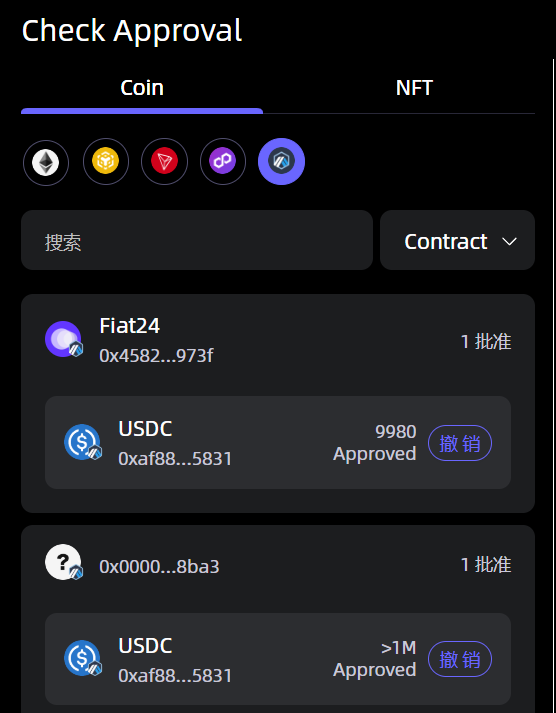
Image source: SafePal “Approval Manager” feature
In addition, scammers often use small transactions to mimic legitimate addresses and deceive victims. Leading wallets such as OKX Web3 Wallet and SafePal now include transaction interception services targeting “address spoofing” (e.g., first/last character replacement). Furthermore, combining hardware wallets with a passphrase (also known as a 13th seed word) is an underutilized but powerful feature—ideal for users managing multiple trading accounts:
The passphrase acts as a 13th word, combining with the original 12-word recovery phrase to generate an entirely new wallet address. Even if someone obtains your 12-word seed, they cannot access your funds without the passphrase. This allows users to create multiple isolated wallets securely.
This method enhances private key security and enables flexible multi-account asset management. Since the passphrase can exist only in the user’s memory, it adds another layer of protection.
Andy also noted that beyond project-side risks, many security incidents stem from poor user habits. Even when users know they hold substantial crypto assets or understand investment risks, bad practices still leave them exposed.
He advises cultivating a habit of isolation: Store large holdings in cold wallets that allow interaction but prohibit direct fund transfers. Use a dedicated device (like an iPhone) exclusively for managing crypto assets—install only essential crypto apps, no other software or activities. This significantly reduces the risk of private key leakage.
Conclusion
The DEXX security incident highlights a core dilemma in the on-chain trading tool space: How to balance convenience and security?
While striving for efficient trading and superior user experience, platform security must not be sacrificed. Whether it's centralized private key storage or insufficient memory-level protection, any technical weakness exposes user assets to high risk.
“There’s always a compromise between high returns and absolute security.” For investors, understanding the risk logic behind trading tools and developing sound security habits form the foundation for navigating the on-chain “dark forest.” In this decentralized and uncertain ecosystem, only by controlling your own private keys can you truly own your assets—and help drive the entire on-chain ecosystem toward healthier development.
Join TechFlow official community to stay tuned
Telegram:https://t.me/TechFlowDaily
X (Twitter):https://x.com/TechFlowPost
X (Twitter) EN:https://x.com/BlockFlow_News