








DeSci: A New Path for Scientific Funding
TechFlow Selected TechFlow Selected
DeSci: A New Path for Scientific Funding
This article explores the methods and attempts made by the technology sector in the field of life sciences from 2011 to 2021 to innovate and reform scientific research funding and institutions.
 Navigating Web3 tides with focused insights
Author: Nadia Asparouhova
Translation: LlamaC
 (Portfolio: Burning Man 2016, about Tomo: eth Foundation illustrator)
For those situated at the intersection of science and technology, it’s hard not to notice the surge of new initiatives over the past two years specifically aimed at improving the life sciences.
Though I have no scientific background and no personal connection to the field (aside from knowing and liking many people involved), I’ve become curious about why this area is suddenly changing—especially from a philanthropic perspective. Figuring out what works in science could help us tackle other similarly-shaped problems in the world.
To understand what’s happening, I examined examples of tech-related efforts in science over the past decade (roughly 2011–2021). I looked for patterns that could help me infer the norms and values of the time, as well as turning points that shifted these attitudes. I also interviewed many people in the space to fill gaps and learn about their values and visions of success.
One caveat: For complex questions like “why has this culture changed,” clear answers are rarely possible, so please treat this article as a starting point for further exploration.
Problems in Science
When people say they want to “do science better,” what problems are they trying to solve—and how?
Those working in or around science seem to broadly recognize several observations. These themes have been widely and more thoroughly discussed elsewhere, so I’ll only briefly mention them:
The funding process for scientists is slow and bureaucratic
The popularity of Fast Grants—a rapid grant program launched during the COVID-19 pandemic—illustrates the lack of options available to scientists. Its founders noted in a retrospective that they were surprised by the number of applicants from top twenty research institutions: “We didn’t expect people at elite universities to struggle financially during the pandemic.” Yet, in a survey sent to grant recipients, 64% said their work would have been impossible without the Fast Grant.
The academic reward system, while functional, doesn't select for the best work
Scientists are expected to publish their findings in journals, and their reputations are measured by citation counts. But peer review tends to favor consensus over risk-taking, and scientists feel pressure to prioritize quantity over quality—among many other issues.
Early-career scientists are disadvantaged
Science is trending toward older, more experienced researchers. Most NIH funding goes to senior scientists, and the age at which scientists make Nobel-worthy discoveries is increasing.
Defining a Theory of Change
Why do these problems matter? If we had to answer the “so what” question for the above observations, we might say that due to these systemic challenges, scientific progress isn’t as strong as it could be. Compared to historical periods like the Victorian era or the Cold War, promising, talented scientists today seem to struggle to pursue their work—especially when their ideas are experimental or unproven.
Alexey Guzey, founder of New Science, pointed out in a 2019 survey of life sciences that scientists have learned to work around these problems—for example, applying for grants with "boring" ideas and then using part of the funds to pursue "experimental" ones. It’s reasonable to assume that if scientists didn’t have to navigate such constraints, more work could get done. For instance, from the aforementioned Fast Grants survey, 78% of respondents said they would “significantly” change their research plans if they had access to “unrestricted, permanent funding.”
If we were to write a tech-flavored theory of change for science, it might look like this:
By removing financial and institutional barriers faced by the world’s top scientists, ensure that scientific progress can flourish, allowing them to fully follow their curiosity and produce research that benefits humanity.
Within this statement, practitioners differ on what they see as the most important activities:
-
Some people I spoke with believe insufficient funding or slow funding processes are the biggest leverage point: give scientists money and let them freely pursue their ideas.
-
Others believe academic norms are the larger obstacle: research should operate more like startup culture.
-
Still others see a divide between those focused on basic research and those who want to apply findings: the latter want to move research to market faster so humanity can benefit from scientists’ work.
I’ll explore some of these approaches in more detail in the following sections.
Science can also be seen as a subset of a broader problem statement: “How do we support a research culture in tech?” For example, artificial intelligence falls under this umbrella but has a different trajectory and funding history. So does human-computer interaction (HCI) and “thinking tools.” Even “science” itself is an extremely broad category, as we’ll see in the coming sections. (Note: Special focus on improving the scientific process is sometimes called “meta-science.”)
In this case study, I focus only on the overlap between scientific research and tech over the past decade. However, in many cases, tech’s attitude toward research influences how we think about science—and vice versa—so I’ll occasionally reference that here.
Now that I’ve laid out these caveats, let’s examine what today’s practitioners have in common. Looking back at the theory of change above, what’s unusual or significant about the tech-native approach to science?
To me, one standout aspect is the emphasis on supporting and attracting top-tier scientific talent. There’s an implicit assumption here that individual scientist quality matters—even that leaps in science may stem from contributions by a few geniuses rather than the entire scientific community. (A meta-analysis by José Luis Ricón seems to support this, though he notes conclusions may vary by field.)
This focus on “top talent” feels very tech-like, similar to how founders approach startups. While no meritocracy is perfect, tech culture thrives partly because companies tend to care less about pedigree or tenure and more about actual output. Prioritizing high-quality talent also helps organizations avoid decline as they scale. So it’s no surprise that the tech world applies this mindset to science.
Second, there's a consistent emphasis on output—especially moving research to market. Again, this “results-oriented” approach feels very characteristic of the tech industry: the belief that basic research should ultimately serve a long-term goal of benefiting humanity—and that we should shorten that timeline as much as possible.
Most people I spoke with believe that if you can commercialize your work, you should—of course, recognizing not everything can be commercialized. Even nonprofit science projects often emphasize startup-inspired values like speed, proof-of-concept, and collaboration.
Finally, there’s a prevailing implicit belief among today’s practitioners that change is exogenous: we must work outside institutions, exerting influence from the outside to achieve these goals. While some organizations do partner with universities, they still operate outside traditional academic career paths.
These values may seem obvious to those in tech, but if we return to the high-level vision of “ensuring scientific progress can flourish,” applying these values excludes options non-tech practitioners might pursue—such as creating postdoctoral programs, improving tools in university research labs, or expanding STEM graduate admissions.
With these values in mind, let’s now look at how tech-driven research funding has evolved over the past decade.
Driving Scientific Innovation Through Startups (2011–2014)
A recurring theme I heard in conversations was that the problem statement around science hasn’t significantly changed over the past decade. For a long time, there’s been widespread awareness that science isn’t working as well as it should, and a desire to do something about it. However, views on how to fix it have evolved.
Ten years ago, most believed that startup companies were the best way to advance science: either by founding companies or funding them.
At the time, economist and writer Tyler Cowen’s 2011 book The Great Stagnation provided a philosophical foundation for thinking about scientific progress. Cowen made broader arguments about economic stagnation in the U.S., but identified the lack of scientific breakthroughs and slowing technological progress as key causes.
Cowen dedicated the book to Peter Thiel, who had publicly discussed the decline in technological innovation. In The Great Stagnation, Cowen cited an interview where Thiel said: “Pharmaceuticals, robotics, AI, nanotechnology—all of these fields have advanced far less than people imagine. The question is why.”
Around 2011, Thiel also adopted Founders Fund’s now-infamous slogan: “We wanted flying cars, instead we got 140 characters.” Thiel turned this into an investment thesis, revealing his theory of change: scientific progress would be solved through markets—not by funding basic research.
It’s hard to pinpoint exactly why startups became the preferred vehicle for science at the time, but the simplest explanation is their general popularity in the 2010s. Y Combinator played a major role in making startups more accessible and appealing. Founded in 2005, it reached cultural prominence in the 2010s, with many of its most successful alumni launching or scaling companies during that period. Marc Andreessen’s 2011 essay “Software is eating the world” captured the mood: software-driven startups could solve diverse problems across industries.
Besides Breakout Labs (which, though a grant program, was structured as a revolving fund earning revenue from grantees’ IP or royalties), notable science-focused efforts at the time were typically startups or venture capital funds. Examples include:
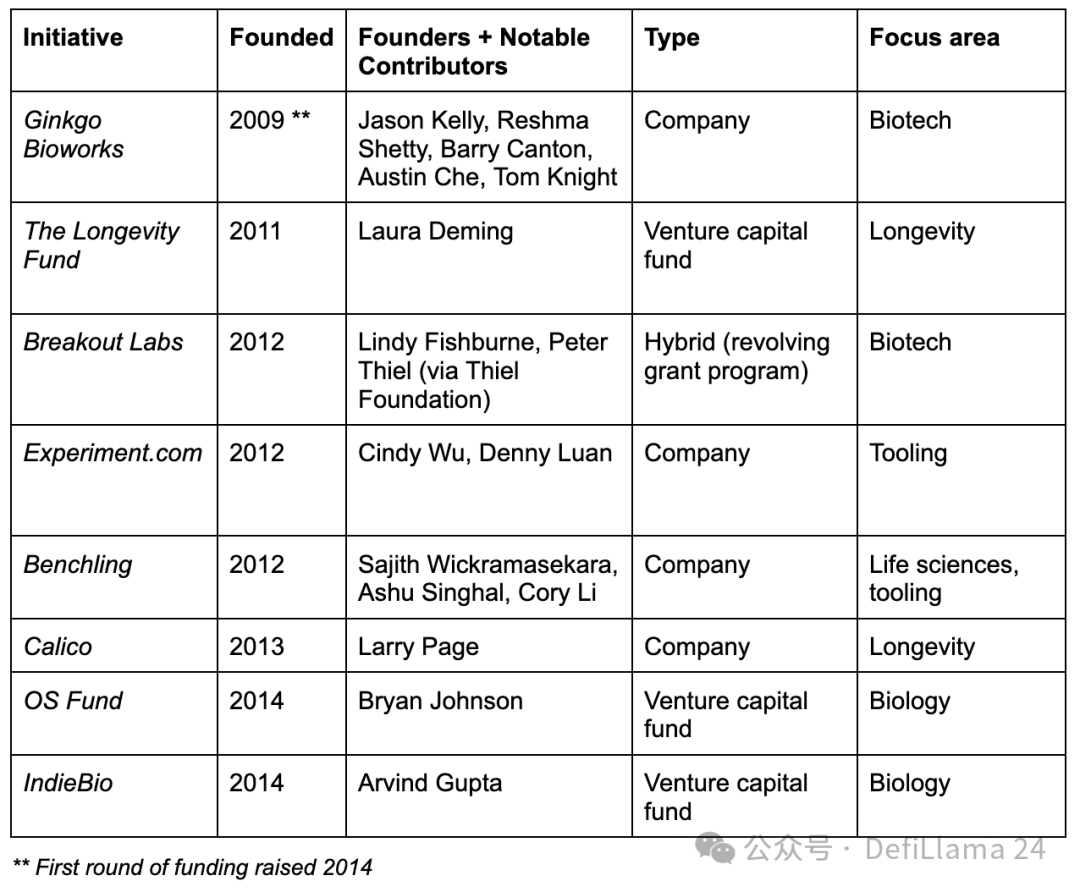
Beyond startups, two prominent research sponsors in tech were closer to science and reveal how research was viewed at the time:
Google X: Quietly founded in 2010 and first revealed by The New York Times, Google X was described as a secret lab within Google focused on “moonshot ideas.” Google X popularized the term “moonshots” and now describes itself as a “moonshot factory.”
MIT Media Lab: Now described as an “interdisciplinary research lab,” it wasn’t focused on science per se but was often cited as a symbol of tech-academic research culture. It thrived in the 2010s under its charismatic leader Joi Ito, until his abrupt resignation in 2019 due to controversial financial ties.
Early Philanthropic Approaches (2015–2017)
-
By the mid-2010s, tech exits had generated enough personal wealth that some investors began experimenting with traditional philanthropy.
-
In 2015, Y Combinator announced the creation of a nonprofit research arm, YC Research, initially funded by a $10 million personal donation from its president, Sam Altman. Though not directly involving science (its first projects focused on universal basic income, cities, and human-computer interaction), YC Research signaled a shift in cultural attitudes. As Altman explained in his announcement, sometimes “startups aren’t the right model for certain types of innovation”—a novel idea at the time:
Our mission at YC is to promote innovation as much as possible. This mostly means funding startups. But for certain kinds of innovation, startups aren’t ideal—like work that takes a very long time, seeks to answer very open-ended questions, or develops technologies that shouldn’t be owned by any single company.
He emphasized, however, that YC Research would still operate differently from typical research institutions (emphasis mine):
We think research institutions can be better than they currently are… Researchers’ compensation and power wouldn’t be driven by publishing large numbers of low-impact papers or speaking at numerous conferences—the whole system seems broken. Instead, we’ll focus on the quality of output.
That same year, Mark Zuckerberg and Priscilla Chan announced they would donate 99% of their Facebook shares to charity via the Chan Zuckerberg Initiative (CZI). Like YC, CZI chose a different structure—forming as an LLC rather than a 501c3 nonprofit (like most foundations)—believing this would give them “greater flexibility to execute our mission.”
CZI’s first commitment was $3 billion to “cure, prevent, or manage all diseases in our children’s lifetime,” to be distributed over ten years. Of that, $600 million was allocated to create Biohub, a research center at UCSF in partnership with Stanford and UC Berkeley.
In their joint statement, Zuckerberg explained that slow progress in life sciences stems from current funding and organizational models (emphasis mine):
Building tools requires new models of scientific funding and organization… Our current funding environment doesn’t really incentivize much tool development… Solving big problems requires bringing scientists and engineers together to work in new ways: sharing data, coordinating, and collaborating.
The following year, in 2016, Sean Parker founded the Parker Institute for Cancer Immunotherapy. Parker echoed similar concerns about how science is conducted (emphasis mine):
The cancer problem isn’t just a resource problem—it’s a problem of how we allocate those resources… The system is somewhat broken… Institutions responsible for funding most scientific research typically don’t encourage scientists to pursue their boldest ideas, so we don’t get ambitious science.
Compared to the first half of the 2010s, this period saw emerging interest in funding basic research and a growing recognition that startups alone couldn’t achieve the desired outcomes—though donors emphasized the importance of innovative research culture, with greater focus on tech-inspired outputs, collaboration, and tool-building.
Other projects launched around this time reflecting these trends include:
-
Open Philanthropy: A research and grantmaking organization broadly focused on improving philanthropy, with initial focus areas including biological research. Open Philanthropy became independent in 2017 but grew out of earlier collaborations between Good Ventures (Dustin Moskovitz and Cari Tuna) and GiveWell.
-
OpenAI: A nonprofit initially described as a “nonprofit research company,” launched in 2015 with a $1 billion pledge from Elon Musk, Sam Altman, and others. (OpenAI later transitioned to a for-profit structure.) Though not science-focused, OpenAI became one of tech’s largest research projects in recent years. Its initial announcement emphasized open publishing, open patents, and collaboration.
During this period, despite stated interest in improving researcher collaboration, one thing seemed missing: coordination among donors. Instead, each effort felt centered on the donor rather than collectively tackling a clearly defined problem through multiple approaches.
This isn’t a criticism, but highlights the difficulty early major donors faced in learning how to strategically address scientific problems through non-startup methods and define their philanthropy beyond traditional expectations—compared to today’s cohort.
Field Building and New Institutions (2018–2021)
In recent years, coordination among funders and founders has tightened, helping spawn a wave of new science initiatives.
A 2017 NBER working paper titled “Are Ideas Getting Harder to Find?” argued that “research effort is rising sharply while research productivity is falling rapidly,” reigniting debate on scientific innovation. In 2018, Patrick Collison and Michael Nielsen published an essay in The Atlantic featuring original research making a similar argument: despite “more scientists, more funding, more published papers than ever before… is our scientific understanding growing proportionally?”
The following year, Patrick Collison and Tyler Cowen published another related piece in The Atlantic: “We Need a New Science of Progress,” proposing that “the world would benefit from an organized effort to understand” progress—including identifying talent, incentivizing innovation, and the benefits of collaboration.
Though their essays broadly addressed progress, science was a central example. Collison and Cowen noted: “While science produces most of our prosperity, scientists and researchers themselves haven’t paid enough attention to how science should be organized,” and “critical evaluation of how science is practiced and funded is in short supply, perhaps unsurprisingly.”
The Atlantic essays—along with extensive follow-up efforts—helped form the “progress studies” community, providing a much-needed intellectual home and social network for those interested in topics like scientific advancement.
Though today’s science practitioners aren’t formally affiliated with progress studies (most would likely say they’re not part of it), and progress studies covers far more than science, I believe this community formation helped:
-
Serve as a coordination point for like-minded individuals, attracting more talent into the space, and
-
Legitimize practitioners’ work.
In 2021, a group gathered for an in-person “Tech Bottlenecks Workshop” premised on the idea that bottlenecks “exist across the entire science and tech landscape, and solving them could bring massive gains to the entire field.” Attendees included founders and investors, many already working on science-related projects like Fast Grants, Convergent Research, and Rejuvenome.
The workshop was well-received. It helped people connect, strengthened shared approaches and interests, and even sparked new collaborations.
Below are some science initiatives launched in recent years. Notably, there’s diversity in experimentation within a shared problem space, along with increased coordination among funders and founders (note the overlap between initiatives). Compared to the more isolated, siloed approaches of the 2010s, these are signs of a healthy, thriving ecosystem.
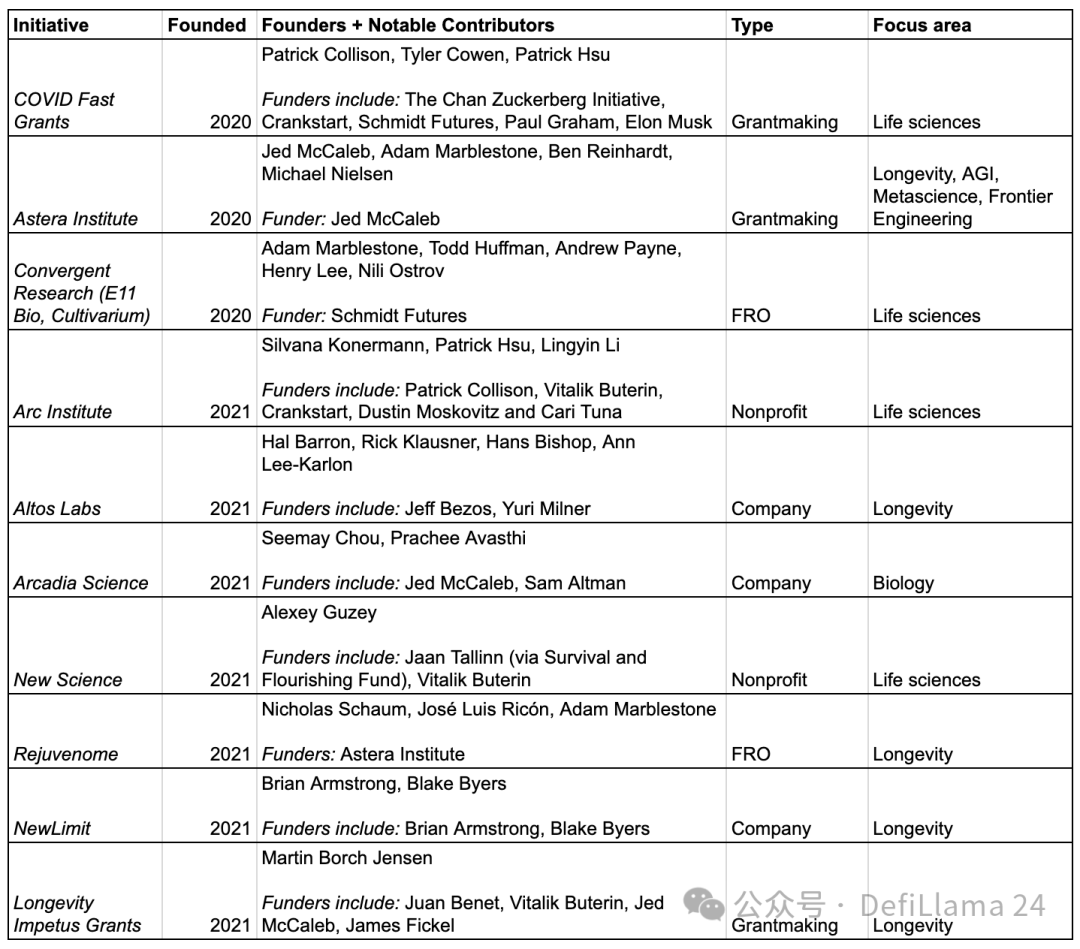
Most of these initiatives focus on life sciences. I asked several people why this might be. Possible reasons include:
-
Personal connections and interests: Some funders and founders have pre-existing ties or backgrounds in life sciences.
-
Storytelling and public narrative: Life sciences involve curing diseases, extending lifespan, reproductive medicine, and genetics. The benefits of such work are easier for the public to grasp compared to, say, space exploration—especially after a global pandemic.
As noted, this group is characterized by diverse approaches: a mix of for-profit and nonprofit efforts, and combinations of funding and operating organizations. We also see variation across levels of systemic change (organization vs. individual), types of research (basic vs. applied), and project time horizons (short-term vs. long-term).
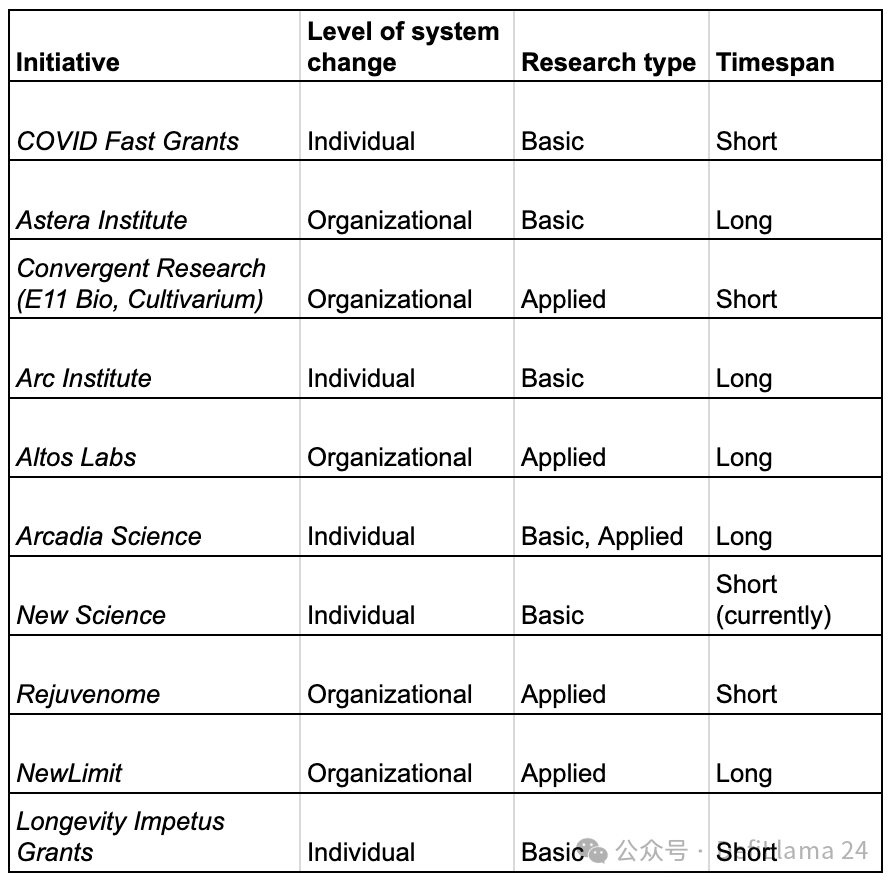
Why So Many New Initiatives Today?
Though there’s long been a cohort of science-interested practitioners, only recently has funding surged to the point where long-held ideas can be implemented. (For example, Adam Marblestone and Sam Rodriques had been thinking about focused research organizations for years before securing funding.)
Some funders downplay their role as “funders,” but I believe it’s important to highlight good grantmaking practices. Specifically, today’s tech-based science funders aren’t just “throwing money at problems,” but are strategically using classic philanthropic methods to build a new field. Two key efforts laid the groundwork:
-
Better coordination: Increased coordination and co-funding among donors helps them learn from each other, make larger bets, and gives practitioners confidence to pursue long-term work;
-
Field building: Demonstrating these are interesting, worthy problems attracts others into the space and legitimizes practitioners’ work.
What caused renewed interest in funding science? Likely several factors—some external conditions, others results of deliberate effort:
Global Pandemic
By forcing people to confront large, seemingly immovable systems, the pandemic helped us realize the world is more malleable than it appeared. Frustration with bureaucracy, inability to escape it, and realizing immediate action—not distant future change—could improve things.
Fast Grants was launched in direct response to the pandemic, and its success influenced Arc Institute’s vision. The Longevity Escape Velocity Grants were also inspired by the Fast Grants model, albeit with a different focus.
The founder of Arcadia Science directly noted that the pandemic “sparked urgency, collaboration, and enthusiasm for scientific progress beyond our usual circles. The resulting vaccine development demonstrated how powerful collaboration among scientists and science itself can be.”
One person I spoke with believes geographic dispersal caused by the pandemic may have disrupted Silicon Valley groupthink, exposing people to new ways of thinking and making non-startup approaches more acceptable.
Successful Field Building and Better Coordination Among Practitioners
Publishing articles, hosting workshops, and forming the progress studies community made it easier for like-minded people to find and coordinate with each other. As Luke Muehlhauser noted in his early field growth report for Open Philanthropy, while these methods may seem “obvious,” they are also “often effective.”
In my conversations, long-time practitioners remarked that while people have been interested in this space for decades, only in recent years have they been surprised to discover (in their words) “there are more people like us than I thought.”
Even among practitioners who’ve known and worked with each other for years, field building has elevated their work’s status—making it feel more like being a startup founder—which continues to attract others.
Several people commented on this effect. One said such projects (i.e., launching ambitious non-startup ventures) were previously considered “unfundable,” but now a few people have “made it cool.” Another felt that while average tech workers might not yet understand their work, it no longer feels “low-status.”
Crypto Wealth Boom
2017 and 2021 were two major inflection points for crypto wealth creation. We’re beginning to see downstream effects from the first boom and may see impacts from the second in coming years.
Crypto has had both direct and indirect impacts on science funding. First, practically, it created a new pool of potential funders. Today’s active crypto funders in science are largely beneficiaries of the 2017 crypto boom—just as Mark Zuckerberg, Dustin Moskovitz, and Sean Parker were beneficiaries of Facebook’s 2012 IPO and became active philanthropists years later.
Second, crypto wealth has emboldened “traditional tech” to take bigger cultural risks. While hard to prove, it’s akin to an Overton window shift: the emergence of a group holding more extreme views makes previously radical positions seem plausible. In tech, the fact that the crypto industry seriously wants to rebuild society from scratch makes creating a new 501c3 research institute seem less strange.
Other macro conditions may have shifted tech’s interest in funding new science projects: cheap capital during bull markets; growing public disillusionment with traditional institutions; a wave of liquidity events generating new wealth in late 2010s; and a fundamental shift in tech’s relationship with mainstream culture since mid-2010s. These are beyond the scope I want to cover here, but worth noting as contributing factors.
Measuring Success
Finally, I wanted to understand how today’s practitioners think about measuring impact. Ten years from now, how will we know if these efforts succeeded?
Almost everyone I spoke with mentioned some version of the “$100 billion question” (a term credited to David Lang), referring to the relatively small scale of private capital compared to federal R&D spending, which exceeds $100 billion annually in the U.S. Based on estimates, the latest wave of initiatives represents billions of dollars—significant, but still a fraction of government capacity.
Given these financial constraints, participants instead think about demonstrating possibilities to inspire improvements in federal funding (especially NIH funding in life sciences), rather than competing dollar-for-dollar. This aligns with the role of philanthropic capital in civil society: not to compete with or replace government, but to seed new ideas through private experiments that don’t affect public taxes. For example, U.S. public libraries, schools, and universities were shaped by early philanthropy.
Those choosing to launch companies rather than nonprofits are similarly driven by a desire to extend capital longevity. If a company succeeds, it can inspire other tech startups, given abundant venture capital. In contrast, successful nonprofits rarely inspire more nonprofits (even if they influence each other’s practices), due to limited charitable capital, creating a more competitive zero-sum dynamic.
Below are some near-term and long-term goals I heard in conversations, along with suggestions for measuring them.
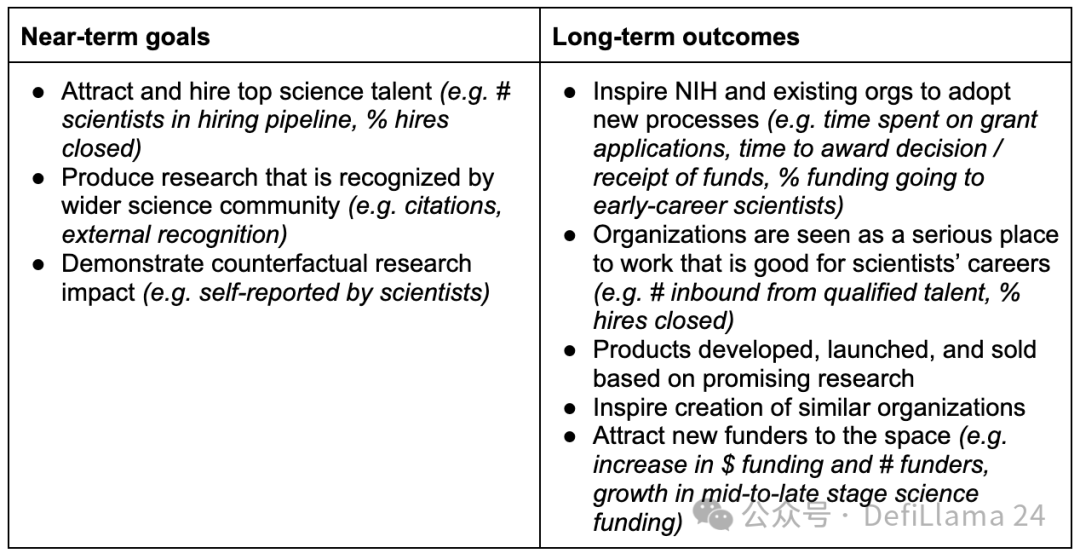
Epilogue: DeSci and New Crypto Primitives
There’s one final chapter, which I place in a separate “epilogue” because it’s both new and distinctly different from the above approaches—yet serves as an important contrast to everything covered so far.
If we zoom out and consider how science gets funded and supported, we can take multiple approaches. Public goods aren’t funded only by governments—they can also be shaped by markets (i.e., startups) and philanthropic capital. All the examples we’ve seen so far, however novel they appear, fall into one of these existing categories.
There’s another, more radical approach, which I (reluctantly) call the crypto-native method. Its proponents argue that while the above efforts are positive developments, they ultimately replicate the same problems of our existing traditional systems. They’d say that creating new institutions without rewriting their core incentive structures won’t solve anything long-term: it merely resets the clock on institutional decay.
Even within the “traditional tech” group, there’s wide variation in answers to “Are we trying to create new public institutions, or just improve existing ones?” Some initiatives are thinking long-term about avoiding institutional decline, such as limiting funding or organizational size. Still, most people I spoke with seem to align with the “$100 billion question” approach: deploying limited funds efficiently to create outsized impact at the federal level.
In contrast, crypto-native supporters aim to invent entirely new ways to fund public goods. While they share the long-term vision of improving scientific progress, attracting top talent, and pushing research to market, their strategy differs. Their theory of change might look like this:
By inventing new ways to reward scientists, improve collaboration, evaluate, and enhance the quality of their work, ensure that scientific progress can flourish, enabling them to fully pursue their curiosity and produce research that benefits humanity.
In my conversations, I heard nearly identical phrasing from supporters of different methods: “The existing systems in academia, research, and government are designed to produce a certain set of outcomes. Nothing will change unless we invent new rules of the game.” Yet in traditional tech, new rules mean creating new institutions (but core organizational principles are seen as static), whereas in crypto, it means designing entirely new incentive systems (where organizational principles are seen as malleable).
At a 2021 virtual conference hosted by Protocol Labs on funding public goods—“Funding the Commons”—founder Juan Benet gave a talk titled “Crossing the Innovation Chasm.” He noted that over the past decade, the startup ecosystem achieved remarkable success in R&D innovation by productizing new technologies. From his view, Y Combinator contributed far more to R&D innovation than Alphabet or Ethereum.
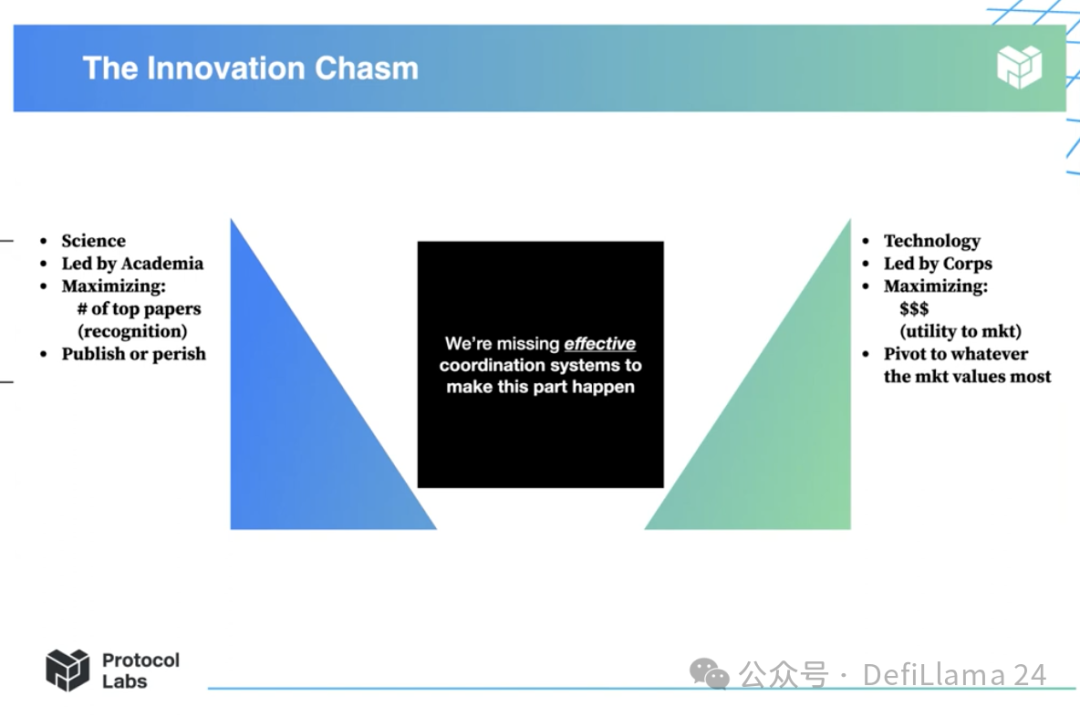
Yet while basic research efforts focus on solving problems in the “blue triangle” above, they neglect the missing “black square”: translating research into real-world innovation. Just as the tech ecosystem created billions in VC funding for startups, the crypto ecosystem could do the same for public goods.
To me, this touches the core difference between tech-native and crypto-native approaches to public goods. At their best, tech approaches generate wealth via startups, then redirect surplus wealth to charitable purposes (via for-profit or nonprofit initiatives). Crypto approaches, by contrast, aim to create native funding systems for public goods, allowing participants to generate wealth directly through the development of public goods themselves.
Vitalik Buterin’s talk at Funding the Commons echoed these points. He explained that blockchain communities are built more on public goods than private ones—open-source code, protocol research, documentation, and community building. Thus, he stressed that “public goods funding needs to be long-term and systematic,” meaning funding must come “not just from individuals, but from apps and/or protocols.” New crypto primitives like DAOs or token rewards can help meet these needs.
Some differences between crypto and traditional tech-native approaches:
-
Belief in capped vs. uncapped upside. Traditional tech acknowledges the $100 billion limitation, while crypto holds a broader view of possibility. One interviewee believes crypto networks could match federal funding levels within a decade. New crypto primitives could also vastly increase financial rewards for scientists. Whether achievable or not, I find this belief in uncapped upside inspiring.
-
Centralization vs. decentralization of talent. As noted, traditional tech focuses on helping exceptional scientists being slowly crushed by decaying bureaucracies. Crypto, by contrast, takes a more decentralized talent approach, attracting and coordinating a broader network of contributors. (As someone told me: “Scientific progress is a coordination problem.”) Crypto aims to provide tools so anyone can experiment (eventually filtering for top talent), rather than actively identifying and recruiting top individuals. We might see this as open-source vs. Coasian approaches to talent—a broader thematic difference between crypto and traditional tech.
While traditional tech and crypto offer two distinct approaches to solving scientific problems, there’s still crossover among funders. Donors aren’t categorized by location but by differences in theory of change. Some, like Vitalik, support both traditional tech and crypto efforts—a “diversified portfolio” approach to improving science.
Focusing further on crypto, an emerging movement is applying new primitives to science—sometimes called DeSci (decentralized science) in Web3 circles. While not everyone agrees with the term, I’ll use it here as shorthand for crypto-centric approaches to improving science, simply because it’s catchier.
Surprisingly, many DeSci practitioners have scientific backgrounds. These aren’t just crypto evangelists applying skills to a new domain—some scientists are leaving academic or industrial roles to dive full-time into DeSci.
Jessica Sacher, a microbiologist turned co-founder of Phage Directory, described her previous life as intensely “analog”:
I came from a molecular microbiology lab bench, where I wrote experimental methods and data in paper notebooks (on good days; other times on napkins and rubber gloves). In seven years at the bench, I barely used Excel.
Yet she was drawn to decentralized science (DeSci) because it offered an optimistic vision unavailable in academia (emphasis mine):
As I spent more time talking to people in tech/startups, I increasingly realized that the problems in science stem from artificial incentive systems, not from fundamental truths of the universe… This might be obvious to those already in tech, but it wasn’t to me as a biologist.
Joseph Cook is another DeSci supporter, an environmental scientist at Aarhus University in Denmark, focused on computational work. While he and other scientists agree “our current [scientific research] infrastructure is no longer fit for purpose,” he believes “decentralized models can be used to rewrite the rules of professional science.”
Interestingly, many DeSci participants also seem to have life science backgrounds or focus on life science projects—just like their traditional tech counterparts.
While the DeSci space is still evolving, here are a few experiments launched in the past year:
VitaDAO
VitaDAO is a community fund managed by a DAO, aiming to “fund and advance longevity research in an open and democratic way.” With over 4,500 members on Discord, it funds projects ranging from $25,000 to $500,000. As of January 2022, it had funded two projects totaling $1.5 million in research funding.
VitaDAO’s revenue model resembles Thiel’s Breakout Labs but with a crypto twist: VitaDAO members hold IP rights to funded projects (though negotiable), theoretically increasing the financial value of $VITA tokens. VitaDAO partners with Molecule, which calls itself the “OpenSea for biotech IP,” to develop an IP-NFT framework for managing intellectual property. (Molecule is launching a similar project for psychedelic research called PsyDAO.)
CryoDAO
CryoDAO is a DAO-managed community fund advancing cryopreservation research—e.g., developing new cryoprotectants to reduce toxicity, or tailoring cryoprotection protocols based on ischemic conditions.
CryoDAO aims to support cryopreservation research with high potential to improve preservation quality and capabilities. Cryopreservation technology has numerous current and potential applications in organ availability and even whole-body preservation.
OpScientia
OpScientia is building a platform to develop a new research workflow based on openness, accessibility, and decentralization. Examples include decentralized file storage for research data, verifiable reputation systems, and “game-theoretic peer review.”
It’s useful to compare OpScientia’s language with traditional tech’s talent-focused theory of change: OpScientia describes itself as “a community of open science activists, researchers, organizers, and enthusiasts” building a “scientific ecosystem that unlocks data silos, coordinates collaboration, and democratizes funding.”
LabDAO
LabDAO aims to create a community-operated network of wet and dry lab services, where members can run experiments, exchange reagents, and share data. Founder Niklas Rindtorff is a physician-scientist at the German Cancer Research Center in Heidelberg, Germany. LabDAO hasn’t officially launched but is actively developing, with nearly 700 members in its Discord community.
Planck
Planck aims to improve how scientific knowledge is created and rewarded by placing digital manuscripts on the blockchain, which they call “alt-IP.” Founder Matt Stephenson, a behavioral economist, once sold an NFT containing independent data analysis for $24,000.
Summary
Compared to previous years, there are now more pathways to improve scientific research, thanks to:
-
Changing macro conditions—like the pandemic, a series of tech liquidity events, and the crypto boom raising the ceiling of what’s imaginable;
-
Deliberate field-building efforts (writing, community building, conferences) that legitimize scientific work and attract talent;
-
Better coordination among funders (including co-funding opportunities) and practitioners.
New science startups continue to emerge—like New Limit, Arcadia Science, and Altos Labs. But now we also see research institutes like Arc Institute and New Science, and emerging crypto-native experiments like VitaDAO and LabDAO. No single approach replaces another; instead, more people are trying different things—a sign of a growing, vibrant field.
Tech remains dominated by startups and likely will for a long time. But as tech matures as an industry and more extreme wealth outcomes emerge, there’s now (as expected) growing interest in using philanthropic capital to tackle ambitious problems.
Crypto pushes this further by developing new primitives for public goods. Worried that traditional philanthropy repeats the mistakes of traditional institutions, it seeks new ways to reward scientists and enable them to share uncapped returns. If successful, it could have an impact on science (and other public goods) comparable to what startups did for venture capital.
Tech-native and crypto-native theories of change differ fundamentally. Tech emphasizes recruiting top talent but retains reward structures similar to current science and startups. Crypto embraces a more decentralized, networked talent model and is more willing to reimagine foundational structures like patents, IP, and even research labs. Both groups believe in improving traditional institutions through external action.
In traditional tech, watch whether the first “anchor” funders can attract more donors. If successful, we should see:
-
Scientists publishing high-quality work recognized by the broader scientific community;
-
New initiatives consistently attracting top talent, seen as ideal places to build scientific careers;
-
Changes in NIH and other federal agencies driven by the demonstration effects of new initiatives.
In crypto, watch whether new initiatives can:
-
Generate and distribute funding for scientific work;
-
Produce research recognized by the broader scientific community;
-
Create uncapped rewards (financial or otherwise) for participating scientists.
I’m especially interested in how the tension between tech-native and crypto-native approaches unfolds. Though at different stages of maturity, macroscopically, these are two simultaneous, large-scale experiments.
The tech story closely mirrors past decades of philanthropy—meaning it has a higher chance of success: it’s a pattern people can more easily understand. The crypto story is radically different, requiring us to start from a new set of assumptions and reimagine what it means to fund and develop public goods. It’s more likely to fail—or succeed only in limited cases. But if it does succeed, the potential payoff is unimaginably large.
Join TechFlow official community to stay tuned
Telegram:https://t.me/TechFlowDaily
X (Twitter):https://x.com/TechFlowPost
X (Twitter) EN:https://x.com/BlockFlow_News
 @nayafia






