








Can it get any crazier? Musk leads DOGE, Trump randomly picks his cabinet.
TechFlow Selected TechFlow Selected
Can it get any crazier? Musk leads DOGE, Trump randomly picks his cabinet.
Elon Musk establishes new government department, hiring employees with "extremely high IQ, working 80 hours per week."
 Navigating Web3 tides with focused insights
Text: Fanfan
Editor: Odette
Source: Guokr
In August this year, Musk and Trump held a two-hour live conversation on X, discussing everything from international affairs to domestic U.S. politics. At the end of their dialogue, Musk summarized: "Inflation comes from government overspending. We need a government efficiency committee to control expenditures." Trump responded: "You're great at layoffs. If you're willing to do this, I'd be happy to have you."
After the conversation, Musk tweeted on X that he looked forward to serving America—"no compensation, no title, no recognition."
At the time, many found it absurd—after all, the two had always seemed like chalk and cheese, talking past each other. But after Trump’s election victory, one of his first major moves was fulfilling his promise to Musk by establishing the "Department of Government Efficiency," or DOGE.
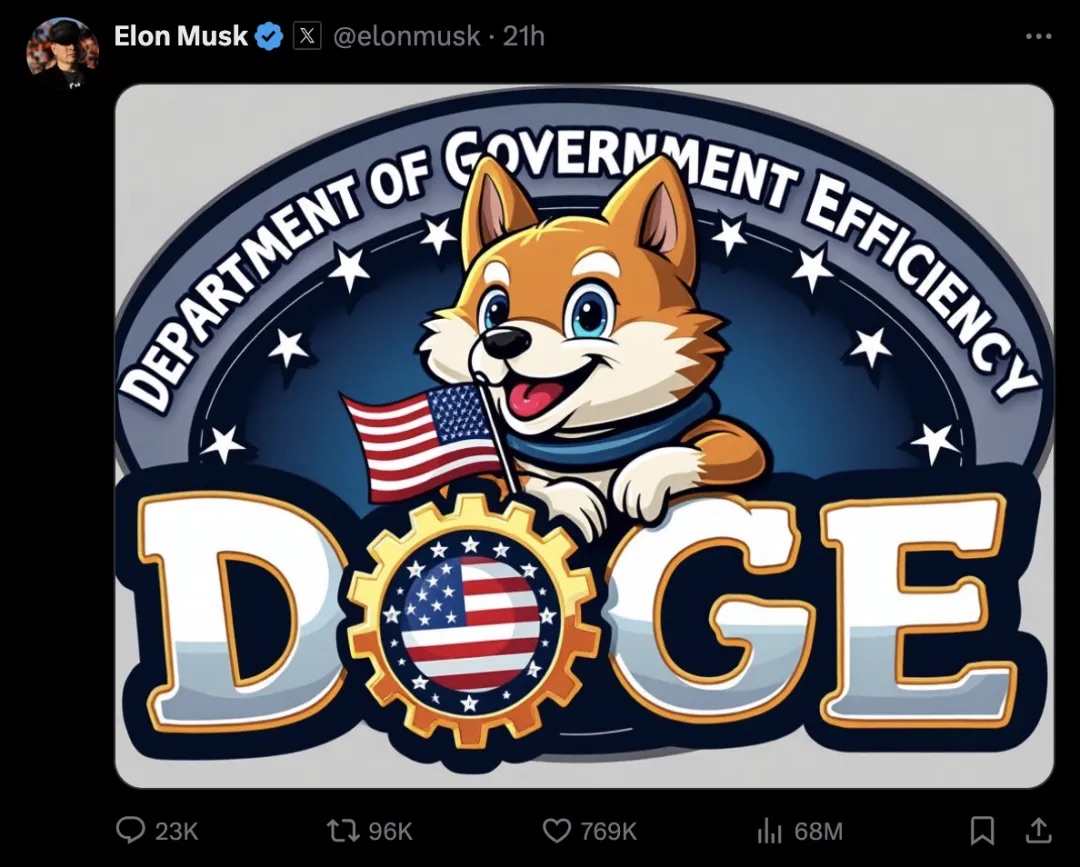
Musk even designed a logo for his new department. The fewer the words, the bigger the mission. | x.com
DOGE clearly borrows its name from Dogecoin, the cryptocurrency championed by Musk. Yet Trump quickly issued an official announcement confirming that this seemingly playful name was serious.

Remember the chaos caused by Dogecoin's pump-and-dump cycle? Naming a government agency this is quite ironic.
"The great Elon Musk," the announcement stated, "will jointly lead the newly established Department of Government Efficiency (DOGE) alongside Vivek Ramaswamy, an Indian-American businessman, entrepreneur, and Republican."
The announcement also declared that the effort to reduce government spending would be as significant as the Manhattan Project. The Department of Government Efficiency will collaborate with the White House Office of Management and Budget to drive large-scale governmental restructuring, aiming to complete reforms by July 4, 2026—"a gift for the 250th anniversary of the Declaration of Independence," said Trump.
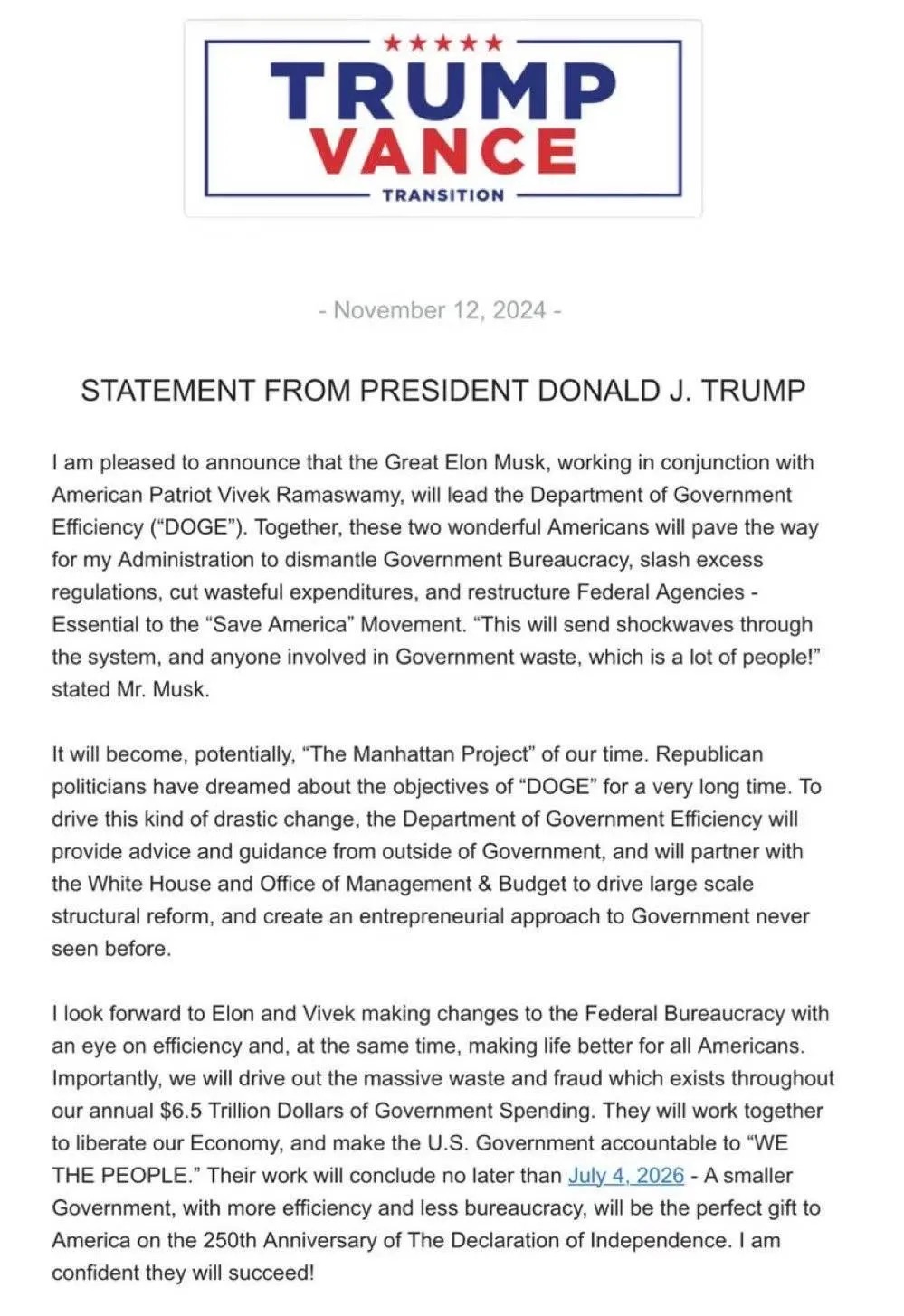
Announcement released by the Trump-Vance administration
Immediately after the news broke, Dogecoin’s price surged—apparently, speculative stock trading works the same everywhere.

Currently, the DOGE department is recruiting talent online, requiring candidates to be "extremely intelligent and ready to work 80+ hours per week." Musk himself will personally review the top one percent of applicants.

Musk’s Next Step in Politics
Two likely actions Musk may take upon taking office are cutting U.S. government spending and streamlining administrative agencies.
In October, Musk publicly stated at a rally in New York’s Madison Square Garden that he plans to cut at least $2 trillion from the federal budget. However, according to data from the Congressional Budget Office, in fiscal year 2024, total U.S. federal spending reached $6.75 trillion, with discretionary spending—including defense—estimated at $1.9 trillion.
This means that under current government spending levels, the amount Musk wants to cut is nearly equivalent to all discretionary government spending.
Another likely move is mass layoffs.
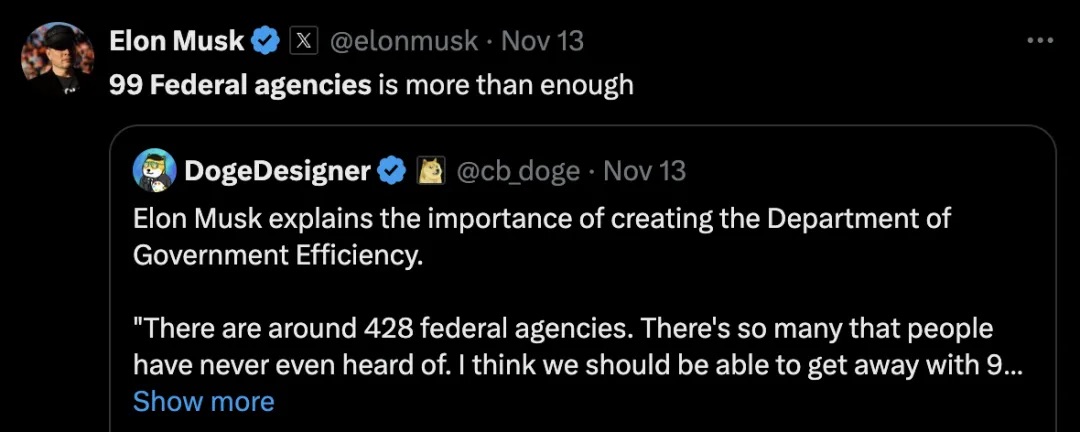
There are currently about 428 administrative agencies in the U.S. federal government, but Musk believes even 99 would be too many. On multiple occasions, Musk has publicly called for eliminating existing agencies. He urged his followers: "If you think there’s any agency I should eliminate but haven’t yet, tell me directly." He also claimed he would later publish a ranking list exposing the most wasteful and foolish uses of taxpayer money.
When Musk says he’ll fire people, he really does. In 2019, he swiftly laid off 10% of SpaceX employees via email—many staff lost access to work systems immediately upon reading it. After acquiring Twitter in 2022, Musk fired 80% of the workforce, slashing headcount from 8,000 to just 1,500. Earlier this year, he laid off 28,000 Tesla employees.
Will the U.S. government now face a similar wave of layoffs? What will happen to the civil servants who lose their jobs? And could the already low efficiency of the U.S. government fall further due to staffing shortages? These are pressing concerns.
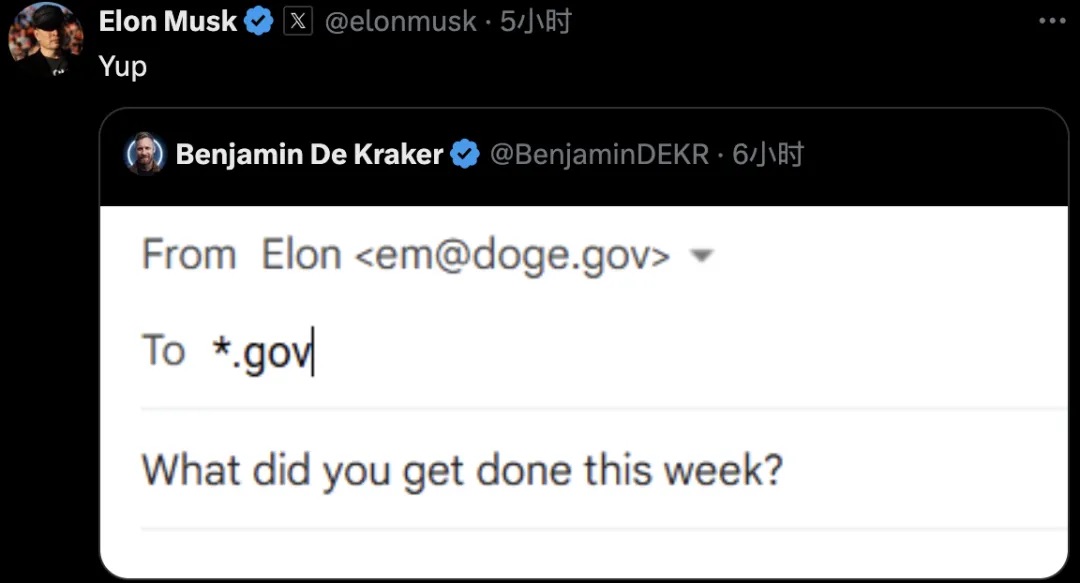
What Musk might do once in office: Email every government official asking, “What did you do this week?”
Beyond serving as a government efficiency officer, Musk may leverage his close ties with Trump to influence broader U.S. politics. For example, last Wednesday, Musk joined Trump’s first post-election phone call with Ukrainian President Volodymyr Zelenskyy.
Can Layoffs Really Cut Spending?
While appealing in theory, Musk’s approach may not work in practice.
American political economist Francis Fukuyama published an open letter to Musk yesterday, stating: "It’s commonly believed that the federal bureaucracy is bloated and overstaffed, but that’s not true—in fact, the government is understaffed."
Since 1969, the number of U.S. civil servants has remained largely unchanged at around 2.3 million, due to continuous downsizing efforts. For instance, the Centers for Medicare & Medicaid Services, which oversees $1.4 trillion in spending—about one-fifth of the entire federal budget—has only 6,400 full-time employees. Meanwhile, the Office of Refugee Resettlement, responsible for resettling millions of refugees, has just 150 staff members. Reducing these numbers could increase fraud and waste within healthcare programs and lead to uncontrolled refugee flows. The economic costs of such side effects are difficult to quantify.
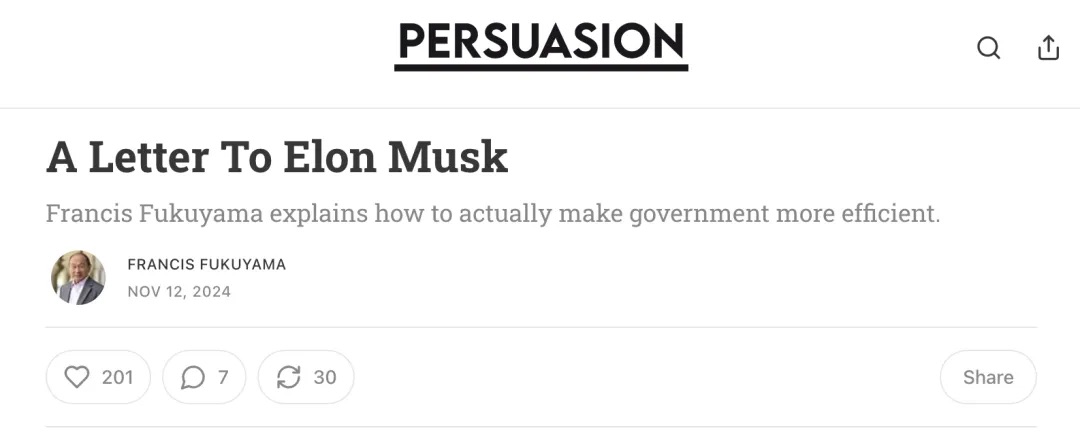
Additionally, some media outlets argue that America’s fiscal issues shouldn’t be entrusted to three billionaires (referring to Musk, Trump, and Ramaswamy), who inherently represent elite interests—an environment ripe for corruption.
Others say Musk’s fervor echoes the 1920s, particularly former Treasury Secretary Andrew Mellon, who was determined to drastically cut government spending. Mellon reportedly fired one Treasury employee per day on average and reduced the size of paper currency to save printing costs. Yet later historians blamed his austerity policies for accelerating the onset of the 1929 Great Depression.
Trump’s Cabinet
Eight years ago, when Trump first won the U.S. presidency, he himself didn’t expect victory and was thus poorly prepared. According to the Center for Presidential Transition, a new president must oversee appointments and transitions for roughly 4,000 political appointees and senior staff. Because Trump hadn’t decided whom to place where, many positions were filled through direct appointments by the Republican Party.
This time, however, Trump is well-prepared and has already lined up his cabinet picks.
To date, Trump has confirmed the following appointments:
-
Secretary of State: Marco Rubio, known for his hardline stance toward China and banned from entering the country.
-
Attorney General: Matt Gaetz, a Florida congressman accused of rape and sexual assault of minors, and under investigation by the House for misusing campaign funds.
-
Secretary of Defense: Pete Hegseth, a U.S. Army veteran and Fox News host, previously holding the rank of major in the military.
-
Secretary of Health and Human Services: Robert F. Kennedy Jr., an environmental lawyer and anti-vaccine activist.
Trump has also stated that upon taking office, he will further increase tariffs on China, pressure NVIDIA to shift chip manufacturing back to the U.S., and revoke Biden-era executive orders restricting AI development. On the other hand, Trump remains one of the few politicians to state he will "never ban TikTok"—his election may offer TikTok a chance to avoid a ban.
Join TechFlow official community to stay tuned
Telegram:https://t.me/TechFlowDaily
X (Twitter):https://x.com/TechFlowPost
X (Twitter) EN:https://x.com/BlockFlow_News


