A Regular Engineer's Web3 Redemption: Don't Just Dream of Financial Freedom—Next Year Will Be Crucial for Implementation
TechFlow Selected TechFlow Selected
A Regular Engineer's Web3 Redemption: Don't Just Dream of Financial Freedom—Next Year Will Be Crucial for Implementation
Now is the perfect time to seize the opportunity.
 Navigating Web3 tides with focused insights
Author: The Black Swan
Translation: TechFlow
I used to be a corporate engineer, spending my days commuting and dreaming of breaking free from the 9-to-5 grind. I often fantasized about an ideal future—relaxing on a beach, financially unburdened, fully immersed in my passions.
I encourage you to do the same: vividly envision your dream, whether it's starting a business or spending more time with family.
Now is the perfect time to seize the opportunity, especially as the crypto market stands on the brink of growth. Every challenge you've faced has prepared you for this moment. Believe in yourself and boldly pursue your dreams.

My Personal Journey
You might not believe it, but I was once an ordinary engineer with modest net worth. I was the classic high-performing corporate employee—commuting one hour to the office every day, pretending to work. Honestly, I did get a lot done, but this wasn’t the life I wanted. I disliked being told what to do, where to work, and having to work weekends just to chase bonuses. Still, I constantly visualized my ideal life. No exaggeration—I probably spent about a quarter of my waking hours fantasizing about future success. It wasn't a deliberate exercise; it was simply my default mental state.
During daily activities—whether walking, exercising, or commuting—vividly imagine your ideal life:
-
Picture yourself relaxing on a beach
-
Endless ocean views before you
-
A refreshing cocktail in hand
-
A beautiful companion by your side
-
The feeling of financial freedom—and most importantly, imagine reclaiming all the time you’ve spent working for others.
You don’t necessarily need the beach imagery. Maybe you just dream of quitting your 9-to-5 job. But visualize what you truly want. Who would you spend your time with? Perhaps you want to start a business? Or maybe you simply wish to engage more in sports, spend time with your kids, or dive deeper into your hobbies.
Make these visualizations a regular practice. While there’s no guarantee it will work, the potential benefits are worth trying. Who knows? It might just work for you too.
Get ready, because next year could be the most important year of your life. A bull market is coming, and venture capitalists, professionals, entrepreneurs, and everyday investors are all preparing to pour significant resources into our industry. This is your moment to seize the opportunity and build a better future for yourself and your family.
Over the past two years, you’ve struggled through the bear market, facing challenges and setbacks while navigating the difficult landscape of crypto trading. Despite promises of prosperity, you may have experienced painful losses. But remember, every effort you made has been preparing you for this very moment.
Sometimes making money seems effortless; other times it demands courage and determination. You’ve just emerged from a tough phase and are now entering a period full of potential. It’s time to set higher goals and pursue your financial milestones. Now is the time to focus your energy and resolve on achieving your main objective—success. I believe in you!
Now, let’s talk about the problems in the industry and why, in this cycle, average investors and traders have struggled to succeed.
Problems in the Industry
There’s a recurring phenomenon in the crypto space: DeFi protocol projects raise large amounts of funding, operate briefly, and then disappear. This isn’t limited to a few isolated cases—it’s unfortunately widespread across the crypto ecosystem.
The core issue lies in the utility token model, which has become standard for many crypto projects. While beneficial for founders, this model can be detrimental to retail investors, angel investors, and hedge funds alike.
Main characteristics of the utility token model:
-
No equity distribution (unlike stock ownership granted via SAFE agreements in traditional startups)
-
Tokens themselves lack intrinsic value (surprisingly, this applies to 98% of tokens)
-
Tokens are assigned arbitrary “utility”
-
Limited accountability for founders and the project itself
Comparison with Traditional Startups
Unlike traditional startups, where investors typically receive equity and certain shareholder rights, crypto projects often operate in regulatory gray areas. This lack of oversight can lead to:
-
Reduced sense of responsibility among project teams
-
Limited legal recourse for token holders
-
Higher risks for investors
The crypto space has already seen multiple high-profile cases of projects disappearing after raising substantial funds. Recently, Friend.Tech was completely abandoned after its founders quickly amassed significant wealth. Do you remember how hot the $FRIEND token was in early May?
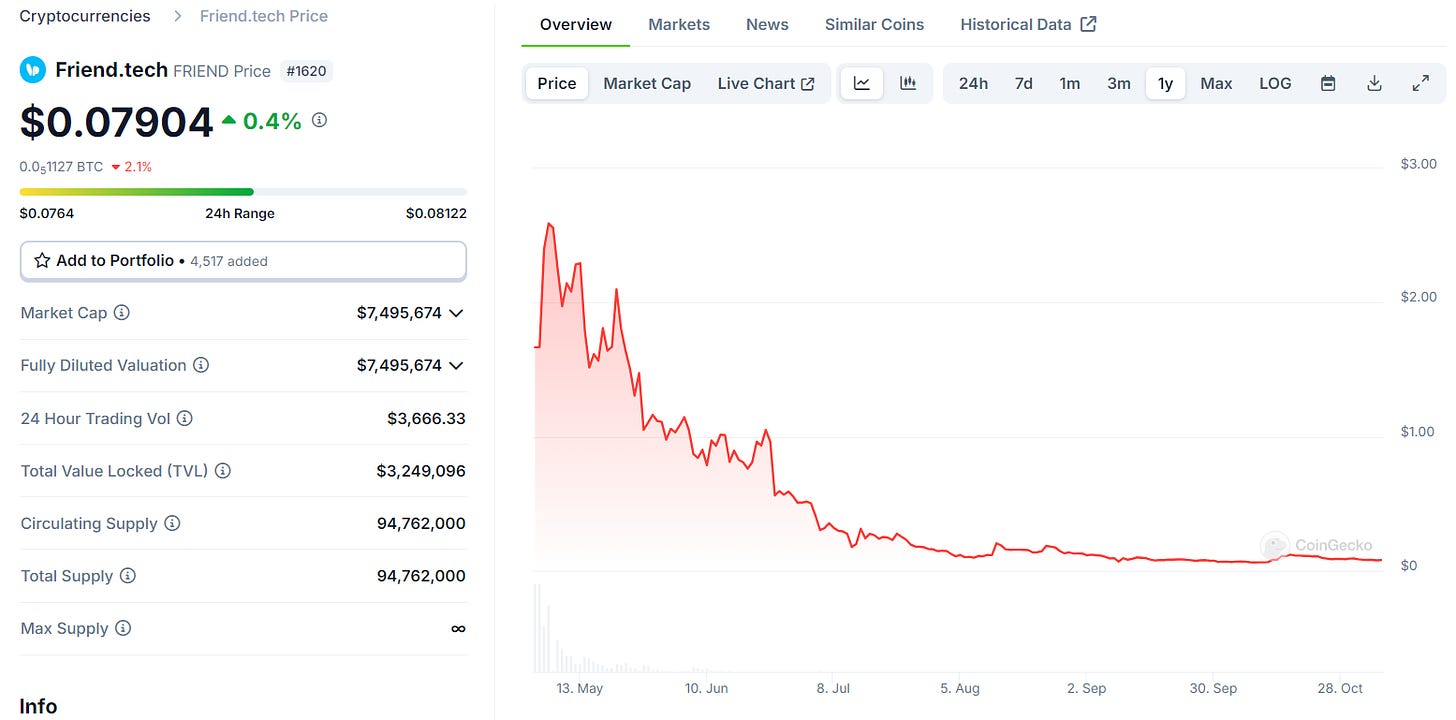
The chart shows a 97.5% decline since launch. The remaining holders are likely just people who forgot they ever owned the token. Beyond the concerning token distribution models, other issues deserve attention. Many projects have received valuations exceeding $1 billion from venture capital firms—valuations that severely limit the profit potential for ordinary users or investors.
Cobie wrote a detailed piece on this, and I touched on it briefly in my April newsletter. It’s crucial to understand that early investors—such as the VCs who backed Ethena’s initial $20 million round—have already seen their investments multiply by 500x.
This raises an important question: Will these early investors hold for even greater returns, or will they gradually sell to lock in profits? (The answer: They will sell!)
Many projects with low circulating supply but high FDV appear structurally designed to transfer wealth from retail users to VC firms and project team members. Such arrangements may undermine the decentralization and democratization principles that blockchain technology originally promised.
Almost all tokens can, to some extent, be considered meme coins. Their value relies more on collective belief and speculation than on intrinsic utility. Take the AAVE token, for example. Although associated with the popular Aave decentralized lending platform, AAVE’s primary function is governance voting. It does not directly reflect Aave’s economic activity nor generate fee revenue for holders.
Yet, its market cap has reached billions of dollars simply because it’s perceived as important. OP, the Optimism token, is another classic case. Despite Optimism being a major Layer 2 scaling solution for Ethereum, OP is primarily used for governance. Most voting power remains concentrated in the hands of the team and venture investors, raising questions about its true decentralization.
Nonetheless, OP has achieved a multi-billion dollar valuation. Aside from gas tokens on Layer 1 blockchains, most tokens derive their value from shared belief rather than actual use.
Their value depends on a collective conviction that they represent the growth and success of their associated protocols or projects. This highlights the speculative nature of the cryptocurrency market.
Summary
In the crypto industry, it's common to see DeFi projects raise large sums of capital, operate briefly, and then vanish—largely due to flaws in the utility token model.
Unlike traditional startups, these crypto projects often lack accountability mechanisms and investor protections, operating instead in regulatory gray zones.
High-profile cases like Friend.Tech being abandoned highlight the significant risks faced by token holders and investors.
Moreover, early investors and venture capital firms frequently capture disproportionate benefits from these projects, potentially undermining the democratizing promise of blockchain technology.
In the end, most tokens resemble meme coins, deriving their value more from collective belief than from intrinsic utility or economic returns.
That’s all for today.
See you on the order book, anon.
Join TechFlow official community to stay tuned
Telegram:https://t.me/TechFlowDaily
X (Twitter):https://x.com/TechFlowPost
X (Twitter) EN:https://x.com/BlockFlow_News
 @Route2FI