Public Goods Research: How Has Wikipedia Sustained Development to This Day?
TechFlow Selected TechFlow Selected
Public Goods Research: How Has Wikipedia Sustained Development to This Day?
Only with stable economic sources, efficient fund utilization, transparent financial management, and deep community engagement can public goods steadily advance in long-term development.
 Navigating Web3 tides with focused insights
Author: Baiding & Wuyue, Geeks Web3
When discussing public goods in the internet era, Wikipedia is arguably the most representative example. This globally renowned online encyclopedia was co-founded in 2001 by Jimmy Wales and Larry Sanger with the mission of providing a freely accessible knowledge platform via the internet—"to enable every person to access all human knowledge freely."
To this day, Wikipedia has undeniably achieved this goal. Through its open-editing model based on "user-generated content," anyone can contribute online, allowing Wikipedia to aggregate intellectual contributions from around the world.
To date, the platform hosts content in over 300 languages, includes more than 62 million articles, experiences over 14 million edits per month, and alone holds over 20TB of data for its English version—with monthly page views exceeding 6 billion. It consistently ranks among the top 10 most visited websites globally. By these metrics, Wikipedia stands as the benchmark for knowledge repositories in the Web2 era.
In today’s era of rapid AI development, Wikipedia’s value becomes even harder to quantify. Computer scientist Jesse Dodge noted that Wikipedia is the largest single source of information for ChatGPT's underlying large language models (LLMs), possibly accounting for 3%–5% of the data LLMs scrape. Nicolas Vincent, a faculty member at Simon Fraser University, went further: “Without Wikipedia, generative artificial intelligence would not exist.”
What’s most astonishing is that such a massive and operationally successful platform is not a commercial private entity—it is even described as “the largest non-commercial advertising website in the world.” This sounds almost unbelievable, since internet platforms of similar scale typically survive either through ad revenue or heavy subsidies. For Web2 public goods—which often struggle with monetization and have short lifespans—achieving sustained operations without commercialization while maintaining such scale seems nearly impossible.
Katherine Maher, CEO of the Wikimedia Foundation, stated in 2021: “If Wikipedia hadn’t been founded in the early 21st century, it could never emerge today in our fragmented, commercialized internet landscape.”
How did Wikipedia, committed to non-profit ideals, achieve such influence? The secrets are worth exploring. Motivated by interest in public goods, we conducted a brief investigation into Wikipedia. Given its profound implications for operators of public goods—especially content platforms—we recommend reading this article. Below, we will examine Wikipedia from multiple angles: its content production model, cash flow sources and expenditure allocation, and controversies regarding power and fiscal governance.
UGC: A Revolutionary Content Generation Model
Wikipedia’s open-editing model traces back to its early days. Its predecessor was Nupedia, aimed at creating a high-quality online encyclopedia. However, Nupedia had an extremely slow editorial process—content required multi-level reviews and expert approval, severely limiting content output. After launching in 2000, it managed to publish only a handful of articles within a year.
To improve efficiency, Nupedia co-founder Larry Sanger proposed a new idea: developing a knowledge web system called "Wiki," which allows users to freely upload content and enables anyone to edit entries—this later became Wikipedia.
From a product perspective, wiki is a knowledge network system where creating, editing, and publishing wiki text costs far less than HTML. Additionally, wiki systems support community-based collaborative writing and offer simple tools for communication, facilitating knowledge sharing in specific domains.
In his book *The World Is Flat*, the author directly refers to this model as “community-uploaded content.” In academic literature, Larry Sanger’s editing model is known as UGC (User-Generated Content), driven largely by personal interest rather than monetary incentives.
UGC quickly disrupted the traditional encyclopedic model dominated by experts and publishers. It flexibly incorporated non-academic yet notable topics, rapidly capturing widespread user attention. This bottom-up crowdsourcing model enabled Wikipedia to expand its reach across countless domains. After launching in January 2001, Wikipedia quickly surpassed Nupedia, which shut down in 2003. Even the Encyclopædia Britannica ceased print publication in 2012 under Wikipedia’s competitive pressure.
Today, millions of volunteers worldwide continue to edit and maintain Wikipedia, with approximately 120,000 active editors (those editing at least once per month) and about 300 edits occurring every minute.
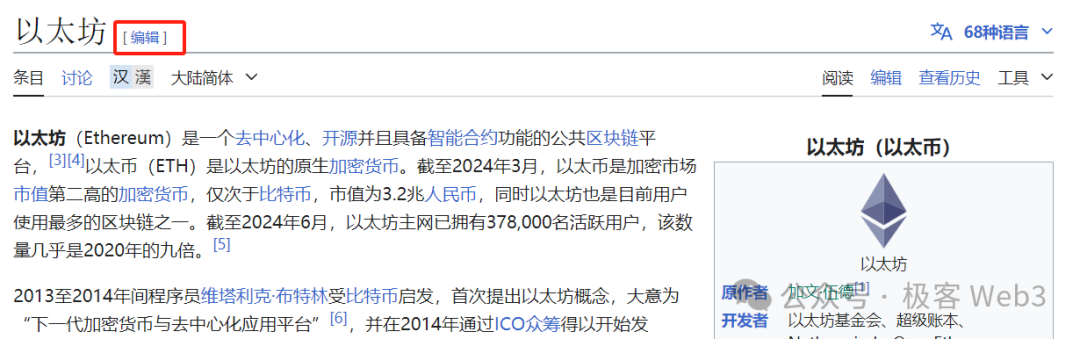
While UGC enabled Wikipedia’s rise, it also brought clear side effects. Under an open and free editing model, ensuring content accuracy remains an unavoidable challenge. Wikipedia has experienced countless incidents of article falsification or malicious edits, including insertion of false information, advertisements, or politically biased content. The most famous case is the “John Seigenthaler biography scandal.” Addressing such destructive behavior remains a daunting and difficult-to-eliminate task.
Wikipedia’s current solution is to allow reverting articles to previous versions. Every article maintains a full history of edits, enabling any user detecting malicious changes to restore prior versions.
Data shows that obvious malicious edits are usually detected and removed quickly—experiments indicate correction occurs within minutes on average. Today, Wikipedia widely uses bots to correct simple grammatical errors or vulgar content, though subtle acts of sabotage still require human intervention.
For issues requiring manual resolution, Wikipedia has established a three-tiered safeguard system executed in a decentralized manner. When a malicious edit occurs, the standard procedure is “edit, revert, discuss.” If User A edits an article and User B disputes it, they can revert it and use the discussion page to explain differences and seek consensus.
Sometimes disputes become circular—“edit, revert, edit, revert”—requiring intervention by higher-authority roles: administrators and patrollers.
Administrators possess elevated permissions including deleting pages, protecting content, resolving edit conflicts, and handling complaints. Patrollers primarily review and flag newly published content, marking problematic items as “pending review” and reporting them to admins or senior volunteers.
Additionally, administrators may place frequently targeted articles (e.g., those on public figures) under partial or full protection, restricting editing rights to maintain stability. They can also ban users who repeatedly make malicious edits.
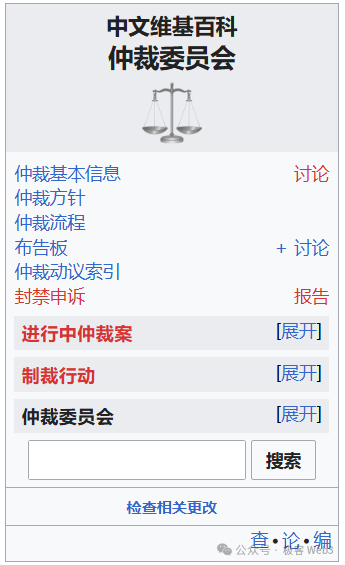
For more complex cases, Wikipedia has an Arbitration Committee composed of veteran volunteers, serving as the final dispute resolution body. Committee members base decisions on Wikipedia’s editorial policies and community norms, ensuring content meets neutrality and verifiability standards.
Regarding open-content licensing, Wikipedia adopts several Creative Commons licenses, most importantly CC BY-SA 4.0, which permits free sharing and adaptation of content under two conditions:
1. Proper attribution must be given to the original author, source, and link
2. Adapted works must also be licensed under CC BY-SA 4.0, encouraging further derivative creations. Earlier content and images may still fall under the GNU Free Documentation License (GFDL).

Cash Flow Analysis: Can Donations Alone Sustain the Tower of Babel?
Revenue Sources
For large-scale internet platforms with massive user bases, securing stable cash flow is a persistent headache. Wikipedia, emphasizing non-commercialization, free access, and value neutrality, cannot monetize like Twitter or YouTube through ads or subscriptions. Moreover, lacking backing from powerful private entities offering massive subsidies, many wonder how it funds its operations.
Consider Baidu Baike as a contrast. Searching “health insurance” reveals Baidu Baike heavily relies on ad-driven revenue—a model prone to biased or misleading information. The 2016 Wei Zexi incident exemplifies the negative externalities of excessive monetization of public goods. That tragedy prompted regulators like CAC to mandate reduced commercial promotions on such platforms.
By Vitalik’s “Revenue vs. Evil” curve metric, the Wei Zexi incident epitomizes the negative externalities arising from over-monetizing public goods. In contrast, Wikipedia’s non-commercial stance preserves neutrality and maximizes positive externalities—but is this model truly sustainable?
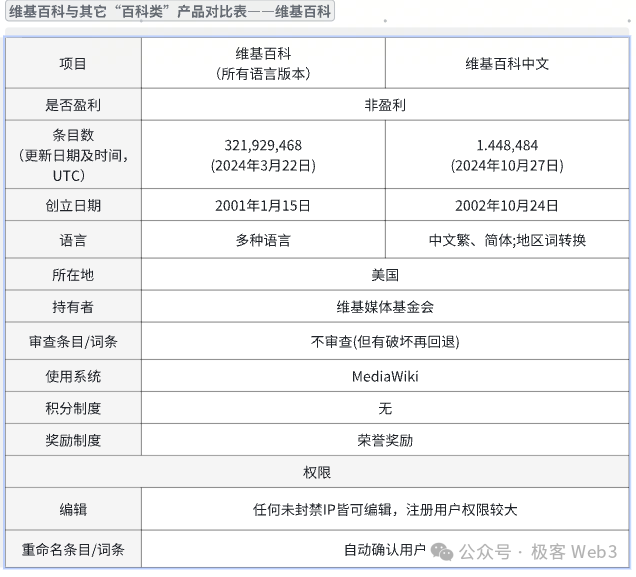
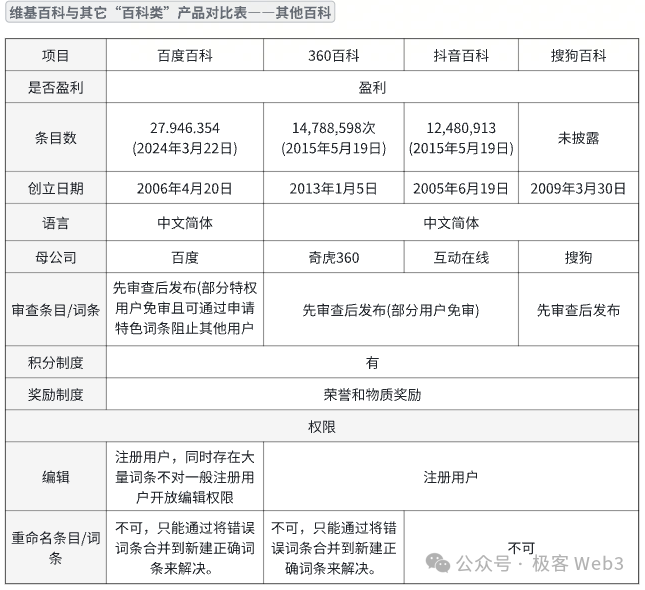
Comparison table between Wikipedia and other "encyclopedia-style" products
To understand Wikipedia’s sustainability, we must examine its parent organization—the Wikimedia Foundation. Established in 2003 and headquartered in San Francisco, the foundation now employs over 500 staff. Its funding comes primarily from donations and grants. According to publicly disclosed materials, the Wikimedia Foundation’s income sources include:
First, individual donations. Annually, the foundation runs fundraising campaigns appealing to global users for financial support. Though individual amounts are small, donor numbers are vast, forming a major portion of its revenue. Most users see donation banners twice a year while browsing Wikipedia.
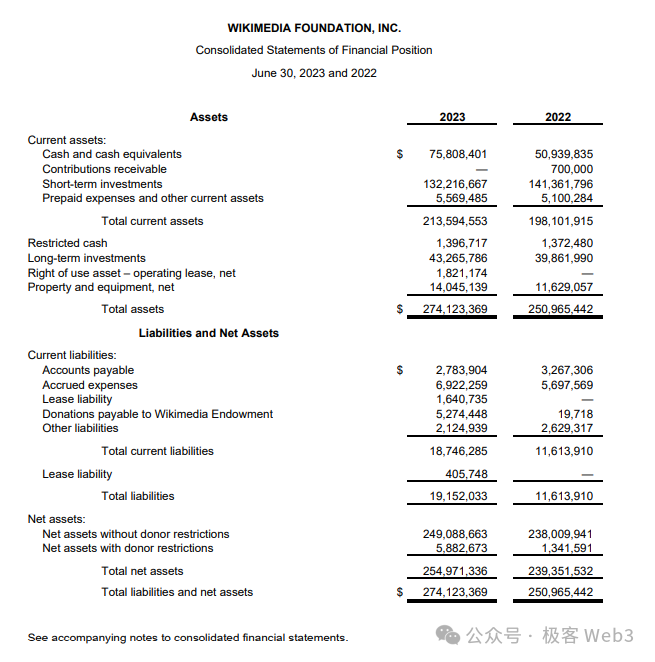
In the 2022–2023 fiscal year, the foundation reported total revenue of $180 million, with small individual donations accounting for over 90% of funding. On average, each donor contributes about $11, with roughly 7.5 million people supporting Wikipedia this way annually.
Besides individual donors, the Wikimedia Foundation receives support from major corporations and foundations, such as Google, Microsoft, and the Bill & Melinda Gates Foundation. Google and the Alfred P. Sloan Foundation have each donated over $3 million to Wikipedia.
Moreover, the foundation actively applies for grants from public-interest initiatives. One example is “Reading Wikipedia in the Classroom,” designed to help teachers and students use Wikipedia effectively in education. Piloted in Nigeria, Bolivia, and the Philippines, it now spans over 40 countries. This project has attracted multiple sponsors.
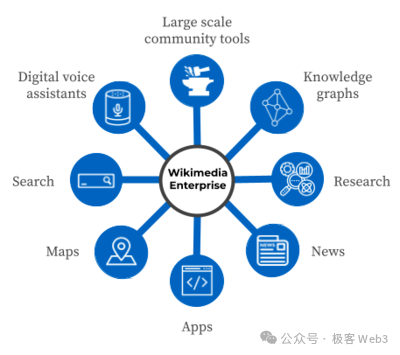
To ensure long-term sustainability, the foundation is also exploring self-sustaining economic models beyond donations. In October 2021, it launched “Wikimedia Enterprise,” offering paid APIs tailored for large tech companies like Google and Amazon. This service generated millions in revenue during the 2022–2023 fiscal year, with Google alone paying over $2 million. Paid API services could become a key growth driver for Wikipedia’s future revenue.
The foundation also operates an online store (store.wikimedia.org), selling merchandise featuring Wikipedia branding, such as T-shirts, mugs, and stickers. While this revenue stream is relatively small, it contributes hundreds of thousands of dollars annually as supplementary income.
Beyond these officially acknowledged sources, balance sheet analysis shows the Wikimedia Foundation also engages in investment activities. In 2023, it earned about $6.5 million from investments, although it lost over $11 million in 2022.
Expenditure Allocation
The Wikimedia Foundation maintains detailed budget planning and financial audits for all fund usage. Significant expenditures undergo multiple layers of approval to ensure reasonableness and transparency. Financial reports are regularly published so donors and the public can track fund utilization.
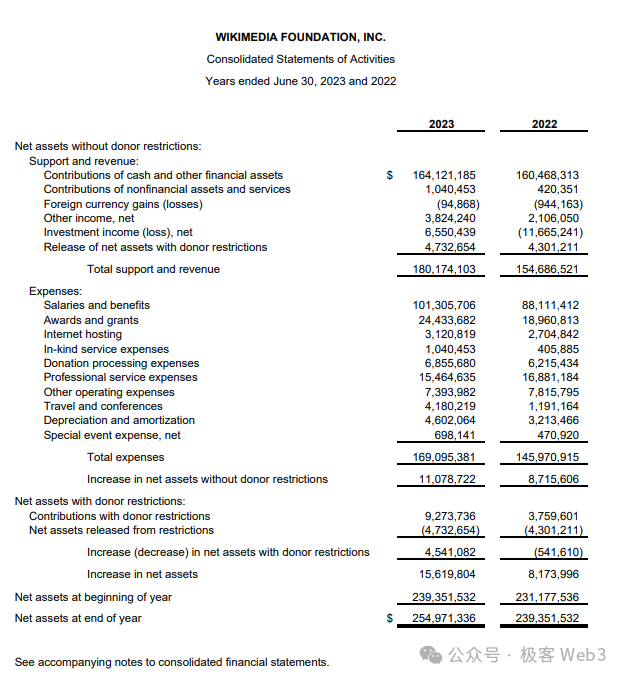
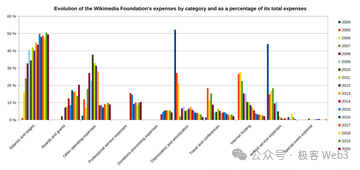
According to its financial statements, the foundation spent $169 million in the 2022 fiscal year alone, with 60% allocated to staff salaries and benefits. This covers compensation for technical teams and community support staff, including server maintenance, software updates, and data security.
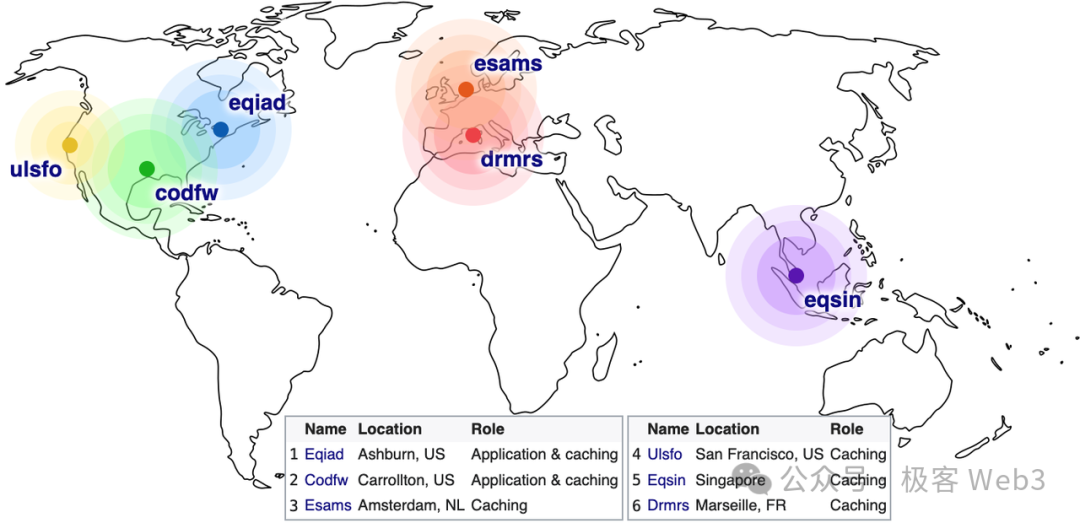
As the world’s largest online encyclopedia, Wikipedia handles enormous data and traffic volumes. Maintaining and upgrading servers and data centers represents a major expense. As of 2024, Wikipedia operates six data centers globally, located in the United States, the Netherlands, France, and Singapore, ensuring stable performance across all Wikimedia projects.
Wikipedia also relies on its global volunteer community. The foundation allocates about 14% of spending to awards and grants promoting community engagement. For instance, it has organized “edit-a-thons” encouraging volunteers to collaboratively expand content on specific themes. Notable examples include “Fashion Edit-a-thons” across multiple countries led by France and the 2020 “Wiki4Climate” initiative focused on climate change.
In addition, the foundation invests heavily in professional services—including legal counsel, external technical support, and accounting audits—to ensure compliance and operational safety worldwide.
Administrative expenses also cover office rentals and daily management costs, supporting internal operations. Regular technical workshops and international editor conferences are held to foster collaboration among global volunteers, requiring ongoing financial support.
These two categories combined account for 15% of total expenditures. Furthermore, fundraising campaign costs—including advertising and payment processing—account for 4% of total spending.
Challenges Facing Wikipedia: Donation Scandals, Corruption, and Political Bias
The sustainable development of any public good presents significant challenges. Undeniably, Wikipedia has excelled in this regard historically, but it still faces serious vulnerabilities. First, its primary reliance on user donations—though instrumental in growth—creates inherent financial instability. With the rise of large language models, public willingness to donate to Wikipedia may decline.
Second, as a non-profit, if the foundation increasingly adopts commercial methods like paid APIs to boost revenue, it risks criticism over compromising platform neutrality. Thus, instability in both funding and perceived neutrality has become a chronic issue. This leads to another critical concern.
As the saying goes, “The taller the tree, the stronger the wind.” Wikipedia raises vast sums through donations alone, drawing widespread skepticism and controversy. Allegations of “over-fundraising” and “donation scams” persist. Partly, fundraising messages sometimes exaggerate financial urgency, creating a false impression that Wikipedia is “on the verge of collapse,” misleading users about its actual financial health.
On the other hand, insiders have provided data suggesting Wikipedia does not need such large funds, raising suspicions of misappropriation.
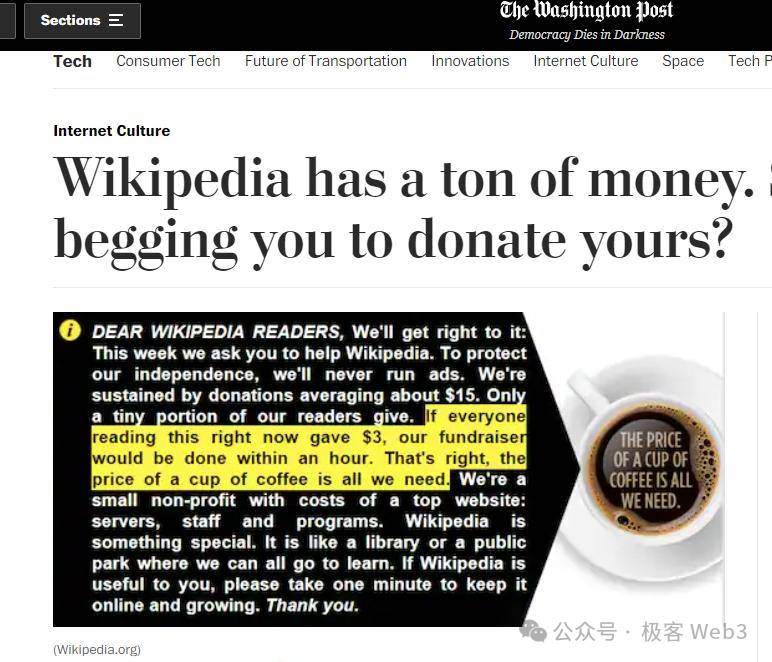
Kolbe, former co-editor-in-chief of The Signpost (a community-run newspaper), claims deep familiarity with internal operations. He notes that the foundation’s 2016 endowment campaign aimed to raise $100 million over ten years, but recent increases in fundraising frequency and banner ads suggest the target could be met years ahead—and at multiples of the original goal. In contrast, Wikipedia actually requires only about $10 million annually for normal operations.
A Brazilian editor, Felipe da Fonseca, previously remarked: “Begging for money using others’ work results is simply disgraceful and unethical.”
Wikipedia co-founder Jimmy Wales has also faced repeated community accusations. Many argue the cost-effectiveness ratio of the Wikimedia Foundation is abysmal—spending millions on software development over years without producing anything useful. In 2014, Wales admitted frustration over endless disputes criticizing him for unilaterally wasting funds on valueless software without proper community consultation or incremental rollout.
In February 2017, The Signpost published a column titled “Wikipedia Has Cancer,” criticizing the foundation’s continuously rising annual expenditures without corresponding productivity gains.
Elon Musk is another staunch critic of Wikipedia. In 2023, when Musk rebranded Twitter to “X,” he jokingly suggested: If Wikipedia changed its name to “Dickipedia” for one year, he would donate $1 billion to the Wikimedia Foundation—expressing dissatisfaction with Wikipedia’s aggressive fundraising and over-collection rumors. Musk later posted comments such as “Wikipedia is broken” and “Wikipedia is losing its objectivity,” among others we won’t list exhaustively here.
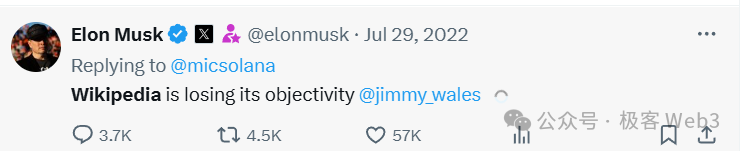
Musk’s remarks may carry political undertones (many Wikipedia entries show clear anti-Trump bias), which we won’t delve into, but they reflect the negative sentiment many prominent figures hold toward Wikipedia.
In response to such allegations, the Wikimedia Foundation explains that donated funds aren’t just for daily operations—they also build reserves to protect Wikipedia against potential crises, ensuring it remains ad-free, accessible, and free from commercial influence. This financial strategy enhances resilience and safeguards Wikipedia’s independence as a non-profit public good.
Beyond these issues, Wikipedia faces additional challenges.
First, as an open-editing platform, Wikipedia depends on global volunteers for content creation and maintenance. While this encourages broad participation, it also introduces risks of misinformation, inaccuracies, and malicious edits. Despite strict rules and moderation mechanisms, ensuring reliability and neutrality in the age of AI—and correcting errors promptly—remains a major challenge moving forward.
Third-party data also reveals that while Wikipedia’s user base continues to grow, the number of active editors has clearly declined in recent years. Two main reasons:
-
Wikipedia’s review mechanisms have become increasingly strict, discouraging new contributors
-
Administrators wield growing power, capable of blocking accounts and IP addresses, leading to concerns about abuse of authority
Furthermore, internal management is far from unified. Significant tensions exist between the Wikipedia community and the Wikimedia Foundation, occasionally erupting publicly—including allegations of managerial corruption and power abuse.
In 2014, the Wikimedia Foundation attempted to install new multimedia-viewing software on the German Wikipedia, but German editors refused to update their interface. The standoff ended with the foundation forcibly installing the software and using elevated privileges to prevent rollback to older versions.
On September 13, 2021, the Wikimedia Foundation took action against Chinese Wikipedia, resulting in seven users being banned and twelve administrators stripped of their rights. Three of the affected users were among the top ten most active contributors on Chinese Wikipedia. Since the foundation failed to provide systematic evidence or explanation afterward, the incident was perceived by mainland Chinese Wikipedia communities and media as涉嫌 excessive interference in community autonomy, suppression of voices holding ideologies opposed to Western perspectives, and lack of procedural justice.
Additionally, disagreements persist over resource allocation—such as funding distribution among language editions, software development budgets, infrastructure maintenance costs, and regional investments—with ongoing power struggles between the community and the foundation.
As a public good, Wikipedia relies on credibility to secure donations, and that credibility stems from content authority, comprehensiveness, and decentralized power-sharing between the community and foundation. Yet these publicized internal conflicts damage trust. Combined with disruption from AI and large language models, Wikipedia risks irreversible declines in article quality and user engagement, further eroding its credibility.
Meanwhile, Wikipedia suffers from insufficient contributor diversity. Topics related to women, ethnic minorities, and non-English cultures are often underrepresented. Attracting more volunteers and encouraging broader participation across different backgrounds and regions remains a crucial challenge for the platform’s future.
Conclusion
Wikipedia’s success lies not only in its achievements as a knowledge-sharing platform but also in offering valuable insights into the sustainable development of public goods. As the world’s largest open encyclopedia, Wikipedia avoids commercial monetization, preserving content neutrality and successfully navigating challenges of the internet age—providing profound lessons for managing other public goods.
Wikipedia’s history shows that only through stable funding, efficient resource use, transparent financial management, and deep community involvement can public goods achieve long-term sustainability. At the same time, we must acknowledge that Wikipedia’s operations—financially, organizationally, and reputationally—are far from perfect, facing serious problems and controversies. These serve as cautionary tales for builders of other public goods.
Looking ahead, the sustainable development of public goods will face increasingly complex challenges: fragmented attention due to micro-media, rising operational costs, evolving global regulations, and shifting user demands. This means public goods must not only sustain user engagement but also explore diverse revenue streams to forge resilient, sustainable paths forward.
Join TechFlow official community to stay tuned
Telegram:https://t.me/TechFlowDaily
X (Twitter):https://x.com/TechFlowPost
X (Twitter) EN:https://x.com/BlockFlow_News
 @godrealmx