








Trump's return to the White House triggers a major reshuffle in global financial markets
TechFlow Selected TechFlow Selected
Trump's return to the White House triggers a major reshuffle in global financial markets
This is not merely a political narrative, but a critical moment that will profoundly impact global financial markets.
 Navigating Web3 tides with focused insights
Author: TechFlow
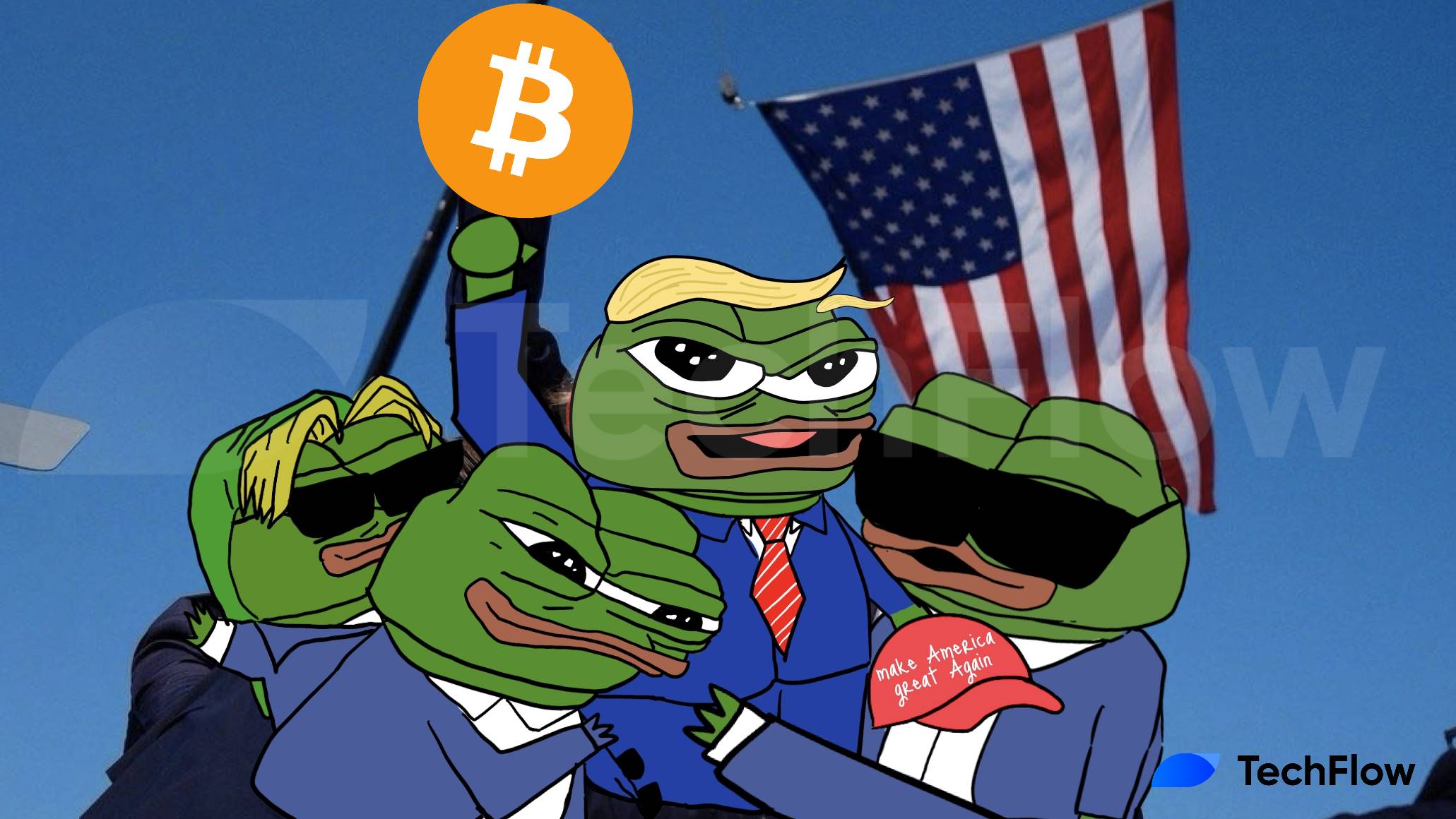
TRUMP WIN — Donald Trump has won the 2024 U.S. presidential election, returning to the White House after a four-year absence.
Businessman, real estate tycoon, television personality, former president—Donald Trump, a political figure who faced four criminal indictments and 91 felony charges, is now crafting the most improbable political comeback in American history.
The White House, a solemn institution that has witnessed 46 presidential transitions, is about to welcome its first-ever "returning resident."
This is not merely a political narrative; it is a pivotal moment poised to profoundly impact global financial markets.
Trump’s signature “America First” agenda, controversial trade stances, and support for cryptocurrencies like Bitcoin could trigger fresh turbulence across global financial markets.
As Trump’s odds of victory rose, Bitcoin continued breaking new all-time highs.
While Wall Street traders watch this political transformation unfold and global investors weigh various scenarios, we may be standing at the threshold of a new financial era—one that will be redefined in unique and contentious ways by one of the most controversial political figures of our time.
What will Trump’s future economic policies look like, and how will they affect U.S. equities and cryptocurrency markets? TechFlow provides an in-depth analysis.
Summary of Trump's Economic Policies
First, it's essential to understand Trump’s base—his core voter bloc consists primarily of “blue-collar” Americans, including evangelical, lower-income white voters, and residents of Rust Belt and agricultural states.
Compared to Biden’s advocacy for global liberalization, these voters lean toward isolationism, embrace Trump’s “America First” strategy, worry about economic and employment issues, and represent the interests of industries such as oil, automotive, manufacturing, transportation, and raw materials.
Trump remains committed to “America First,” protecting domestic manufacturing, proposing universal baseline tariffs on foreign companies, increasing energy supply, expanding oil production, and offering tax breaks to oil, gas, and coal producers.
We summarize his key economic policies as follows:
1. Trade Policy
-
Plans to impose at least a 10% tariff on most goods imported into the U.S. from other countries, with tariffs on Chinese imports potentially rising to 60% or higher;
-
Introduce the “Trump Reciprocal Trade Act,” aimed at “stopping American jobs from moving overseas,” gradually halting imports of essential goods such as electronics, steel, and pharmaceuticals from specific countries, and banning companies from those countries from owning infrastructure in U.S. energy, technology, and farmland sectors;
2. Fiscal and Tax Policy
-
Extend the 2017 Tax Cuts and Jobs Act, which lowered the corporate tax rate from 35% to 21%;
-
Propose further reducing the corporate tax rate to 15%, significantly cut taxes for workers, including eliminating tip taxes for restaurant and hotel employees;
-
Maintain “America First” principles to protect domestic manufacturing, promising to “lower taxes, raise wages, and increase job opportunities” for American workers through incentives for domestic production and universal tariffs on foreign firms;
3. Immigration Policy
-
Pledge to launch “the largest deportation operation in American history,” aiming to deport millions of undocumented immigrants annually;
-
End automatic citizenship for children born to undocumented immigrants;
-
Stop “birth tourism,” implement travel bans, and suspend refugee admissions;
4. Energy Policy
-
One top priority: “DRILL, BABY, DRILL.” Expand oil drilling and provide tax breaks for oil, natural gas, and coal producers;
-
Oppose existing government subsidies for wind power development;
-
Repeal Biden’s electric vehicle targets and aggressively promote the traditional auto industry;
5. Infrastructure Investment
-
Commit to spending taxpayer money on roads, bridges, dams, and other infrastructure projects;
-
Emphasize that funds will not be “wasted on meaningless green new scams”;
6. Healthcare Policy
-
Plan to reinstate his August 2020 executive order to ensure basic medicines, medical countermeasures, and critical inputs are produced in the U.S.;
-
Consider repealing or reforming the Affordable Care Act to reduce costs;
7. Cryptocurrency Policy
Once skeptical and critical of cryptocurrencies, Trump has now shifted stance and emerged as a pro-crypto presidential candidate.
In July 2024, at the Bitcoin Conference, Trump expressed near-unreserved affection for Bitcoin, stating that Bitcoin’s market cap would surpass gold, pledging to remove the crypto-hostile SEC Chair upon taking office, and declaring his ambition for the U.S. to become the “global capital of cryptocurrency” and a “world superpower” in Bitcoin.
Some of Trump’s proposed cryptocurrency policies include:
-
Establish a government Bitcoin reserve: The government would “retain 100% of all Bitcoin currently held or acquired in the future by the U.S. government”;
-
Create a cryptocurrency advisory committee;
-
Block the creation of a central bank digital currency (CBDC).
Impact on Financial Markets
If elected, Trump is likely to continue his previous policy approach—pushing large-scale fiscal stimulus and pressuring the Federal Reserve to implement significant interest rate cuts. This would feel like an extension of the financial “party” for markets.
Dollar Index
Trump has long advocated for a weak dollar policy.
He rejects the notion that a strong dollar benefits the U.S. economy, arguing instead that it hinders the revival of American manufacturing. A weaker dollar, he believes, would help narrow the trade deficit and advance “reindustrialization.”
Robert Lighthizer, former U.S. Trade Representative under Trump and now considered a potential Treasury Secretary nominee, also favors a weaker dollar.
However, reality may not fully align with Trump’s wishes. His hallmark policies—raising import tariffs and cutting taxes—could create upward pressure on interest rates due to increased demand for capital, potentially strengthening the dollar despite his intentions.
U.S. Equities
During his previous term, Trump viewed the stock market as one of his major achievements. His return could therefore extend the long bull run in U.S. equities.
His large-scale fiscal stimulus, dollar-weakening stance, and deep corporate tax cuts would boost corporate earnings and drive stock prices higher.
Yet black swan risks remain: his trade policies and international relations could disrupt the global economy and negatively impact long-term U.S. market performance.
By sector, traditional energy, defense, and infrastructure-related industries are likely to benefit, while environmental and renewable energy sectors may face headwinds.
Cryptocurrencies
A Trump presidency would be favorable for cryptocurrency development.
Based on his prior commitments, Trump is expected to push for more crypto-friendly policies, potentially involving relaxed regulation or clearer legal frameworks.
Previously, Trump stated that if elected, he would fire current SEC Chair Gary Gensler and appoint pro-crypto regulators.
The DeFi sector would directly benefit from a lighter regulatory environment. In the past, projects like UNI and AAVE were constrained by the SEC’s strict oversight. Trump’s family-backed cryptocurrency project, World Liberty Financial (WLFI), falls under the DeFi category and previously submitted a proposal on the Aave governance forum to build a customized lending market based on Aave V3.
Additionally, meme tokens associated with Trump’s staunch supporter Elon Musk would likely gain, most notably DOGE.
Musk once said he wanted to create a “Department of Government Efficiency,” abbreviated as DOGE—a name suggested by the DOGE community. Trump responded that, if elected, he would establish this department to conduct comprehensive financial audits of the government and eliminate waste. As a result, DOGE’s price performance has increasingly become linked to the presidential election.
Gold
For gold, a Trump victory could boost safe-haven assets like gold and Bitcoin. His “America First” doctrine and protectionist trade measures may heighten geopolitical risks. Moreover, from monetary and financial perspectives, Trump’s weak-dollar stance, tax cuts, and higher tariffs could fuel inflation, supporting stronger gold prices.
Join TechFlow official community to stay tuned
Telegram:https://t.me/TechFlowDaily
X (Twitter):https://x.com/TechFlowPost
X (Twitter) EN:https://x.com/BlockFlow_News
 深潮TechFlow


