How to monitor the movements of "smart money" in the cryptocurrency sector on U.S. Election Day?
TechFlow Selected TechFlow Selected
How to monitor the movements of "smart money" in the cryptocurrency sector on U.S. Election Day?
As the presidential election approaches its conclusion, cryptocurrency prices may experience significant volatility depending on the outcome.
 Navigating Web3 tides with focused insights
By: James Hunt
Translation: Baishuo Blockchain
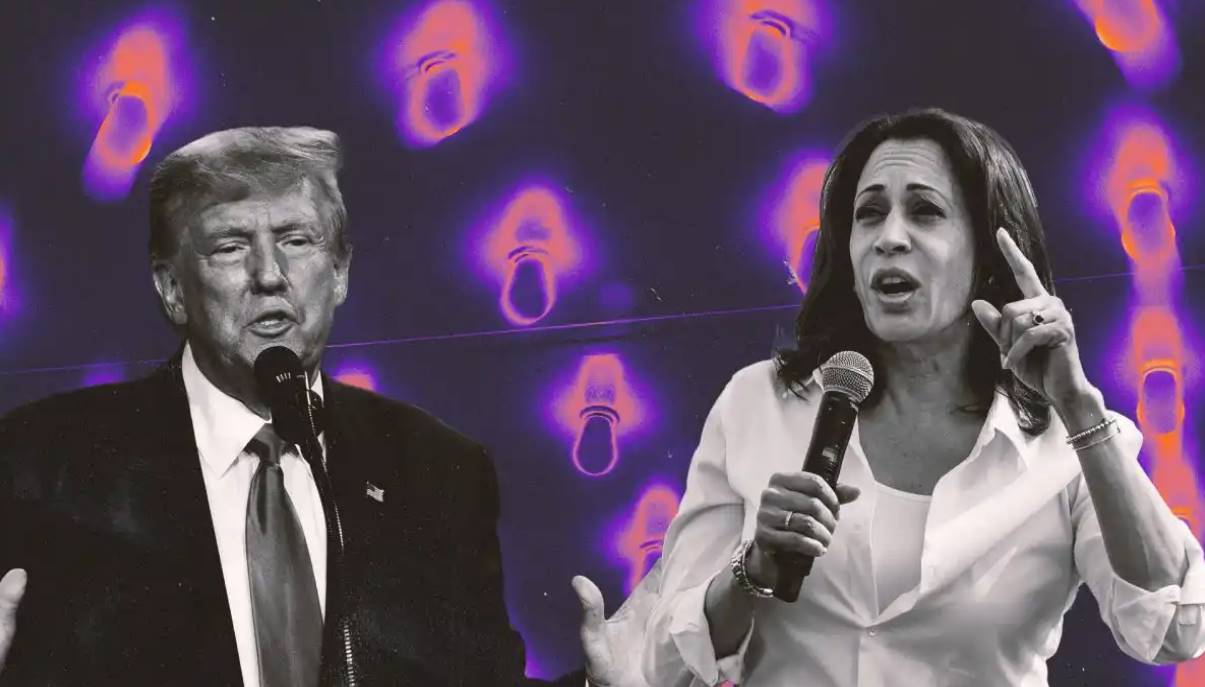
U.S. election day has arrived, and the 24/7 nature of cryptocurrency markets offers an advantage over traditional market trading hours. Analysts at Kaiko have outlined three key metrics to watch as election results unfold.
1. Tick-by-tick Trading Data
First, analyzing tick-level trading data from major platforms can provide insight into the movements of "smart money." By calculating cumulative volume delta (CVD) from tick-by-tick trades, one can measure net buy and sell activity across global crypto exchanges. According to Kaiko analyst Adam Morgan McCarthy, this metric provided valuable insights during the presidential debates between Trump and Kamala Harris and is expected to be useful again during the election period. In September’s debate, CVD turned negative, indicating a bearish market reaction to Trump's performance—despite Harris being viewed as less friendly toward the crypto industry, while Trump demonstrated clear pro-crypto stances.
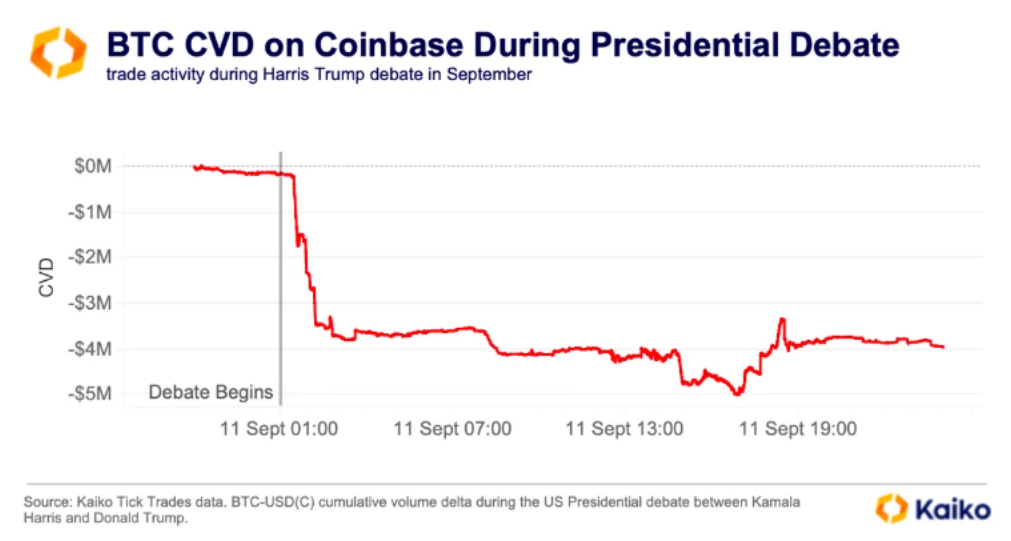
CVD on Coinbase during the presidential debate
Image source: Kaiko
The analyst explained that by separating tick-level trades into buys and sells, strong selling pressure in response to Trump’s debate performance could be clearly observed. This helps with timing the market, showing when buying or selling pressure eases and offering clues about participant expectations.
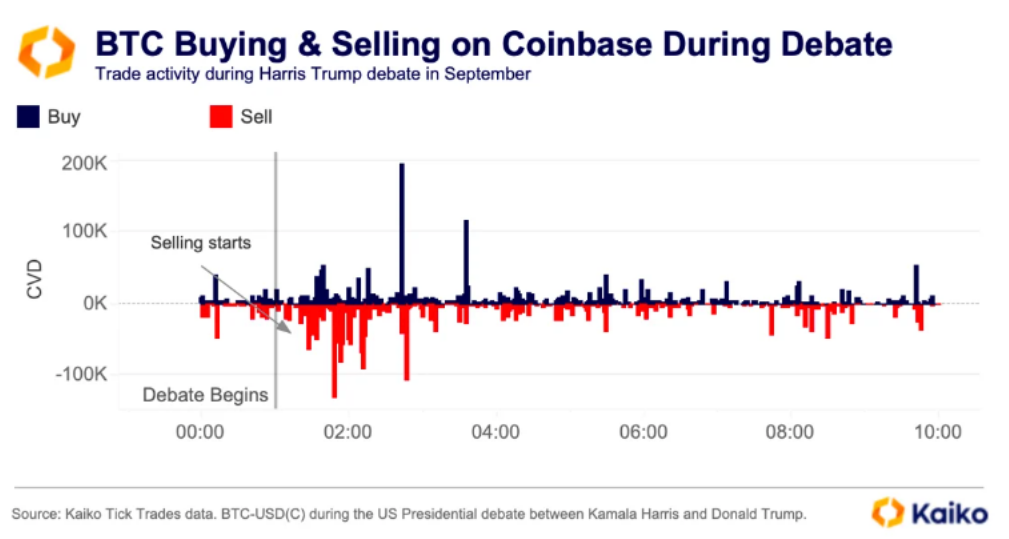
BTC buys and sells on Coinbase during the presidential debate
Image source: Kaiko
2. Funding Rates
According to Kaiko’s analysis, the second key metric to monitor is funding rates. Leveraged traders are highly sensitive to sudden changes, which could lead to liquidations or cascading margin calls, either upward or downward.
Elevated funding rates typically indicate heightened speculative activity in Bitcoin perpetual contracts. In March, when Bitcoin broke above $73,000 to reach a new all-time high, funding rates surged past 0.05%. However, McCarthy noted that last week, as Bitcoin approached similar levels, funding rates remained around 0.01% on BN and Bybit—the two largest perpetual futures platforms—suggesting reduced trader confidence ahead of the election.
BN adjusts its funding rate every eight hours, initially at 12 p.m. Eastern Time, followed by another adjustment at 8 p.m.—after polls close on the East Coast. The next adjustment will occur at 4 a.m. Eastern Time on Wednesday, by which time election outcomes may be clearer.
3. Implied Volatility
Finally, implied volatility (IV) is another crucial indicator in derivatives markets, reflecting how participants price risk. IV is a forward-looking metric that predicts the expected volatility of an asset over a given time frame. It aggregates multiple data points into a single number, allowing traders to assess whether options are relatively cheap or expensive.
Monitoring the IV term structure helps traders anticipate potential market risks. An inverted IV curve—where short-term IV exceeds long-term IV—often signals an imminent risk event such as the U.S. election, according to Kaiko analysts.
Recently, Bitcoin’s rally toward all-time highs caused a spike in short-term IV, catching some traders off guard and prompting them to adjust their positions. This shift impacted the IV smile—a pattern where options slightly above or below the current price show higher implied volatility. A right-skewed IV smile suggests market expectations of upside volatility, while a left skew reflects concerns about potential downside moves. These recent shifts highlight how traders are hedging against anticipated price swings, he added.
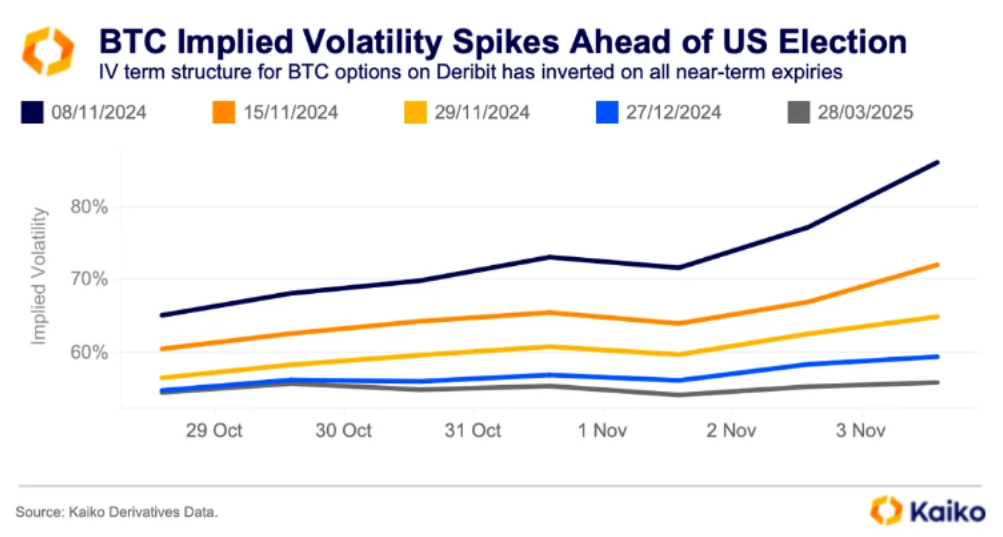
Bitcoin implied volatility ahead of the U.S. election
Image source: Kaiko
Ultimately, markets are driven by supply and demand dynamics influenced by participant behavior. However, McCarthy emphasized that the predictive accuracy of these trends remains uncertain, as traders are far from infallible.
4. Prediction Markets and Polls Diverge Amid Uncertain Outcomes
Currently, Trump has a 62% probability of winning on decentralized platform Polymarket, compared to Harris’s 38%, with $3.25 billion traded on presidential election outcomes—the largest prediction market volume seen to date. On regulated exchange Kalshi, Trump’s odds stand at 57%, with Harris at 43%. However, Bernstein analysts noted Monday that national polling averages remain tight, with Harris leading by just 1%—within the margin of error.
Kaiko previously pointed out that open interest levels on Polymarket suggest insufficient liquidity for reliable U.S. election betting, raising questions about its forecasting ability. This week, analysts from GSR, a crypto trading firm and market maker, mentioned that others have highlighted inconsistent performance of prediction markets during elections, potential manipulation by large players, or inherent biases due to dominance by male, crypto-native, and non-U.S. traders on such platforms.
Nevertheless, after both candidates’ odds briefly converged over the weekend, Gautam Chugani, head of Bernstein Digital Assets, said: “For those who believe Polymarket data is manipulated with a Trump bias, we believe weekend trading activity has sufficiently demonstrated it functions like any open market, with traders reacting rationally to gradually shifting poll data.”
Moreover, supporters of prediction market accuracy argue that the focus on voter polls rather than Electoral College outcomes, along with the use of retrospective polling in election models, are key limitations. They also emphasize that most betting markets show odds similar to Polymarket, suggesting minimal likelihood of market manipulation. GSR added that academic research shows prediction markets tend to be more accurate than surveys or expert opinions, with transparency, collective intelligence, and market mechanics driving odds toward accuracy.
Kaiko noted that Pennsylvania, North Carolina, Georgia, Michigan, Wisconsin, Arizona, and Nevada are critical states to watch on election night—especially Pennsylvania. If Harris loses its 19 electoral votes, her path to the White House becomes extremely difficult, if not nearly impossible, according to some polls.
Currently on Polymarket, Trump leads in Arizona, Georgia, Nevada, North Carolina, and Pennsylvania, while Harris leads in Wisconsin and Michigan.
5. Expected Impact on Bitcoin Price
Greg Magadini, Head of Derivatives at Amberdata, told The Block he expects Bitcoin to fluctuate between $6,000 and $8,000 post-election. A Harris victory could push prices down to the $60,000 level, whereas a Trump win might propel Bitcoin above $75,000, setting a new all-time high.
BRN analyst Valentin Fournier echoed this view, predicting a roughly 10% price swing following the election—positive if Trump wins, potentially negative if Harris prevails. “However, regardless of the outcome, Bitcoin’s medium- to long-term outlook remains bullish,” Fournier noted.
On Monday, Bernstein analysts projected that if Trump wins, Bitcoin could reach $80,000–$90,000 by January 20, Inauguration Day. However, they warned that a Harris victory could send Bitcoin down to $50,000 during the same period before recovering later.
According to The Block’s Bitcoin price page, Bitcoin is currently trading at $68,828. It has fallen about 4% over the past week but is up 63% year-to-date.
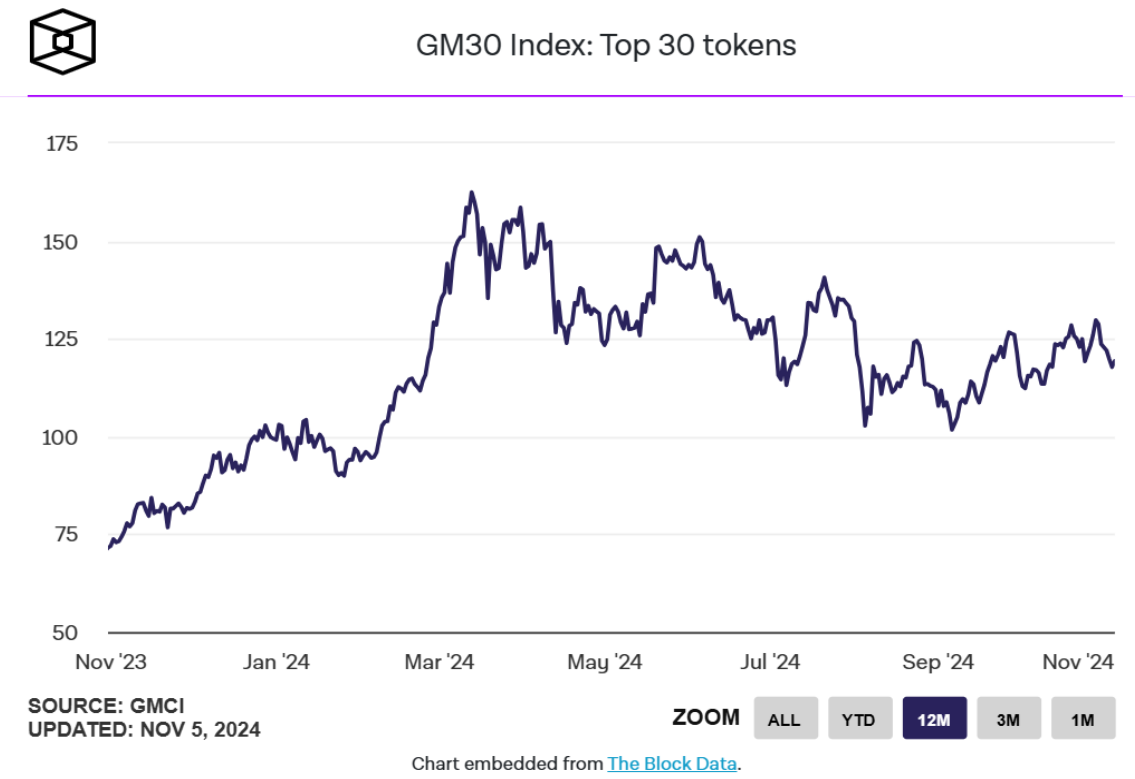
In the meantime, the GMCI 30 Index, representing the top 30 cryptocurrencies, has declined approximately 7% over the past seven days, sitting at 120.08, though it remains up about 21% for 2024.
Join TechFlow official community to stay tuned
Telegram:https://t.me/TechFlowDaily
X (Twitter):https://x.com/TechFlowPost
X (Twitter) EN:https://x.com/BlockFlow_News
 The Block