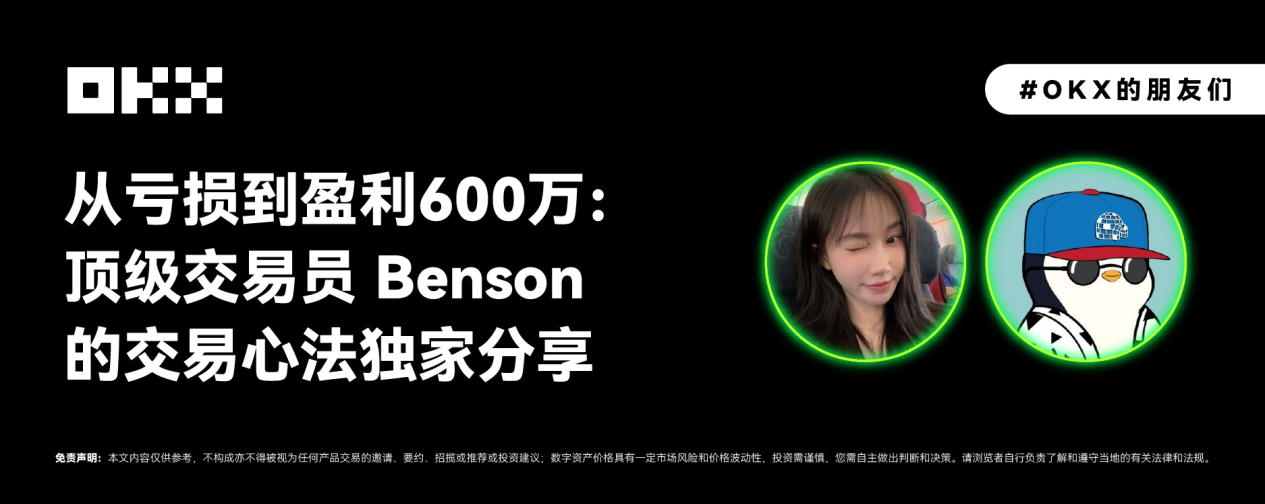
OKX Friends Episode 04 | From Losses to Earning 6 Million: Trading Insights from Top Trader Benson
TechFlow Selected TechFlow Selected
OKX Friends Episode 04 | From Losses to Earning 6 Million: Trading Insights from Top Trader Benson
Guest Message: Human nature is often the biggest obstacle in trading. As a data-driven trader, I've always been committed to promoting more rational trading decision models. OKX's diverse product lineup and deep technical support have greatly helped CoinKarma, and I look forward to continuously creating value in the future.
 Navigating Web3 tides with focused insights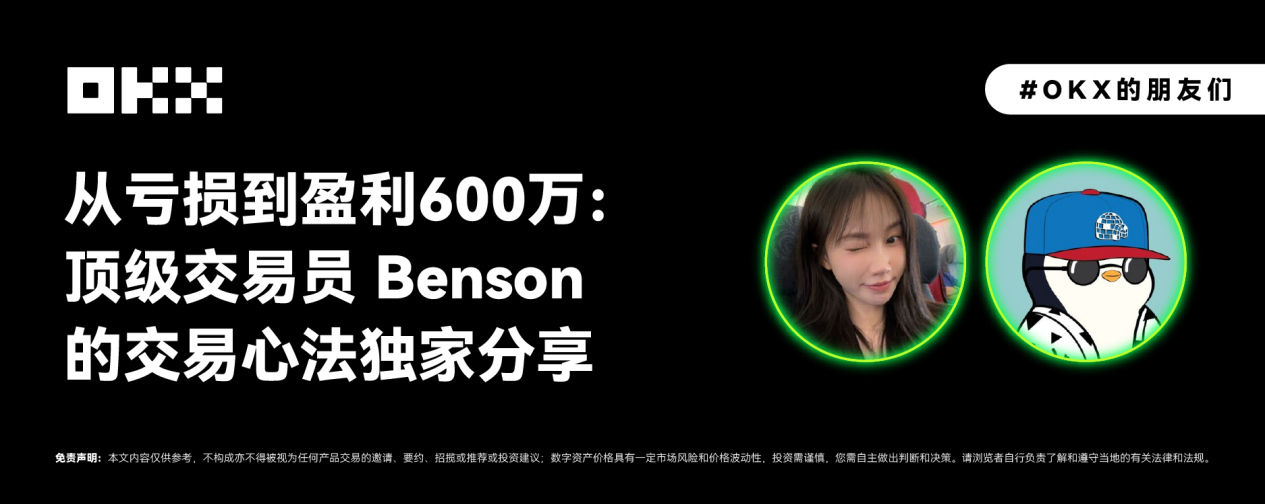
Benson runs Coinkrama, a trader data platform focused on identifying market reversal points from a liquidity perspective. He is also a secondary market trader who previously worked in data analysis at a large financial holding company in Taiwan. He entered the blockchain industry after being noticed by an exchange for his online articles.
OKX has specially invited him as a guest speaker for the "Friends of OKX" series, hoping that his past experiences and insights into the industry will inspire others.
The "Friends of OKX" series is a special column curated by OKX’s official community ambassador Mercy (@Mercy_okx), aiming to uncover the career journeys, industry perspectives, and lessons learned from KOLs with diverse backgrounds, offering valuable references for new users.
1. Recalling My Entry Into Crypto
Mercy: What led you into the cryptocurrency industry? Did you start trading right away?
Benson: I officially entered the industry in March 2018. Prior to that, I was working in data analysis at a large financial holding company. After publishing articles online, I caught the attention of an exchange's HR team. At the time, I was also exploring new opportunities, so I joined this exchange.
The exchange had a vision of becoming the "Goldman Sachs of crypto"—operating both as an exchange and conducting ICOs, similar to how Goldman handles IPOs by underwriting quality projects. However, my timing wasn’t ideal—I joined near the end of the 2017 bull market.
When I first started, I wasn't truly doing what you'd call "trading." I bought spot assets. Many people advised me to buy Bitcoin and Ethereum, saying prices were at a low point. I also invested in several ICOs, including one logistics-related ocean project whose team claimed the ICO was highly successful and promised a 60x return post-listing. I invested around $7,000, which eventually went to zero. I kept averaging down as Bitcoin dropped from $9,000 to $6,000, but lost all confidence when it hit over $4,000 and sold everything, losing more than $10,000 overall.
Mercy: After leaving the exchange, you turned to writing—did this shift change your understanding of the industry?
Benson: After leaving, I was quite disappointed and even considered joining mainstream Web2 giants like Amazon or Google. While job hunting, I began writing articles on Dongqu (a Chinese crypto media outlet), mainly criticizing blockchain technology. I remember writing an article titled "Six Challenges Facing Blockchain Adoption," interestingly, these issues still seem unresolved today.
The real turning point in my career came when I discovered a consistently profitable strategy—lending on Bitfinex. I wrote an article explaining how to lend USDT on exchanges to fund leveraged positions. It gained widespread attention across the Chinese-speaking community, prompting many to participate. One group member, dissatisfied with existing lending bots, developed his own—this eventually became the origin of FundingBot.
2. Building a Personal Trading Framework
Mercy: Why did you choose to focus on derivatives trading? How did you develop your methodology?
Benson: Honestly, I didn’t have any real trading methodology at first. People might assume I was skilled from the beginning, but actually, I was more familiar with product structures—like the design logic behind perpetual contracts or how market depth forms.
Later, I realized that due to the lack of fundamental analysis in crypto, most rely on technical analysis. But this market has strong reflexivity—when too many people use the same TA methods, they tend to fail. For example, when everyone watches for head-and-shoulders patterns, the market often breaks those expectations.
As for why I chose derivatives—it was July 2019 when I was observing FTX. Although the spot market had already formed a three-player oligopoly, I saw significant opportunity in derivatives. At the time, BitMEX, the leader in derivatives, had daily trading volume of $10 billion just in Bitcoin perpetuals. That showed me product innovation would be key to winning in this space.
Mercy: You mentioned growing capital from hundreds of thousands to millions of dollars—how did that happen?
Benson: In 2021, I started with $300,000 on a certain platform and grew it to over $6 million. This was during a bull market, so the returns weren’t extraordinary in context. Looking back, I primarily used BitMEX funding rates to gauge market sentiment. When funding rates dropped below 0.01%, indicating weak market enthusiasm, I’d go long with tighter stop-losses given the broader bullish trend.
In spot markets, exchange tokens delivered the highest returns. Coinbase was about to go public with a valuation nearing $1 trillion, while crypto-native exchange tokens were valued in just the billions—an obvious valuation mismatch. This created massive upside potential, leading to strong rallies across major exchange tokens.
However, when the Fed began hiking rates, the entire market environment fundamentally shifted. It wasn’t until mid-2022 that I realized my previous trading approach no longer worked, so I paused trading altogether. That taught me the importance of constantly evaluating under what conditions my trading system works—and when it fails.
Mercy: What does a typical day look like for a derivatives trader? Who is best suited for this role?
Benson: Every trader has different habits—there’s no one-size-fits-all model—but I can share my routine.
Each morning, I check Bitcoin’s price to see if the market is up or down, then review the top 10 altcoins. Next, I analyze market liquidity and decide whether to trade based on that data. My decisions hinge on two factors: price reaching a specific level, or the emergence of a particular market signal.
I’m not a frequent trader; I lean toward contrarian ("left-side") entries, waiting patiently for the right moment. My system is strict—typically only 1–2 trading opportunities arise per week, sometimes none for 2–3 weeks due to lack of favorable setups.
3. Entrepreneurship and the Current Market Environment
Mercy: What motivated you to launch your current platform? Can you tell us what your platform does?
Benson: Initially, it was simple—I'm a data-dependent trader who constantly needs information from various sources: on-chain data, spot exchanges, derivatives markets. I originally wanted to integrate all these APIs into a personal dashboard.
Later, when discussing the idea with friends, they suggested turning it into a product. Progress was slow at first, but after the FTX collapse, I realized I needed to take the project more seriously.
Our platform specializes in analyzing order book liquidity in the spot market—a system that performs particularly well in ranging markets. We’ve also built unique indicators, such as tracking meme token dominance and Coinbase app rankings, combining them into a composite metric called the "Karma Index" to identify macro trends.
We currently have over 3,000 users, nearly 600 of whom are paying subscribers. We operate on a subscription model, committed to delivering professional-grade market analysis tools.
Mercy: How do you view the current market environment?
Benson: The most notable feature today is the lack of fresh capital inflows. Despite Bitcoin approaching all-time highs, most altcoins have seen limited gains. Exchanges are listing Telegram-based projects to attract new users, but these users mostly come for airdrops and leave immediately after claiming tokens—adding little real demand.
This industry-wide stagnation shows in other ways too: mid-tier exchanges are cutting staff, and companies like DYDX, Prekin, and MetaMask’s parent firm have recently announced layoffs. While Bitcoin performs well, its spillover effect on other crypto assets remains minimal. If we exclude Bitcoin, it's hard to argue we're in a true bull market. Most clearly, external capital isn't entering—the market has become a pure zero-sum game. Many VCs hold large amounts of low-cost tokens and keep selling, putting sustained pressure on numerous projects.
Mercy: If no new growth drivers emerge, how do you see the market evolving?
Benson: If we don’t create new narratives or find growth vectors recognized by outside capital within the next one to two quarters, I’ll be very bearish on future prospects. Bitcoin may decouple and follow its own path. If it solidifies its status as digital gold, it could enter a prolonged slow bull run. But for altcoins—including Solana—I remain pessimistic. Even Solana, after the meme coin frenzy fades, will likely face challenges similar to ETH.
Some find my views contradictory—I express optimism about Q4 while sounding bearish at times. The key is that a true bull market requires external capital to embrace the Bitcoin/crypto narrative and bring in continuous new funds. Today’s rally is largely driven by Trump hedge trades and ETF expectations—such momentum may not last.
Mercy: Given the broader market context, what advice do you have for newcomers?
Benson: My advice is to stay清醒 (clear-headed) at all times. Don’t blindly follow others just because they’re making money—the rules can change overnight.
Regarding strategy, I now adopt a more defensive mindset. Even if the market continues rising, I plan ahead for when to exit rather than chasing higher profits. Especially when optimism runs high and people mock those warning of risks, caution becomes even more critical.
In this fast-changing market, only those who detect shifts early and adapt their strategies can achieve long-term success. Remember: no strategy is permanently correct—the key is always being ready for change. As for myself, I’ll continue focusing on developing and refining our data platform to provide better analytical tools. I believe timely, accurate data analysis and rational judgment will always be the keys to success in this space.
4. First Impressions of OKX
Mercy: When we met offline in Dubai, I noticed your collaboration with OKX was already quite deep. Could you share your thoughts on OKX?
Benson: After FTX collapsed, I began re-evaluating various exchanges. I found OKX’s products exceptionally sophisticated, especially in derivatives. Their options offerings stood out—they’ve invested heavily with remarkable professionalism. Given OKX’s public image as primarily a retail-focused exchange, their depth in complex, institutional-grade products like options was surprising.
Also, I see OKX as a deeply product-oriented company. Features like Signal Trading and comprehensive API support may not interest average retail users, but are crucial for professionals. Their dedication to perfecting these details left a strong impression.
I particularly appreciate how thoroughly developed OKX’s professional tools are. While many exchanges implement features superficially, OKX pushes each function to its limit. Take options: not only are core functions robust, but even niche features used only by expert traders are thoughtfully included. This level of product refinement is rare in the industry.
Another standout is the number of “under-the-radar” features—powerful tools not highlighted on the homepage but extremely useful for pros. These hidden capabilities reflect OKX’s commitment to product depth.
Mercy: Can you talk about how your collaboration with OKX began?
Benson: During the development of our data platform, I found that only OKX’s API architecture fully met our needs and could be used directly. When building our quantitative trading platform, we required seamless integration with multiple data feeds. OKX’s interface design and documentation were exceptionally professional—this was a major reason we chose to partner closely with them.
Through collaboration, I’ve increasingly recognized OKX as a truly product-driven company. When we提出 (raised) professional user requirements, the OKX team consistently listened carefully and responded quickly. Their focus on product excellence and responsiveness to user needs makes OKX a trustworthy long-term partner.
Risk Warning and Disclaimer
This article is for informational purposes only. The views expressed are those of the author and do not necessarily represent the positions of OKX. This article does not constitute (i) investment advice or recommendations; (ii) an offer or solicitation to buy, sell, or hold digital assets; or (iii) financial, accounting, legal, or tax advice. We make no guarantees regarding the accuracy, completeness, or usefulness of the information provided. Holding digital assets—including stablecoins and NFTs—carries high risk and values may fluctuate significantly. You should carefully consider whether trading or holding digital assets is suitable for you based on your financial situation. Please consult your legal/tax/investment professionals regarding your specific circumstances. You are solely responsible for understanding and complying with applicable local laws and regulations.
Join TechFlow official community to stay tuned
Telegram:https://t.me/TechFlowDaily
X (Twitter):https://x.com/TechFlowPost
X (Twitter) EN:https://x.com/BlockFlow_News
 OKX
OKX