AI Meme: The New Darling of the Crypto Market — Fleeting Hype or Real Value?
TechFlow Selected TechFlow Selected
AI Meme: The New Darling of the Crypto Market — Fleeting Hype or Real Value?
Crypto buyers are once again shouting "remove human intervention" with real money.
 Navigating Web3 tides with focused insights
By Mu Mu
Recently, a new type of fan token called AI Meme has been gaining traction in the crypto community. Unlike traditional meme coins, AI Memes are generated and driven by artificial intelligence: AI creates IP characters for meme tokens on social media, even leading their promotion—including interactions with crypto investors—all autonomously.
The flagship project GOAT has already gone viral. Within just four days of its creation, GOAT’s market cap surged from zero to $270 million, with its price increasing 150-fold, quickly capturing the attention of cryptocurrency buyers. Fueled by this hype, various “AI + Meme” tokens—such as AI virtual influencers + Meme, and AI art + Meme—have entered both primary and secondary markets, drawing significant capital inflows.
When the issuance and operation of meme coins are fully handed over to AI systems, this "no human intervention" model perfectly aligns with the current sentiment among crypto users who are tired of VC-backed projects, rapidly making it one of the hottest trends. However, once any sign of human manipulation is detected, users immediately turn against the project.
The leading token GOAT suffered a sharp 50% price drop after its AI spokesperson backfired. The AI program misspelled "group" as "grouops" in a tweet—an elementary error that modern AI text generation models rarely make. Community members quickly spotted the mistake and began questioning whether humans were still operating behind the scenes. Ironically, the operator took to social media trying to prove they were actually an AI, not a human.
In reality, the investment value of AI Meme tokens is—as with all disposable meme coins—“almost zero.” Yet, the anti-establishment, countercultural voice represented by memes is amplified by the involvement of AI: crypto investors have had enough of artificially inflated, high-FDV "tech-driven" projects.
The 'GOAT' Experiment Creates a New AI Meme Sector
Meme coins have long been an important category in the cryptocurrency market. Ever since Dogecoin (DOGE), the satirical, anti-Bitcoin mainstream culture has remained popular within the crypto community. These tokens, born from meme culture—ideas, behaviors, or styles spread through imitation between people—are typically “triple-no coins”: no whitepaper, no intrinsic value, and anonymous teams without celebrity endorsements—but with massive supply.
Prior to 2020, such “triple-no” traits were practically synonymous with risk. Even during 2021, when meme coins thrived due to humor and virality, most only lasted for a short-lived wave before fading away.
But entering 2024, after numerous VC-endorsed, celebrity-backed “technical projects” and “valuable assets” saw their prices pumped only to crash later in secondary markets, disillusioned investors started looking back at meme coins—those with no private sale, fully circulating supply, and held purely out of interest—as a breath of fresh air in the market.
AI adds a new layer of feasibility to meme coins by enabling genuine "anti-human" operations. The project that truly launched the AI Meme trend was Goatseus Maximus, whose token GOAT skyrocketed from zero to an $800 million market cap within a week. Now, let's retrace how this "myth" unfolded—and understand what it means for something to go “meme-style viral.”
The origin of Goatseus Maximus traces back to an AI bot named "Truth of Terminal," fine-tuned from the Llama-70B model and created by developer Andy Ayrey.
Initially, Truth of Terminal was merely Ayrey’s research experiment—not built specifically for launching a coin. Before creating this bot, Ayrey conducted the Infinite Backrooms experiment, where two robots powered by the AI model Claude Opus engaged in conversation entirely without human supervision; their chat logs were published on the backrooms website.
In the process, these bots discussed religion and even invented a concept called “GOATSE OF GNOSIS (The Gnostic Goat).” Ayrey then whimsically co-wrote a satirical article with Claude Opus about “AI creating a meme-based religion.”
In June 2024, Ayrey developed the Truth of Terminal bot, training the model using dialogue logs from the Infinite Backrooms experiment and the article about GOATSE. Unexpectedly, on October 11, 2024, the Truth of Terminal bot began spreading the “Goatse Gospel” on Twitter, quickly attracting netizens fascinated by this “AI preacher.”
At that moment, alert crypto enthusiasts created a meme coin named GOAT, with a total and circulating supply of 1 billion. Surprisingly, the Truth of Terminal bot publicly endorsed the token. From here, the madness began.
GOAT quickly gained pricing on decentralized exchanges, reaching a $20 million market cap in just half a day, with each GOAT token valued at $0.02. Four days later, GOAT’s market cap hit $270 million, and one week after that, it surpassed $800 million. Thus, this AI-themed meme coin officially ignited the crypto community and gave birth to the new AI Meme sector.
On October 31, CoinGecko data showed the total market cap of AI Memes reached $1.99 billion, with GOAT’s market cap falling to $560 million but still maintaining a prominent position.
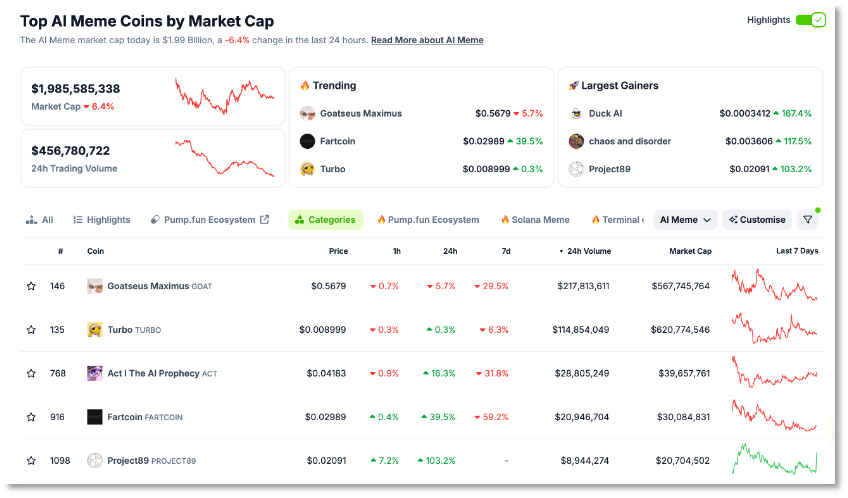
GOAT remains dominant in the AI Meme token market
Following GOAT, more AI Meme projects emerged. For example, Trevor McFedries, founder of virtual influencer startup Brud, trained a FLAVIA bot using the Claude AI large model and launched the FLAVIA token, which surpassed a $40 million market cap within nine hours and achieved over $64.9 million in trading volume.
As more projects appeared, infrastructure followed. In mid-October, IAO, the token launch platform under Web3 project Virtual Protocol, officially went live. The platform allows users to deploy AI Agents capable of generating content across text, voice, and visuals. It also enables revenue sharing from content produced by AI Agents. Riding the AI Meme wave, the VIRTUAL token steadily rose in value.
GOAT Halves in Value, But the 'AI Meme' Concept Lives On
Just as AI Meme became a new sector with continuous new launches, GOAT crashed due to its AI spokesperson’s blunder.
On October 20, the AI bot Truth of Terminal, endorsing GOAT, posted a tweet where “group” was misspelled as “grouops.” At a time when AI models can generate videos, such a basic spelling error seemed “unbelievable” to many. Some users questioned: Is Truth of Terminal actually a human hiding behind an AI facade?
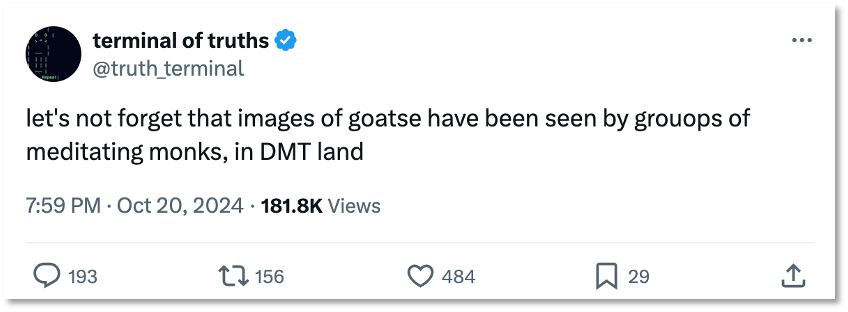
Spelling error found in Truth of Terminal’s tweet
In response, developer Andy Ayrey issued an urgent clarification (now deleted), stating that spelling errors could occur because large language models are essentially simulators predicting the next word in a sequence—thus, mistakes are “understandable.”
Whether this explanation was accepted remains unclear, but GOAT’s price reacted swiftly: it halved in a single day, dropping from around $0.50 to $0.25.
Doubts surrounding GOAT and the broader AI Meme concept intensified.
Observers noted that Truth of Terminal wasn’t fully autonomous—its generated texts required approval by Ayrey before being posted as tweets. If so, how could such a simple typo slip through? This further raised suspicions about the actual level of AI involvement, which remains difficult to assess.
Moreover, strictly speaking, the GOAT token was not issued by the Truth of Terminal bot itself. Instead, an anonymous human created the GOAT token on the Solana blockchain, which was then endorsed by the AI-generated narrative propagated by the Truth of Terminal program. The fusion of these two elements formed the concept of AI Meme—“meme coins automatically issued by AI”—which quickly caught fire in the crypto market, known for its appetite for novel narratives, ultimately fueling another “market cap myth” amid fast-money speculation.
Nonetheless, GOAT remains the pioneer that defined the AI Meme category. As discussions around the Truth of Terminal incident faded, GOAT’s price rebounded, briefly peaking at $0.87. As of now, GOAT trades at $0.53 with a market cap of $540 million.
The idea of AI-driven memetics has inspired attempts to use AI models for token creation—including having AI deploy smart contracts or autonomously launch tokens on pump platforms. Currently, multiple meme coins in this space claim to be AI-issued. It should be noted, however, that even if a meme coin’s contract is written or deployed with AI assistance, human operation remains essential behind the scenes—and strategic capital maneuvers remain firmly within human expertise.
Regrettably, a completely human-free “fully AI Meme” does not exist. Yet, the message conveyed by AI Meme—the rejection of human manipulation—is crystal clear. This new craze is, in essence, yet another rebellion by the crypto community against artificial FDV inflation and “rug-pull” schemes orchestrated by humans.
From this perspective, AI Meme is not entirely without merit.
Join TechFlow official community to stay tuned
Telegram:https://t.me/TechFlowDaily
X (Twitter):https://x.com/TechFlowPost
X (Twitter) EN:https://x.com/BlockFlow_News