Layer1 Public Chain XION: A User Experience Revolution on Chain Abstraction
TechFlow Selected TechFlow Selected
Layer1 Public Chain XION: A User Experience Revolution on Chain Abstraction
From User Experience to XION: How Chain Abstraction Simplifies Web3
 Navigating Web3 tides with focused insights
By shaofaye123, Foresight News
Over 1,800 public blockchains are currently operating in the Web3 world, yet real applications remain few and far between. As infrastructure continues to mature, the race among blockchains for high performance and scalability is no longer the central focus. Layer 1s now need genuine builders and users—something that cannot happen without widespread adoption. In today’s multi-chain landscape, liquidity is fragmented, user onboarding barriers are high, application deployment is difficult, and capital efficiency remains low. User experience still sits at the “usable” stage, making mass adoption elusive. What’s needed is a user experience revolution driven by chain abstraction—and we see Layer 1 blockchain XION leading this shift through protocol-level chain abstraction to truly simplify Web3.
Starting with User Experience
Looking at human technological progress, every era of mass technology adoption has been fueled by a revolution in user experience. The evolution of user experience determines which lifecycle stage a technology is in. While today's Web3 wears the facade of cutting-edge technology, its actual development level resembles that of an agrarian society. The path to mass adoption remains long, and the rapid advancement of technology urgently needs to catch up with improvements in user experience.
Mass Adoption Requires a User Experience Revolution
Web2 achieved mass adoption not just through improvements in underlying infrastructure, but most importantly through the evolution of user experience—from “usable” to “easy to use,” and ultimately to “enjoyable to use.” Across different development stages, we can clearly observe a shift in the key metrics being prioritized. Early eras focused on faster data transmission speeds and broader coverage during 3G and 4G rollouts; today, the emphasis lies squarely on daily active users and retention rates. Under mass adoption, industry attention has shifted from foundational infrastructure to application-layer innovation—an inevitable progression toward mainstream use.
Today, while Web3 infrastructure is maturing, most blockchains still prioritize low-level metrics like TPS (transactions per second) and TVL (total value locked) growth, largely overlooking high-value indicators such as user activity and velocity of money. This results in rapid technical progress but minimal actual user engagement. For mass adoption to occur, projects must first shift their focus—from growing TVL to cultivating user activity and monetary velocity. This pivot will determine when true mass adoption happens. And improving user engagement and capital flow demands nothing less than a user experience revolution.
Simplification Through Chain Abstraction
For non-crypto-native users, entering Web3 has always involved significant barriers: 12- or 24-word seed phrases, tokens burned due to incorrect addresses, varying gas requirements across chains, assets that cannot be transferred seamlessly, and confusing jargon everywhere. These obstacles form a major gap between Web2 users and Web3 applications.
Even for crypto-native users, the multi-chain ecosystem introduces fragmentation in assets, liquidity, and accounts, leading to lower user activity and slower capital velocity:
-
Asset fragmentation — Different gas tokens across chains and expensive cross-chain bridges make asset interoperability difficult.
-
Liquidity fragmentation — Differences in user behavior and token deployment across chains result in isolated ecosystems.
-
Account fragmentation — Users struggle to consolidate identities and wallets across multiple chains.
Chain abstraction offers solutions to these challenges.
— "Chain abstraction" generally refers to infrastructure that allows anyone to use decentralized applications without needing to understand manual processes tied to underlying chains—such as bridging assets, managing multiple gas tokens, or monitoring balances. It streamlines unnecessary manual interactions, enabling both developers and users to focus on the application itself.
XION expands this definition beyond multi-chain usability, focusing instead on holistic user experience. XION simultaneously solves distribution and fragmentation issues. After all, if there are no meaningful applications running on these chains, who cares about connecting them? XION first provides developers with the foundation to build real-world applications, then tackles multi-chain fragmentation—a comprehensive and well-rounded approach.
The solution proposed by XION reflects not only deep technical understanding of blockchain fundamentals but also strong capabilities in product operations, resource access, and ecosystem collaboration—all areas where XION excels.
Overview of XION
Abstraction from Account to Chain Level
Since the concept of chain abstraction emerged, various projects have approached it differently. Most existing products fall into one of three categories: application-level, account-level, or blockchain-level abstraction. XION stands out as the only solution covering all three layers. XION supports abstracted applications built atop it, while also delivering universal account abstraction and protocol-level abstraction.
-
Application-level chain abstraction provides developer-centric tools and components.
-
Account-level chain abstraction gives users a unified mechanism for seamless cross-chain interaction, solving user-side fragmentation.
-
Blockchain-level chain abstraction addresses the lack of parity in infrastructure across chains, enabling interoperability and creating a true chain-abstracted experience—while minimizing risk, latency, and cost.
Unlike cross-chain bridges, middleware, or intent protocols, chain abstraction targets more specific problems with a much broader vision. As a leader in this space, XION exemplifies both account abstraction and blockchain-level abstraction.
XION eliminates wallet complexity through powerful abstracted accounts and combines modular design with a parametric fee layer to deliver a composable, user-first, future-proof infrastructure. Its generalized abstraction layer establishes user experience as a core objective at the protocol level. By integrating abstracted accounts, signatures, fees, and interoperability directly into the protocol, XION enables secure, streamlined, and seamless experiences. It simplifies development while fostering a user-centric environment. Compared to other chain abstraction solutions that focus narrowly—often solely on multi-chain connectivity—XION’s approach is more comprehensive and systematic. It dramatically lowers the barrier for mainstream users to adopt applications within its ecosystem while effectively addressing fragmentation.
Strong Comprehensive Capabilities
Beyond technical innovation, XION demonstrates exceptional strength across multiple dimensions.
Team Strength: The XION team consists of serial entrepreneurs. Founder Burnt Banksy was involved early in establishing NFT standards and gained global media attention after burning a Banksy artwork and minting it as an NFT.

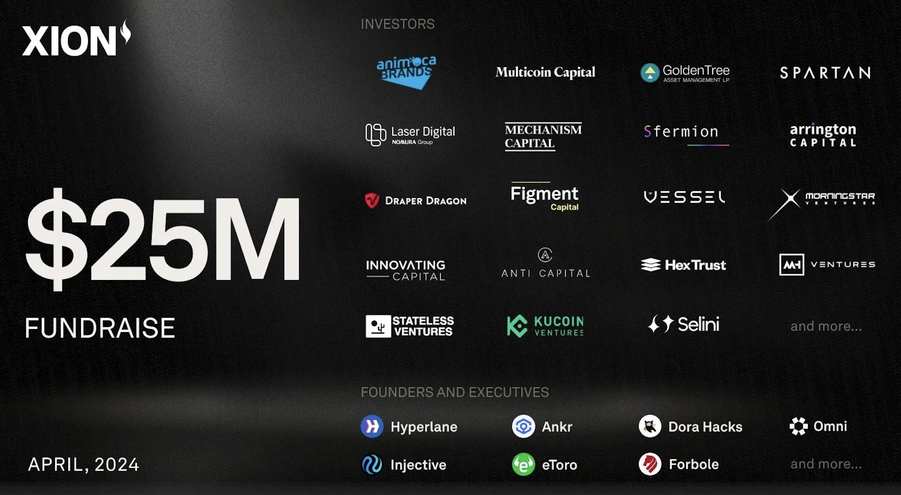
Funding Background: XION has raised $36 million in funding from prominent investors including Multicoin, Circle, Animoca Brands, Hashkey, Spartan, Valor, Morningstar Ventures, Mechanism, Figment, CoinList Seed, Injective, and Alliance DAO.
Ecosystem Expansion: XION is actively growing its ecosystem, which already includes over 200 applications, infrastructure providers, and partners. Additionally, XION is extending its chain abstraction solution to integrate with major ecosystems such as Solana, BNB, AVAX, Injective, Saga, Neutron, MultiversX, and Sei.
Product Growth: XION places strong emphasis on product rollout and operations. To date, it has created over 3,600,000 meta-accounts and hosts more than 200 top-tier deployments, integrations, and partnerships building on XION. On social platforms, XION has grown to over 1.3 million members (Twitter: 700k+, Discord: 650k+).
Building XION
XION possesses the capability to realize its vision of chain abstraction, allowing users to interact with Web3 products in a truly “chain-abstracted” way—effectively simplifying Web3. Much like the internet, users won’t need to understand blockchain technology to benefit from Web3 applications.
Product Driven by Demand
While XION’s concept of chain abstraction may sound abstract, the problems it solves are concrete and clear-cut. XION’s product design is scenario-driven and demand-oriented, tackling real-world pain points. This use-case-first approach ensures alignment with actual business needs and user behaviors.
Use Cases — Highly Demand-Oriented
How XION’s Chain Abstraction Meets User Needs
What is the primary need for users in Web3? — “Transacting.”
This answer is unquestionable. Yet executing even a simple transaction is extremely cumbersome. When a user wants to trade tokens on Base, they must first buy ETH on a decentralized exchange for gas, withdraw both the target token and ETH to their Base address, then locate a DEX to complete the trade. This seemingly basic process requires understanding gas mechanics, remembering multiple seed phrases, and ensuring correct address entries. Cross-chain operations compound this difficulty with multiple incompatible wallets, differing gas tokens, and numerous DEXs.
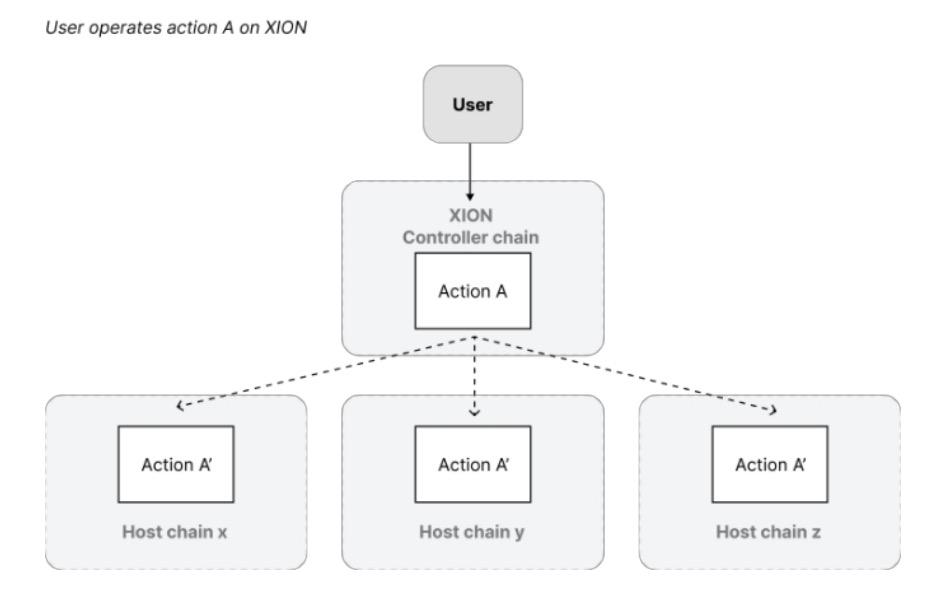
All of this can be simplified with XION. Using its wallet-free L1 protocol, XION integrates account abstraction, signature abstraction, and price abstraction to deliver seamless user interaction. Users can log into XION-based apps using familiar Web2 methods (e.g., email), interact via mobile devices, begin using apps without holding the chain’s native token, and experience pricing in stablecoins—making costs feel familiar. At the protocol level, XION handles fund transfers, conversions, and transactions behind the scenes. The frontend experience becomes invisible; wallets fade into the background. Users can access any asset on any chain without worrying about gas—similar to using WeChat Pay or Alipay abroad without manually exchanging currencies or seeking optimal exchange rates.
On security, XION enhances protection by offering temporary keys with time-limited access, allowing users to define custom transaction limits and conditions. For high-value transactions, multiple verification methods can be set, and account recovery remains possible even if certain verification methods are unavailable.
How XION’s Chain Abstraction Supports Product Needs
What do Web3 products need today? — “Fluidity.”
Currently, users and products across chains are static. Users tend to stick with fixed applications on preferred chains—usually the largest protocols. This makes competition revolve around TVL, a misleading indicator of health. True breakthroughs in Web3 products will only come when user migration costs drop, capital flows freely, and ecosystems interconnect.
XION’s chain abstraction helps achieve this by aggregating multiple applications, reducing user migration friction, and breaking down financial barriers between chains. Products become accessible to users across multiple blockchains. Decentralized autonomous organizations (DAOs) can operate seamlessly across chains, enabling efficient governance. Developers can focus entirely on building better products, free from the burden of choosing where to deploy.
How XION’s Chain Abstraction Impacts Mass Adoption in Web3
What does Web3 truly need? — “Mass adoption.”
Web3 must find new markets. Whether through modular architectures improving development efficiency or TON’s efforts to reach end-users, the goal is to boost productivity on both developer and user fronts. XION’s Generalized Abstraction Layer removes complexity around account interaction, transaction fees, and interoperability, drastically lowering entry barriers. Its cross-chain functionality sets a precedent for sustainable, flexible, and user-centered blockchain infrastructure. With diverse use cases emerging—digital banking, creator platforms, cross-chain gaming—the integration of these ecosystems could usher in a new chapter for Web3 mass adoption.
Conclusion
Every revolution in how humans use and control tools has been, at its core, a revolution in user experience. In eras of low productivity and primitive technology, human needs were subservient to external constraints. With technological advancement, industrial-era product design evolved from utilitarian “form follows function” to “user-centered” thinking. This shift in user experience reflects broader industrial development and liberates humans from machine-dominated production. Web3 is still transitioning from “usable” to “easy to use”—a transformation requiring a user experience revolution starting at the protocol layer. XION is leading this revolution. TechFlow
Join TechFlow official community to stay tuned
Telegram:https://t.me/TechFlowDaily
X (Twitter):https://x.com/TechFlowPost
X (Twitter) EN:https://x.com/BlockFlow_News
 Foresight News