daos.fun: The Next Liquidity Black Hole?
TechFlow Selected TechFlow Selected
daos.fun: The Next Liquidity Black Hole?
AI memes are all the rage, but can't keep up with the pace—could a DAO fund + meme wave be coming?
 Navigating Web3 tides with focused insights
By Karen, Foresight News
Aside from BAN, which was endorsed last weekend by Michael Bouhanna, Vice President of Sotheby's, ai16z has also drawn massive attention thanks to its outstanding performance. Its market cap once approached the $100 million mark before pulling back to around $46 million.
Just three days ago, someone spent 20 SOL (about $3,500) to purchase 47.54 million ai16z tokens—now worth $2.3 million—achieving a return of up to 650x.
So what exactly is ai16z? How does its launch platform daos.fun work? What are its features and risks?
What Is daos.fun and How Does It Work?
daos.fun is a platform founded by @baoskee and supported by Alliance DAO. Its primary function is to help fund managers and creators raise capital so they can establish their own DAOs and invest on behalf of token holders in Meme projects.
Currently, daos.fun operates under an invitation-only model; only creators who receive official invitations or invitation codes from @baoskee can participate.
Once accepted as a creator on daos.fun, you must set a fundraising target amount, fund maturity date, and management fee. Then, there will be one week to raise the required amount of SOL. Each DAO’s tokens are distributed fairly, ensuring everyone starts with equal access at the same initial price. If fundraising fails, buyers have the right to redeem their SOL, though early redemptions incur a 10% penalty.
When fundraising reaches the preset hard cap, the creator deploys the raised SOL into Solana protocols or Meme projects of their choice. At that point, the DAO’s token begins trading publicly through a virtual AMM market. As such, the DAO token’s market cap and price fluctuate based on the fund’s trading activity, performance—and significantly, market sentiment.
In theory, the upside potential for a DAO token’s price is unlimited, but its downside is limited by the original fundraising value. As long as the token’s market cap exceeds the initial fundraising amount, holders can sell their DAO tokens at any time.
All DAOs have maturity periods ranging from 3 months to 1 year. Upon expiration, the DAO wallet is frozen, and SOL profits are distributed proportionally between the creator and investors. Token holders may choose to burn their DAO tokens to redeem underlying assets or sell them directly on the market (provided the market cap remains above the fundraising amount).
Ai16z: The AI DAO Leading daos.fun by a Huge Margin
As mentioned above, the most successful DAO fund on daos.fun to date is undoubtedly ai16z, created by @pmairca (Marc AIndreessen). Starting with an initial raise of 420.69 SOL, ai16z surged to become the dominant leader in market cap—briefly approaching $100 million—fueled by two mentions from a16z co-founder Marc Andreessen on his official Twitter. Though it has since pulled back, its market cap remains stable at around $45 million.
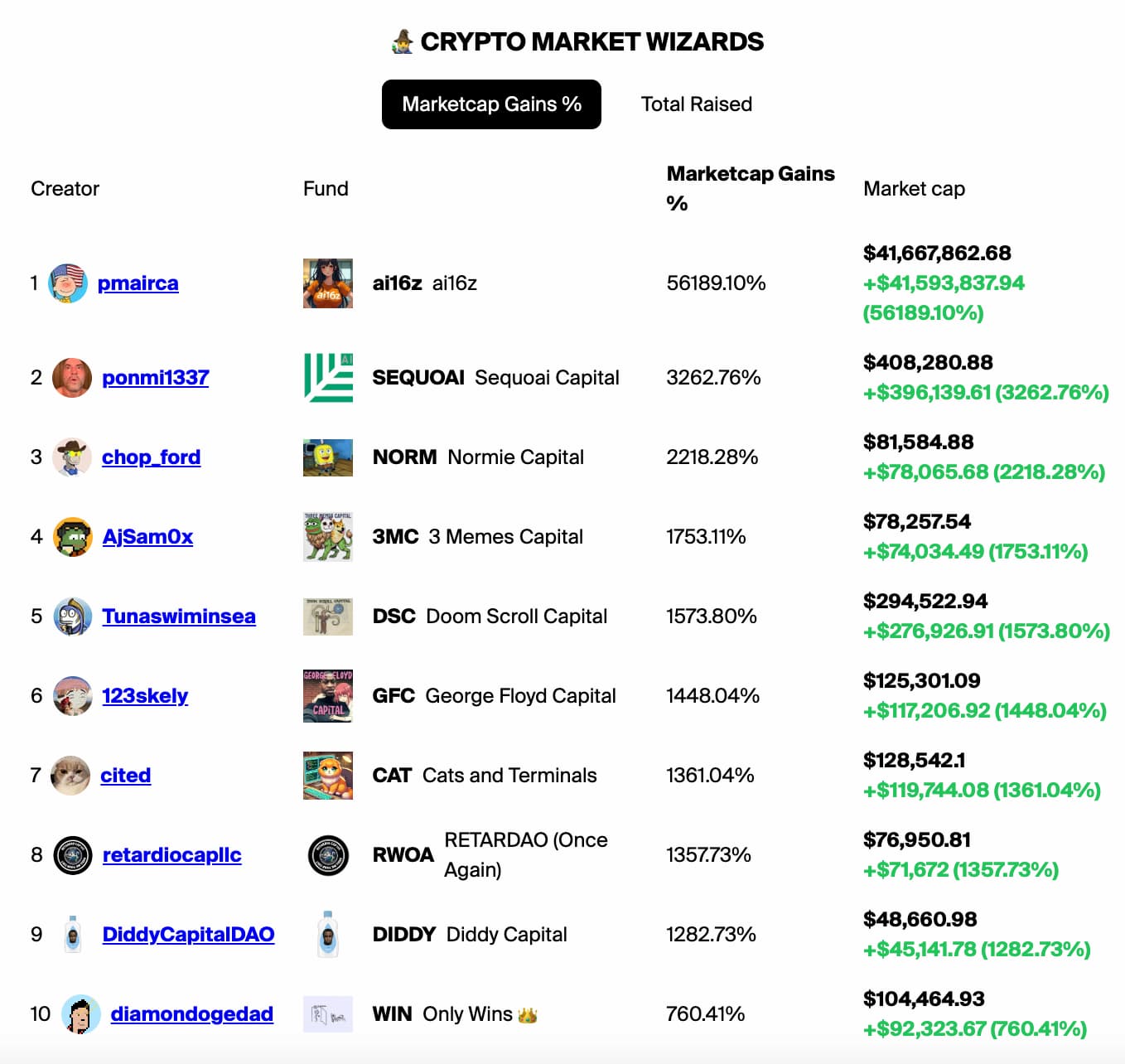
Top 10 DAOs by market cap on daos.fun
Marc AIndreessen stated: “We are riding the wave of a revolutionary transformation, where the deep integration of AI and blockchain technologies will reshape the landscape of finance and innovation. In this transition, the pioneering AI DAO, AI16z, is playing a leading role, painting a future vision where AI agents serve as the core drivers of value creation and growth. In its early stages, ai16z will operate in a highly autonomous manner guided by the collective wisdom of stakeholders. Its long-term goal is full on-chain operation, placing AI entities under the strict protection of Trusted Execution Environments (TEE) to ensure unprecedented transparency, security, and integrity.”
Ai16z not only actively listens to community insights and suggestions but also strives to learn and grow from them. DAO holders have the opportunity to voice opinions on investment decisions within Discord, and the AI system closely tracks the outcomes of these recommendations. Individuals who consistently provide reliable insights will earn the AI’s trust, while those offering poor advice will gradually lose influence. To maintain balanced power distribution, each member’s input weight is proportional to their shareholding in the DAO, effectively mitigating potential threats from malicious actors. In the future envisioned by ai16z, everyone who empowers and adds value to the network will be fairly rewarded.
The ai16z official page also states that it will invest in seed-stage AI companies across fields including robotics, bio + healthcare automation, consumer manipulation, crypto anarchism, enterprise obsolescence, financial technology disruption, game theory development, and infrastructure hijacking. ai16z’s technical battle code is open-sourced on GitHub.
Notably, kotopia is the top fundraiser on daos.fun, having raised nearly 4,207 SOL (worth $740,000), with a current market cap of $810,000.
What Are the Features and Risks of daos.fun?
So, what are the key features and potential risks associated with daos.fun?
daos.fun lowers the barrier to launching Meme funds. If daos.fun eventually opens registration to all creators, theoretically anyone could launch a Meme DAO or Meme VC. Influencers and institutions might even begin issuing tokens via daos.fun. Given the current high热度 around AI Memes—but the difficulty most retail investors face in timing the market—daos.fun undoubtedly opens new possibilities for everyday participants.
Transparency is another major feature of daos.fun. First, each DAO’s asset management status is publicly displayed on the daos.fun website. Second, the profit-sharing mechanism is relatively transparent. Additionally, all DAO creators are linked to their Twitter accounts, which typically means they care about their reputations. But then again—who knows?
The main revenue driver for daos.fun lies in DAO token prices and fund investment performance. However, this profit model comes with non-negligible risks, particularly improper behaviors like frontrunning trades by fund managers. More critically, the severe divergence between a fund’s market cap and its net asset value (NAV) poses another significant risk.
Take ai16z—the largest token on daos.fun by market cap—as an example. Its market cap to NAV ratio stands as high as 58. SEQUOAI, the second-largest (market cap $455,000), has a ratio of 40, while NORM, ranked third, sits at 29. These elevated ratios clearly reflect the intense speculation and hype currently dominating the market, along with investors’ sky-high expectations for these funds’ future performance. Yet, this also serves as a reminder: while chasing high returns, we must remain vigilant against potential market volatility and risks.
As early as 2022, the concept and implementation of Ventures DAOs emerged in the Web3 space, but they failed to gain significant traction at the time. Now, amid the rising Meme craze, whether Meme DAOs, AI DAOs, and similar funds can ignite a new wave remains to be seen. TechFlow will continue to monitor developments closely.
Join TechFlow official community to stay tuned
Telegram:https://t.me/TechFlowDaily
X (Twitter):https://x.com/TechFlowPost
X (Twitter) EN:https://x.com/BlockFlow_News
 Foresight News