








Four Pillars: Everything You Need to Know About Monad
TechFlow Selected TechFlow Selected
Four Pillars: Everything You Need to Know About Monad
This report covers the background of the Monad blockchain, its infrastructure technology, community, and its rapidly expanding ecosystem prior to mainnet launch.
 Navigating Web3 tides with focused insights
Author: Four Pillars
Translation: TechFlow
This article is for general information only and does not constitute legal, business, investment, or tax advice. Please do not use it as the basis for making any investment decisions, nor rely on it for accounting, legal, or tax guidance. References to specific assets or securities are for illustrative purposes only and do not represent recommendations or endorsements. The views expressed in this article are solely those of the author and do not necessarily reflect the opinions of any affiliated institutions, organizations, or individuals. Opinions reflected herein may change without notice.
Four Pillars has prepared a comprehensive report on the Monad blockchain for individuals involved with or part of the Monad community attending Korea Blockchain Week (Asia's largest blockchain conference) and Token 2049.
The report covers the background origins, infrastructure technology, community, and rapidly expanding ecosystem of the Monad blockchain prior to mainnet launch. Its goal is to enhance understanding of the Monad blockchain, especially for those who may be less familiar with it.
1. EVM Again? But This Time It’s Different
The previous market cycle was characterized by numerous chains attempting to accelerate EVM scalability. Describing this period as one of rapid expansion among various EVM-compatible chains would not be an exaggeration. In addition to Ethereum and the many Rollup projects built on top of it, initiatives such as Polygon (Matic), Avalanche C-Chain (AVAX), NEAR AURORA (NEAR), and Binance Smart Chain (BSC) emerged to provide faster EVM execution environments, experiencing particularly notable growth. As a result, in the current market cycle, the narrative of "Ethereum scaling solutions" appears somewhat stale and struggles to capture significant market attention. Nevertheless, the Monad blockchain has surprisingly garnered substantial interest by reintroducing the concept of a "scalable EVM." Why is that?
1.1 EVM-Compatible, but Solana-Fast
"Monad's value proposition is very simple. The performance of EVM today still isn't good enough—everyone wants higher performance, faster transactions, and lower costs," said Keone Hon, co-founder and CEO of Monad Labs.
The "slightly faster EVM-compatible chains" I mentioned earlier are indeed faster than Ethereum and have relatively lower transaction costs. However, compared to Solana (the non-EVM blockchain that stood out in the last cycle and was seen as a viable alternative to Ethereum), they still fall short in several aspects. In terms of speed, Solana is the fastest blockchain and offers the lowest transaction costs. This placed the previous cycle's "fast EVM-compatible chains" in a relatively mediocre position. Although they were faster than Ethereum, Solana was generally viewed as the optimal infrastructure for building transaction-optimized applications. Therefore, there remains a market demand for a blockchain that matches Solana’s speed while leveraging the existing EVM developer community.
The Monad blockchain aims to fill this gap through its technology, becoming a "high-performance blockchain capable of parallel processing within the EVM." To some extent, Monad Labs has popularized the concept of EVM parallel processing in the blockchain space. If the Monad blockchain achieves its target metrics (10,000 TPS and 1-block finality), it could become the first blockchain to combine Solana-like speed with full EVM compatibility.
1.2 More Advanced Optimization
Simply replacing the consensus mechanism with a faster one and then running EVM on top of it faces certain technical limitations—a method commonly adopted by most EVM-compatible Layer 1 chains. To truly achieve a fast and scalable EVM, optimization is required not just at the consensus layer, but across all layers—consensus, execution, and storage (a detailed discussion of these aspects will follow in the technical section). In other words, merely implementing EVM atop a blockchain infrastructure with fast block times and high TPS is insufficient. For example, Ethermint faced major challenges when implementing EVM execution on Tendermint because it couldn’t fully leverage Tendermint’s speed within the EVM environment. This highlights the need for a more comprehensive solution.
Therefore, the Monad blockchain’s goals go beyond accelerating the consensus mechanism. It seeks to fundamentally transform the execution environment by introducing parallel processing and improving data storage methods to build a genuinely fast EVM chain. A detailed explanation of Monad blockchain technology will be provided later.
1.3 Community-Driven Ecosystem
"The crypto community overall is quite remarkable because so many people care about things even before they’re perfect," said Keone Hon, co-founder and CEO of Monad Labs.
Finally, let’s discuss community. Merely supporting EVM is not enough to attract developers to the Monad ecosystem. Therefore, Monad Labs focuses on creating a unique and compelling community to build an attractive ecosystem for developers. While I’ll delve deeper into this later, it’s worth emphasizing that Monad blockchain has already established a strong community before launching its mainnet—an exceptionally strategic move. Ultimately, a Layer 1 blockchain needs to attract developers, who in turn need user support for their applications. Since most users come from communities, the more loyal community members a blockchain has, the easier it becomes to attract talented developers. In a sense, Monad blockchain has laid a solid user foundation to attract skilled service providers. This approach is particularly effective in the blockchain space, and Monad’s ability to execute this strategy demonstrates the team’s excellence. I’ll share more details later on how Monad built such a strong community.
From just these three characteristics, it’s clear that the Monad blockchain stands out. I believe these reasons explain the market’s high expectations for Monad. So, who are the people behind Monad Labs, and what is their background?
2. Monad Labs: A Team Aligned With Vision
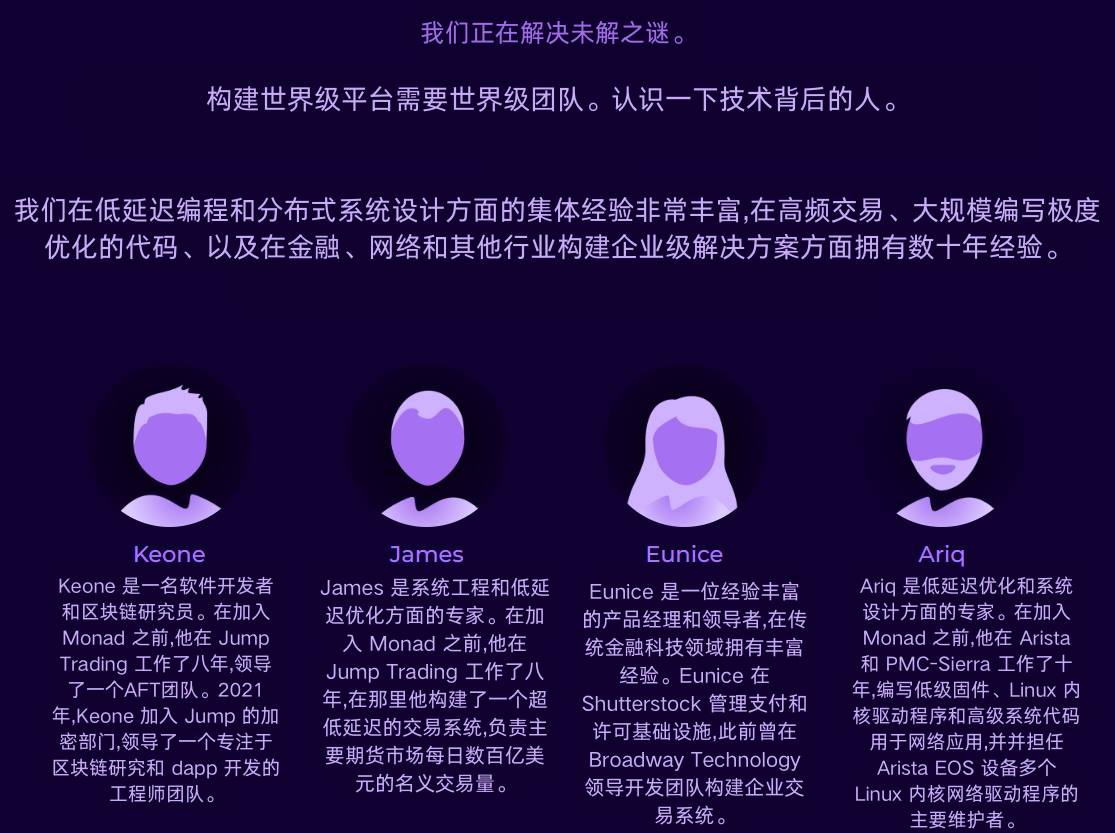
Source: Monad Labs
"At Jump (Keone’s former company), everything was about performance. Whether system-wise or every member of the trading teams, everyone needed to be extremely efficient and give their best effort. That’s what I learned at Jump," said Keone Hon, co-founder and CEO of Monad Labs.
Several members of the Monad Labs team previously worked at Jump Trading. Both CEO Keone and CTO James have backgrounds at Jump Trading, along with several other engineers. Particularly interesting is that many of Monad Labs’ developers have extensive experience building and optimizing systems for trading firms. This background perfectly reflects the nature of the Monad blockchain. Monad Labs aims to create a "highly efficient and fast EVM blockchain." Moreover, since their goal is to optimize the blockchain for handling complex financial transactions, having engineers from trading firms—experts in "optimization, efficiency, and system improvement"—is highly logical.
Of course, engineers aren’t the only important factor. Monad Labs also places equal emphasis on building a strong community, just as much as creating a more efficient EVM environment. As a result, Monad Labs has successfully cultivated one of the most passionate blockchain communities, alongside Berachain. In my view, team members like Bill are key contributors to this achievement, holding the unique role of “Culture Lead” at Monad Labs, and Kevin McCordic, founder of the Twitter Intern account. These individuals possess deep understanding of web3 culture—Bill has a proven track record managing successful NFT projects, while Kevin is widely respected for pioneering the intern account trend, now emulated by many Web3 companies. They consistently produce content loved by community members on Twitter and other platforms.
While some might argue that the Monad blockchain community was primarily built through airdrops, this isn’t entirely accurate (I’ll elaborate later). Airdrops are something any project can do. What sets the Monad community apart is the intrinsic value it provides as a community—and at the heart of this are Bill and Kevin.
Among the various values underpinning Monad, the most crucial are undoubtedly technology and community. Judging by the team composition, they’ve clearly assembled an ideal team to deliver on these two core values. (Since this report focuses on Monad’s technology and community, I encourage you to continue reading for deeper insights.)
3. Deep Dive Into Monad Blockchain Technology
Let’s explore one of the core values of the Monad blockchain: technology. Monad blockchain’s technology can be divided into three main components: consensus, execution, and storage. In this section, we’ll examine in detail the innovations Monad has made in these areas.
3.1 Monad Blockchain Consensus - Monad BFT
Monad’s rapid scalability stems from its consensus mechanism. Monad BFT, similar to Aptos BFT and Diem BFT, is an evolved version of traditional Byzantine Fault Tolerance (BFT) systems. Next, we’ll explore the specific features of Monad BFT.
3.1.1 The Process of Monad BFT
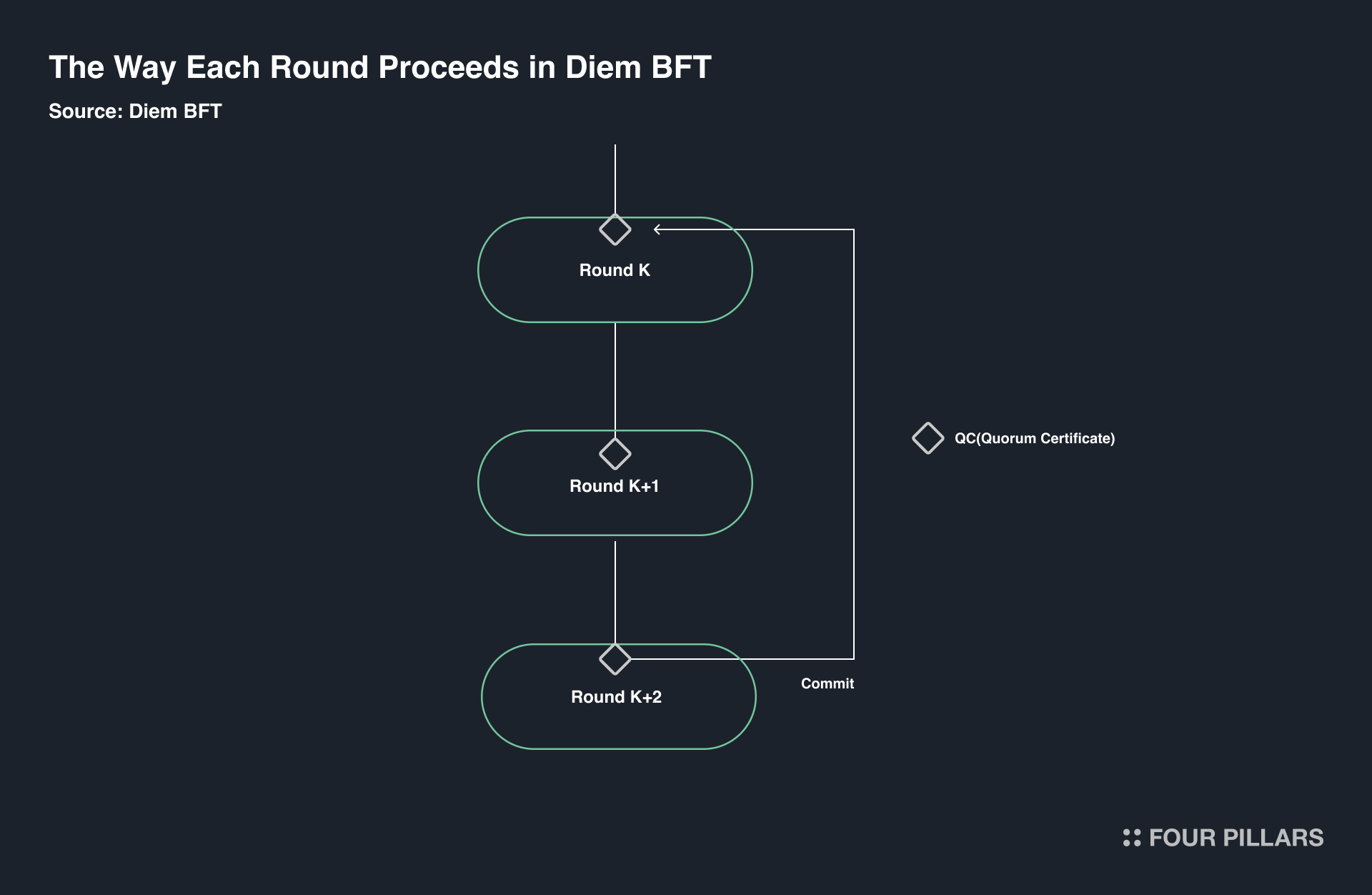
To understand the characteristics of Monad BFT, we must first understand how consensus is achieved within the system. To do so, let’s define a few key terms:
-
Quorum Certificate (QC): A certificate issued when two-thirds of the nodes in the network validate the correctness of the previous block.
-
Timeout Certificate (TC): A certificate issued when two-thirds of the nodes fail to validate the correctness of the previous block (typically when no valid block proposal is received within the expected time).
-
For simplicity, we’ll refer to the initial round as Round K, subsequent rounds as K+1, K+2, etc. The QC for Round K is denoted QC(K), and for subsequent rounds QC(K+1), QC(K+2), and so on. The QC or TC from the round immediately preceding Round K is denoted QC(K-1) or TC(K-1), respectively.
The operation of Monad BFT proceeds as follows:
-
Leader per Round: Each round has a leader responsible for driving the progress of that round. Leaders are predetermined and assigned regularly to each round.
-
Two Phases per Round:
1. Proposal Phase: The leader proposes a block to the validators.
2. Voting Phase: Validators vote on the proposal and send their votes to the leader of the next round.
-
If everything proceeds smoothly and messages are transmitted without network issues, the process follows a linear communication pattern—messages flow from one (leader) to many (validators), then back to one (next round’s leader). However, if validators fail to receive the leader’s proposal in time, they need to communicate among themselves, resulting in a quadratic communication pattern requiring cross-validation between validators.
-
The block proposal includes the new block and voting information from the previous round, which is why Monad BFT is referred to as a "pipelined" mechanism (explained in detail later).
-
-
Handling Proposals:
-
If validators receive a valid proposal, they send a YES vote to the next round’s leader. If two-thirds of the votes are YES, the next round’s leader issues a QC for the previous round’s proposal.
-
If validators receive an invalid proposal or no proposal at all, they generate a timeout message and broadcast it to all other validators. If any validator receives timeout messages from two-thirds of the network, they create a TC and send it to the next round’s leader. The TC also includes the latest QC information observed by the validators.
-
-
Issuing a New Proposal:
-
The leader of Round K+1 issues a QC based on the previous round’s outcome or receives a TC. Then, they create a new proposal including (1) transactions for the new block, (2) the latest QC (from the previous round if successful, or from the most recently successful round in case of timeout), and (3) the TC if the previous round ended due to timeout.
-
-
Finalizing Blocks:
-
Validators finalize the proposal from Round K only after receiving the QC for Round K+1 during Round K+2. Let’s break this down:
-
Holding a QC for Round K means at least two-thirds of the validators voted YES in that round.
-
However, merely holding a QC is insufficient to finalize the block, as validators cannot confirm whether others also hold the same result. Thus, executing transactions safely is not yet possible.
-
This is why validators must wait until Round K+2—to ensure that the quorum of validators in Round K+1 issued a QC, confirming that Round K’s block is indeed finalized. Only then can validators be confident the block has been validated by the majority and is safe to execute.
-
-
3.1.2 Differences Between Monad BFT and HotStuff
As described above, Monad BFT divides the consensus process into multiple rounds, each consisting of two phases. In the first phase, the leader sends a proposal to validators; in the second, validators send signed responses back to the leader to finalize consensus. A significant difference between Monad BFT and HotStuff lies in the number of phases. HotStuff typically requires three phases, introducing additional latency in the consensus process. Monad BFT reduces this to two phases. Monad BFT achieves this by allowing validators to communicate directly with each other in case of network issues (e.g., failing to receive the leader’s proposal in time), enabling them to skip problematic rounds.
Linear Communication vs. Quadratic Communication
In quadratic communication mode, after the leader broadcasts the proposal to nodes, each node must broadcast its vote data to all other nodes, causing network cost to scale proportionally to n² (where n is the number of nodes). This includes the leader’s broadcast (n) and each node broadcasting votes to all others (n). In contrast, linear communication requires nodes to only transmit their votes to the next round’s leader, reducing network cost to approximately n (leader broadcasts to n nodes, and each vote is sent to one node). This improvement in linear communication enhances blockchain throughput and reduces latency.
When the network operates well, Monad BFT relies on linear communication. As previously noted, this approach doesn’t allow validators to cross-validate the leader’s integrity within a single round. Hence, finalization of a block in Round K occurs in Round K+2.
3.1.3 Pipelining
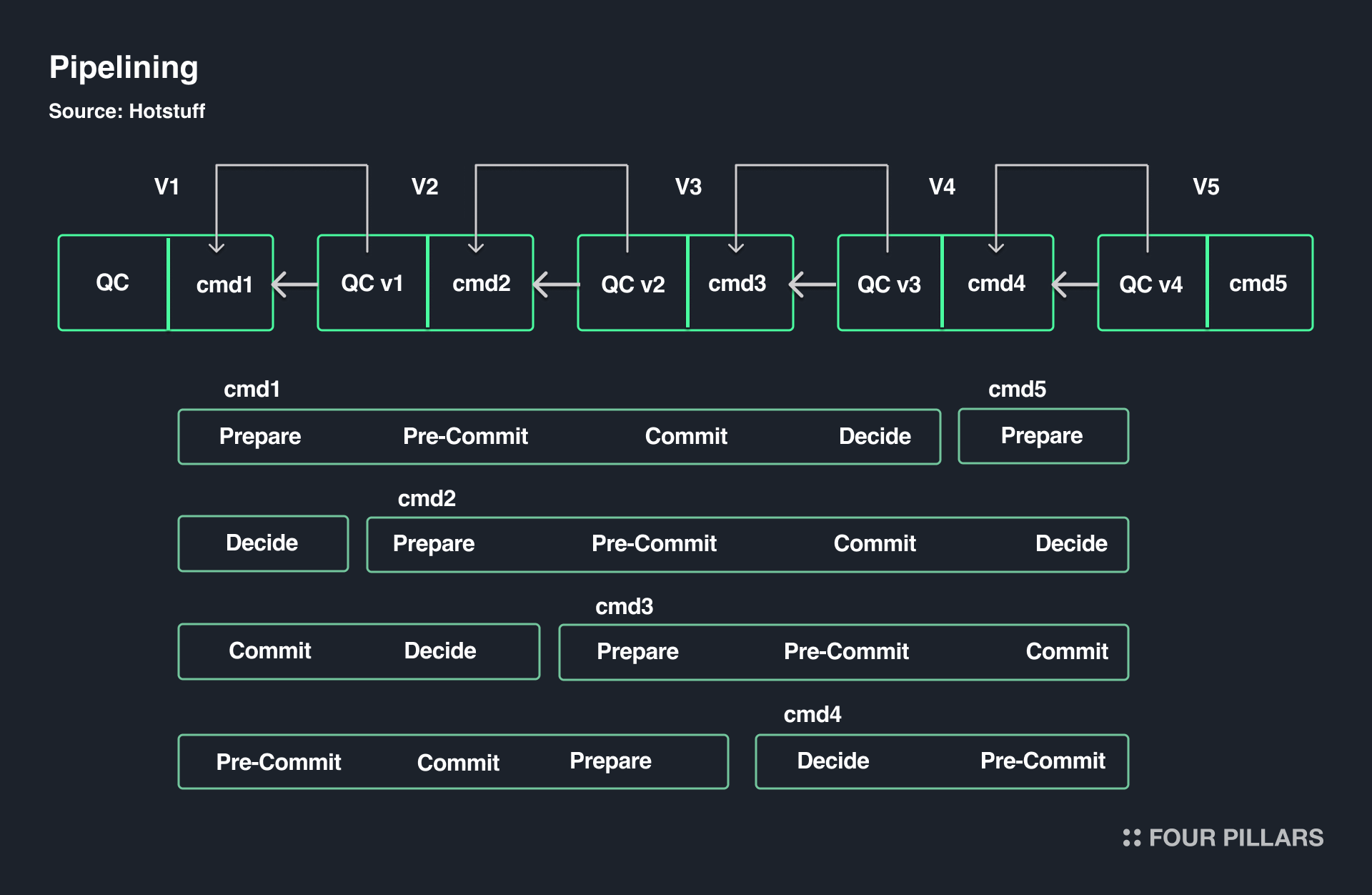
In simple terms, pipelining splits the entire consensus process so it spans multiple rounds rather than being completed in a single round. For example, suppose there is Block N followed by Block N+1. Even if the quorum has voted on the leader’s message and generated a Quorum Certificate (QC) for Block N, this QC does not necessarily need to be finalized within Block N—it can be carried over (piggybacked) into Block N+1.
The process and methodology of Monad BFT resemble Diem BFT, but Monad BFT includes several unique key components: shared mempool, deferred execution, transport fees, and reserve balances.
3.1.4 Separating Execution from Consensus - Deferred Execution
A key feature of the Monad blockchain is separating transaction execution from the consensus process, thereby improving consensus efficiency. As we understand from modular blockchain design, execution and consensus are distinct concepts. Consensus involves how transactions are included in blocks, while execution refers to actually processing these transactions to change state. In the Monad blockchain, leaders and validators participating in consensus vote on proposals but do not execute transactions.
Why does the Monad blockchain separate execution from consensus? Let’s look at Ethereum. In Ethereum, execution happens before consensus. This means that during Ethereum’s consensus process, validators must 1) agree on the transactions in the block, and 2) agree on the Merkle root generated after executing those transactions. This requires the leader to execute all transactions before sharing the proposal, and validators must also execute transactions before voting. This creates significant overhead, as gas limits must be carefully estimated, leaving very tight windows for consensus.
The Monad blockchain addresses this by decoupling execution from consensus: while nodes execute transactions in Block K, they can simultaneously participate in consensus for Block K+1. This design allows execution to follow consensus, enabling the blockchain to operate within reasonable gas budgets. This separation assumes that once a majority of nodes agree on transaction order, the outcome is determined.
However, separating execution and consensus raises a concern: "If transactions are ordered without updating state (since execution follows consensus), could users’ transactions be included without gas fees, potentially leading to denial-of-service (DDoS) attacks?" To address this, the Monad blockchain introduces the concept of transport fees.
3.1.5 Transport Fees and Reserve Balances
Transport fees refer to "transaction fees" associated with transactions. Because the Monad blockchain separates execution from consensus, its fee structure is also unique. Typically, transaction fees are paid during execution, but in the Monad blockchain, execution fees and transport fees are separated. If a transaction has the necessary transport fees but lacks required execution fees, the transaction will fail. This design prevents users from repeatedly attempting to send transactions with insufficient funds.
Additionally, nodes create a reserve balance for each account—a separate balance specifically for transport fees. The purpose of the reserve balance is to ensure only transactions with necessary fees are included in blocks.
3.2 Monad Blockchain Execution - Parallel Execution
Having understood the consensus mechanism of the Monad blockchain, we now turn to how the Monad blockchain processes transactions. The attention the Monad blockchain has received in the industry, and the keyword that defines it today—parallel transaction processing—originates precisely from this domain. How does the Monad blockchain achieve parallel transaction processing?
3.2.1 Parallel Transaction Processing
Consider two transactions, labeled:
-
Transaction A: Account A receives Monad blockchain tokens from Account B.
-
Transaction B: Account A sends Monad blockchain tokens to Account C.
If these two transactions are processed in parallel (i.e., Transaction B starts before Transaction A completes), Account A’s balance after these concurrent transactions may differ from the balance if transactions were processed sequentially. This could lead to incorrect transaction execution.
To solve this, the Monad blockchain adopts an approach inspired by Software Transactional Memory (STM) and Optimistic Concurrency Control (OCC). As suggested by the term OCC, the Monad blockchain assumes all transactions are valid and proceeds with execution, only re-executing transactions if issues arise during validation. Monad ensures these execution results match those of sequential processing—even with parallel execution, state updates are merged sequentially to guarantee validity. In other words, the Monad blockchain first processes transactions, then re-processes any problematic ones based on information gathered during initial execution, rather than pre-validating dependencies between transactions.
This approach is far more efficient than pre-validating transaction dependencies and executing accordingly. In the optimistic concurrency model, once all prior transactions in a block are processed, it becomes clear which transactions need re-execution. At this point, since state values from prior transactions have already been merged, the risk of failure during re-execution is minimal (in this scenario, transactions cannot fail). Additionally, tasks like signature recovery don’t need to be repeated during re-execution, and accounts or storage accessed during transaction execution remain unchanged, making this method highly efficient.
3.3 Monad Blockchain Storage - Monad DB
In practice, parallel processing at the execution layer is not particularly difficult. It has already been implemented in multiple blockchains, but the key question is whether parallel transaction processing can be done efficiently. The Monad blockchain emphasizes performance, meaning information for all accounts grows rapidly. This information is stored in the blockchain’s state, and as state size increases, performance may degrade, undermining the advantages of parallel transaction processing. Therefore, efficient management of blockchain state is crucial for effective parallel transaction processing.
To address this, the Monad blockchain developed a unique database structure for efficient state management—Monad DB. Most Ethereum clients use key-value databases implemented with B-tree structures (like LMDB) or LSM-tree structures (like LevelDB and RocksDB). However, Ethereum uses a data structure called the Merkle Patricia Trie (MPT) to store state—an inefficient method because MPT is used within another data structure (key-value database). Monad DB solves this by natively implementing the Patricia Trie structure on both disk and memory.
Moreover, Monad DB supports asynchronous I/O, allowing the CPU to process multiple transactions simultaneously without waiting for input/output operations. Traditional Ethereum databases lack asynchronous I/O support, while Monad DB’s implementation significantly improves transaction processing efficiency.
Beyond these features, Monad DB further optimizes I/O processes by bypassing the file system and eliminating unnecessary overhead, enhancing database performance. This ensures not only optimized execution but also efficient transaction processing at the database level.
4. Beyond Technology: Monad Blockchain’s Unique Approach to Community Building
So far, we’ve explored the technology of the Monad blockchain—one of its key strengths. But what about the other critical aspect of Monad’s success—its community? It’s well known that the rapid growth of the Monad blockchain stems from a strong and mature community. Currently, the Monad Discord server has around 380,000 members, giving us a preliminary sense of the community’s massive scale. Additionally, on X, memes symbolizing the Monad community continue to be actively shared, primarily centered around posts by Monad Labs members and official accounts. What fuels the enthusiasm for the Monad blockchain?
First, one thing is clear: as I mentioned earlier, airdrops are not the primary driver of this community’s growth. Airdrops are tools available to anyone. If Monad had relied solely on airdrops to build its community, other projects could have created communities of similar scale. Yet, alongside Berachain, the Monad blockchain is considered one of the most passionate communities in the blockchain space. Therefore, attributing Monad’s community success simply to airdrops is inaccurate.
"Quality > Quantity."
"Automated tasks aren’t a good strategy. On some platforms, people claim rewards for 'follow, like, retweet,' which seems like a low-cost way to boost engagement, but it actually dilutes authentic users who would naturally participate. When you see 7,200 likes, 7,200 retweets, and 10,000 views, it looks really bad. Don’t sacrifice real users who’ll stay in your community for months or years just to gain bot participation—you’ll never create a sustainable flywheel this way," said Kevin McCordic, Growth Lead at Monad Labs.
When we closely examine interactions among Monad community members and the strategies Monad Labs employs in community building, it becomes evident that the view that Monad relies entirely on airdrops to create its community is unlikely. Undoubtedly, factors beyond mere economic incentives are uniting this community. Moreover, Monad Labs doesn’t seem to treat community as a short-term marketing tactic to generate interest. So, what drives the strong community behind the Monad blockchain? And what thought processes and strategic actions enabled Monad to create such an influential community? Let’s explore step by step.
4.1 Nads Represent Culture, EVM/ACC Represents Vision
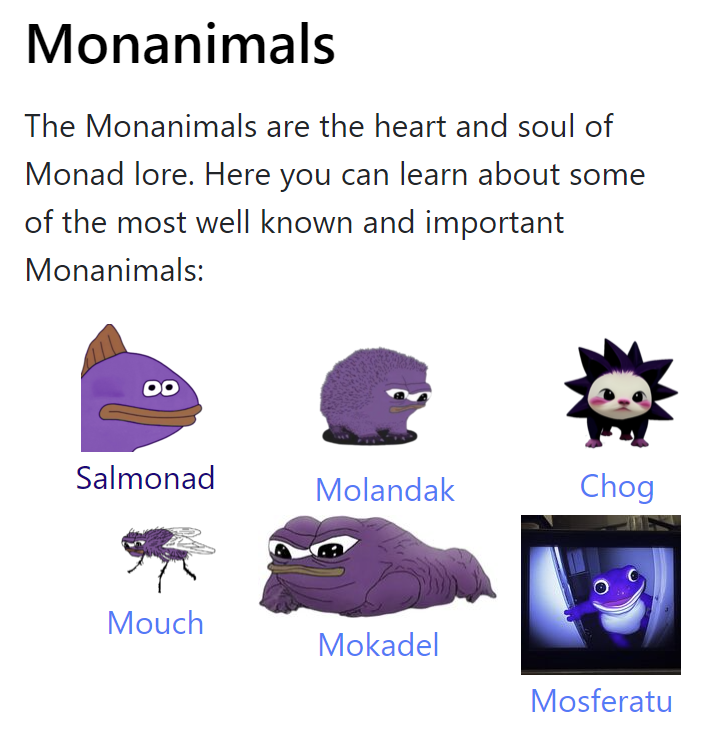
The core of the Monad community lies in its vibrant meme culture. Anyone familiar with crypto Twitter may have seen the purple Monanimals, a meme originating from the Monad community that symbolically represents their "cult" culture. This is just one example—community members call themselves "Nads," constantly creating and reshaping memes, images (e.g., keonegg), and language (e.g., Gmonad) to express the identity of the Monad community. Participating in these memes plays a key role not only in strengthening internal community bonds but also in raising external awareness of the Monad community.
However, is the growth of the Monad blockchain’s strong community solely attributable to its meme culture? In my opinion, these memes act more as catalysts for growth rather than the root cause. The true driving force behind the rapid development and solid foundation of the Monad community—the idea often referred to as the "first team"—lies in the shared vision between community members and Monad Labs: EVM/ACC. While Nads represent culture, EVM/ACC embodies the essence of the community.
The technological vision of the Monad blockchain centers on scaling EVM, targeting "10,000 TPS and 1-block finality." Precisely because of this clear objective, community members frequently mention "EVM/ACC" in their X bios to signify their identity as Nads. EVM/ACC is a variation of "e/acc," standing for "Effectiveness Efficiency"—a philosophy advocating unrestricted technological advancement, especially in fields like artificial intelligence. This contrasts sharply with the so-called "decel" movement, which argues for slowing technological progress due to potential risks.
So, what exactly does EVM/ACC mean? It can be understood as "unrestricted technological advancement of EVM blockchains," perfectly aligning with Monad blockchain’s mission to overcome EVM limitations. When a community shares the same goals as the project they support, it forms the foundation of a powerful community. This alignment enables community members to become passionate supporters of the project’s success, while the project team views the community as a vital partner in growth, encouraging active participation.
I often compare blockchain to a nation, considering how a country functions similarly to how Monad Labs builds and develops its community. Monad Labs set a clear technological goal—"building a high-performance blockchain capable of EVM parallel processing"—and those resonating with this vision gathered to form a community with shared purpose. From there, unique community activities, including memes, helped attract more members and sustain the existing community.
As mentioned earlier, airdrops are implicit economic incentives nearly every project offers to its community. Meme-based marketing has also become standard for crypto projects. Yet, what distinguishes the Monad blockchain and enables it to build such uniquely successful community is that the project started with a clear, compelling goal—something people could genuinely resonate with and support.
4.2 Applying Systematic Methodology to Community Building
This month I've had calls with over 10 S-tier crypto projects discussing how to build stronger marketing and community flywheels – here are some thoughts to share publicly.
10 Rules of Crypto Marketing and Community: A Systematic Approach
1. Stop posting ads.
If your main Twitter account constantly talks about your product, you're posting ads. People hate ads. When you open YouTube to watch a specific video, you eagerly skip the pop-up ad. Crypto Twitter is the same. If you keep posting ads, don’t be surprised when people dislike your brand or don’t engage.
2. You’re competing for attention with influencers and entertainment content on Twitter, not just other protocols.
When most people open crypto Twitter, they’re checking what Cobie posted or what memes were made about ETH ETFs or today’s trends—they’re enjoying entertaining content. You’re competing in the same attention economy as these creators, not just against your project’s competitors.
3. Your marketing and community strategy should take a systematic approach.
View marketing and community as a complex system with various inputs and outputs, rather than isolated silos. There are interdependent flows between Discord, Telegram, Twitter, etc. Optimizing the healthy flow between these areas produces better results than treating each separately. Community and marketing are intertwined. If you isolate them, both become less effective. They’re a team—ensure your system allows them to reinforce each other.

Source: X(@intern)
Given the strong central focus emerging within the Monad community, it’s clear that the community’s sustained growth and current form are the result of careful planning and strategic design by Monad Labs. As previously mentioned when introducing Monad Labs members, Kevin McCordic, Growth Lead at Monad Labs and pioneer of the popular Intern account trend in crypto projects, shared insights on marketing and community strategy via his X account. His perspectives reveal core principles of community and marketing strategy, with a key insight being the importance of a systematic approach—one that creates a flywheel effect where community and marketing mutually reinforce each other.
This flywheel approach ensures that as community engagement increases, marketing efforts are amplified, attracting more community members and forming a self-sustaining growth loop. The ultimate result is not just quantitative growth, but enhanced strength and cohesion, contributing to the project’s overall success and longevity.
"Your marketing and community strategy should take a systematic approach. More accurately, view marketing and community through the lens of complex systems rather than as one-off, segmented areas. There are interdependent flows between Discord, Telegram, Twitter, etc. Optimizing healthy flow between these areas yields better results than treating each separately. Community and marketing are deeply intertwined. If you isolate them, both become less effective. They’re a team—ensure your system enables them to strengthen each other," said Kevin McCordic, Growth Lead at Monad Labs.
Source: X(@monad_xyz)
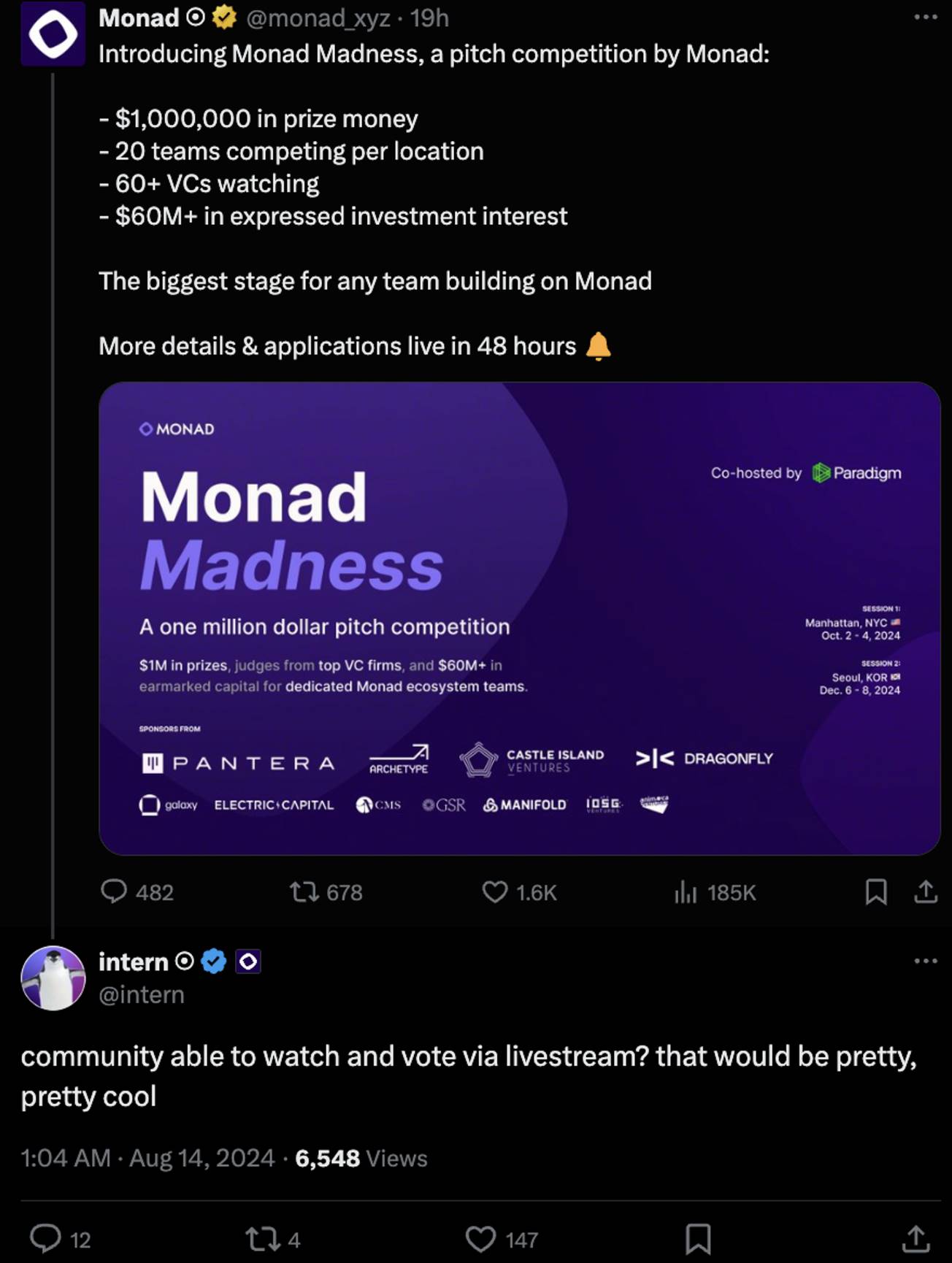
For instance, Monad recently announced a project competition with a prize pool of up to $1 million, involving over 60 venture capital firms, drawing widespread attention. In response, Intern proposed that the community could livestream the event and vote in real time. This idea evolved into a broader community discussion about creating a prediction market where members could bet on competition outcomes. Although the competition was only recently announced and no prediction market platform has formally planned to launch based on this event, this scenario illustrates the close relationship between community engagement and marketing, and how they actively contribute to project growth. In other words, this project competition—Monad’s growth initiative to attract ecosystem builders and marketing strategy showcasing commitment to ecosystem development—provides content that captures community attention. Interactions around this content further drive discussions and creativity, ultimately contributing to the project’s marketing and growth.
Unlike relatively standardized marketing strategies in traditional industries, community and marketing strategies in crypto projects are still in early stages, with ongoing discussions and experiments. The notable activities of the Monad community, combined with the team’s exceptional growth strategy, offer valuable insights for future crypto projects. These insights emphasize the importance of having a clear goal and direction before starting community building, and once an initial community exists, adopting a systematic approach that considers the interaction between community and marketing is crucial. Such an approach can lead to sustainable growth and further innovation.
5. Monad Ecosystem
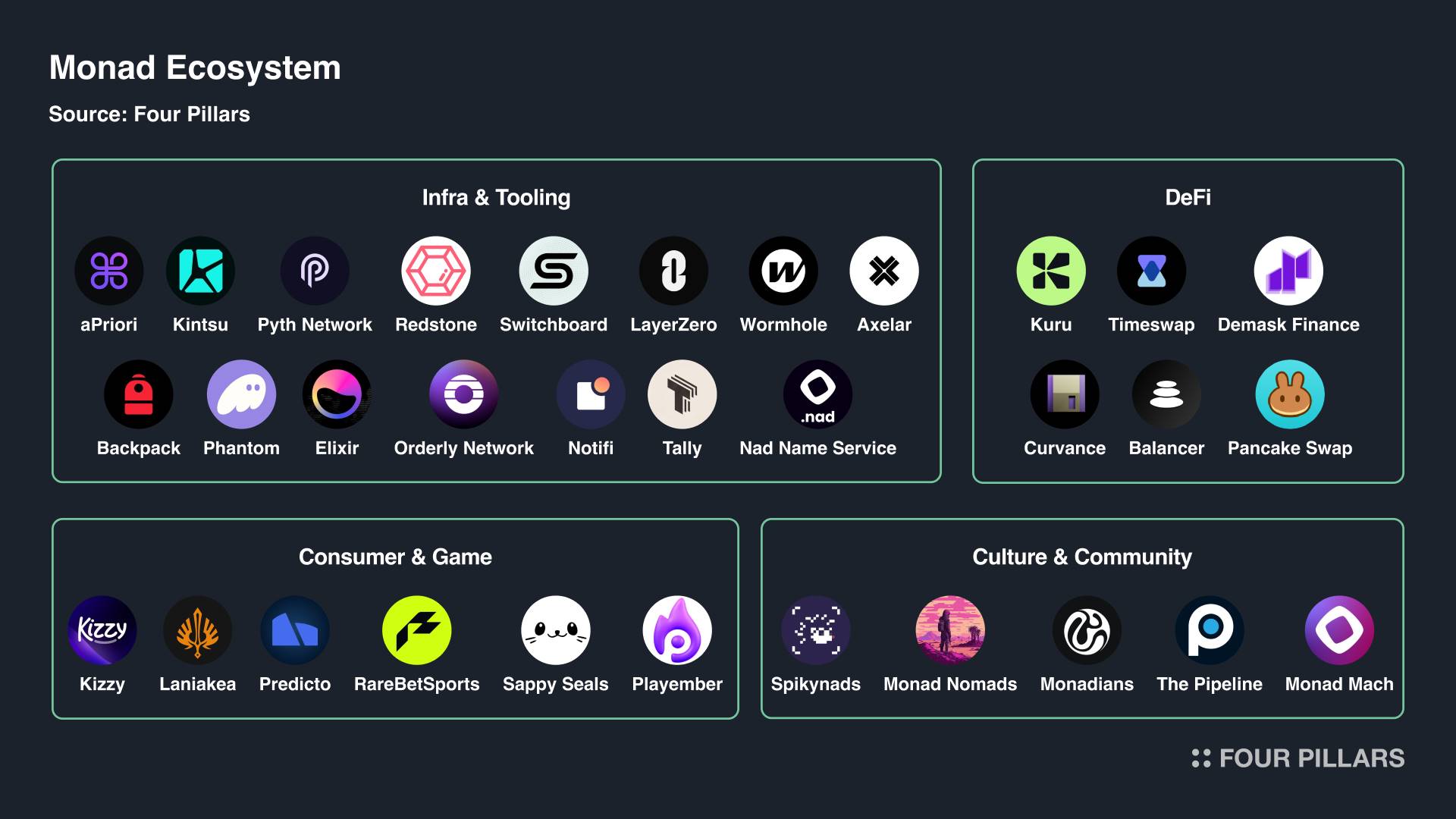
Through the combination of Monad BFT, parallel transaction processing, and Monad DB, the Monad blockchain achieves significant scalability within its EVM-based network. A mature community, combined with these technological factors, creates an ideal environment for builders to innovate and experiment. The scalable EVM environment enables high-performance protocols while maintaining minimal friction for developers, users, and liquidity migrating from other EVM-based networks. Additionally, a strong community ensures new projects have a ready audience, making Monad a highly attractive development ecosystem.
Unsurprisingly, despite not yet launching its mainnet, the Monad ecosystem is rapidly expanding. Useful projects such as Phantom Wallet, Wormhole, and Balancer are joining the Monad ecosystem. Meanwhile, new projects optimized specifically for the Monad blockchain, such as Kuru, aPriori, and Kintsu, continue to emerge. Many other projects are also preparing to establish themselves in the Monad ecosystem before mainnet launch. Next, we’ll explore some interesting applications and infrastructure projects filling gaps in the Monad ecosystem.
5.1 Infrastructure and Tools
-
aPriori
aPriori is a MEV Auction (MEVA) infrastructure optimized for Monad BFT. The Monad blockchain’s block production mechanism uses deferred execution, separating execution from consensus. aPriori is designing MEV infrastructure adapted to this approach and recently raised $10 million in seed funding from Consensys, OKX Ventures, and others, positioning it as a key player in the Monad ecosystem.
-
Kintsu
Kintsu is a liquid staking protocol, similar to Lido Finance on Ethereum, tokenizing staked assets participating in PoS network validation. Liquid Staking Tokens (LSTs) play a crucial role in improving capital efficiency within networks, especially during the cold-start phase of new Layer 1s like the Monad blockchain. Kintsu recently raised $4 million in seed funding and is emerging as the leading liquid staking protocol in the Monad ecosystem, with potential to integrate with various DeFi applications and expand the ecosystem.
-
Pyth Network
Pyth Network is an oracle network providing real-time first-party financial data to DeFi protocols on blockchains. Pyth currently aggregates data from over 111 first-party data providers and delivers real-time price data for crypto assets, stocks, ETFs, and commodities to over 70 blockchain networks, including the Monad blockchain.
-
Redstone
Redstone is a modular oracle network providing real-time price data, focusing on maintaining pegs for interest-bearing tokens such as LSTs and LRTs. Redstone supports over 50 blockchain networks, including the Monad blockchain, playing a vital role in ensuring accurate and reliable data feeds.
-
Switchboard
Switchboard is an oracle aggregator integrating multiple oracles like Pyth Network and Chainlink into a single transaction. This allows applications to efficiently obtain required data feeds and reduces risks associated with relying on a single oracle.
-
LayerZero
LayerZero is a protocol enabling direct communication between blockchains using ultra-light nodes, blockchain endpoints, decentralized oracles, and relayers. LayerZero aims to build a multi-chain network allowing various blockchains to reliably communicate and exchange data.
-
Wormhole
Wormhole is a bridging protocol launched by Jump Crypto in 2021, facilitating message and asset transfers between different blockchains, including the Monad blockchain. Wormhole aims to overcome liquidity fragmentation in the blockchain ecosystem by creating an integrated environment where assets and information can freely flow across networks.
-
Axelar
Similar to Wormhole, Axelar is a cross-chain network connecting various blockchains and enabling their interoperability. Axelar aims to support not just chain connectivity but also the development of cross-chain dApps that can seamlessly operate across multiple chains.
-
Backpack
Backpack initially began as a non-custodial wallet service supporting EVM networks and Solana, later evolving into an ecosystem encompassing NFT collections (Mad Lads), wallets (Backpack Wallet), and exchanges (Backpack Exchange). Monad Labs participated in Backpack’s Series A funding, and its trading platform and user base are expected to integrate closely with the Monad blockchain.
-
Phantom
Phantom is a non-custodial wallet service that initially supported Solana and later expanded its functionality to create a user-friendly mobile environment. Phantom plans to join the Monad ecosystem, extending its services toward chain-agnosticism.
-
Elixir
Elixir is a decentralized market-making protocol providing liquidity to orderbook-based decentralized exchanges (DEXs) across multiple networks. Integrated with orderbook-based perpetual futures exchanges, Elixir minimizes reliance on centralized market makers, enabling retail users to participate in liquidity provision. Given the Monad blockchain’s architecture supporting fast and efficient transaction processing, orderbook exchanges requiring high-frequency trading can benefit greatly from integration with the Monad blockchain.
-
Orderly Network
Orderly Network is an omnichain liquidity layer aggregating shared orderbooks across various networks to enhance liquidity for perpetual futures DEXs. New networks like the Monad blockchain often struggle to ensure stable perpetual trading liquidity, but Orderly Network aims to solve this by providing a shared orderbook, allowing traders to experience seamless trading with tight spreads and minimal slippage.
-
Notifi
Notifi is an infrastructure enabling Web3 projects to conduct on-chain communication with users, ranging from simple messages to wallet-to-wallet communication. Notifi plays an important role in enhancing user experience, allowing any application to choose to interact with end-users via notifications or messages.
-
Tally
Tally provides DAO solutions for Web3 projects conducting on-chain governance. Tally offers plugin user interfaces and DAO governance contracts, enabling users to vote on proposals or delegate voting power. Tally is expected to play a key role in supporting on-chain governance for various projects within the Monad ecosystem.
-
Nad Name Service
Nad Name Service is a blockchain domain service similar to Ethereum Name Service (ENS). It allows users to own unique addresses (domains) within the Monad blockchain. Just as .com, .io, and .xyz domains are used on the internet, Nad Name Service uses .nad domains, enabling entities to interact via domain addresses instead of remembering full wallet addresses.
5.2 Decentralized Finance (DeFi)
-
Kuru
Kuru is a fully on-chain decentralized exchange (DEX) offering a Central Limit Order Book (CLOB), which recently secured $2 million in seed funding. Most EVM-based orderbook DEXs typically handle user orders and trade matching off-chain before settling trades on-chain—a hybrid model. However, Kuru aims to achieve a fully on-chain orderbook, processing all orders and trades on-chain, fully leveraging the Monad blockchain’s fast block times and low latency.
-
Timeswap
Timeswap is an oracle-free lending protocol in the Monad ecosystem. Most lending protocols rely on price data from oracles to manage borrowers’ collateral ratios and initiate liquidations when collateral falls below thresholds. In contrast, Timeswap matches borrowers and lenders peer-to-peer, with loan maturity dates agreed upon by both parties. If a borrower fails to repay before maturity, their collateral is forfeited. This mechanism eliminates the need for oracles, enabling Timeswap to create money markets for any ERC-20-based asset, including illiquid long-tail assets.
-
Demask Finance
Demask Finance is an automated market maker (AMM) protocol designed to facilitate trading between NFTs and ERC-20 tokens, helping to liquidate NFT assets. Demask currently partners with key NFT collections in the Monad ecosystem (such as SpikyNads and Monad Nomads) and is expected to play a significant role in expanding the Monad NFT ecosystem after mainnet launch.
-
Curvance
Curvance integrates multiple DeFi protocols like Curve, Aura, and Convex, offering a unified interface to optimize liquidity management. Users can deposit or borrow tokens as collateral through Curvance in an integrated multi-chain environment, serving as a key tool connecting DeFi liquidity across EVM-based networks including the Monad blockchain.
-
Balancer
Balancer is a scalable AMM offering diverse liquidity pools and trading services, from concentrated liquidity pools to stable swaps and custom pools. As an OG project that has grown alongside Uniswap and Curve, Balancer is expected to provide stable trading support in the emerging DeFi ecosystem of the Monad blockchain.
-
Pancake Swap
Pancake Swap is a leading AMM DEX that initially grew within the BNB network. Recently, Pancake Swap launched Pancake Swap v4, adding new features like Hooks, allowing developers to customize liquidity pools and optimize gas usage. Pancake Swap is actively preparing to join the Monad ecosystem.
5.3 Consumer and Gaming
-
Kizzy
Kizzy is an upcoming consumer app in the Monad ecosystem offering mobile social betting services. Though not yet publicly released, it has already drawn significant attention, with key figures like CEO Keone Hon actively promoting it.
-
Laniakea
Laniakea is an open-world MMORPG game offering multiple modes including real-time combat, player-versus-player (PvP), and player-versus-environment (PvE) challenges. Since gaming requires high-frequency transactions similar to perpetual futures exchanges, the network performance of the Monad blockchain is expected to strongly support these gaming services.
-
Predicto
Predicto is an upcoming prediction market platform in the Monad ecosystem. As interest grows in prediction markets for the 2025 U.S. presidential election and platforms like Polymarket rise, prediction markets are becoming a key application area. Predicto is poised to become Monad’s primary prediction market, and combined with the active Monad community, is expected to thrive.
-
RareBetSports
RareBetSports is a Web3 sports app aiming to revolutionize daily fantasy sports (DFS) experiences, allowing users to create teams for virtual sporting events. This app is highly anticipated in the Monad ecosystem, with key figures like Keone Hon expressing high hopes.
-
Sappy Seals x Playember
Sappy Seals, originally an NFT collection, is now partnering with game studio Playember to launch a game based on its IP within the Monad ecosystem.
5.4 Culture and Community
-
Spikynads, Monad Nomads, and Monadians
Spikynads, Monad Nomads, and Monadians are community-driven NFT collections within the Monad ecosystem. These groups have been part of the Monad community since the testnet launch in 2023 and are expected to play important roles in the NFT ecosystem after mainnet launch.
-
The Pipeline
The Pipeline is a media team dedicated to delivering news and updates about the Monad ecosystem. They produce podcasts featuring key Monad Labs members (such as Keone and Kevin McCordic) and provide essential content support to the Monad community.
-
Monad Mach
Monad Mach is an accelerator program aimed at supporting builders within the Monad ecosystem. The MACH 1 program is expected to launch in Q4 2024, offering guidance, funding, and fundraising support to developers building projects for the Monad ecosystem. Additionally, the program will provide a four-week curriculum covering topics in development, design, and marketing.
These projects and initiatives demonstrate the rapid and dynamic expansion of the Monad ecosystem, continuously attracting diverse applications and infrastructure. With solid technological foundations and strong community support, the Monad blockchain is well-positioned to drive innovation and growth in the blockchain space.
6. The Future of Monad
We’ve explored various aspects of Monad (including the blockchain and labs), and what impresses me is that despite not yet launching its mainnet, the project has already achieved remarkable success. Monad has built a more robust community than many projects that
Join TechFlow official community to stay tuned
Telegram:https://t.me/TechFlowDaily
X (Twitter):https://x.com/TechFlowPost
X (Twitter) EN:https://x.com/BlockFlow_News
 Four Pillars






