
Why have humans yet to establish large-scale settlements on the crypto planet?
TechFlow Selected TechFlow Selected
Why have humans yet to establish large-scale settlements on the crypto planet?
This article is the first in a series of prefaces, exploring the essence and future direction of the crypto world starting from the current state of the crypto market.
 Navigating Web3 tides with focused insights
Author: Brook
Translation: Sissi & Leia, TEDAO
Introduction: Amid chaos and innovation fatigue in the crypto world, one cannot help but question: Are we genuinely moving toward the ideal future? The preface to *The Protocol Revolution and the DigiLaw Project* offers a systematic exploration of the essence of the crypto world, its developmental bottlenecks, and the infinite possibilities for future construction—providing crucial insights into understanding the true nature of this new planet.
This article is the first installment of the preface series, examining the essence and future direction of the crypto world through the lens of current market conditions. More translated content will be released gradually—stay tuned.
In September 2023, Matt Huang’s essay *Casino on Mars* reignited long-dormant hopes during a prolonged crypto bear market. He likened the crypto world to a newly colonized planet, reminding us that despite its current chaos, the vibrant growth and boundless potential for future development remain undeniable. He also rationally analyzed the dual nature of speculative behavior within the crypto casino, objectively acknowledging the existence of fraud, scams, and malicious activities on this planet. At a time when widespread doubt and discouragement prevailed, this piece acted as a shot in the arm, reinvigorating hope in the crypto space.
In 2024, the crypto world witnessed several historic milestones: the U.S. Securities and Exchange Commission (SEC) approved spot ETFs for both BTC and ETH; the U.S. House of Representatives passed the FIT21 bill, formally establishing a regulatory framework for digital assets; BTC underwent its fourth halving; among others. With these favorable developments converging, the crypto market enjoyed a modest bull run.
Yet, during this mini-bull cycle, market volatility remained extreme, casino-style speculation continued rampant, Ponzi schemes and rug pulls persisted, and hacking incidents and scams continued unabated. What genuine, foundational innovations have emerged? In the previous boom, we at least saw the birth of DeFi and NFTs—what about this time? Meme mania? Inscriptions? Why are people increasingly feeling devalued, even experiencing “crypto shame”? Are we truly making substantive progress toward our envisioned future?
Now, nearly a year after *Casino on Mars* was published, the market seems to have once again sunk into a similar lull. A recent self-reflective tweet by Péter Szilágyi sparked an industry-wide debate on the very purpose of crypto. He bluntly stated: "It's past time this industry creates something genuinely useful that people want to use, or should just close up shop."
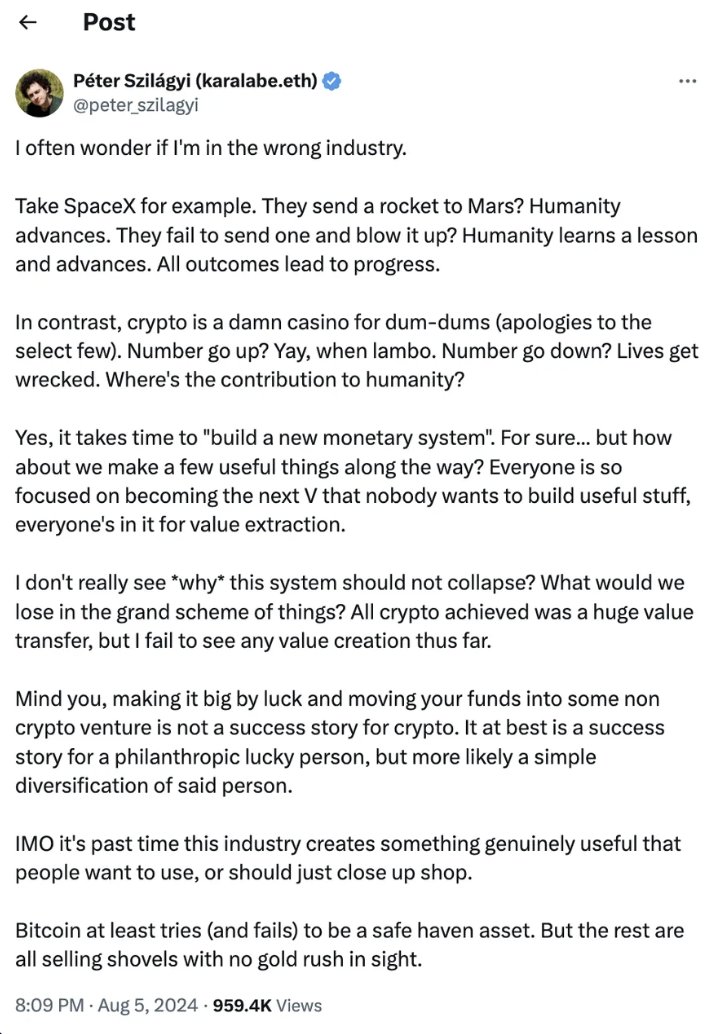
While he believes many great things are being built, one undeniable fact remains: looking down upon the entire crypto planet, we still haven’t established a thriving crypto civilization. If blockchain protocols are seen as city infrastructure and smart contract protocols as buildings, then unflinchingly speaking, beyond undeveloped wastelands, the cities under construction are filled with ruins and half-finished skyscrapers. The systems keeping these cities running are still legacy structures like MakerDAO, AAVE, Compound, and Uniswap. Undeniably, many flashy, fast-moving projects are under development, but how many will withstand the tests of time, human nature, and market storms to become meaningful landmarks? Why can’t we build towering skyscrapers? What gives us the right to attract the next billion users? Where exactly are the bottlenecks in development? Or more fundamentally, what is the true nature of the crypto world we’re striving to build?
The SEC’s narrow 3:2 approval votes, extreme market swings, and the emotional rollercoaster of participants all, to some extent, validate my current thinking:
The crypto world is not a binary state of black and white, but rather a superposition of three states: “infinite future,” “open casino,” and “breeding ground for malice.” Different people, from different perspectives and levels, see vastly different versions of the crypto world.

In terms of market capitalization, high-value projects like Bitcoin and Ethereum account for over 80% of the total crypto market cap. Overall, the crypto market can be considered healthy. From obscurity to surpassing Apple in market value, and now gaining recognition from mainstream financial markets, following this trajectory, crypto could potentially surpass gold—and even real estate—within the next decade. The rise of decentralized finance (DeFi), the popularity of non-fungible tokens (NFTs), the emergence of digital identity (DID) and decentralized autonomous organizations (DAOs), along with gradual regulatory adoption and legal recognition, collectively indicate that the “infinite future” of the crypto world is accelerating into reality.
In terms of project count, out of the tens of thousands of cryptocurrencies in the market (hundreds of thousands if including memes), only around a hundred may ultimately prove valuable—the vast majority still focus primarily on “making money.” They function like “open casinos,” unrestricted by time or space, open to anyone. This new type of casino is “open-ended and evolving”: project teams exploit human greed, constantly upgrading technology to innovate new gambling mechanics, creating endless, diverse betting games that continuously attract waves of speculators to place their “chips.” The inflow of resources further fuels technological and commercial innovation, allowing the “casino ecosystem” to evolve openly through repeated cycles.
In terms of malicious incidents, in areas untouched by regulation, criminals often exploit cryptocurrencies for money laundering, darknet transactions involving drugs and weapons, and other attempts to evade sanctions. Fraud, scams, and exit schemes continue to proliferate. Decentralized finance platforms and wallets are frequent targets of hackers. These are objective realities. The main reason lies in the relatively free and open nature of innovation in the crypto world—its ecosystem evolves far faster than regulations can keep up. These unregulated “gray zones” naturally become “breeding grounds for malice.” Additionally, cryptographic technology requires iterative development; it’s difficult to build a “perfect” foundational architecture in the early stages of a new technology. Vulnerabilities are inevitably discovered and patched through trial and error—but this also provides potential attack vectors for hackers, making it an inevitable breeding ground for malicious acts.
With these three states intertwined, it’s undoubtedly difficult for most people to clearly dissect the true nature of the crypto world. Some see only the “infinite future” and thus blindly worship it; others see only the “breeding ground for malice” and respond with fear and avoidance; others see only the “open casino” and chase profits, ceasing to reflect on the deeper meaning of the crypto world.
Chris Dixon, in his book *Read Write Own*, argues that blockchain networks can combine the social benefits of protocol-based networks with the competitive advantages of corporate networks, ultimately reshaping the internet into a more open, democratic, and innovative “infinite future.” The book is concise and accessible, recommended reading for anyone seeking to better understand the true potential of blockchain and Web3.
However, possibly due to space constraints, Chris Dixon only briefly acknowledges skeptics in the book without delving deeper. To help more people see the true face of the crypto world, I believe we must clarify the following core questions:
First, what is the essential value of the crypto world?
Matt Huang argued in *Casino on Mars* that the crypto world is a planet worth building because it offers a blank canvas—an opportunity to establish a new property rights system and upgrade financial systems and internet platforms. That’s a macro-level analysis. But if we drill down to a more micro, first-principles perspective, what exactly is the fundamental value of the crypto world? What fundamentally distinguishes it from the existing world order? What enduring foundation and driving force sustain its growth?
Second, why, after 16 years, do we still hold such fragmented perceptions of the crypto world?
The emergence of new technologies is often accompanied by significant skepticism and uncertainty—not just because they reshape our lifestyles, but because they challenge our cognition and values. Yet, public perception of the iPhone and Tesla cars quickly converged. Despite the undeniable progress made by the crypto industry led by Bitcoin, why does it still face such intense polarized debates? Why is public understanding of the crypto world still chaotic and conflicted? Why do so many still fail to see its promising future?
Third, why is malice so widespread and persistent in the crypto world?
Why, after more than a decade of development, does the crypto world still suffer from constant chaos and disorder? Many attribute this to the idea that “any emerging financial market will experience various problems.” However, there’s a glaring contradiction here—I call it the “Crypto Paradox”: the original intent of the crypto world was to use blockchain technology and decentralization to move from “don’t be evil” to “can’t be evil,” yet it has ironically fallen into a farcical trap of “widespread malice.” This raises the question: is there something uniquely enabling about malice in the crypto world?
Fourth, how can we fulfill the original vision of crypto and maintain a secure, ethical development environment?
The crypto world is still in its early developmental stage, with many rules yet to be established. Newcomers who rush in unprepared often end up losing both money and trust. When current infrastructure fails to support the original ideals of decentralization, can we collaborate with traditional regulators and community members to create a mechanism that autonomously monitors and reduces malicious activities—building an “immune system” for the crypto world to comprehensively purify its development environment? Meanwhile, can ordinary participants gain a holistic view to better understand the full picture of crypto’s evolution?

Of course, these questions cannot be fully answered in just a few articles.
Since first encountering Bitcoin and Ethereum in 2016, I’ve personally experienced two massive bull-and-bear cycles in the crypto market, witnessing the rise and fall of hundreds of crypto projects. Some have weathered multiple cycles and still firmly stand today; others dominated the bull market but collapsed instantly when the bear market arrived; some were outright scams disguised under the banners of Web3 and decentralization. When we remove the光环 of “crypto” and “decentralization,” turn off the beautification filters and effects, what do these projects truly look like? Crypto entrepreneurship? Crypto business? Or simply crypto money-grabbing? These experiences have deeply impressed upon me the dangerous yet fascinating complexity and chaos of the crypto world, and the urgency and importance of thoroughly understanding and collectively addressing these challenges.
I’ve long wanted to write a book—to gather rational, profound insights buried beneath floods of information, to explore the underlying patterns behind common issues, and to construct a rigorous, systematic logical framework that connects existing wisdom. I plan to title this book *The Protocol Revolution and the DigiLaw Project*. It won’t merely analyze the above questions from a first-principles cognitive perspective, but also aim to outline a comprehensive, systematic methodology—one that reduces haphazard exploration by participants and lowers unnecessary trial-and-error costs.
Wanting to write this book doesn’t mean my answers are necessarily correct or profound. But in the still-chaotic early stages of the crypto world, effective synthesis and summarization are indeed needed. Thus, version 1.0 of this book will initially be completed by my small, centrally-led team. But this is only the beginning. I hope it will eventually evolve into an open forum—a community where everyone can openly discuss, exchange ideas, and co-create version 2.0 together.
It should be noted that when describing this field, I prefer the term “Crypto.” As the industry evolves, the possibilities built on blockchain over the coming decades will far exceed our current imagination. Terms like “Web3” and “metaverse” may well be replaced by emerging concepts. Today’s consensus around the “crypto world” typically refers specifically to the new digital ecosystem built on decentralized public blockchain technology since the advent of Bitcoin and blockchain, including the infinite possibilities arising from combining future cryptographic technologies (such as zk and homomorphic encryption) with blockchain. At least for now, I believe “crypto world” remains a relatively appropriate designation.
This book will primarily focus on exploring and documenting general principles that have been validated by the market—principles that help participants navigate bull and bear cycles and address longer-term challenges. It will not dwell extensively on current trend-driven frontiers, as these may not withstand the test of time. This article serves as the preface to *The Protocol Revolution and the DigiLaw Project*, offering a preliminary overview of my thoughts on the four questions above, along with the vision and content outline of the book.
The book aims to be accessible and understandable, suitable for a broad audience eager to deeply understand the crypto world.
For observers and newcomers, the book will use rich case studies to clearly explain complex concepts, technologies, and the overall development of the crypto world, enabling readers to rapidly form a relatively objective and rational understanding at minimal cost.
For active participants, the book will summarize historical industry patterns and characteristics of high-quality, cycle-resilient projects, offering a “trust economy” perspective to help identify truly valuable crypto projects through rational analysis—rather than relying solely on “luck” or “industry tailwinds.”
For innovators and builders, the book will focus on business model discussions, rapid industry scanning, and sharing a theoretical framework and engineering-grade solutions for designing DigiLaw ecosystems—essential “core curriculum” for every builder’s journey.
For regulators and policymakers, the book aims to provide fresh understanding of the complexity and rapid evolutionary mechanisms of the crypto world. By analyzing the DigiLaw ecosystem, it hopes to help identify the boundaries of regulation, enabling the creation of more comprehensive and long-term effective policies—jointly fostering a healthy, fair, transparent, and innovative digital ecosystem.
Join TechFlow official community to stay tuned
Telegram:https://t.me/TechFlowDaily
X (Twitter):https://x.com/TechFlowPost
X (Twitter) EN:https://x.com/BlockFlow_News