Asian Giant Sony Enters Crypto: What Sparks Will Fly Between Sony and Blockchain?
TechFlow Selected TechFlow Selected
Asian Giant Sony Enters Crypto: What Sparks Will Fly Between Sony and Blockchain?
Under the vision of "Transcending Boundaries," Sony's approach will accelerate digital transformation, create new revenue streams, and enhance synergies.
 Navigating Web3 tides with focused insights
Authors: Leo Park, Jay Jo, and Yoon Lee
Translation: Baicai Blockchain
Summary:
- Sony is entering Web3 to pursue a new growth phase. Key initiatives include acquiring a centralized exchange (CEX), launching the Soneium blockchain mainnet, and developing stablecoins.
- Sony’s Web3 strategy centers on three pillars: non-financial (entertainment and gaming), financial (stablecoins, security tokens), and infrastructure. By connecting these domains, Sony aims to build a comprehensive Web3 ecosystem.
- Under its “Beyond Boundaries” vision, Sony’s approach will accelerate digital transformation, create new revenue streams, and enhance synergies.
1. Introduction
Sony was once a symbol of Japan's economic growth and a leader in electronics, gaming, and entertainment. However, its competitive edge began to erode in the 2000s. The company struggled to adapt to the rapid shift from analog to digital, leaving it vulnerable to competition from firms like Samsung. This slow response to market changes plunged Sony into crisis.
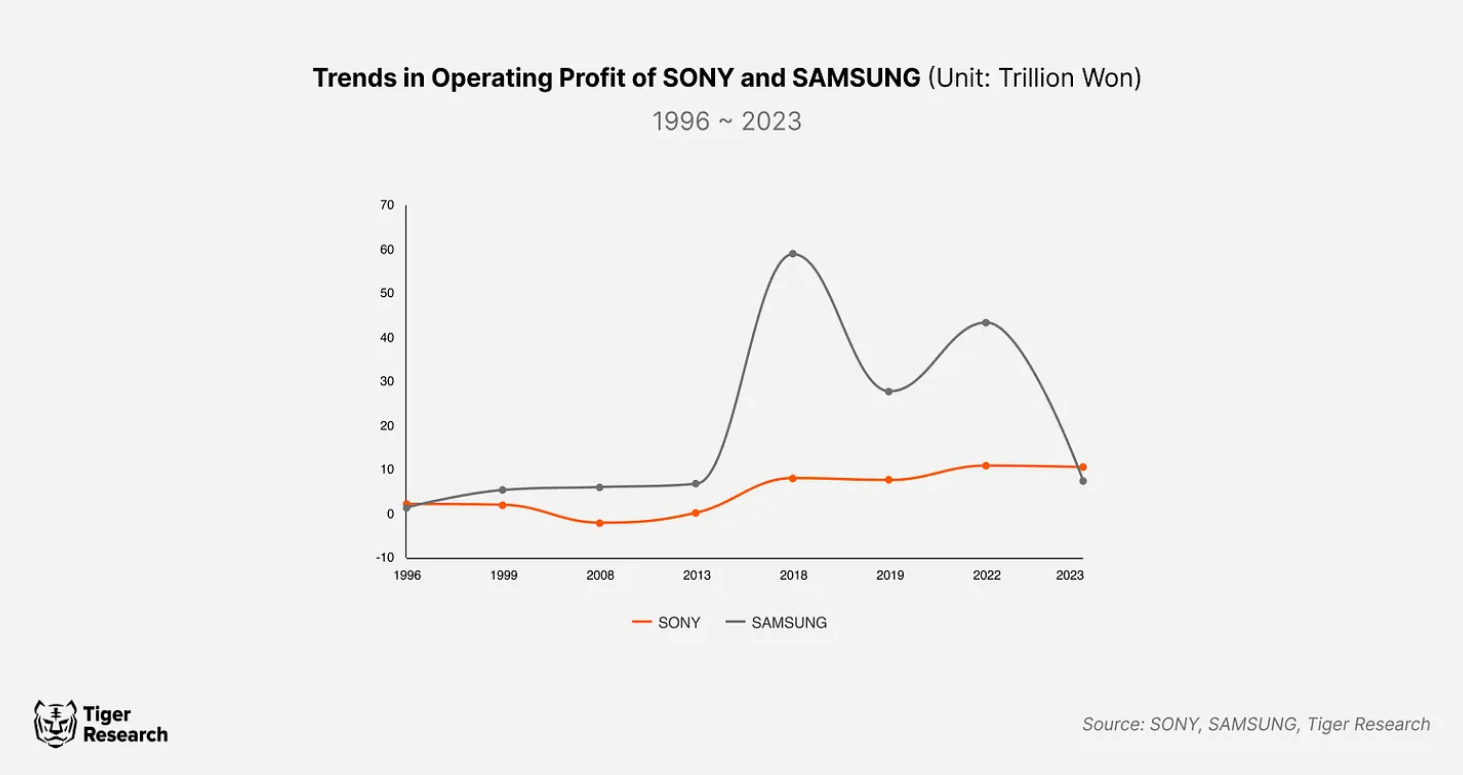
In response, Sony took decisive steps to overcome these challenges and enter a new growth phase. It significantly reduced reliance on its electronics business—once accounting for 70% of total revenue—and shifted focus toward future-oriented entertainment industries. This bold restructuring laid the foundation for future growth and profitability. By 2023, Sony surpassed Samsung in operating profit for the first time in 24 years—an achievement that, while potentially temporary, underscores the success of its transformation and innovation.

Sony’s pursuit of innovation goes further. At its recent annual strategic meeting, the company announced its commitment to cross-industry innovation under the slogan “Beyond Boundaries.” This aligns with Sony’s recent moves into the Web3 space. This report examines Sony’s blockchain initiatives and explores its vision for the Web3 industry, aiming to provide insight into Sony’s future outlook and strategic direction in this emerging field.
2. Sony Group’s Official Entry into the Web3 Industry
Sony’s pursuit of innovation continues to evolve. At its recent annual strategic meeting, the company declared its intent to drive innovation beyond industry boundaries under the banner of “Beyond Boundaries”—a vision closely aligned with its recent foray into Web3. This report analyzes Sony’s blockchain initiatives and investigates its vision for the Web3 industry, seeking to understand Sony’s strategic roadmap and long-term ambitions in this domain.
2017: Sony Global Education develops a blockchain-based digital education platform
2018: Sony Corporation, Sony Music, and Sony Global Education jointly develop a blockchain-based digital content copyright management system
2018: Sony Computer Science Laboratory (CSL) develops cryptocurrency hardware wallet technology using IC cards
2020: Sony develops a blockchain-based database platform for a smart city research project in the Netherlands
2021: Sony Pictures offers NFTs to pre-order customers of *Spider-Man: No Way Home*
2022: Sony Interactive Entertainment files Web3 technology patents, including in-game NFTs
2022: Sony Group establishes "SNFT," a subsidiary operating an NFT marketplace
2023: Sony Network Communications forms a joint venture with Startale Labs to build a blockchain mainnet
2023: Quetta Web, a Sony Group subsidiary, acquires centralized exchange "WhaleFin"
2024: Sony Bank begins proof-of-concept experiments for stablecoin issuance
2024: Sony Bank develops mobile NFT platform "Connect"
2024: Sony Blockchain Solutions Lab announces the launch of Ethereum L2 mainnet "Soneium"
Sony has been actively investing in and developing blockchain technology since its early days. Various Sony subsidiaries across industries have explored integrating blockchain into their respective fields. The first notable move came in 2016 when Sony Global Education announced plans to develop a blockchain-based digital education platform.
The experience gained from developing this digital education platform quickly expanded into other areas. Sony Music Entertainment applied the technology to authentication, sharing, and rights management systems for digital content, including music, films, and e-books. In 2018, Sony Computer Science Laboratory launched a hardware cryptocurrency wallet based on contactless IC cards. By 2019, Sony had built a blockchain-based database platform for a smart city research project funded by the Dutch government.
Since 2022, Sony’s blockchain-related initiatives have accelerated significantly, aligning with Prime Minister Kishida’s policies promoting the Web3 industry. Sony is shifting from blockchain research to transforming the technology into viable business models. Recent moves such as acquiring a centralized exchange, announcing plans to issue stablecoins, and launching its own blockchain mainnet reflect this transition. Notably, Sony is boldly expanding into core areas of the Web3 ecosystem, breaking beyond traditional business boundaries to challenge the Web3 industry. The following sections explore Sony’s recently announced Web3-related ventures.
1) Business Expansion Through CEX Acquisition
In August 2023, Sony acquired the centralized exchange (CEX) WhaleFin, marking its official entry into the trading business. Originally launched under the name DeCurret, WhaleFin was a registered CEX service provider in Japan. It was acquired by Amber Group in 2022 and later fully purchased by Quetta Web, a wholly owned subsidiary of the Sony Group.
Recently, Sony rebranded WhaleFin as "S.BLOX," signaling its intent to expand its trading operations. The company aims to enhance user experience on the trading platform and create new value in crypto trading by leveraging the diverse business networks within the Sony Group. Despite these ambitions, S.BLOX currently lags behind other exchanges in competitiveness. The platform offers only nine cryptocurrencies and has low trading volume, generating just 5% of the revenue of Japan’s leading exchange, Bitflyer—raising questions about its future potential.
Nevertheless, synergistic opportunities remain through Sony’s acquisition. As gateways to the Web3 industry, centralized exchanges can generate significant synergies through enterprise partnerships, especially given current challenges around crypto onboarding and offboarding. Moreover, Sony’s integration across various Web3 sectors is expected to help strengthen the platform’s competitiveness over time.
2) Soneium: Sony’s Blockchain Infrastructure Venture
The Sony Blockchain Solutions Lab announced its formal entry into the mainnet business with plans to launch "Soneium," an Ethereum Layer 2 blockchain—a move revealed approximately one year after forming a joint venture with Startale Labs.
With this announcement, the joint venture changed its name from "Sony Network Communications Lab" to "Sony Blockchain Solutions Lab." Sony Group holds a 90% stake in the venture, while Startale Labs retains the remaining 10%. Given Sony’s controlling interest, the lab is expected to play a central role in Sony’s Web3 strategy, providing the foundational infrastructure for applying and integrating Web3 technologies across Sony’s divisions.
Notably, Sony Blockchain Solutions Lab’s strategy goes beyond simply launching a new mainnet. By integrating Astar’s zkEVM technology into Soneium, Sony aims to leverage this technical asset to accelerate business development. This approach reflects Sony’s recent track record of bold innovation, contrasting with Japan’s traditionally conservative corporate culture.

The leadership structure is equally noteworthy. The lab is led by Jun Watanabe, former president of Sony Network Communications and board member at Startale Labs, who also oversees Sony Group’s cryptocurrency trading platform, S.BLOX. This dual role highlights internal collaboration potential within Sony and suggests deeper commercial ties between Startale Labs and the Astar Network.
3) Sony’s Stablecoin Venture
Sony has shown strong intent to enter the stablecoin market. According to a April report by Nikkei, Sony Bank, part of Sony Financial Group, has begun experimental efforts to issue stablecoins backed by multiple fiat currencies, including the Japanese yen. This initiative appears aimed at exploring the potential use of stablecoins as digital payment methods across the broader Sony Group.
Meanwhile, Soneium’s involvement in stablecoins has heightened interest in stablecoin-related activities within the Sony Group. In September, Soneium announced a partnership with Circle, the issuer of USD Coin (USDC), to support USDC within the Soneium ecosystem.
This move has sparked speculation about whether Sony will issue its own stablecoin on the public Soneium mainnet. However, such a plan is expected to face significant hurdles. Regulators have indicated that issuing stablecoins on public blockchains—particularly by banks—poses risks and would require lengthy regulatory changes.
Despite these challenges, the participation of a leading Japanese internet bank like Sony Bank is seen as a positive signal for the industry. If Sony Bank successfully issues a stablecoin on Soneium, it could enable diverse applications, including cross-border payments via integration with USDC. Developments in this area warrant close attention.
3. Where Is Sony’s Web3 Business Headed?
Sony plans a comprehensive Web3 business strategy spanning multiple subsidiaries. This strategy may revolve around three key pillars: 1) Non-Financial, 2) Financial, and 3) Infrastructure.
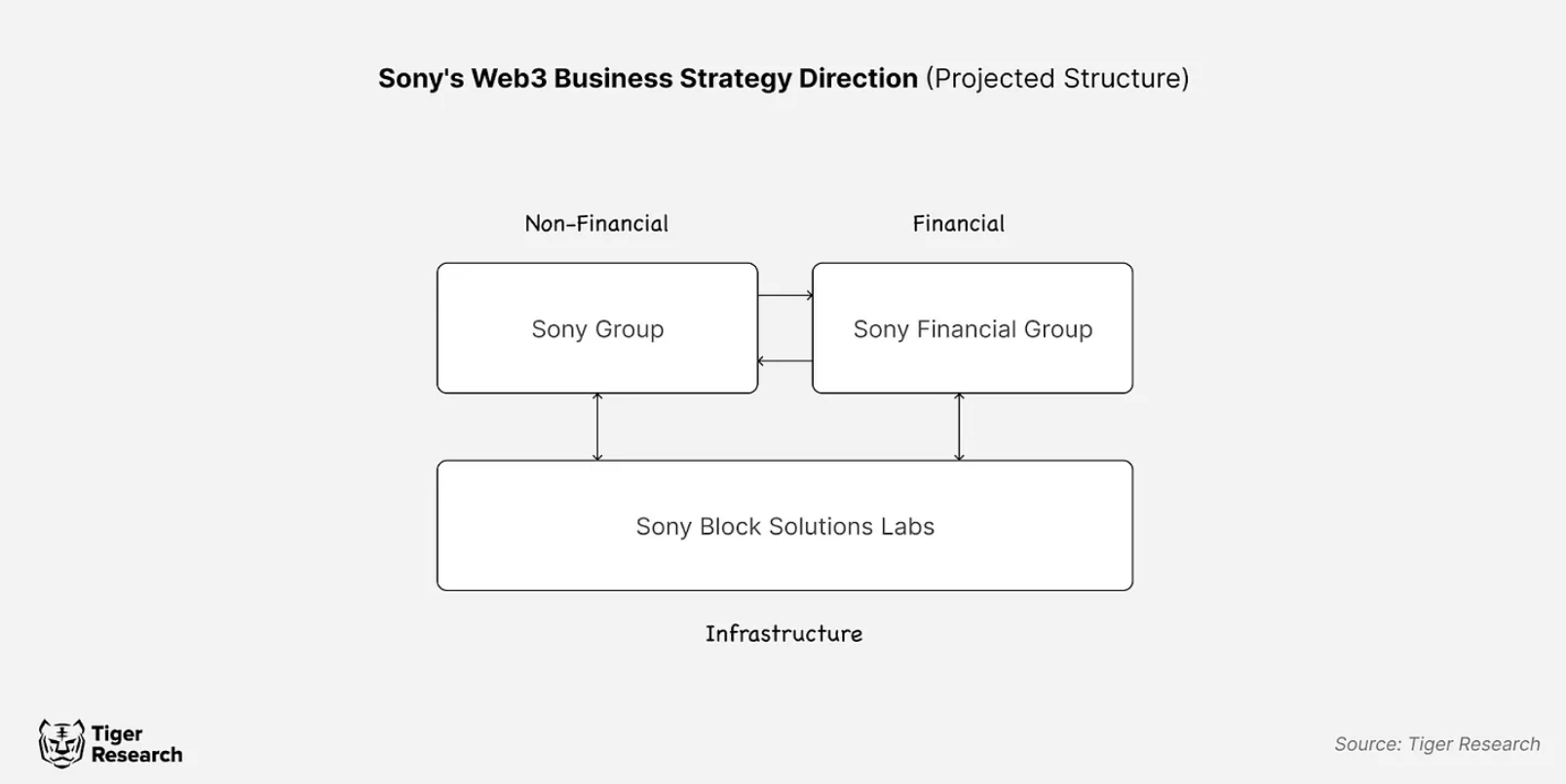
The non-financial pillar is expected to be led by Sony Group, focusing primarily on leveraging Web3 technologies in entertainment and gaming. Sony Music has already launched NFTs based on artist intellectual property and is actively exploring Web3-driven monetization of music IP. Discussions around Web3 in gaming are gaining momentum, evidenced by recent patent filings related to NFT and SFT technologies.
The financial pillar is expected to be driven by Sony Financial Group, which is currently preparing to spin off from Sony Group. It will focus on integrating Web3 technologies into finance, including stablecoins and security tokens. Sony Bank is already conducting R&D on stablecoins and was the first Japanese bank to sell loan-backed bonds as security tokens. Building on this, Sony Financial Group is expected to expand further into Web3 applications in finance.
Finally, the Sony Blockchain Solutions Lab is expected to manage the infrastructure underpinning all Sony Web3 initiatives. Although effectively part of Sony Group due to its majority ownership, the lab is anticipated to serve both Sony Group and Sony Financial Group, acting as a bridge between them. By efficiently leveraging Sony’s assets, the lab is poised to become a core enabler of synergy across Sony’s Web3 ventures.
These three areas are expected to interconnect organically. For example, stablecoins issued by Sony Financial Group could serve as payment methods within Sony Group, or Sony’s diverse intellectual property assets could be tokenized by Sony Financial Group. These collaborative opportunities could allow Sony to build an integrated Web3 ecosystem spanning its diverse business portfolio.
4. Conclusion

In the 1990s, Sony dominated the electronics market with the Walkman, but struggled to diversify in the 2000s. Apple’s rise with the iPod weakened the Walkman’s position, while competition from Korean firms like Samsung and LG in the LCD TV market further threatened Sony’s standing. The company failed to keep pace with the rapid transition from analog to digital, leaving it in a vulnerable position.
To recover, Sony adopted a “focus and select” strategy—cutting underperforming businesses and making substantial investments in high-potential core areas. As part of this transformation, Sony now views blockchain technology as a new engine for growth and is actively exploring related business opportunities. Combining blockchain with Sony’s rich entertainment content—including games, music, and films—is expected to create innovative user experiences and business models.
This approach may accelerate digital transformation within Sony’s existing businesses while opening new revenue streams. Aligned with its recent vision of “Beyond Boundaries: Maximizing Synergies Across the Group,” blockchain technology is expected to play a pivotal role in creating synergies among Sony’s various divisions. We will be watching closely as this long-standing industry leader leverages blockchain to create new value and strengthen its market position.
Join TechFlow official community to stay tuned
Telegram:https://t.me/TechFlowDaily
X (Twitter):https://x.com/TechFlowPost
X (Twitter) EN:https://x.com/BlockFlow_News
 @tiger_research