Everything You Need to Know About Sony's Entry into Blockchain and Soneium
TechFlow Selected TechFlow Selected
Everything You Need to Know About Sony's Entry into Blockchain and Soneium
A Japanese entertainment and electronics giant has announced the launch of its own L2, named Soneium.
 Navigating Web3 tides with focused insights
Author: The Daily Bolt by Revelo Intel
Compiled: TechFlow
Friday brought several interesting announcements critical to the crypto industry. Most notably, Federal Reserve Chair Jerome Powell signaled the beginning of a new rate-cutting cycle, triggering a significant upward momentum in markets. RFK Jr. exited his presidential campaign and endorsed Trump, which will undoubtedly help attract moderates to vote Republican in November. Given Bitcoin's close correlation with election dynamics—and its historical preference for Trump—this news was also welcomed by market participants. In the crypto space, the newly announced Grayscale Avalanche Trust sent AVAX soaring to the top of the most discussed tokens list.
More importantly, the topic we're discussing today is that a Japanese entertainment and electronics giant has announced it will launch its own L2, called Soneium.
This intriguing announcement comes amid recent debates about the state of L2s and what exactly constitutes an L2 versus a sidechain. With the sheer volume of new chains launching—whether as L1s, L2s, or somewhere in between—the line between L2s and independent L1s has blurred. Users now care more about actual activity on a given chain than the technicalities of its underlying infrastructure. This trend seems inevitable with the rise of modular service providers, especially given current insufficient demand for such services.
Soneium’s announcement came just one day after Story Protocol revealed an $80 million funding round. That development sparked renewed criticism around infrastructure, primarily focused on the large sum raised, though some critiques also targeted the fundamental premise—tokenizing intellectual property markets and leveraging the team’s existing entertainment industry relationships.
Soneium may fall into a similar category, with the key difference being that the company backing it is a massive multinational corporation that did not raise additional capital. Both projects, however, are building infrastructure with more specific use cases and establishing direct or indirect ties with products capable of integrating on-chain from day one, thereby reducing cold-start problems.
Soneium Background
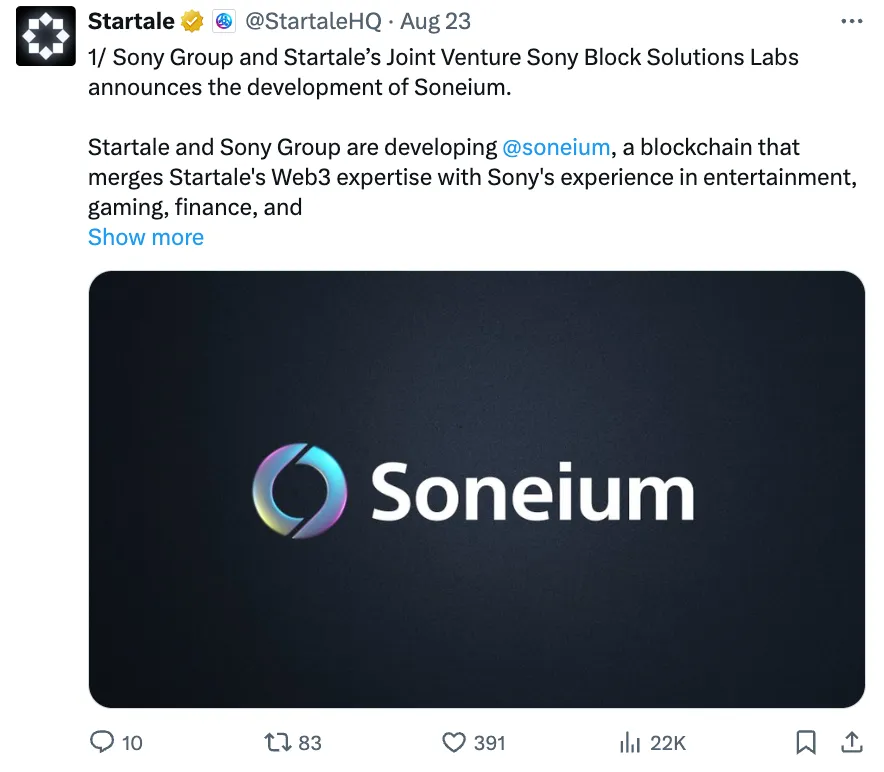
Some may not know that Soneium is not Sony’s first foray into blockchain. Earlier this year, Sony announced plans to launch its own cryptocurrency exchange, S.BLOX, following its 2023 acquisition of the Whalefin exchange. The Sony Blockchain Solutions Lab, headquartered in Singapore and established last October, will lead the Soneium project.
Soneium is being built in partnership with Startale, the organization behind Japan’s leading blockchain, Astar Network. Startale will leverage its Astar zkEVM implementation to assist in developing Soneium and integrating ASTR within the Soneium ecosystem. ASTR rose approximately 28% over the past seven days, showing some buying pressure after the announcement, though not as much as expected—possibly indicating a gap between crypto market participants and Asia-focused blockchains and applications.
Sony has long been a brand that has stood the test of time. This corporate giant has undergone multiple rebrandings and introduced numerous iconic products to the public, including the Walkman and, more recently, the PlayStation.
The Soneium news coincides with an unexpected Chinese game release that significantly boosted PlayStation 5 sales, with Sony selling over 4.5 million units last week. The game drew some criticism due to its Chinese origin and perceived “lack of diversity” in expression. One can’t help but draw a parallel to entering the crypto space—while likely highly profitable for Sony, it’s certainly not without opposition, and these challenges must be overcome. Perhaps Sony knows something critics don’t?
Overall, publicly available information on Soneium remains limited. Key areas to watch include how closely tied Astar (and its ASTR token) will be to Soneium, and which specific applications will launch on the chain. The team has stated their goal is to make the chain highly developer-friendly and not limited to Sony’s existing products and services. They’ve already formulated plans to immediately attract Web3 developers and users, focusing initially on existing Sony products, with broader rollouts planned for the chain’s “second phase,” set to begin within two years. After that, the team aims to attract other enterprises beyond Sony.
Like Story Protocol, Soneium also plans to help protect creators’ intellectual property rights;
"Specifically, we will explore protecting creators' rights to their content, new mechanisms for returning value to support creators and fans, and opportunities for creators to actively participate across digital and real-world environments." — Sony press release on Soneium, August 23, 2023
Whether Soneium can attract a substantial number of developers and users remains to be seen. At the very least, this move signals that large companies with a history of innovation and adaptation are willing to dive into crypto products and services. It can also be viewed as an interesting reflection on Asian crypto trends, particularly regarding how domestic companies provide the majority of products and services within specific countries.
This is evident in South Korea’s CEX landscape, where exchanges are restricted to citizens and offer a different suite of applications and standards compared to global platforms. In jurisdictions where Binance is inaccessible, heavy local trading volumes shift to domestic exchanges. How Soneium will roll out, and whether the chain will integrate well with global games and applications, remains to be seen.
Join TechFlow official community to stay tuned
Telegram:https://t.me/TechFlowDaily
X (Twitter):https://x.com/TechFlowPost
X (Twitter) EN:https://x.com/BlockFlow_News
 Revelo Intel